


Report Overview
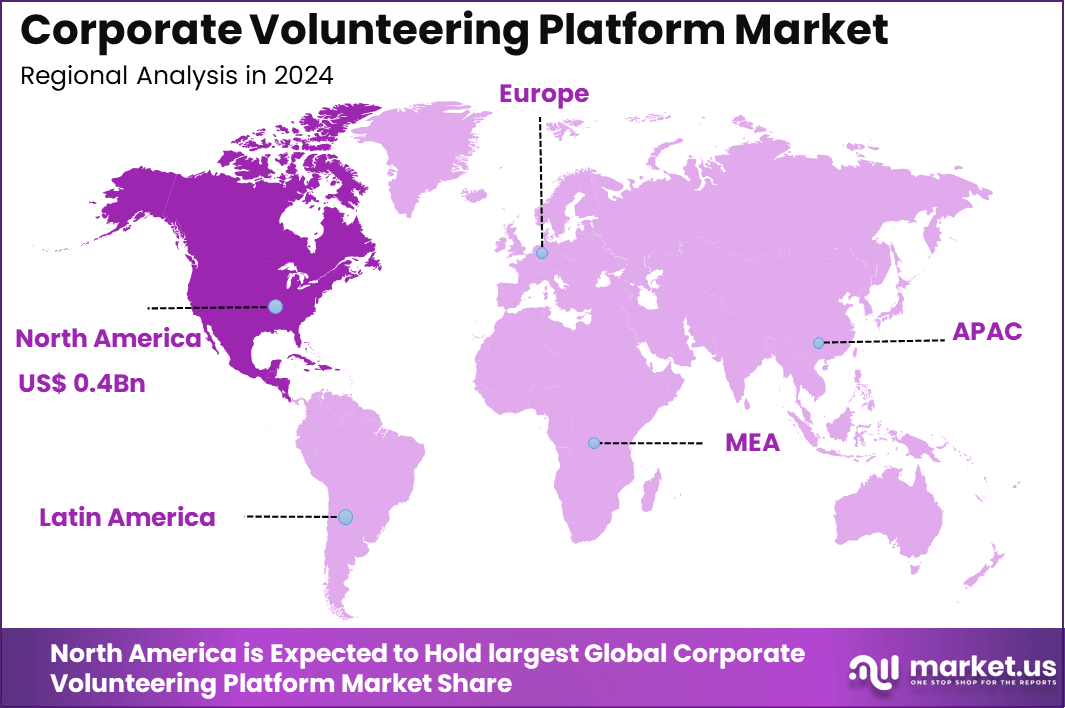
The Global Corporate Volunteering Platform Market generated USD 1.1 billion in 2024 and is predicted to register growth from USD 1.2 billion in 2025 to about USD 2.7 billion by 2034, recording a CAGR of 9.40% throughout the forecast span. In 2024, North America held a dominan market position, capturing more than a 42.4% share, holding USD 0.4 Billion revenue.
The market for corporate volunteering platforms has gained increasing traction as businesses seek digital systems to manage employee volunteer programs, track impact and embed community service within corporate culture. These platforms offer an array of features such as volunteering event scheduling, hours tracking, skill‐match deployment, reporting dashboards and integration with wider corporate social responsibility (CSR) systems.
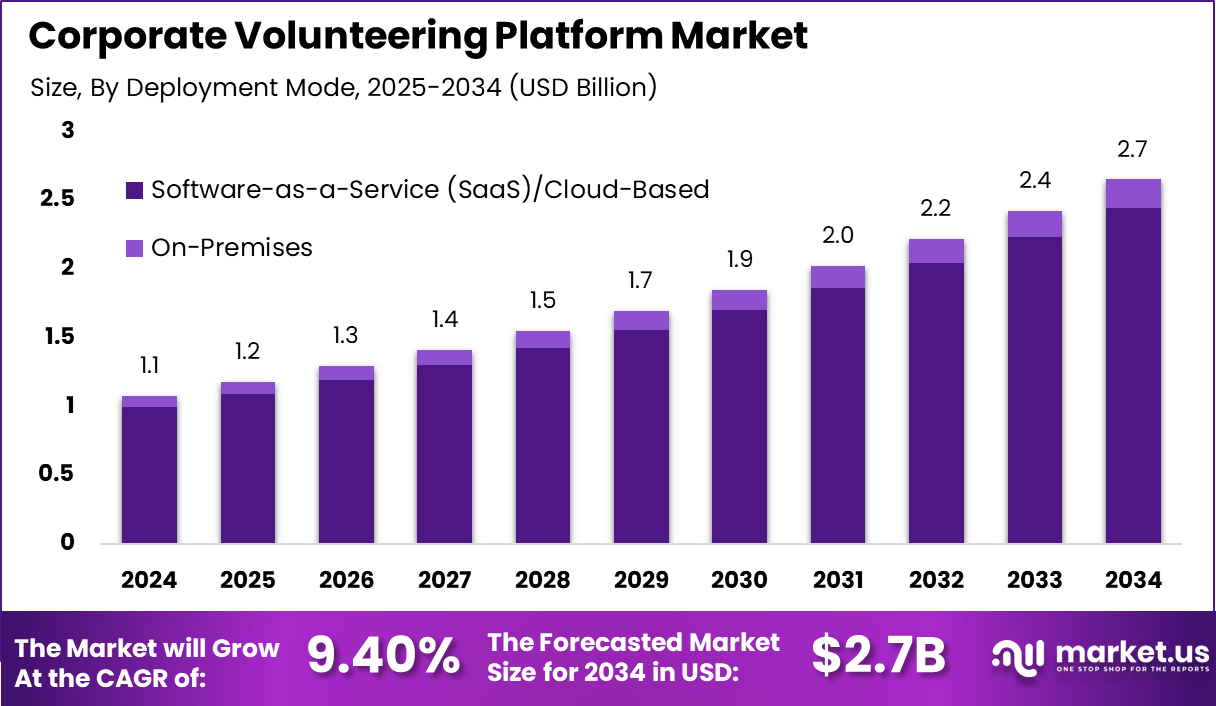
According to WeAreMatchable, around 80% of employees believe that group volunteering strengthens their relationships with colleagues, highlighting its role in building teamwork and collaboration. Approximately 87% of employees who participated in volunteering through their companies reported a more positive perception of their employers, suggesting a direct link between corporate social engagement and employee satisfaction.
Employee retention is also positively influenced, as turnover rates decline by an average of 57% when workers feel deeply connected to their organizations’ volunteering initiatives. In the United Kingdom, nearly 50% of the public intends to engage in volunteering activities. Furthermore, digital participation is rising, with 31% of volunteers in the past 12 months contributing either online or via phone, making remote volunteering the third most common form of engagement today.
Top Market Takeaways
- By deployment, Software-as-a-Service (SaaS) / Cloud-based platforms dominate with 92.1%, reflecting strong demand for scalable and easy-to-integrate volunteering solutions.
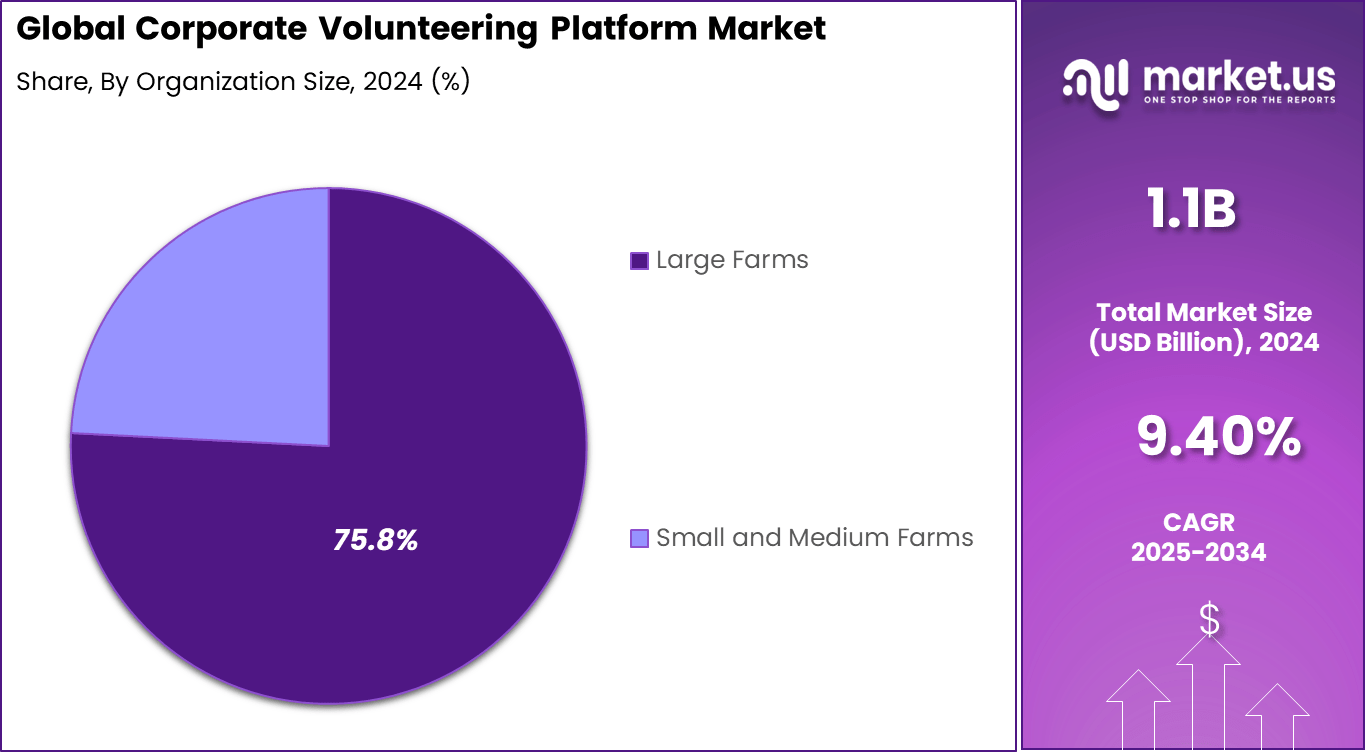
- By organization size, large enterprises lead with 75.8%, driven by structured CSR programs and employee engagement initiatives.
- By end-use industry, financial services and insurance account for 25.3%, showcasing high adoption due to strong ESG commitments and regulated corporate responsibility practices.
- North America holds 42.4%, supported by a mature CSR culture and widespread platform adoption among enterprises.
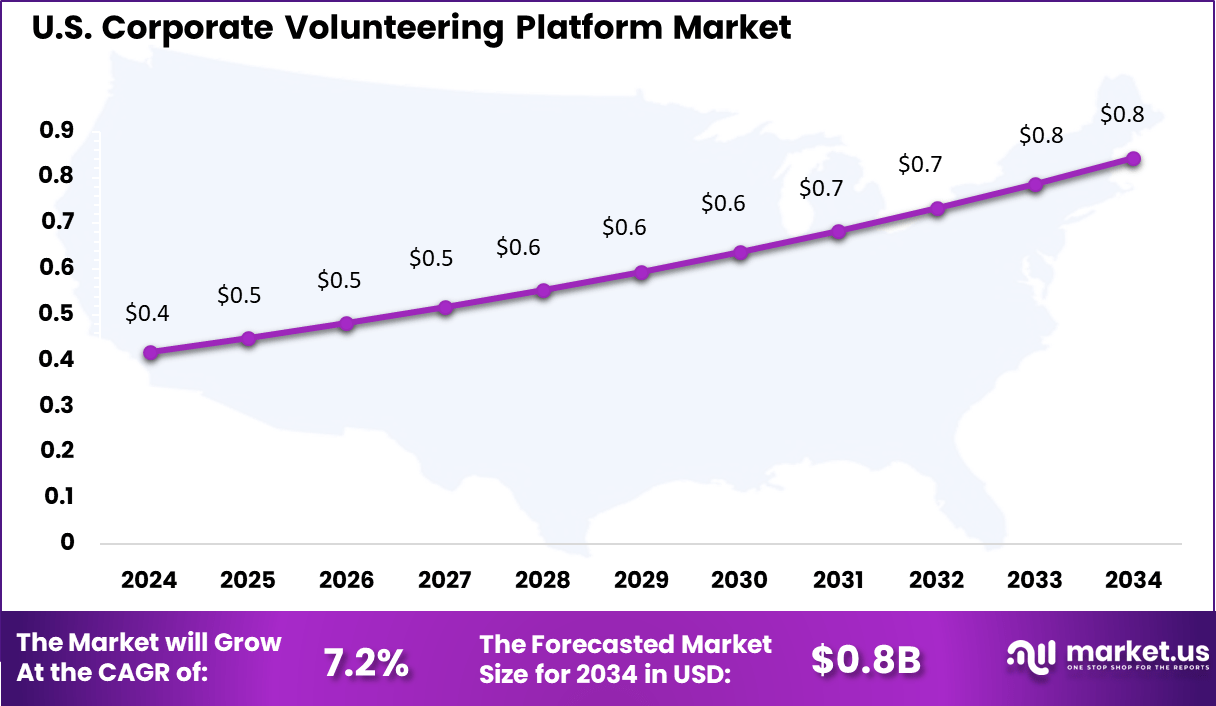
- The US market reached USD 0.42 billion and is growing at a steady CAGR of 7.2%, underscoring consistent investment in employee engagement and social impact technologies.
Employee Engagement and Retention
- High value: Approximately 86% of employees say they value workplace volunteer programs, showing a strong preference for companies that demonstrate social impact.
- Influences retention: Around 82% of employees say that volunteer programs influence their decision to stay with a company, linking corporate purpose with long-term retention.
- Increased engagement: Nearly 96% of companies report that employees who volunteer are more engaged at work, suggesting that social initiatives contribute to better morale and productivity.
- Higher fulfillment: Employees at purpose-driven companies experience 64% higher job fulfillment, showing the connection between meaningful work and employee satisfaction.
Participation and Trends
- Significant growth: Participation in volunteering programs has risen sharply, with a 58% increase in participation rates and a 44% rise in volunteer hours globally in recent years.
- Team-based volunteering: Engagement is much higher when teamwork is encouraged. Companies that offer team-based volunteering see participation rates that are 7.5 times higher than those without team options.
- Virtual volunteering: The adoption of virtual volunteering has grown rapidly, now accounting for 51% of volunteer hours on some platforms and making participation easier for hybrid or remote employees.
Role of Generative AI
Generative AI plays a vital role in corporate volunteering platforms by matching employees to volunteering opportunities that fit their skills, interests, and schedules. This results in more personalized and meaningful volunteer experiences that increase employee motivation and involvement. Additionally, generative AI automates content creation for volunteer events, easing administrative work for organizers.
This intelligent matching and automation also help companies maintain higher volunteer retention rates and stronger programs. Studies show that platforms employing AI matching see up to 30% better volunteer engagement compared to traditional methods.
By Deployment
In 2024, The corporate volunteering platform market is overwhelmingly driven by software-as-a-service and cloud-based deployments, representing a commanding 92.1% of the market share. Cloud platforms provide companies with flexibility, scalability, and ease of access, allowing employees and administrators to manage volunteering projects from any location. This model also reduces upfront infrastructure costs and simplifies ongoing updates and maintenance.
Cloud-based solutions facilitate real-time tracking and integration with other corporate systems, making volunteer programs more efficient and impactful. As remote work becomes more common, the accessibility offered by the cloud increases employee participation and broadens the reach of corporate volunteering initiatives.
By Organization Size
In terms of organisation size, the large-enterprise segment represents about 75.8% of the market. Large companies typically possess the resources, governance frameworks and strategic objectives that support formalised volunteering platforms, including tracking of hours, alignment with ESG metrics, and large-scale employee engagement initiatives. Market reports confirm that large enterprises held the largest share in the volunteering-platform market.
These organisations also tend to demand advanced features such as analytics dashboards, integration with corporate HR systems, and multi-region support. Smaller firms may lack both the budgets and the organisational complexity that justify full-scale platforms, which helps explain the concentration among larger enterprises.
By End-Use Industry
Within industry verticals, the financial services & insurance segment accounts for around 25.3% of market share. Firms in these sectors often face heightened regulatory and stakeholder expectations around corporate social responsibility (CSR) and community engagement; this drives adoption of structured volunteer-management platforms.
These companies frequently leverage such platforms to connect volunteer programmes with broader social-impact and brand-reputation goals, aligning internally with employee-engagement and externally with community expectations.
The relatively high share suggests that the financial and insurance industries are among the early adopters of volunteer-platform technology; their leadership in CSR, combined with large workforces and global operations, positions them to benefit from such systems where metrics-based outcomes and stakeholder reporting are important.
Emerging Trends
Skills-Based and Virtual Volunteering
More companies are moving toward volunteering programs where employees use their professional skills to help communities. This is becoming popular because 87% of workers who volunteer say they feel more positive about their employer. Many employees want to make a real impact, not just spend time on tasks.
Today, around 18% of volunteers help online or remotely, which shows a clear rise in virtual volunteering. This works well for people who prefer flexibility and for companies with remote or hybrid work environments. It also helps organizations match specific employee skills to meaningful causes.
Growth Factors
More Use of Platforms and Automation
There is a growing use of digital platforms to manage corporate volunteering. These tools make it easier to track activities, measure hours, and report results. More than 65% of people say they want to work for a company that supports social or community efforts. This pushes companies to adopt technology that simplifies volunteering and makes it easy to join.
Cloud-based platforms help teams in different locations work together and let employees access volunteering opportunities through mobile devices. This leads to higher participation, better reporting, and stronger links between business goals and social impact.
Key Participation and Growth Insights
Employee engagement in volunteering has shown strong momentum. A recent study found that the global participation rate in employee volunteer programs rose by 57% over the past year, while the total number of volunteer hours increased by 41%. This trend reflects growing interest in purpose-driven corporate cultures.
In another study, 69% of working Americans said they want to volunteer more than they currently do. This gap shows a clear opportunity for companies to create or expand structured volunteering programs that align with employee interests and community needs.
Virtual volunteering is becoming an influential format as technology enables new ways to contribute. Around 31% of volunteers said they participated in virtual or phone-based activities, showing how digital tools are making volunteering more flexible and accessible.
Companies that promote team-based volunteering see much stronger involvement. Participation levels in such programs can be as much as 7.5 times higher compared with organizations that do not offer coordinated team opportunities.
Offering employees a wide range of volunteering choices, including both company-led and employee-initiated options, is also proving effective. This approach can increase participation levels by up to 12 times, supporting greater inclusivity and long-term engagement.
Key Market Segments
By Deployment
- Software-as-a-Service (SaaS)/Cloud-Based
- On-Premise
By Organization Size
- Large Enterprises
- Small and Medium-sized Enterprises (SMEs)
By End-Use Industry
- Financial Services & Insurance
- Technology & Telecommunications
- Healthcare & Pharmaceuticals
- Professional Services
- Consumer Goods & Retail
- Manufacturing & Energy
- Others
Regional Analysis
North America accounts for a substantial 42.4% of the global corporate volunteering platform market. The region’s advanced technological infrastructure and strong culture of corporate social responsibility contribute to this dominant position. Companies in North America are early adopters of digital volunteering solutions to effectively manage their programs and report social impact.
The rise of remote work has further expanded the reach and accessibility of volunteering initiatives across the region, engaging more employees and increasing program effectiveness. This dynamic environment supports continued market growth and innovation.
The United States holds a notable position in the corporate volunteering platform space, with an estimated market value of around US$ 0.42 billion. This reflects strong adoption among U.S. enterprises that place a high priority on employee engagement and community involvement. The maturity of digital CSR ecosystems and the integration of cloud-based platforms into HR and ESG frameworks contribute significantly to this value.
Key Regions and Countries
- North America
- US
- Canada
- Europe
- Germany
- France
- The UK
- Spain
- Italy
- Russia
- Netherlands
- Rest of Europe
- Asia Pacific
- China
- Japan
- South Korea
- India
- Australia
- Singapore
- Thailand
- Vietnam
- Rest of APAC
- Latin America
- Brazil
- Mexico
- Rest of Latin America
- Middle East & Africa
- South Africa
- Saudi Arabia
- UAE
- Rest of MEA
Driver
Growing focus on employee engagement and corporate social responsibility
Companies are increasingly recognising that facilitating employee volunteering through dedicated platforms helps to bolster engagement, strengthen culture and reinforce corporate social responsibility (CSR). A report notes that volunteering programmes allow employees to “develop new skills, improve existing ones and contribute to their professional growth,” which in turn supports workforce development and organisational reputation.
This driver is amplified by shifting workforce demographics: younger employees (Millennials and Gen Z) place more weight on purpose‐driven work and expect their employers to support meaningful community involvement. As a result, demand for corporate volunteering platforms is increasing as a means to engage talent and support brand purpose.
Restraint
Limited awareness and under-resourced implementation in some organisations
Despite the benefits, many organisations exhibit insufficient awareness of the advantages of corporate volunteering platforms and may lack the internal resources to implement them effectively. One source highlights that “limited business knowledge of the benefits and possibilities of corporate volunteering platforms stifles market development.”
In smaller organisations or those with constrained budgets, the cost, time and operational effort required to deploy and maintain a volunteering platform may be seen as prohibitive. This restraint slows adoption, especially among SMEs and organisations that view volunteering as a discretionary rather than strategic activity.
Opportunity
Technology and personalisation capabilities to enhance impact
The evolution of digital technologies presents a significant opportunity for corporate volunteering platforms to deliver greater value through personalisation, analytics and integration. For example, platforms leveraging AI and predictive analytics can match volunteers to causes based on their skills, interests and availability, thereby enhancing efficacy and engagement.
Additionally, the shift to remote and hybrid work models has opened up new formats for volunteering (virtual, micro-volunteering, skills-based) which platforms can support. By enabling richer data tracking and impact measurement, platform providers can help organisations quantify social value and communicate CSR results more transparently, thereby strengthening business case and adoption.
Challenge
Ensuring meaningful matching, data security and integration with enterprise systems
One of the key challenges for corporate volunteering platforms lies in ensuring that volunteer experiences are meaningful, well-matched and aligned with both organisational goals and community needs. A news article pointed out that although volunteering programmes are offered by many employers, actual use remains low (e.g., only about 15% of employees use volunteer-leave in one case) because the match was not compelling or convenient.
Another challenge relates to integrating the platform with existing enterprise systems (HR, CSR reporting, management dashboards), and ensuring data privacy, security and compliance. Without seamless integration and trust, organisations may hesitate to scale their volunteering platform usage, limiting the potential market expansion.
Competitive Analysis
The Corporate Volunteering Platform Market is led by specialized service providers such as Benevity Goodness Platform, CSRconnect, Causecast, Bright Funds, and Alaya. These organizations deliver cloud-based platforms that facilitate employee volunteer programs, matching corporate teams with nonprofit projects, managing hours, and tracking impact.
Major enterprise software and HR system providers including Oracle, MaximusLife, and Realized Worth integrate volunteering modules with broader employee engagement and benefits platforms. These companies enable corporations to manage volunteer initiatives alongside payroll, rewards, and learning systems, creating seamless experiences for employees to participate in socially responsible activities.
Additional contributors such as Project Helping, VolunteerMatch, and other market participants specialize in volunteer matching networks, mobile-friendly engagement, and global project discovery. Their offerings expand access to diverse volunteering opportunities, enable micro-volunteering and skills-based volunteering models, and support international corporate programs.
Company Benefits
- Improved reputation: Approximately 88% of HR executives believe that employee volunteering programs have a positive impact on the organization’s reputation, helping build trust with customers and stakeholders.
- Skill development: Around 65% of HR leaders report that employees gain valuable skills – such as leadership, teamwork, and problem-solving – through volunteering activities, making it a useful tool for professional growth.
- Stronger culture: About 52% of HR executives agree that volunteering is an important contributor to a strong company culture, supporting shared values and employee engagement.
- Lower turnover: Companies that support volunteering and giving programs experience 52% lower turnover among new employees, showing that purpose-driven initiatives help improve retention and satisfaction.
Top Key Players in the Market
- Benevity Goodness Platform
- CSRconnect
- Causecast
- Alaya
- Bright Funds
- MaximusLife
- Oracle
- Project Helping
- Realized Worth
- VolunteerMatch
- Others
Recent Developments
- May, 2025, Benevity launched its first Enterprise Impact Platform designed to solve core CSR and social impact challenges for companies globally. The platform unifies giving, volunteering, grants management, and employee mobilization within a single environment powered by AI-enabled design. This launch empowers organizations to scale social impact, improve engagement, and enhance program visibility and measurement.
- February, 2025, YourCause, which includes CSRconnect, announced multiple innovations for 2025 including enhanced impact reporting through its Impact Edge tool and integration with True Impact’s data platform. They are also rolling out Blackbaud Copilot, an AI assistant integrated with Impact Edge, to simplify data tasks for CSR administrators. These updates aim to drive better program insights and employee engagement.









