


Report Overview
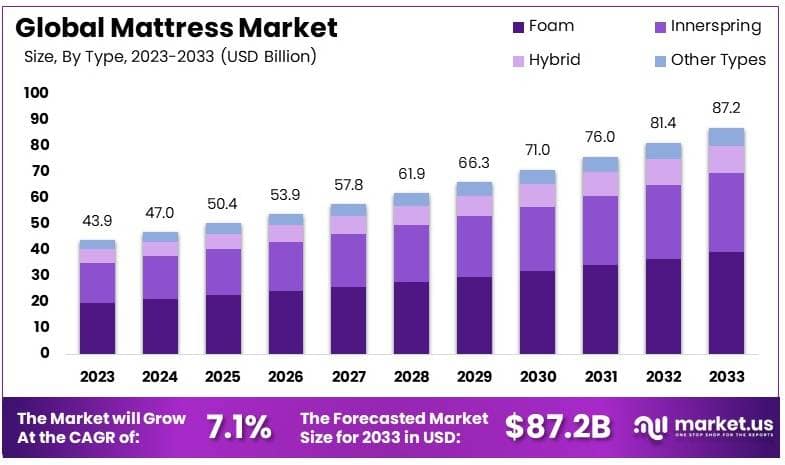
The Global Mattress Market size is expected to be worth around USD 87.2 Billion by 2033, from USD 43.9 Billion in 2023, growing at a CAGR of 7.1% during the forecast period from 2024 to 2033.
A mattress is a rectangular pad made of different materials, such as foam, springs, or latex, designed to support the body during sleep. It provides comfort and improves sleep quality by distributing body weight evenly.
The mattress market refers to the global industry that produces, distributes, and sells mattresses. It includes a wide range of products such as foam mattresses, spring mattresses, and advanced hybrid models. The market also covers related accessories like mattress toppers and bed frames.
The demand for mattresses is increasing as more consumers prioritize sleep quality and comfort. As people spend more time at home, they are investing in better home products, including mattresses. The rise of e-commerce platforms also makes it easier for consumers to compare products and purchase mattresses online.
According to the Sleep Foundation, memory foam mattresses range from $800 to $2,500 for a queen size, while hybrid mattresses, which combine foam layers with coil systems, typically cost between $1,200 and $2,000. Hybrid mattresses are gaining popularity due to their enhanced edge support and temperature regulation, making them ideal for consumers who value both comfort and durability.
The global focus on improving sleep health has further fueled the demand for high-quality mattresses. According to ResMed’s 2023 Global Sleep Survey, 8 in 10 adults across 12 countries reported symptoms of disrupted sleep.
Countries like Mexico and South Korea saw more than 85% of respondents experience poor sleep quality, indicating a strong need for home bedding products that can improve rest. In contrast, Japan reported a lower rate at 60%, but even in regions with fewer reported issues, the demand for sleep-enhancing products continues to grow.
The economic impact of poor sleep is significant, with the U.S. economy estimated to lose over $411 billion annually due to insufficient sleep-related productivity losses and health issues. This underscores the opportunity for mattress manufacturers to position their products as solutions for both individual well-being and broader economic benefits.
Key Takeaways
- Mattress Market was valued at USD 43.9 Billion in 2023, and is expected to reach USD 87.2 Billion by 2033, with a CAGR of 7.1%.
- In 2023, Foam mattresses led the market with 45%, due to their comfort and ability to conform to body shapes.
- In 2023, Household use dominated the end-use segment with 78%, driven by increased focus on home comfort and sleep quality.
- In 2023, Offline distribution led with 68%, as many consumers prefer to test mattresses before purchase.
- In 2023, Asia-Pacific led the market with 38% share and USD 16.68 Billion, driven by increasing urbanization and disposable incomes.
Business Environment Analysis
The global mattress market exhibits high saturation, particularly in regions like the United States and Europe. Numerous established brands compete for market share, making it challenging for new entrants. Therefore, companies must innovate and differentiate to gain a competitive edge in this crowded landscape.
The primary target demographic includes adults aged 25-60 with middle to upper incomes. Additionally, there is growing demand from health-conscious consumers seeking advanced and luxury bedding for better sleep quality and personalized comfort.
Product differentiation is achieved through technology and sustainability. For example, King Koil’s SmartLife Mattress features body-sensing technology, while Ziwi leverages over 80 years of expertise to introduce innovative products. These unique offerings help companies attract diverse customer segments and stand out from competitors.
Analyzing the value chain reveals opportunities for optimization. For Instance, investments like Bassett Bedding LLC’s $1.7 million in May 2024 in new machinery enhance production efficiency and reduce import reliance. As a result, the entire supply chain becomes more cost-effective and performs better, supporting overall business growth.
Investment opportunities in the mattress market are significant. Valesco Industries’ acquisition of American Bedding Manufacturers and Ashley Furniture’s $80 million expansion in Mississippi demonstrate strong growth potential. These investments enable companies to scale operations and integrate advanced manufacturing technologies effectively.
Export and import dynamics play a crucial role in the market. According to OEC, global mattress exports reached $21.5 billion in 2022. China led with $9.84 billion (45.8%) in exports, while the U.S. was the top importer with $5.58 billion (25.9%). These figures highlight key trade flows and the dominance of major players.
The mattress industry intersects with adjacent markets such as furniture, home decor, and sleep technology. Notably, in May 2024, a consortium comprising Ecomaison, Covestro, Secondly, and Federal Eco Foam initiated the Foam Recycling Ecosystem Evolution (FREE) project to enhance recycling of end-of-life PU mattress foams. This collaboration opens new revenue streams within related industries.
Type Analysis
Foam mattresses dominate with 45% due to their comfort and support capabilities.
The mattress market is segmented by type, including innerspring, foam, hybrid, and other types. Foam mattresses are the leading sub-segment, capturing a 45% market share. This dominance is largely due to the high level of comfort and support provided by foam materials, which adapt to the shape of the body, offering effective pressure relief and spinal alignment.
Innerspring mattresses, though historically popular, now follow foam in market share due to their traditional coil-based structure that offers a firmer sleeping surface, which some consumers still prefer for its bounce and airflow.
Hybrid mattresses combine the supportive features of innerspring coils with layers of foam to provide a balance of comfort and support, appealing to a wide range of preferences. Other types of mattresses, such as latex and airbeds, cater to niche markets looking for specific characteristics like eco-friendliness or adjustable firmness levels.
Despite the prevalence of foam mattresses, the overall growth in the mattress market is driven by technological advancements in mattress materials, increasing health awareness among consumers, and an expanding global population seeking better sleep solutions.
Innovations such as gel-infused memory foam and eco-friendly manufacturing processes are making other types of mattresses more appealing, diversifying consumer choices and expanding market segments.
End-Use Analysis
Household use dominates the mattress market with 78% due to the growing demand for better sleep quality in residential settings.
The mattress market is segmented by end-use into household and commercial. The household segment dominates, accounting for 78% of the market. This is largely due to the increasing consumer demand for high-quality sleep experiences and the rising importance of health and well-being in residential settings.
As people spend more time at home, particularly due to recent global shifts like remote workplace service trends, there is a growing focus on creating comfortable and supportive sleeping environments.
The commercial segment, which includes hotels, hospitals, and other institutional facilities, also plays a vital role in the mattress market. Hotels and resorts are significant consumers of mattresses, requiring regular updates to ensure guest comfort and satisfaction. The healthcare sector requires specialized mattresses for patient care, which must meet specific hygiene and support standards.
Although the household segment leads the market, the commercial segment is also seeing growth driven by the global travel and tourism industry’s recovery and increased healthcare expenditures. As both segments evolve, the mattress industry continues to innovate, focusing on sustainable practices and advanced materials that meet the diverse needs of both residential and commercial consumers.
Distribution Channel Analysis
Offline channels dominate mattress sales with 68% due to consumer preference for testing mattresses before purchase.
The mattress market is segmented by distribution channels into offline and online. Offline channels are predominant, holding a 68% share, as many consumers prefer to test mattresses in-store before making a purchase.
This preference stems from the desire to physically experience the comfort, firmness, and texture of a mattress, which are critical factors in the decision-making process. Retail stores also offer the advantage of immediate customer service and the possibility to negotiate prices or obtain financing options.
The online segment, while smaller, is rapidly growing. This growth is attributed to the convenience of shopping from home, competitive pricing, and the rise of direct-to-consumer mattress brands that offer risk-free sleep trials.
Online retailers are increasingly using augmented reality and advanced digital marketing software to simulate the in-store experience, making it easier for consumers to make informed decisions from a distance.
Despite the current dominance of offline sales, the trend toward online shopping is expected to continue growing, driven by technological advancements and changing consumer behaviors. The mattress industry is adapting to these changes by enhancing online customer experiences and integrating omnichannel retail strategies, which blend online and offline elements to provide a seamless shopping experience.

Key Market Segments
By Type
- Innerspring
- Foam
- Hybrid
- Other Types
By End-Use
- Household
- Commercial
By Distribution Channel
- Offline
- Online
Driver
Increasing Focus on Sleep Health and Urbanization Drive Market Growth
The mattress market is witnessing considerable growth, driven by several key factors. First, the increasing consumer focus on sleep health has led to a higher demand for mattresses that offer better support and comfort. As people become more aware of the importance of quality sleep, they are more willing to invest in premium products, fueling market expansion.
Rising disposable incomes, particularly in urban areas, are contributing to increased consumer spending on home decor, including mattresses. Urbanization has led to the growth of compact living spaces, where consumers seek high-quality mattresses to enhance their living conditions.
Moreover, the hospitality industry is another driving factor for market growth. As tourism and business travel increase globally, hotels and resorts are upgrading their bedding to provide enhanced guest experiences, which boosts the demand for mattresses.
Lastly, the expansion of e-commerce platforms is making it easier for consumers to browse and purchase mattresses online, further driving the market. These platforms offer convenience, detailed product information, and a variety of choices, helping boost sales.
Restraint
High Costs and Fluctuations in Material Prices Restraints Market Growth
Several factors are restraining the growth of the mattress market. First, the high cost of premium mattresses limits accessibility for a broad range of consumers. While there is growing demand for quality products, price sensitivity remains an issue, especially in cost-conscious markets. This creates a challenge for manufacturers aiming to penetrate mid- to low-income segments.
Low awareness in emerging markets also acts as a restraint. In many developing regions, consumers are either unaware of the benefits of high-quality mattresses or prefer cheaper, locally produced alternatives, which hinders market growth in these areas.
Furthermore, fluctuations in the prices of raw materials, such as foam, latex, and springs, can disrupt the cost structure for manufacturers, affecting profit margins and pricing strategies. Finally, the relatively short product replacement cycle for mattresses reduces the frequency of purchases, limiting consistent market growth.
Opportunity
Smart Mattresses and Health Partnerships Provide Opportunities
The mattress market offers several opportunities for growth, driven by the adoption of innovative technologies and strategic partnerships. First, the development and adoption of smart mattresses, which come equipped with sensors to monitor sleep patterns and adjust firmness, offer significant growth potential.
Second, the growth of online sales and direct-to-consumer models provides businesses with an opportunity to reach customers more efficiently. E-commerce platforms allow mattress companies to bypass traditional retail channels, lowering costs and offering consumers a wider range of options.
Another growth opportunity lies in expanding into untapped rural markets, where there is rising disposable income but limited access to branded mattresses. Finally, collaborations with health and wellness brands can boost the market by positioning mattresses as essential tools for improving overall well-being. Such partnerships can enhance product credibility and attract a health-conscious audience, opening new revenue streams for manufacturers.
Challenge
Intense Competition and Supply Chain Issues Challenge Market Growth
The mattress market faces several challenges that could slow its growth. One of the primary challenges is the intense competition among local and global players. Numerous companies offer a wide range of products, making it difficult for any one brand to differentiate itself. This competitive landscape can drive down prices and squeeze profit margins, especially in price-sensitive regions.
Additionally, complexities in the supply chain and logistics pose another challenge. Disruptions in the availability of raw materials or delays in transportation can affect production schedules and lead to higher operational costs. For businesses looking to offer customizable products, these challenges become even more significant as scaling personalized options across markets adds operational complexity.
Moreover, the market is vulnerable to economic slowdowns, as mattresses are often seen as discretionary purchases. During periods of reduced consumer spending, demand for mattresses can decline, further challenging market growth.
Growth Factors
Innovations and Health Awareness Are Growth Factors
Several factors are driving the growth of the mattress market. Technological innovations, particularly in materials and manufacturing processes, are leading to the development of products that offer better comfort, durability, and support. These innovations are helping businesses meet the evolving preferences of consumers, particularly those looking for high-performance mattresses.
Rising awareness about the link between sleep and overall health is contributing to increased demand for quality mattresses. As consumers become more focused on preventing sleep disorders, they are willing to invest in mattresses that promise improved sleep quality.
Furthermore, the real estate and housing sectors are experiencing growth, which is driving demand for home decor, including mattresses. As housing projects expand, so does the need for household essentials, boosting mattress sales. Lastly, increasing brand awareness and aggressive marketing strategies are helping mattress companies establish a stronger presence in the market, attracting new customers and driving growth.
Emerging Trends
Eco-friendly Mattresses and Hybrid Designs Are Latest Trending Factor
Several trends are shaping the future of the mattress market, creating opportunities for businesses to innovate. One of the leading trends is the growing demand for eco-friendly and organic mattresses. Consumers are increasingly concerned about the environmental impact of the products they purchase, leading to a preference for mattresses made from sustainable materials.
Another key trend is the rising popularity of memory foam and hybrid mattresses. These products, which combine various materials for enhanced comfort and support, are gaining traction among consumers looking for personalized sleep solutions.
Additionally, customizable and adjustable mattresses are becoming more common, offering consumers the flexibility to tailor firmness levels to their needs. Finally, mattress-in-a-box solutions, which allow mattresses to be easily shipped and set up, continue to gain popularity due to the convenience they offer.
Regional Analysis
Asia Pacific Dominates with 38% Market Share
Asia Pacific leads the Mattress Market with a 38% share, contributing USD 16.68 billion. This region’s dominance is driven by rapid urbanization, rising disposable incomes, and increasing awareness of sleep health. Key markets such as China, India, and Japan are seeing strong demand due to population growth and a growing middle class investing in home comfort products.
Asia Pacific benefits from large-scale manufacturing capabilities and cost-effective production, enabling local companies to meet the rising demand for mattresses. Additionally, the booming real estate and hospitality sectors across major cities in the region further drive mattress sales. The region’s expanding e-commerce platforms also make mattresses more accessible to a wider audience.
In the coming years, Asia Pacific’s dominance in the global mattress market is expected to strengthen, supported by continued economic growth and increasing consumer spending on home furnishings. With rising health consciousness and innovation in mattress technology, the region is well-positioned for sustained market leadership.

Regional Mentions:
- North America: North America remains a key player in the mattress market, driven by high consumer spending and growing demand for premium sleep products. E-commerce growth and technological innovations, like smart mattresses, are significant contributors to the market.
- Europe: Europe shows strong growth due to increasing consumer awareness of sleep health. The demand for eco-friendly and luxury mattresses is growing in countries like Germany and the UK, driven by health-conscious consumers.
- Middle East & Africa: The mattress market in the Middle East & Africa is gradually growing, fueled by an expanding hospitality industry and real estate development. However, limited consumer awareness and purchasing power constrain faster growth.
- Latin America: Latin America’s mattress market is expanding due to rising disposable incomes and increased urbanization. Countries like Brazil and Mexico are seeing a rise in demand for both affordable and premium mattresses, but economic challenges continue to limit potential growth.
Key Regions and Countries covered іn thе rероrt
- North America
- US
- Canada
- Europe
- Germany
- France
- The UK
- Spain
- Italy
- Rest of Europe
- Asia Pacific
- China
- Japan
- South Korea
- India
- Australia
- Rest of APAC
- Latin America
- Brazil
- Mexico
- Rest of Latin America
- Middle East & Africa
- South Africa
- Saudi Arabia
- UAE
- Rest of MEA
Key Players Analysis
The global mattress market is led by prominent players such as Tempur Sealy International Inc., Serta Simmons Bedding LLC, and Sleep Number Corp. These companies dominate through their strong brand equity, product innovation, and expansive distribution channels.
Tempur Sealy International Inc. is a leading player, known for its high-end mattresses and strong global brand presence. Its Tempur-Pedic line is synonymous with luxury and premium comfort, and the company consistently innovates by incorporating advanced materials like memory foam.
Serta Simmons Bedding LLC is another key player, with a broad portfolio that includes Serta and Beautyrest brands. The company has a strong foothold in the mid- to high-end market, catering to a wide range of consumer preferences.
Sleep Number Corp. is known for its innovation in customizable sleep solutions. Its smart mattresses, which allow users to adjust firmness and monitor sleep quality, have gained popularity among tech-savvy consumers. Sleep Number’s direct-to-consumer model, combined with strong digital marketing, has enabled it to rapidly grow in the U.S. market.
These companies shape the global mattress market through innovation, brand strength, and strategic positioning. Their focus on premium products, sustainability, and digital engagement ensures continued leadership in the evolving market.
Top Key Players in the Market
- Tempur Sealy International Inc.
- Serta Simmons Bedding LLC
- Spring Air International
- Sleep Number Corp.
- Kingsdown Inc.
- Southerland Sleep
- Boll & Branch
- Casper Sleep Inc.
- Purple Innovation LLC
- Simmons Bedding Company LLC
- Relyon Ltd.
- Other Key Players
Recent Developments
- DreamCloud Flash Memory Foam Mattress Sale: DreamCloud launched a sale on its Flash Memory Foam Mattress, offering significant discounts. This initiative is part of an effort to make luxury mattresses more accessible to a broader customer base.
- Mattress Warehouse Expansion Plans: Mattress Warehouse is accelerating its expansion plans by strategically opening new locations and enhancing its retail footprint. This move reflects the company’s commitment to scaling its operations and meeting growing consumer demand.
- Tempur Sealy’s Acquisition of Mattress Firm: In September 2023, Tempur Sealy pursued a $4 billion acquisition of Mattress Firm to consolidate its market position. However, the deal faces scrutiny from the Federal Trade Commission over concerns about reduced competition and higher consumer prices. To gain regulatory approval, Tempur Sealy plans to divest 176 stores.









