


Report Overview
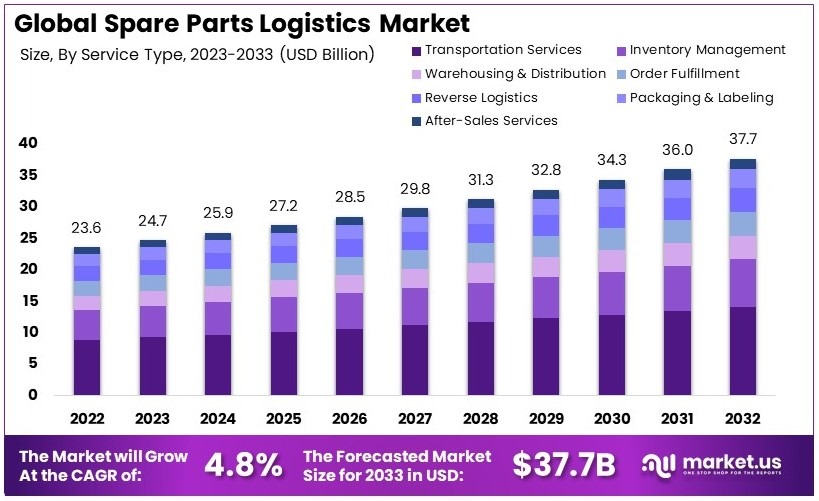
The Global Spare Parts Logistics Market size is expected to be worth around USD 37.7 Billion by 2033, from USD 23.6 Billion in 2023, growing at a CAGR of 4.8% during the forecast period from 2024 to 2033.
Spare parts logistics involves the efficient management of transportation, storage, and delivery of spare parts to ensure availability when needed. It supports maintenance and repair operations across industries, reducing downtime and enhancing operational efficiency by ensuring the timely supply of critical components.
The Spare Parts Logistics Market represents the industry focused on providing logistics solutions for spare parts. This market includes services like inventory management, transportation, warehousing, and distribution, catering to industries such as automotive, aerospace, and manufacturing, ensuring efficient supply chain operations.
Spare Parts Logistics is critical to maintaining vehicle performance and reducing downtime. For instance, the growing global vehicle production, led by Toyota with 10 million units in 2023, boosts demand for efficient spare parts supply chains. Additionally, high ownership rates, with 91.7% of U.S. households owning vehicles in 2022, sustain this demand. Thus, opportunities for logistics improvement are vast.
The Spare Parts Logistics Market shows strong growth potential. According to Forbes Advisor, 22.1% of U.S. households own three or more vehicles, driving consistent demand. Meanwhile, market competition intensifies as automotive OEMs like Volkswagen and Hyundai produce 9 million and 7 million vehicles, respectively. Consequently, innovation and regional expansion are vital to remaining competitive.
Government Investments play a significant role. Policies supporting automotive growth, like tax benefits and infrastructure development, enhance spare parts logistics. Furthermore, the U.S.’s annual car ownership costs exceeding $12,000 drive the need for affordable and efficient car parts supply. Thus, government initiatives create growth opportunities for logistics providers globally.
Spare Parts Logistics Market Key Takeaways
- The Spare Parts Logistics Market was valued at USD 23.6 billion in 2023 and is expected to reach USD 37.7 billion by 2033, with a CAGR of 4.8%.
- In 2023, Transportation Services dominated the service type segment with 37.5%, ensuring efficient and reliable spare parts delivery.
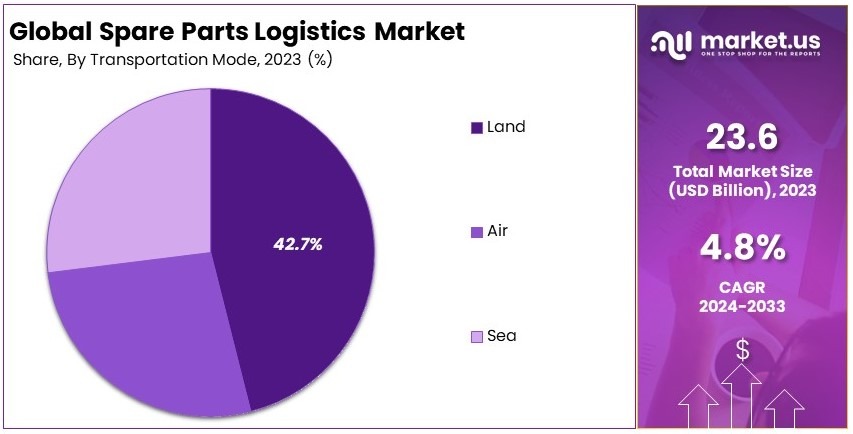
- In 2023, Road Transportation led the transportation mode segment with 42.7%, offering flexibility and accessibility for last-mile delivery.
- In 2023, Original Equipment Manufacturers (OEMs) dominated the end-user segment, driven by their reliance on a consistent parts supply.
- In 2023, Automotive Sector led the application segment, supported by continuous demand for vehicle maintenance and repairs.
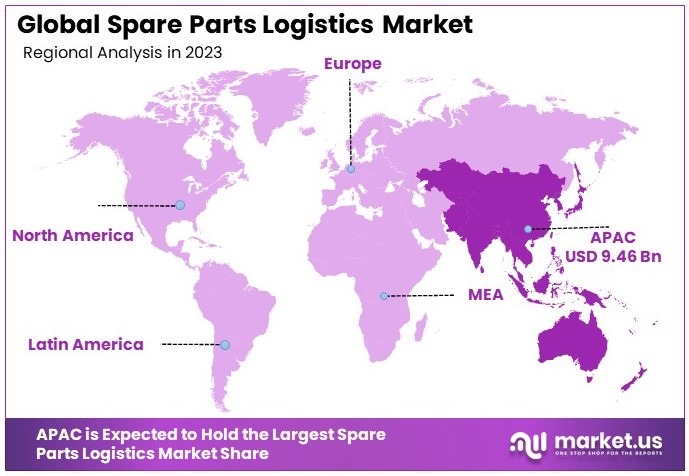
- In 2023, Asia Pacific dominated with 40.1% market share, fueled by a growing automotive industry and robust logistics infrastructure.
Business Environment Analysis
The spare parts logistics market experiences moderate saturation with major players like Liebherr and AIT Worldwide expanding their facilities. According to World’s top Exports, global automotive parts exports reached $454 billion in 2023, driving competition and pushing companies to innovate to capture market share.
Target demographics include automotive manufacturers and aftermarket suppliers across North and South America and the Middle East. For example, Liebherr’s new 480,000 square meters logistics center in Mississippi and OMODA’s 6,000-square-meter warehouse in Saudi Arabia cater to high-demand regions, ensuring rapid parts delivery and enhanced customer service.
Product differentiation is achieved through advanced technologies and specialized services. According to SAUDI PRESS, OMODA and JAECOO’s warehouse stocks over 3,000 SKUs, while VHIT’s AutoStore solution in Italy optimizes logistics with automated storage, enhancing efficiency and scalability in spare parts management.
Investment opportunities are robust with significant capital flowing into logistics infrastructure and technology. Implementation reflect substantial investments aimed at improving logistics capabilities, meeting increasing demand, and supporting global expansion strategies.
Export-import dynamics play a crucial role, with Europe leading exports at $209 billion in 2023. According to OEC, Germany, China, and the USA are top exporters, while the U.S. imports $102 billion in automotive products. Efficient logistics are essential to handle the 14.8% growth in exports since 2019.
Adjacent Markets Analysis
The Global Spare Parts Logistics Market is closely connected with several adjacent markets that play a vital role in complementing its growth and efficiency. These markets, including automotive logistics, third-party logistics (3PL), digital logistics, and e-commerce logistics, provide specialized services and technological advancements that enhance spare parts management.
- By 2033, the Global Third-Party Logistics (3PL) Market is anticipated to grow to USD 2446.1 billion, up from USD 1102 billion in 2023, at a CAGR of 8.3%. Increased reliance on logistics outsourcing to manage complex supply chains efficiently is driving this upward trend, enhancing operational flexibility.
- The Global Fourth-Party Logistics (4PL) Market is forecasted to grow from USD 62.1 billion in 2023 to USD 121.0 billion by 2033, at a CAGR of 6.9% during the period 2024 to 2033, driven by rising demand for integrated supply chain solutions.
- From USD 266.3 billion in 2023, the Global Car Parts Market is forecasted to reach USD 486.0 billion by 2033, at a CAGR of 6.2%. The automotive industry’s growing focus on just-in-time manufacturing and vehicle maintenance solutions is bolstering demand for efficient logistics in this market.
- The Global Digital Logistics Market will witness rapid growth, expanding from USD 30.8 billion in 2023 to USD 182.9 billion by 2033, with a remarkable CAGR of 19.5%. The integration of advanced technologies like IoT, AI, and blockchain is reshaping logistics, enabling real-time data visibility and predictive capabilities.
- Experiencing robust growth, the Global E-Commerce Logistics Market is set to rise from USD 412.5 billion in 2023 to USD 1698.0 billion by 2033, at a CAGR of 15.2%. Surging online retail activity is creating high demand for efficient last-mile delivery and reverse logistics services, driving this market forward.
Each of these adjacent markets provides distinct yet complementary services or solutions, which integrate seamlessly into the 4PL framework, enabling a robust and responsive global logistics ecosystem.
Service Type Analysis
Transportation services dominate with 37.5% due to their critical role in ensuring timely delivery and distribution efficiency.
In the Spare Parts Logistics Market, transportation services are essential, comprising a significant portion of the market. This dominance is primarily due to the necessity of moving spare parts from manufacturers to various distribution channels and ultimately to end users efficiently and reliably. These services are crucial for maintaining the supply chain’s fluidity, minimizing downtime in production and operations across various industries.
Inventory management services are integral in optimizing the storage and availability of spare parts, ensuring parts are available when needed without excessive stock holding. Warehousing and distribution services provide the necessary infrastructure and management to store and dispatch spare parts effectively.
Order fulfillment involves the processing and delivery of spare part orders, which is vital for customer satisfaction. Reverse logistics handles the return or recycling of spare parts, an increasingly important aspect as companies focus on sustainability.
Packaging and labeling ensure that spare parts are well-protected and correctly identified throughout their logistical journey. After-sales services, including part installation and maintenance, are critical for ensuring product longevity and customer retention.
Transportation Mode Analysis
Land transportation leads with 42.7% due to its flexibility and accessibility in reaching diverse geographical locations.
Land transportation is the most utilized mode within the Spare Parts Logistics Market, favored for its extensive reach and ability to provide door-to-door service. This mode’s flexibility in schedule and route planning makes it indispensable, especially for urgent or time-sensitive deliveries, ensuring that spare parts are delivered swiftly and efficiently to required destinations.
Air transportation is valued for its speed and is typically used for very urgent or high-value spare part shipments. Sea transportation is crucial for international logistics, offering cost-effectiveness for bulk shipments but at slower transit times. Each mode plays a vital role in the global supply chain, with choices influenced by factors such as cost, speed, and the physical characteristics of the spare parts being transported.
End User Analysis
Original Equipment Manufacturers (OEMs) dominate the end-user segment due to their need for reliable part supply to maintain production efficiency.
OEMs are the primary end users in the Spare Parts Logistics Market, as they require a continuous supply of parts to maintain seamless production processes. This segment’s dominance is underpinned by the critical need for OEMs to prevent production delays that can result from parts shortages, which could significantly impact manufacturing efficiency and profitability.
The aftermarket, which involves parts and services provided after the initial sale of the equipment, also plays a crucial role by ensuring the availability of parts for maintenance and repair, thus extending the lifecycle of the machinery and enhancing customer satisfaction.
Application Analysis
The Automotive Sector leads the application segment due to the high demand for efficient logistics to support ongoing vehicle maintenance and repair.
The Automotive Sector dominates the application of spare parts logistics, driven by the global presence of automotive manufacturing and the continuous need for parts and services throughout a vehicle’s lifecycle.
This segment’s importance is bolstered by the automotive industry’s standards for quick turnaround times and the need to reduce vehicle downtime, pushing logistics providers to optimize their supply chain strategies.
The Industrial Sector relies heavily on spare parts logistics for maintaining machinery and equipment in various manufacturing processes. The Aerospace Sector requires stringent logistics solutions that can handle the complex demands of transporting highly specialized spare parts.
The Electronics Sector, characterized by rapid product life cycles and global supply chains, depends on efficient logistics to manage the distribution of numerous small, high-value components. Each sector’s reliance on effective spare parts logistics underlines the diversity and complexity of the market.
Key Market Segments
By Service Type
- Inventory Management
- Warehousing and Distribution
- Transportation Services
- Order Fulfillment
- Reverse Logistics
- Packaging and Labeling
- After-Sales Services
By Transportation Mode
- Air
- Sea
- Land
By End User
- Original Equipment Manufacturers (OEMs)
- Aftermarket
By Application
- Automotive Sector
- Industrial Sector
- Aerospace Sector
- Electronics Sector
Driving Factors
Increasing Demand for Timely Spare Parts Delivery Drives Market Growth
Increasing demand for timely spare parts delivery significantly drives the Spare Parts Logistics Market. As the automotive industry expands, the need for efficient logistics to ensure quick and reliable delivery of spare parts becomes paramount.
Customers expect minimal downtime for their vehicles, which necessitates a robust logistics network that can deliver parts swiftly. Additionally, the growth of the e-commerce sector in the automotive industry enhances the need for streamlined logistics operations to handle higher volumes of orders efficiently.
Advancements in logistics technology, such as automated warehouses and real-time tracking systems, further bolster the ability to meet these demands by improving accuracy and reducing delivery times. Moreover, the expansion of the automotive aftermarket, where consumers seek replacement parts for maintenance and repairs, increases the overall demand for effective spare parts logistics.
Restraining Factors
High Logistics Costs Restraints Market Growth
High logistics costs pose a significant restraint to the growth of the Spare Parts Logistics Market. The expenses associated with transportation, smart warehousing, and inventory management can be substantial, especially when dealing with a wide range of spare parts that require specialized handling and storage conditions.
Additionally, fluctuating fuel prices directly impact transportation costs, making it challenging for logistics providers to maintain competitive pricing while ensuring profitability. Complex supply chain management further exacerbates costs, as coordinating multiple suppliers, manufacturers, and distribution channels requires sophisticated systems and processes.
The lack of standardization in spare parts also contributes to inefficiencies, leading to increased handling and processing times that drive up costs. Moreover, regulatory compliance challenges, including adhering to safety and environmental standards, necessitate additional investments in technology and training, further elevating overall logistics costs.
Emerging Trends
Use of Artificial Intelligence in Logistics Is Latest Trending Factor
The use of Artificial Intelligence (AI) in logistics is the latest trending factor significantly influencing the Spare Parts Logistics Market. AI technologies enhance the efficiency and accuracy of logistics operations by enabling predictive analytics, demand forecasting, and route optimization.
The implementation of blockchain for transparency is another trending factor, as it ensures secure and transparent transactions across the supply chain, enhancing trust and reliability among stakeholders. The shift towards omni-channel distribution caters to the growing consumer preference for seamless shopping experiences.
It requires logistics providers to integrate various distribution channels and ensure consistent service delivery. Additionally, the growth of last-mile delivery solutions addresses the increasing demand for quick and efficient final delivery stages, particularly in urban areas, enhancing customer satisfaction and loyalty.
Regional Analysis
Asia Pacific Dominates with 40.1% Market Share in the Spare Parts Logistics Market
Asia Pacific holds a substantial 40.1% share of the global Spare Parts Logistics Market. This dominance is fueled by the region’s rapid industrial growth, extensive manufacturing base, particularly in automotive and electronics, and an expanding e-commerce sector.
The region’s robust growth in vehicle production, especially in countries like China, India, and Japan, boosts the demand for automotive spare parts logistics. The expansive manufacturing sector, coupled with increasing internet penetration, enhances the e-commerce platforms for spare parts distribution, further driving market growth. Additionally, significant investments in infrastructure development and logistics technologies are pivotal.
Asia Pacific benefits from a large, diverse market with varying consumer demands which necessitates efficient logistics networks. High population density in urban areas and increasing consumer spending power contribute to the rising demand for quick and reliable spare part deliveries. The region’s strategic geographic location also facilitates extensive trade routes both within Asia and internationally.
Regional Mentions:
- North America: North America maintains a strong market presence in spare parts logistics, driven by advanced logistics infrastructure and a high demand for automotive and technology parts replacement.
- Europe: Europe’s market is characterized by high efficiency in logistics operations, supported by excellent transportation networks and stringent regulations on spare parts quality and distribution.
- Middle East & Africa: This region is experiencing growth due to increasing vehicle sales and investments in infrastructure, which are expanding the spare parts logistics sector.
- Latin America: Latin America shows potential for growth with improvements in logistic infrastructures, such as ports and roads, and a rising demand for aftermarket parts driven by an aging vehicle fleet.
Key Regions and Countries covered in the report
- North America
- US
- Canada
- Europe
- Germany
- France
- The UK
- Spain
- Italy
- Rest of Europe
- Asia Pacific
- China
- Japan
- South Korea
- India
- Australia
- Rest of APAC
- Latin America
- Brazil
- Mexico
- Rest of Latin America
- Middle East & Africa
- South Africa
- Saudi Arabia
- UAE
- Rest of MEA
Competitive Landscape
The Spare Parts Logistics Market is competitive, driven by demand for efficient supply chain solutions. Leading players include DHL Supply Chain, CEVA Logistics, DB Schenker, and Kuehne + Nagel International, each contributing significantly to the market’s growth.
DHL Supply Chain leads with its global presence and advanced digital platforms. Their expertise in managing complex supply chains ensures seamless delivery, particularly in the automotive and industrial sectors. DHL’s continuous investment in AI and automation enhances operational efficiency.
CEVA Logistics excels in tailored logistics solutions. Their focus on integrating technology into operations ensures fast and accurate spare parts delivery. CEVA’s strategic partnerships and acquisitions strengthen its position in high-demand markets.
DB Schenker leverages its extensive network to provide end-to-end logistics solutions. Their investments in sustainable logistics and smart warehousing set them apart. DB Schenker’s expertise in managing large-scale operations supports its leadership in the spare parts sector.
Kuehne + Nagel International specializes in efficient warehousing and distribution systems. Their digital platforms enhance supply chain visibility, ensuring timely delivery. Their strong presence in Asia-Pacific and Europe allows them to address global demand effectively.
These key players dominate the market through innovation, strong logistics networks, and customer-centric solutions. Their commitment to operational excellence ensures leadership in the Spare Parts Logistics Market.
Major Companies in the Market
- DHL Supply Chain
- CEVA Logistics
- DB Schenker
- Kuehne + Nagel International
- FedEx
- DSV
- AnJi
- Logwin
- SAIC AnJi Logistics
- Nippon Express
- Ryder System, Inc.
- XPO Logistics
- Yusen Logistics
- Panalpina
- Geodis
Recent Developments
- Broekman Logistics: In March 2024, Broekman Logistics partnered with Groenewout for a warehouse redesign in Born, Netherlands, to support Liebherr’s spare parts operations, optimizing layout and efficiency for the new distribution requirements.
- Honda: In April 2024, Honda began constructing a 140,000-square-meter spare parts warehouse near Bengaluru, India, aiming to streamline logistics for two-wheelers, four-wheelers, and power products, set to launch in FY 2025-26.
- OMODA & JAECOO (Thailand): In October 2024, OMODA & JAECOO partnered with DHL Supply Chain to open a 1,000-square-meter spare parts warehouse in Thailand, handling up to 80,000 automotive parts monthly to enhance warehousing and transportation services.









