


Report Overview
The Global Virtual Reality in Tourism Market size is expected to be worth around USD 59.9 Billion by 2033, from USD 8.9 Billion in 2023, growing at a CAGR of 21% during the forecast period from 2024 to 2033. In 2023, North America held a dominant market position, capturing more than a 37% share, holding USD 3.3 Billion revenue.
Virtual reality (VR) in tourism refers to the application of VR technology to enhance the travel experience by creating immersive environments for potential tourists. This technology allows users to explore destinations, attractions, and accommodations virtually before deciding to visit in person. VR in tourism serves as a powerful tool for marketing and planning, offering interactive tours and experiences that can evoke emotional responses and boost travelers’ interest.
The virtual reality in tourism market is witnessing significant growth, driven by the increasing demand for enhanced travel experiences and innovative marketing strategies. As tourism providers seek to differentiate their offerings, VR technology emerges as a key element in captivating the attention of a tech-savvy consumer base. This market segment includes various stakeholders like VR content creators, tourism boards, travel agencies, and tech companies, all working collaboratively to develop immersive travel products and services.

The major drivers for the VR in Tourism market include the rising demand for immersive and interactive travel experiences and the ongoing technological advancements in VR technologies. Companies are continuously innovating to improve VR content and hardware, making virtual tours more realistic and accessible to a broader audience.
The market demand for virtual reality in tourism is on the rise. Travelers are increasingly seeking innovative ways to explore destinations from the comfort of their homes, particularly in scenarios where travel is not possible. This demand is also fueled by the growing prevalence of social media and digital content, where users are keen to share unique travel experiences online.
The integration of VR into tourism presents numerous market opportunities. For tourism businesses, it offers a new revenue stream through virtual travel experiences that can be monetized directly. It also opens up possibilities for partnerships between VR technology providers and travel companies. Moreover, destinations that are less accessible or are striving to manage overtourism can benefit from VR by offering virtual visits, thus balancing real and virtual tourism flows.
For instance, In July 2024, Greater Anglia introduced a 360-degree virtual tour for Witham railway station and 18 other stations in the U.K. This initiative was designed to help passengers, especially those with accessibility needs, by allowing them to explore station facilities online before traveling. Key areas covered include restrooms, ticket machines, platforms, and transport links.
A recent trend report by ZEISS and YouGov highlights the growing influence of virtual reality (VR) in the travel industry. According to the survey, 73% of entrepreneurs believe customers will use VR to make decisions about travel, such as choosing destinations or hotels. Additionally, 61% see significant potential for VR and AR technologies in enhancing the overall travel experience.
A recent study reveals mixed views on the role of VR in travel planning. Only 12% of respondents currently see potential in VR for tourism, showing a strong preference for traditional trip-planning methods. However, there’s a clear interest in its potential, as 62% said they would find VR useful for holiday planning – especially if offered for free.
Technological advancements in VR, such as enhanced graphical fidelity, more intuitive user interfaces, and better integration with other digital platforms, continue to elevate the user experience. The development of lighter, wireless VR headsets and more immersive content that includes multisensory experiences – such as touch and smell – are transforming how consumers interact with virtual environments.
Key Takeaways
- The Global Virtual Reality in Tourism Market is on a robust growth trajectory, projected to reach a market value of USD 59.9 billion by 2033, up from USD 8.9 billion in 2023. This impressive expansion reflects a CAGR of 21% from 2024 to 2033.
- In 2023, the hardware segment emerged as a frontrunner, accounting for more than 47% of the total market share. This dominance is driven by the rising demand for VR headsets, controllers, and other equipment that enable immersive experiences for travelers and service providers alike.
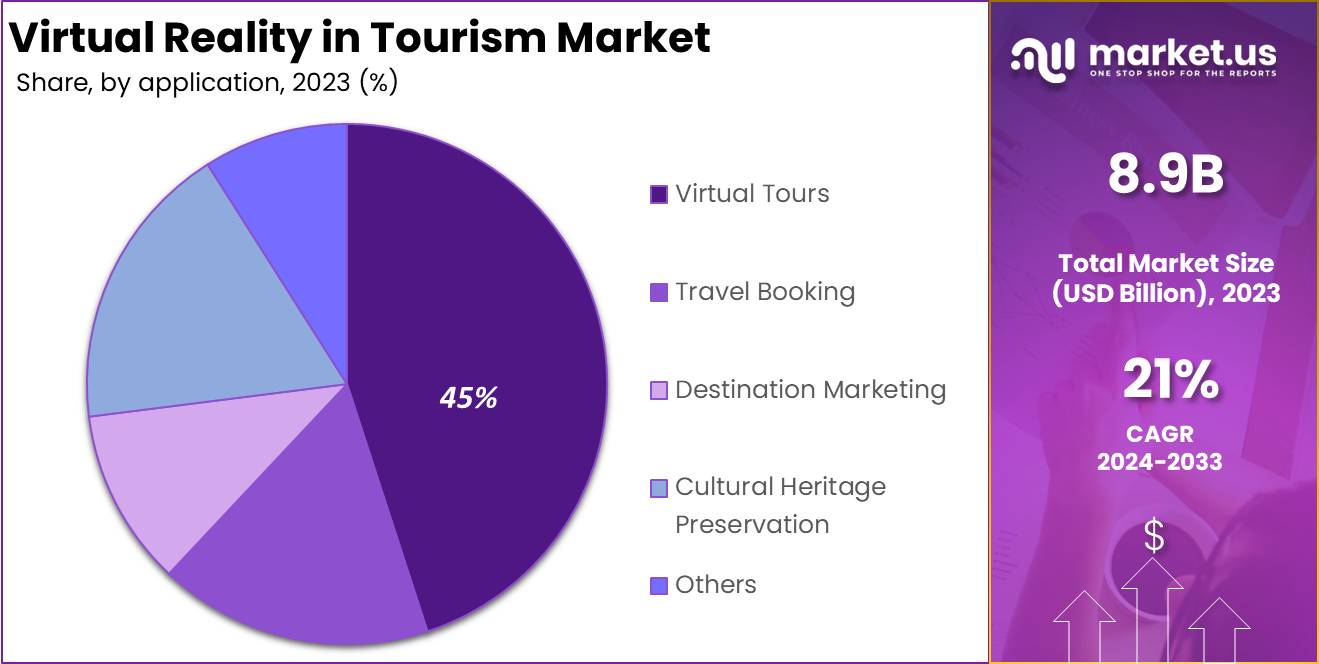
- Virtual tours have revolutionized the way people explore destinations before booking. In 2023, this segment captured over 45% of the market, proving its value as a tool for both marketing and customer engagement.
- The tourism segment, encompassing attractions, accommodations, and travel planning, held a substantial 55% share of the market in 2023. This highlights how VR is being widely adopted to enhance the traveler’s experience and streamline decision-making processes.
- North America stood out as the leading regional market, securing over 37% of the global share in 2023. The region’s dominance is fueled by advanced technological infrastructure, early adoption of VR in tourism, and a strong focus on innovative travel solutions.
Impact of AI On Virtual Reality in Tourism Market
The impact of artificial intelligence (AI) on the Virtual Reality (VR) in tourism market is profound and multifaceted, primarily enhancing the personalization and efficiency of tourist experiences. AI’s capabilities are being leveraged to improve various aspects of VR applications in the tourism sector, from content creation to user interaction and market analytics.
- Enhanced Personalization: AI technologies enable highly personalized travel experiences in VR by analyzing user preferences and behavior. This personalization can range from recommending virtual tours tailored to individual interests to adjusting the virtual environment in real-time based on user interactions. AI’s predictive analytics allow for more nuanced understanding of customer preferences, which can be used to customize VR content effectively, enhancing user engagement and satisfaction.
- Operational Efficiency: AI contributes to operational improvements within VR tourism platforms by automating routine tasks and optimizing system operations. For instance, AI can streamline content management processes, from updating virtual tours to ensuring the accuracy and relevancy of the VR content presented to users. Furthermore, AI facilitates real-time problem-solving within VR environments, enhancing the overall user experience by minimizing disruptions during virtual tours.
- Data-Driven Insights: AI provides valuable insights through data analysis, helping tourism businesses understand market trends and consumer behavior. This capability supports more informed decision-making and strategy development in VR tourism. By analyzing large datasets, AI can identify patterns and trends that inform the development and marketing of VR tourism products, ultimately leading to better targeted and more effective marketing campaigns.
- Interactive and Immersive Experiences: AI enhances the interactivity of VR applications by enabling more sophisticated user interfaces and interaction models. This includes natural language processing tools that allow users to interact with the VR environment using voice commands or chatbots that guide users through virtual experiences. Such interactions make VR tours more accessible and engaging, appealing to a broader audience by simplifying navigation and providing informational content in an interactive manner.
Component Analysis
In 2023, the hardware segment held a dominant market position within the virtual reality (VR) in tourism market, capturing more than 47% of the total market share. This leading status can be attributed to several key factors that underscore the pivotal role of VR hardware in the tourism industry.
The proliferation of head-mounted displays (HMDs), which form the cornerstone of the hardware segment, is a significant driver. These devices provide immersive experiences that are crucial for virtual tourism, offering users realistic explorations of global destinations from the comfort of their homes. The high demand for HMDs is fueled by their enhanced capabilities to simulate detailed and interactive environments, which are essential for an engaging virtual travel experience.
Further bolstering the hardware segment’s dominance are the technological advancements in VR devices, including improved graphics, performance, and user interface, which enhance the overall user experience. Companies within this space are continuously innovating, offering more sophisticated and user-friendly products that cater to a wide array of tourism applications, from virtual tours to educational programs in historical preservation.
Moreover, the strategic moves by leading market players, such as partnerships with tourism boards and integration of VR in destination marketing strategies, illustrate the segment’s growth trajectory. These collaborations not only enhance the visibility of VR technology in the tourism sector but also expand the practical applications of VR hardware in the market. For example, initiatives like the Hello! Tokyo Friends platform demonstrate how VR can offer interactive and culturally enriching experiences through technology.
The ongoing development and adoption of VR technologies in tourism are expected to continue driving the market forward, with hardware remaining a critical component due to its direct impact on the quality and accessibility of virtual travel experiences. This trend is underscored by increasing investments in the sector and the expanding range of VR applications in tourism, suggesting a promising future for the hardware segment in shaping the next generation of travel experiences
Application Analysis
In 2023, the Virtual Tours segment in the Virtual Reality in Tourism market held a commanding market position, capturing more than a 45% share. This dominance can be attributed to several key factors that have driven the popularity and functionality of virtual tours within the tourism sector.
Virtual tours have become integral in offering immersive experiences that simulate physical travel, allowing users to explore destinations and attractions in vivid detail from their own homes. The segment’s growth is fueled by the advancement in virtual reality and augmented reality technologies, which enhance the interactive experience by providing users with a lifelike sense of place and the ability to explore at their own pace.
This has proven particularly appealing to a tech-savvy consumer base and has become a cornerstone in marketing strategies for travel agencies, hotels, and cultural sites. Economic factors also play a crucial role. The affordability and accessibility of virtual tours, which do not require specialized equipment beyond a simple internet connection and a computing device, have enabled their rapid adoption.
During periods such as the COVID-19 pandemic, when physical travel was restricted, virtual tours offered an invaluable alternative for exploring the world, thus maintaining consumer engagement with tourism destinations and contributing significantly to the market’s resilience and growth.
The integration of virtual tours into various marketing and promotional strategies has further solidified their value, providing a realistic preview and interactive exploration options that entice potential visitors. As such, these tours have not only catered to individual travelers but have also been extensively utilized by educational institutions and businesses to provide enriching, educational content in a cost-effective manner.
End User Analysis
In 2023, the tourism segment in the virtual reality in tourism market held a dominant position, securing over a 55% market share. This leading role can be largely attributed to the increasing adoption of VR technologies that enhance the way travelers engage with and experience destinations.
Virtual reality offers a highly immersive form of travel, allowing individuals to explore global attractions, landscapes, and cultural experiences from the comfort of their own homes, making it particularly appealing in the current era where digital interaction is highly valued.
The robust growth of this segment is driven by several factors. Firstly, the integration of virtual reality in tourism marketing strategies has revolutionized destination marketing. It allows potential tourists to virtually experience destinations before booking, increasing their likelihood of visiting in person. This technological shift is supported by advancements that make VR more accessible and affordable to the general public, thus broadening the technology’s appeal and utility across the travel industry.
Moreover, the tourism segment benefits from strategic collaborations and innovations that continuously enhance the virtual travel experience, making it richer and more engaging. Examples include virtual tours of landmarks, virtual hotel and resort tours, and interactive travel experiences that simulate the physical act of traveling. These offerings not only cater to traditional tourists but also attract a new demographic that might be restricted by physical, financial, or time constraints.
Overall, the convergence of technology, marketing, and consumer behavior trends around digital experiences suggests that the tourism segment of the virtual reality market is poised for sustained growth. This trend underscores the transformative impact of VR on the travel industry, providing a virtual yet realistic preview of destinations, which is reshaping how travel and tourism products are marketed and consumed globally.
Key Market Segments
By Component
- Hardware
- Software
- Services
By Application
- Virtual Tours
- Travel Booking
- Destination Marketing
- Cultural Heritage Preservation
- Others
By End-User
- Tourism
- Real Estate
- Art Galleries and Museums
- Others
Driver
Enhanced User Engagement through Technological Innovations
The virtual reality (VR) in tourism market is significantly driven by continuous technological advancements in VR and augmented reality (AR). These technologies are revolutionizing the tourism industry by providing immersive and interactive travel experiences, enabling users to explore destinations in great detail without leaving their homes.
The increasing integration of VR into tourism marketing strategies enhances the attractiveness of destinations and boosts user engagement by allowing potential tourists to experience locations remotely. Innovations such as high-definition VR headsets and interactive virtual tours are making these technologies more accessible and affordable, thereby increasing consumer adoption. As these immersive experiences become a fundamental part of travel planning, they are set to drive the market’s growth substantially.
Restraint
High Implementation Costs and Technological Barriers
Despite the rapid growth of VR in tourism, high implementation costs pose a significant restraint. The development and maintenance of high-quality VR content and the required infrastructure involve substantial investments, which can be a barrier for smaller operators in the tourism industry.
Additionally, the need for advanced hardware and software to support seamless VR experiences adds to the financial burden. Technological barriers also extend to the end-users who require the latest in hardware technology to experience VR fully, which may not be readily available or affordable for all, limiting the widespread adoption of VR tourism on a global scale.
Opportunity
Expansion into New Markets and User Demographics
VR tourism offers vast opportunities to expand into new markets and user demographics. With the global increase in internet penetration and mobile device usage, VR tourism can reach a broader audience, including regions previously underserved by traditional tourism services.
Furthermore, as VR technology continues to evolve, its potential applications in tourism expand, ranging from virtual reality travel booking to educational programs that can significantly enhance the user’s interactive experience. These factors combined provide a unique opportunity for market growth, especially in developing regions that are now experiencing increased digital connectivity.
Challenge
Need for High-Speed Internet Connectivity
A major challenge facing the VR tourism industry is the dependency on high-speed and reliable internet connectivity. VR applications, particularly those that offer immersive and interactive experiences, require robust internet connections to function effectively without latency issues.
In many potential markets, especially in developing countries, consistent access to fast internet is still a challenge. This limitation can degrade the user experience, leading to buffering, lag, and reduced resolution, which significantly detracts from the immersive quality of VR tourism. Overcoming these connectivity issues is crucial for the global expansion of VR tourism services.
Growth Factors
The virtual reality (VR) in tourism market is experiencing significant growth, driven by several key factors that are transforming the travel industry. One of the primary growth drivers is the increased accessibility and affordability of VR technology. As VR devices become more user-friendly and less expensive, more consumers are able to experience immersive travel from their homes, broadening the market base.
Advancements in technology also play a crucial role, with continuous improvements in VR hardware and software enhancing the realism and interactivity of virtual travel experiences. These advancements make it possible for users to enjoy detailed explorations of global destinations, significantly enhancing the appeal of VR tourism.
Moreover, the integration of VR with mobile technology is expanding the reach of virtual tourism, allowing users to access immersive experiences on their smartphones, thereby increasing consumer engagement and the overall market potential. The rise of 5G technology further enhances these experiences with faster, more reliable internet speeds, reducing latency, and improving the quality of virtual tours.
Emerging Trends
Emerging trends in the VR tourism market include the blending of virtual reality with augmented reality (AR) to create mixed reality experiences that offer a more immersive and interactive exploration of tourist destinations. Social VR platforms are also gaining popularity, enabling users to meet and interact in virtual environments, which enhances the social aspect of travel and opens new avenues for virtual tourism.
Additionally, the use of VR for destination marketing is on the rise, with tourism boards and agencies leveraging the technology to showcase attractions and provide potential visitors with a preview of what they can expect. This marketing strategy has proven effective in increasing visitor interest and boosting tourism.
Business Benefits
Virtual reality offers substantial business benefits for the tourism industry, particularly in marketing and customer engagement. VR allows potential tourists to virtually visit destinations, which can significantly influence their travel decisions and increase conversion rates for tourism businesses. It also provides a competitive edge by differentiating offerings in a crowded market.
For tourism operators, VR offers cost-effective solutions for training and education, enabling staff to experience and learn about destinations and services virtually, which can improve service quality and customer satisfaction. Additionally, VR can generate valuable data on user preferences and behaviors, which can be used to tailor marketing strategies and enhance the visitor experience.
Regional Analysis
In 2023, North America held a dominant position in the Virtual Reality in Tourism market, capturing over 37% of the market share with revenues reaching approximately USD 3.3 billion. This prominence can be attributed to several pivotal factors that underscore the region’s leadership in the VR tourism sector.
Firstly, North America benefits from a robust technological infrastructure which is crucial for the development and dissemination of VR technologies. This advanced infrastructure supports high-speed internet access, essential for delivering the high-definition, seamless virtual experiences that are fundamental to VR tourism. This technological edge is complemented by widespread internet access across the region, enabling a broader audience to engage with VR platforms.
Moreover, there is a high consumer interest in digital experiences within North America, driven by a tech-savvy population eager to adopt new technologies. This consumer base is highly receptive to innovations that enhance travel experiences through virtual means, making the region a fertile ground for VR tourism applications.
Additionally, the region’s rich cultural, historical, and natural attractions are well-suited for exploration via VR. From the iconic landscapes of national parks to bustling city scenes and historical sites, North America offers a diverse range of destinations that are appealing in virtual formats. This diversity not only attracts local users but also garners interest from global audiences, further boosting the market.

Key Regions and Countries
- North America
- US
- Canada
- Europe
- Germany
- UK
- Spain
- Austria
- Rest of Europe
- Asia-Pacific
- China
- Japan
- South Korea
- India
- Australia
- Thailand
- Rest of Asia-Pacific
- Latin America
- Brazil
- Middle East & Africa
- South Africa
- Saudi Arabia
- United Arab Emirates
Key Players Analysis
One of the leading player in the market is Google LLC that offers VR solutions like Google Earth VR and Expeditions, enabling virtual exploration of global destinations. Another prominent player in the market is HTC Corporation that provides advanced VR headsets like HTC Vive, widely used for immersive travel experiences.
Top Key Players in the Market
- Google LLC
- Oculus VR (Meta Platforms Inc.)
- Samsung Electronics Co., Ltd.
- HTC Corporation
- Microsoft Corporation
- Dubai 360
- Matterport
- YouVisit
- Real Tour Vision (RTV)
- 360Cities
- TourVista
- Blue Raven Studios
- Kuula
- Panedia
- Other Key Players
Recent Developments
- In November 2024, Minister of Tourism and Chairman of the Saudi Tourism Authority launch of Saudi Arabia’s latest coastal tourism initiative, the Saudi Red Sea. Key coastal destinations such as NEOM, Amaala, Red Sea Global, Jeddah Historical, and King Abdullah Economic City (KAEC) showcased their unique offerings at the pavilion, emphasizing the richness of this new super destination.
- In February 2024, Hainan Airlines has launched augmented reality (AR) experiences, offering passengers a unique immersive experience aboard Hainan Airlines flight HU7874. Special AR glasses awaited passengers at their seats, allowing them to enjoy 3D films with a 360-inch borderless screen, 1080P resolution, and a 120Hz refresh rate, similar to having a private cinema at 30,000 feet.









