


Report Overview
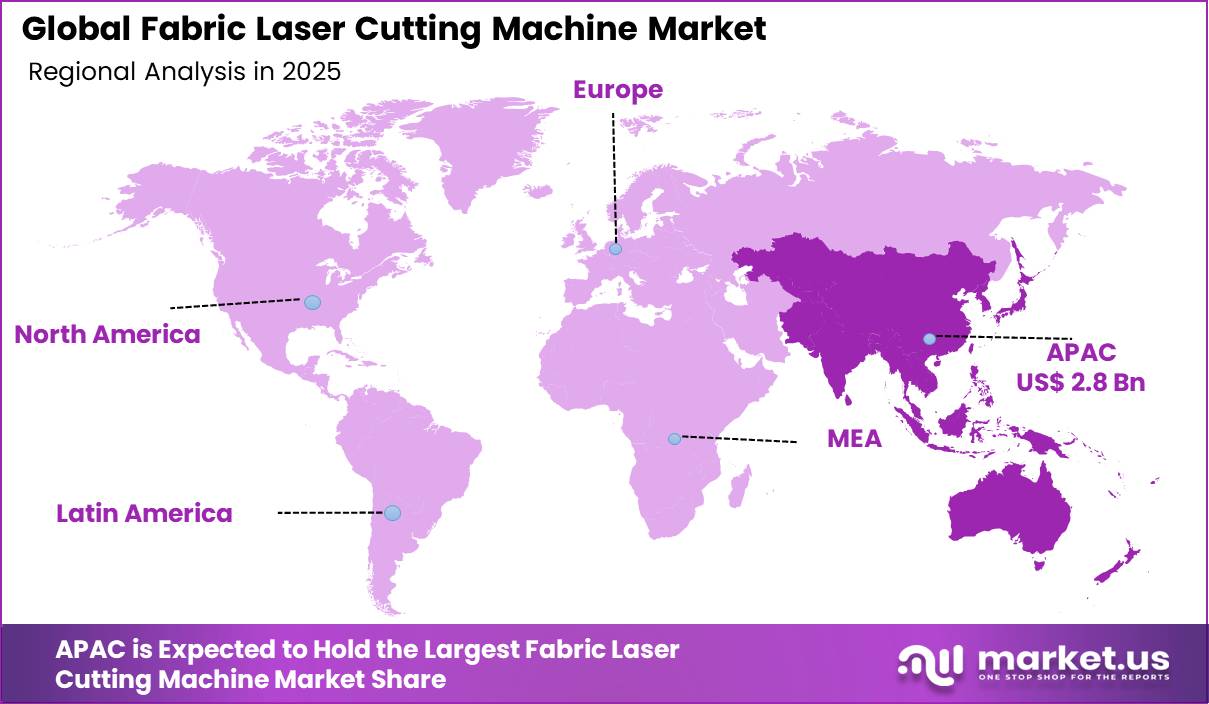
The Global Fabric Laser Cutting Machine Market size is expected to be worth around USD 14.8 Billion by 2035, from USD 6.8 Billion in 2025, growing at a CAGR of 8.0% during the forecast period from 2026 to 2035. In 2025, Asia Pacific held a dominant market position, capturing more than a 40.5% share, holding USD 68.1 Million revenue.
The fabric laser cutting machine market is shaped by the increasing shift toward precision-based and digitally controlled textile manufacturing. These systems utilize focused laser technology to cut, engrave, and process fabrics with high accuracy, reducing material wastage and eliminating reliance on traditional mechanical tooling.
nments can deliver 10-30% cost efficiencies in production processes and similar improvements in logistics and quality management, driven largely by automation and system integration. Within fabric processing units, laser systems increasingly incorporate intelligent vision modules capable of detecting fabric patterns and automatically adjusting cutting parameters such as speed, focus, and power, improving consistency across varied textile types.
Operational advancements further include multi-head laser configurations and automated nesting algorithms, which enhance throughput by enabling simultaneous cutting of multiple components while optimizing material utilization. Some industrial setups demonstrate multi-layer fabric processing capabilities, allowing stacked cutting with maintained accuracy, thereby reducing cycle time per unit output.
Integration with centralized production software further enables predictive maintenance and remote monitoring, reducing downtime risks and improving equipment lifecycle management. As manufacturing environments shift toward digitally coordinated ecosystems, fabric laser cutting machines are increasingly functioning as connected nodes within broader smart textile production networks rather than standalone equipment.
Geopolitical Impact Analysis
Fragmented Trade Architectures and Their Influence on Advanced Textile Laser Equipment Flows.
Heightened geopolitical friction across major manufacturing blocs is increasingly influencing the procurement and deployment of industrial laser systems used in fabric processing. Trade restrictions and tariff actions between major economies, particularly involving China, the United States, and parts of Europe, have contributed to reconfiguration of machinery sourcing routes.
China remains a dominant exporter of industrial machinery, accounting for a significant share of global machine tool exports, while the U.S. continues to rely on imported equipment for advanced manufacturing applications, including textile automation systems. This interdependence creates exposure when tariffs or export controls are introduced, often translating into higher landed costs and delayed capital investment decisions for end users.
Supply chain fragmentation has further been observed in textile-linked manufacturing corridors, where geopolitical disputes and sanctions have disrupted raw material and equipment flows, extending lead times and increasing procurement uncertainty across multi-stage production systems. Consequently, manufacturers of fabric laser cutting machines are increasingly adjusting production footprints and component sourcing strategies, with partial relocation toward China+1 ecosystems to mitigate policy risk exposure.
Similarly, shifting trade routes and export realignments are creating uneven access to advanced automation technologies, particularly in cost-sensitive textile hubs. This has resulted in delayed adoption cycles for capital-intensive laser systems, especially where import duties and compliance costs escalate total system acquisition expenses. The cumulative effect is a more regionally segmented market structure, where technology diffusion is increasingly shaped by trade policy alignment rather than purely industrial demand dynamics.
Regional Analysis
Asia Pacific Held the Largest Share of the Global Fabric Laser Cutting Machine Market.
In 2025, Asia Pacific dominated the global fabric laser cutting machine market, holding about 40.5% of the total global consumption, supported by its deeply embedded textile and apparel manufacturing ecosystem. The region contributes nearly half of global textile output, with China alone producing majority of worldwide textile and apparel goods. Similarly, India also maintains a strong position, with textile exports exceeding USD 34 billion in FY2023-24 as reported by the Ministry of Textiles, reflecting sustained investment in production modernization and automation-led processing lines.
The concentration of large-scale garment clusters in China, Bangladesh, Vietnam, and India has accelerated deployment of laser-based cutting systems to replace conventional blade-based methods, particularly in export-oriented production units. Operational advantages such as cutting accuracy within sub-millimeter tolerance levels and material utilization improvements in automated fabric processing lines have further supported adoption across high-volume apparel production. The combination of cost-competitive manufacturing, export dependency, and ongoing mechanization continues to reinforce Asia Pacific’s structural dominance in this equipment category.
Key Regions and Countries
- North America
- The US
- Canada
- Europe
- Germany
- France
- The UK
- Spain
- Italy
- Russia & CIS
- Rest of Europe
- APAC
- China
- Japan
- South Korea
- India
- ASEAN
- Rest of APAC
- Latin America
- Brazil
- Mexico
- Rest of Latin America
- Middle East & Africa
- GCC
- South Africa
- Rest of MEA
Key Players Analysis
Manufacturers of fabric laser cutting machines concentrate on continuous product differentiation through improvements in precision, cutting speed, and multi-material compatibility to address diverse textile applications. Significant emphasis is placed on integrating advanced control systems, including CAD/CAM compatibility, AI-assisted pattern recognition, and automated nesting software to enhance operational efficiency and reduce material wastage.
Expansion of after-sales service networks, including remote diagnostics, predictive maintenance, and rapid spare-part supply chains, is a key focus to strengthen customer retention. Companies further invest in modular machine designs that allow scalability from semi-automatic to fully automated configurations, catering to both SMEs and large industrial users. In parallel, efforts to improve energy efficiency and compliance with industrial safety standards support broader acceptance across regulated manufacturing environments, reinforcing long-term equipment adoption.
The Major Players in The Industry
- Trotec Laser
- Epilog Laser
- Han’s Laser Technology Industry Group
- Golden Laser
- GCC LaserPro
- Gravotech
- TRUMPF Group
- Amada Co., Ltd.
- Bystronic AG
- Coherent Corp.
- IPG Photonics
- Bodor Laser
- HSG Laser
- Eurolaser GmbH
- Sahajanand Laser Technology Ltd.
- Other Key Players
Key Developments
- In September 2025, Trotec Laser and Lindenmeyr Munroe announced a partnership, with Lindenmeyr Munroe adding Trotec’s Speedy laser systems and premium laserable materials to its portfolio, providing customers across multiple U.S. regions access to advanced laser technology.
- In March 2026, Epilog Laser added the Fusion Ascent Laser Series to its product lineup. The company showcased the new system during the ISA Sign Expo in Orlando, Florida.









