Quick Navigation
- Report Overview
- Key Takeaway
- Role of Generative AI
- Investment and Business Benefits
- Global Insurtech-as-a-Service Market Scope
- Service Type Analysis
- Application Analysis
- End-User Analysis
- Emerging Trends
- Growth Factors
- Key Market Segments
- Drivers
- Restraint
- Opportunities
- Challenges
- Key Regions and Countries
- Key Players Analysis
- Recent Developments
- Report Scope
Report Overview
The Global Insurtech-as-a-Service Market size is expected to be worth around USD 5.98 billion by 2035, from USD 1.96 billion in 2025, growing at a CAGR of 11.8% during the forecast period from 2025 to 2035. North America held a dominant market position, capturing more than 39.5% share and generating USD 0.77 billion in revenue.
Insurtech-as-a-Service refers to a cloud-based model where insurance technology tools are provided as a service to insurers, brokers, or other providers. It helps companies manage tasks such as policy issuance, claims handling, customer support, and analytics without building full systems in-house, making digital insurance operations easier, faster, and more flexible.
![]()
Emerging Trends
Embedded insurance is becoming more common, allowing users to purchase coverage directly within digital platforms such as shopping apps. This approach simplifies the buying process and improves accessibility. Adoption has increased by 35%, showing that customers prefer insurance options that are easy to access at the point of purchase.
Hyper-personalization is also gaining traction, where AI uses customer data to design tailored insurance plans. This helps align coverage with individual needs and behavior patterns. Around 45% of customers now prefer these personalized offerings, as they provide more relevant protection compared to traditional, one-size-fits-all policies.
Growth Factors
Advances in AI and automation are playing a key role in improving efficiency across insurance operations. These technologies streamline claims processing and underwriting, reducing delays and improving accuracy. Reports indicate that firms using such tools have achieved up to a 50% reduction in handling costs.
At the same time, increasing customer awareness is driving demand for digital insurance solutions. Users are actively seeking faster and more convenient services through online platforms. Surveys show that 55% of customers now prefer technology-based insurance services over traditional methods, supporting steady market expansion.
Key Market Segments
By Service Type
- API Platforms
- White-label Solutions
- Analytics & AI Services
- Claims Processing Services
By Application
- Digital Distribution
- Automated Underwriting
- Claims Management
- Customer Service
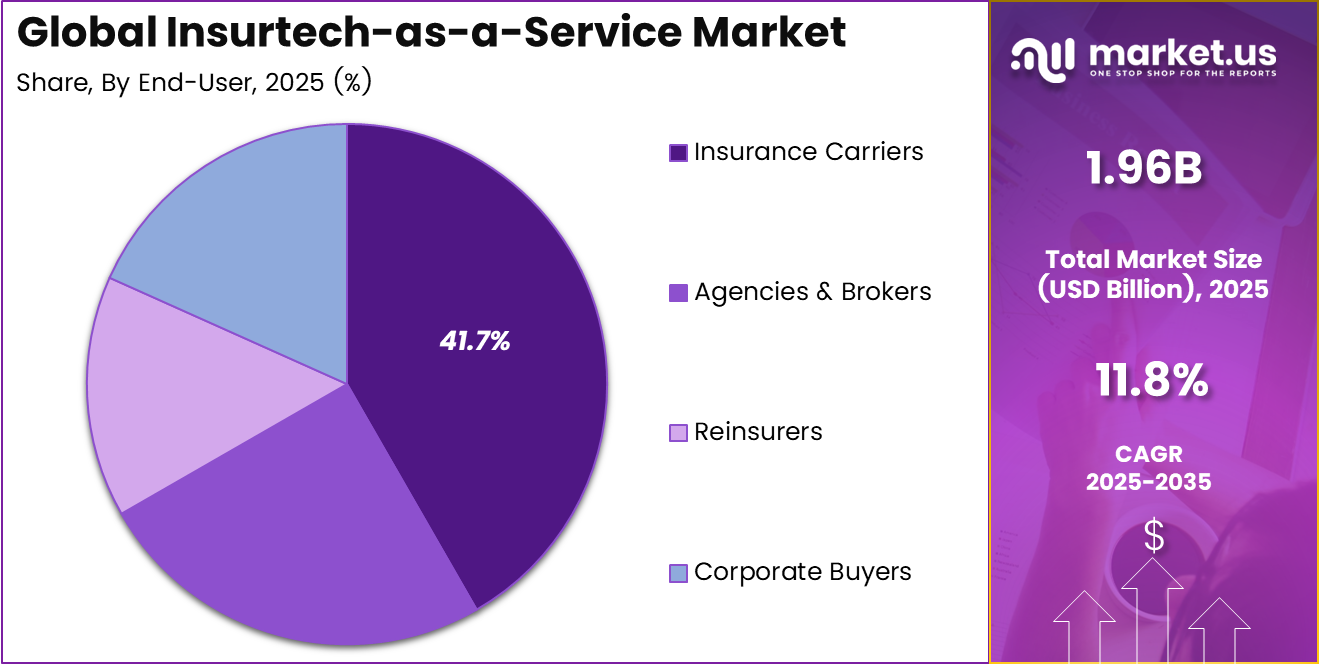
By End-User
- Insurance Carriers
- Agencies & Brokers
- Reinsurers
- Corporate Buyers
Drivers
Faster Digital Insurance Operations
Insurers are under pressure to deliver faster service across quoting, underwriting, claims, and policy management. Service-based insurtech platforms help reduce delays by connecting digital tools with core insurance workflows. This makes daily operations more efficient and supports smoother communication between teams, systems, and customers.
Faster digital operations also improve the customer experience. Policyholders now expect quick responses, easy access to services, and fewer manual steps. Insurtech-as-a-Service helps insurers meet these expectations by simplifying routine processes and supporting real-time service across different insurance functions.
For instance, in October 2024, Salesforce launched Financial Services Cloud for Insurance Brokerages, embedding AI-driven automation into policy servicing and commission workflows. This lets brokers process renewals, update policies, and manage client data faster from a single platform, reducing manual data entry and improving response times to customers.
Restraint
Regulatory and Governance Pressure
Regulatory and governance pressure remains a key restraint for the market. Insurance is a highly regulated industry, and any digital platform used in core operations must meet strict compliance standards. This creates hesitation among insurers when adopting external technology for underwriting, claims, and customer-facing services.
Governance concerns also increase when automated systems influence important decisions. Insurers must ensure fairness, transparency, and accountability in every process. As rules continue to evolve, companies often take a cautious approach, which can slow implementation and make platform adoption more difficult in some areas.
For instance, in September 2024, Guidewire reported strong recurring revenue growth, tied to insurers’ modernizing core systems amid stricter regulatory expectations. Many customers used Guidewire’s cloud-based core platforms to standardize underwriting and policy management, yet still had to layer additional governance and reporting layers to meet evolving regulatory and internal audit standards.
Opportunities
Rise in Customized Insurance Offerings
The rise in customized insurance offerings is creating a strong opportunity for this market. Customers are no longer satisfied with standard products that do not reflect their specific needs. Service-based insurtech platforms make it easier for insurers to design flexible plans based on user behavior, risk profile, and service preferences.
This shift supports better customer engagement and stronger product relevance. Insurers can launch tailored offerings more quickly by using digital tools that support product design, pricing, and policy adjustments. As personalization becomes more important in insurance, these platforms are well placed to support future market expansion.
For instance, in October 2024, at ITC Vegas, Duck Creek demonstrated how its platform supports configurable product engines and digital front-ends, letting insurers quickly design niche policies for specific risks or verticals. Partners are using these tools to build tailored coverage for emerging use cases, such as usage-based or embedded products, while keeping core processes on a shared platform.
Challenges
Security Concern
Security concerns are a major challenge in the Insurtech-as-a-Service Market. These platforms handle sensitive customer information, financial records, and claim-related data, which makes them attractive targets for cyber threats. Any weakness in system security can affect customer trust and create serious operational and legal problems for insurers.
The challenge becomes greater as insurers connect more cloud tools, partner systems, and digital channels. While this improves service delivery, it also increases the number of points that must be protected. Strong cybersecurity, regular monitoring, and secure data practices are essential, but they also add complexity to platform growth.
For instance, in October 2024, Guidewire’s push into cloud-based InsuranceSuite deployments has drawn attention to how insurers protect sensitive data while integrating third-party analytics and AI tools. Even as the platform offers built-in security and self-service capabilities, insurers still need to invest in identity management, anomaly detection, and secure API gateways to lower exposure to cyber threats.
Key Regions and Countries
North America
Europe
- Germany
- France
- The UK
- Spain
- Italy
- Russia
- Netherlands
- Rest of Europe
Asia Pacific
- China
- Japan
- South Korea
- India
- Australia
- Singapore
- Thailand
- Vietnam
- Rest of APAC
Latin America
- Brazil
- Mexico
- Rest of Latin America
Middle East & Africa
- South Africa
- Saudi Arabia
- UAE
- Rest of MEA
Key Players Analysis
One of the leading players in March 2026, Salesforce expanded its Insurance Cloud with V3 Insurtech Exchange, a marketplace connecting 1,200+ carriers with embedded insurance partners. The platform handles quoting, binding, and claims in real-time across 15 countries. This builds on Salesforce’s CRM dominance, turning customer data into instant insurance opportunities without carriers building from scratch.
Top Key Players in the Market
- Guidewire
- Duck Creek
- Salesforce
- Oracle
- IBM
- Microsoft
- Appian
- Sapiens
- SercClaim
- Shift Technology
- Tractable
- Zelros
- EIS Group
- BriteCore
- Majesco
- Others
Recent Developments
- In January 2026, Guidewire launched Guidewire Predict, an AI-powered Insurtech-as-a-Service module that helps insurers predict claims with 92% accuracy. Built on their CloudNative platform, it lets smaller carriers access enterprise-grade analytics without massive IT overhauls. This move opens up sophisticated risk modeling to mid-market players, solidifying Guidewire’s position as the go-to platform for scalable insurtech deployment.
- In January 2026, IBM Watson Insurance launched as-a-service with hybrid deployment options, combining on-prem security with cloud scalability. A $150M deal with three top-20 global carriers showcased its ability to process 10M claims/month using federated learning. IBM’s enterprise-grade AI makes sophisticated insurtech finally practical for regulated giants.











