


Report Overview
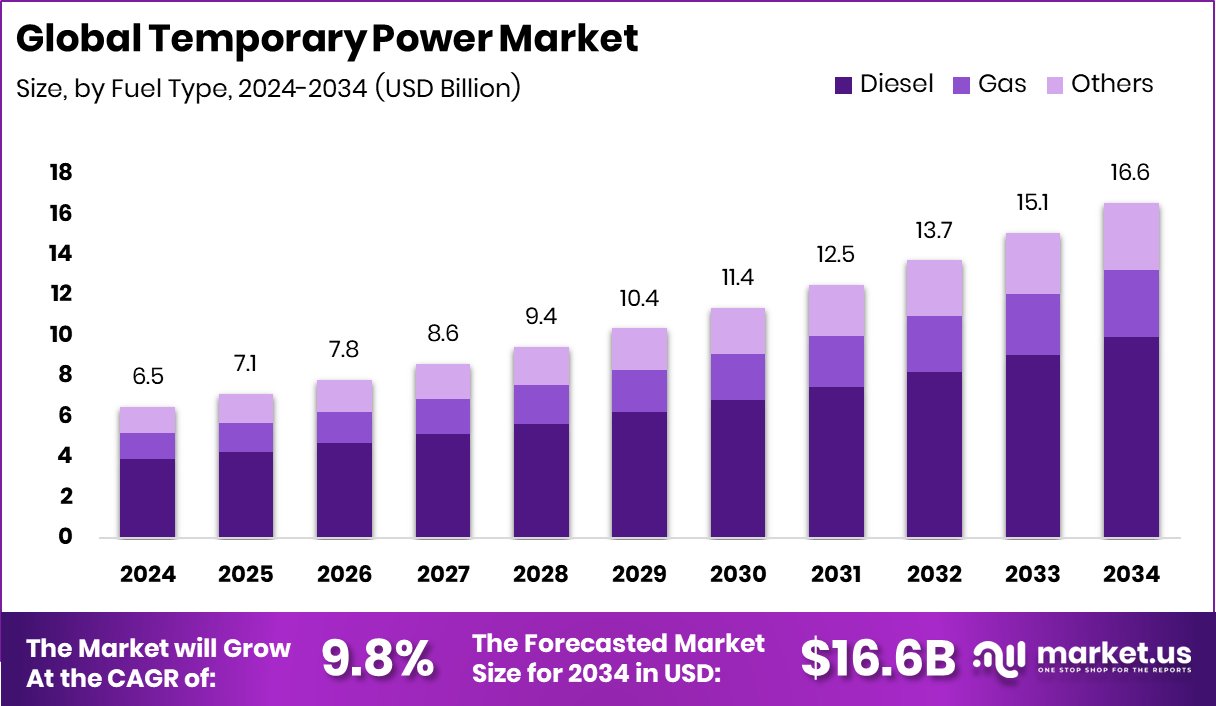
The Global Temporary Power Market is expected to be worth around USD 16.6 billion by 2034, up from USD 6.5 billion in 2024, and is projected to grow at a CAGR of 9.8% from 2025 to 2034. High power reliability needs and emergency support systems boosted North America’s 43.70% share.
Temporary power refers to short-term electrical power systems set up to supply electricity during periods when the permanent power supply is unavailable or insufficient. This can happen in events, construction sites, emergency relief operations, or during grid outages. These systems typically use portable generators, mobile substations, or modular power units to fulfill demand for hours, days or weeks. Because they must be deployed quickly, they emphasize flexibility, reliability, and ease of setup.
The temporary power market encompasses the ecosystem of providers, equipment manufacturers, rental firms, and service operators who supply these short-duration power solutions. It covers everything from generator sets, power distribution gear, cabling, and control systems to maintenance and logistics. Clients often include event organizers, construction contractors, disaster response agencies, film sets, or backup needs for industries. The market grows as demand for flexible, on-demand power rises.
One key growth factor is the boom in large-scale events and outdoor activities needing power infrastructure—festivals, sports meets, concerts all require reliable temporary power. Another driver is the expansion of infrastructure and construction in emerging markets, which often lack grid access at early stages and hence rely on temporary power. Also, increased frequency of natural disasters and grid instability propels demand for emergency temporary power. On the technology side, lighter, higher-efficiency generator sets and modular containerized power units improve deployability and economics, making adoption easier.
Demand is rising because even businesses that take grid power for granted now value redundancy and resilience: hospitals, data centers, telecom towers, and critical infrastructure may require backup power capacity. There is also growing demand in remote or rural areas where extending a permanent grid is expensive or delayed, so temporary power bridges the gap. An opportunity lies in coupling temporary power with clean energy: hybrid systems combining diesel, batteries, solar, or fuel cells that reduce emissions and operating costs. Another opportunity is in service models such as doorstep delivery of fuel or remote monitoring of generators.
Recent funding trends support both expansion and cleaner operations: for example, a doorstep diesel delivery startup, The Fuel Delivery, raised $2 million to scale its IoT-enabled platform. Also, DNR announced $385,000 to fund projects reducing diesel engine emissions. On a larger scale, the EPA has awarded $3.2 million to boost air quality in Southwest Detroit by incentivizing cleaner or retired diesel engines. These funding flows both stimulate new business models (e.g., fuel delivery, emission control) and push the market toward greener temporary power solutions.
Key Takeaways
- The Global Temporary Power Market is expected to be worth around USD 16.6 billion by 2034, up from USD 6.5 billion in 2024, and is projected to grow at a CAGR of 9.8% from 2025 to 2034.
- In 2024, diesel held a dominant 68.2% share in the Temporary Power Market.
- The 81 KW–280 KW segment captured 39.4% share of the Temporary Power Market in 2024.
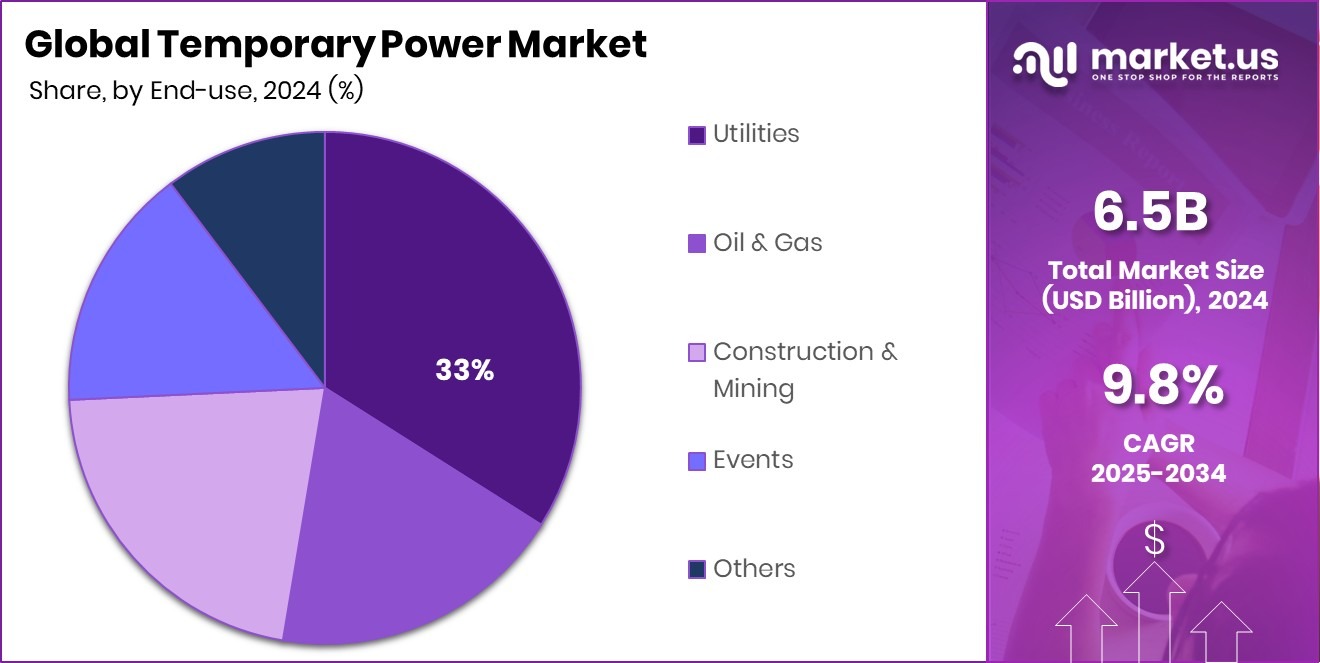
- Utilities accounted for 33.8% of the Temporary Power Market share in 2024, dominating end-use demand.
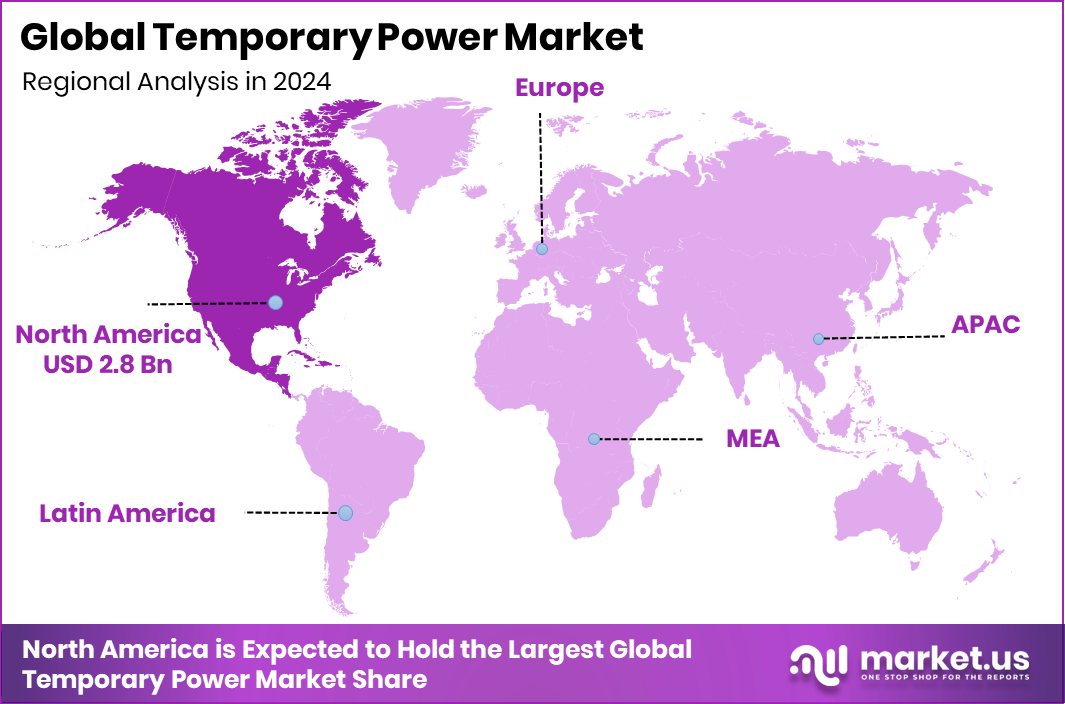
- The North American market value reached approximately USD 2.8 billion, reflecting strong infrastructure demand.
By Fuel Type Analysis
In 2024, diesel dominated the temporary power market with 68.2%.
In 2024, Diesel held a dominant market position in the By Fuel Type segment of the Temporary Power Market, with a 68.2% share. Diesel-based systems remained the preferred choice due to their high reliability, quick deployment capability, and cost-effectiveness in supplying temporary electricity across construction, industrial, and event applications. Their ability to deliver consistent power output in remote or grid-deficient areas further strengthened their adoption.
Additionally, diesel generators are well-established, easily serviceable, and compatible with varied load requirements, making them ideal for both short- and medium-term usage. Despite the gradual shift toward cleaner alternatives, diesel maintained its leadership owing to widespread availability, proven efficiency, and robust infrastructure support across diverse operational environments.
By Power Rating Analysis
The 81–280 KW segment led the Temporary Power Market with 39.4%.
In 2024, 81 KW–280 KW held a dominant market position in the By Power Rating segment of the Temporary Power Market, with a 39.4% share. This power range was widely adopted for its versatility and balanced performance, serving mid-sized industrial operations, construction projects, and event power setups. Its ability to efficiently handle moderate energy loads while ensuring a stable and continuous power supply made it a preferred choice among end users.
The segment’s dominance was further supported by growing infrastructure development and emergency power requirements, where reliable and easily transportable generator units are crucial. The 81 KW–280 KW systems also offer optimal fuel efficiency and operational flexibility, aligning well with the rising demand for dependable, quick-deployment temporary power solutions.
By End-use Analysis
Utilities accounted for a 33.8% share in the temporary power market.
In 2024, Utilities held a dominant market position in the by-end-use segment of the Temporary Power Market, with a 33.8% share. The segment’s dominance was driven by the rising need for uninterrupted electricity supply during grid failures, maintenance activities, and peak demand periods. Utilities relied on temporary power systems to ensure consistent service delivery and prevent power disruptions affecting residential and industrial consumers.
These systems played a vital role in supporting network stability during outages, equipment upgrades, or emergency response operations. The growing investments in grid modernization and maintenance projects further boosted demand, as utility providers increasingly adopted temporary power solutions to enhance operational reliability and ensure seamless power availability during planned or unexpected interruptions.
Key Market Segments
By Fuel Type
- Diesel
- Gas
- Others
By Power Rating
- Less Than 80 KW
- 81 KW-280 KW
- 281 KW-600 KW
- Above 600 KW
By End-use
- Utilities
- Oil and Gas
- Construction and Mining
- Events
- Others
Driving Factors
Rising Dependence on Reliable Diesel Power Solutions
One of the major driving factors for the Temporary Power Market is the increasing dependence on reliable diesel-based power systems to ensure uninterrupted electricity supply during outages, construction projects, and emergencies. Diesel generators remain the most trusted solution for their quick start-up, consistent performance, and easy availability of fuel. Many industries and utility providers prefer diesel units due to their proven durability and capacity to handle variable loads effectively.
Supporting this trend, a major car brand recently axed £222 million in electric vehicle funding in favour of a £659 million petrol and diesel boost, reflecting the continued market confidence in diesel technology. This reinforces the importance of diesel-powered systems in sustaining the temporary power market’s strong growth.
Restraining Factors
Rising Environmental Concerns Over Diesel Emissions
A key restraining factor for the Temporary Power Market is the growing environmental concern over diesel generator emissions. Diesel-powered systems, though reliable and widely used, produce significant amounts of greenhouse gases and particulate matter, contributing to air pollution and climate change. Governments and environmental agencies are enforcing stricter emission regulations, which are increasing the operational and compliance costs for users of temporary power solutions.
Moreover, the global shift toward renewable energy and cleaner technologies is putting pressure on industries to reduce dependency on diesel-based systems. These environmental and regulatory challenges are prompting end users to explore alternative power sources, potentially limiting the growth of diesel-dominated temporary power systems in the coming years.
Growth Opportunity
Emerging Opportunities in Cleaner Hybrid Power Systems
A major growth opportunity for the Temporary Power Market lies in the adoption of cleaner hybrid power systems that combine diesel generators with renewable energy sources such as solar or battery storage. These hybrid setups can lower fuel consumption, reduce emissions, and provide stable, efficient electricity in both remote and urban settings. The transition toward sustainable temporary power aligns with global efforts to balance energy reliability and environmental responsibility.
Supporting this shift, the U.S. Department of Energy (DOE) announced $625 million for “beautiful, clean coal” and gas projects, aiming to enhance cleaner fuel technologies. Such funding encourages innovation and supports the integration of efficient, low-emission power solutions within the temporary power industry’s future growth landscape.
Latest Trends
Growing Use of Smart Remote Monitoring Systems
One of the latest trends in the Temporary Power Market is the growing use of smart remote monitoring systems to manage and optimize power equipment. These digital technologies allow real-time tracking of generator performance, fuel levels, and maintenance needs through connected sensors and software platforms. By using data analytics, operators can predict potential faults, schedule timely maintenance, and reduce downtime. This not only improves efficiency but also extends equipment life and lowers operational costs.
Remote monitoring also helps in managing multiple power units across different locations, offering better control and faster response during emergencies. As industries prioritize reliability and cost-efficiency, the adoption of smart, connected monitoring systems is rapidly shaping the temporary power landscape.
Regional Analysis
In 2024, North America dominated the Temporary Power Market with a 43.70% share.
In 2024, North America held a dominant position in the global Temporary Power Market, accounting for 43.70% share, valued at approximately USD 2.8 billion. The region’s leadership was supported by the high demand for reliable backup power across industries, frequent weather-related outages, and strong adoption of advanced generator technologies. The United States and Canada continue to drive regional growth with expanding construction activities and emergency preparedness programs.
Europe followed closely, supported by growing investments in infrastructure modernization and renewable integration projects that require short-term power support during grid transitions. In the Asia Pacific, rapid urbanization and industrial expansion in countries such as India and China have significantly increased the need for temporary power in construction and manufacturing sectors.
Meanwhile, the Middle East & Africa region is witnessing growing utilization of temporary power systems to support oil, gas, and mining operations in remote areas. Latin America continues to expand its temporary power deployment for events, construction projects, and power grid stabilization initiatives. Overall, North America’s strong infrastructure base, technological adoption, and emphasis on power reliability firmly position it as the global leader in the Temporary Power Market in 2024.
Key Regions and Countries
- North America
- US
- Canada
- Europe
- Germany
- France
- The UK
- Spain
- Italy
- Rest of Europe
- Asia Pacific
- China
- Japan
- South Korea
- India
- Australia
- Rest of APAC
- Latin America
- Brazil
- Mexico
- Rest of Latin America
- Middle East & Africa
- GCC
- South Africa
- Rest of MEA
Key Players Analysis
Aggreko continues to anchor itself as a global front-runner in the temporary power sector by leveraging its strong global presence and modular power solutions. It offers mobile, modular, and turnkey systems across diesel, hybrid, and temperature-control lines, allowing deployment in urban, remote, or harsh environments. Its portfolio of scalable generator solutions, along with power distribution and support infrastructure, gives it flexibility in meeting a variety of use cases. The firm’s capacity to respond quickly to outages or project demands reinforces its reliability reputation. Additionally, Aggreko’s deployment in high-visibility projects (such as major sporting events) helps maintain brand prestige and validates its operational capabilities to clients requiring robust, mission-critical temporary power support.
APR Energy operates in niche “bridge to permanent power” and crisis response segments, positioning itself where an immediate, high-intensity power supply is needed before full-scale infrastructure is built or repaired. The company’s strength lies in the rapid mobilization of large generator fleets and project engineering to support clients in remote or distressed grid environments. Its focus on quick turnaround projects allows APR to operate where traditional power sources falter. Because of this specialization, APR can capture contracts with higher margins, albeit in more volatile or risky environments.
Ashted (Ashtead’s energy or temporary power arm) benefits from being part of a broader rental and equipment services group, which gives it operational leverage and cross-industry network advantages. It can integrate temporary power offerings into its existing rental and service infrastructure, enabling clients to bundle services or access support across geographies. Its strength lies in its flexibility and scale, allowing it to cater to mid-size power demands and support growth in construction, industrial, or event sectors. Because of its parent group’s backing,
Top Key Players in the Market
- Aggreko
- APR Energy PLC
- Ashted Group PLC
- Atlas Copco CB
- Caterpillar, Inc.
- Cummins, Inc.
- Kohler Co., Inc.
- Rental Solutions & Services LLC
- United Rentals, Inc.
Recent Developments
- In January 2025, Fortress Investment Group acquired APR Energy’s assets, including 30 mobile gas-powered turbines and related infrastructure, amounting to 850 MW in generation capacity, making those turbines immediately available for deployment.
- In June 2024, Aggreko announced that it would increase its global investment in mobile battery energy storage systems (BESS) to around USD 200 million, as part of its push to blend temporary power with cleaner energy solutions.









