


Report Overview
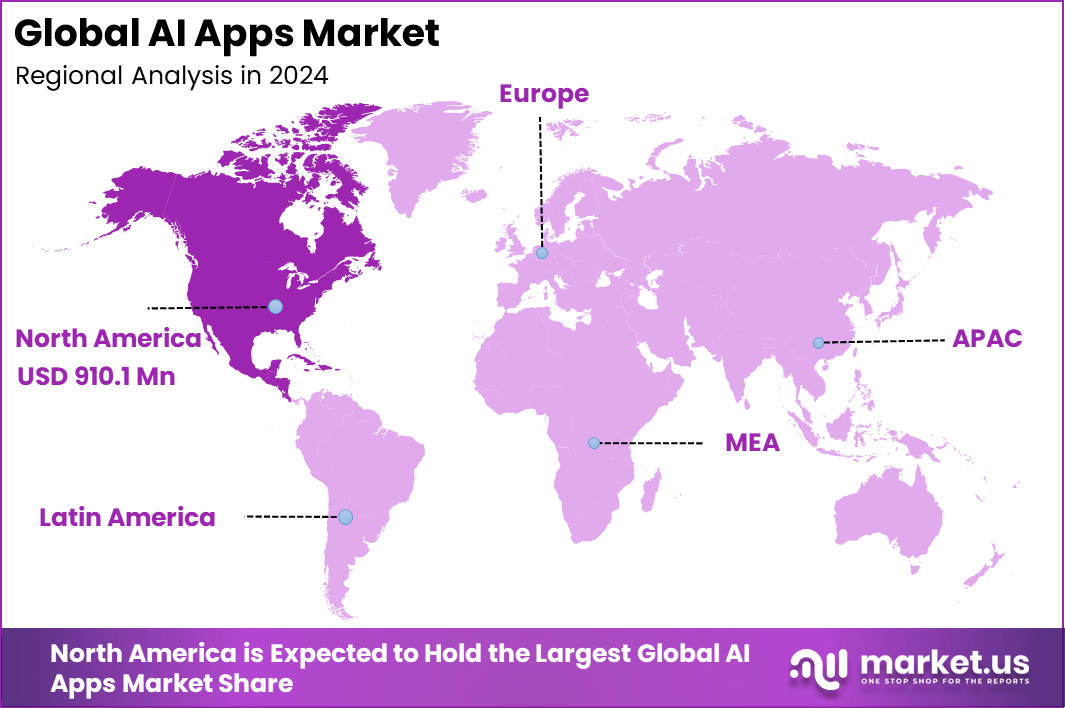
The Global AI Apps Market generated USD 2,955.1 Million in 2024 and is predicted to register growth from USD 4,107.6 billion in 2025 to about USD 7,9564.7 Million by 2034, recording a CAGR of 5.94% throughout the forecast span. In 2024, North America held a dominan market position, capturing more than a 39% share, holding USD 910.1 Million revenue.
The AI apps market is growing quickly as more industries use intelligent applications. AI apps enhance user experience, automate tasks, and optimize business operations, making them essential across healthcare, finance, retail, and manufacturing. This growth is supported by the rising use of generative AI, machine learning, and AI automation tools. Additionally, increased availability of high-quality data and a growing talent pool contribute to the expansion of AI apps worldwide.
Top driving factors include smartphone and connected device growth, which expands access to AI apps for billions of users globally. This access allows app developers to add features like real-time language translation and personalized recommendations, which appeal strongly to users. Venture capital investments and funding in AI startups are accelerating innovation, helping grow AI capabilities and applications continuously.
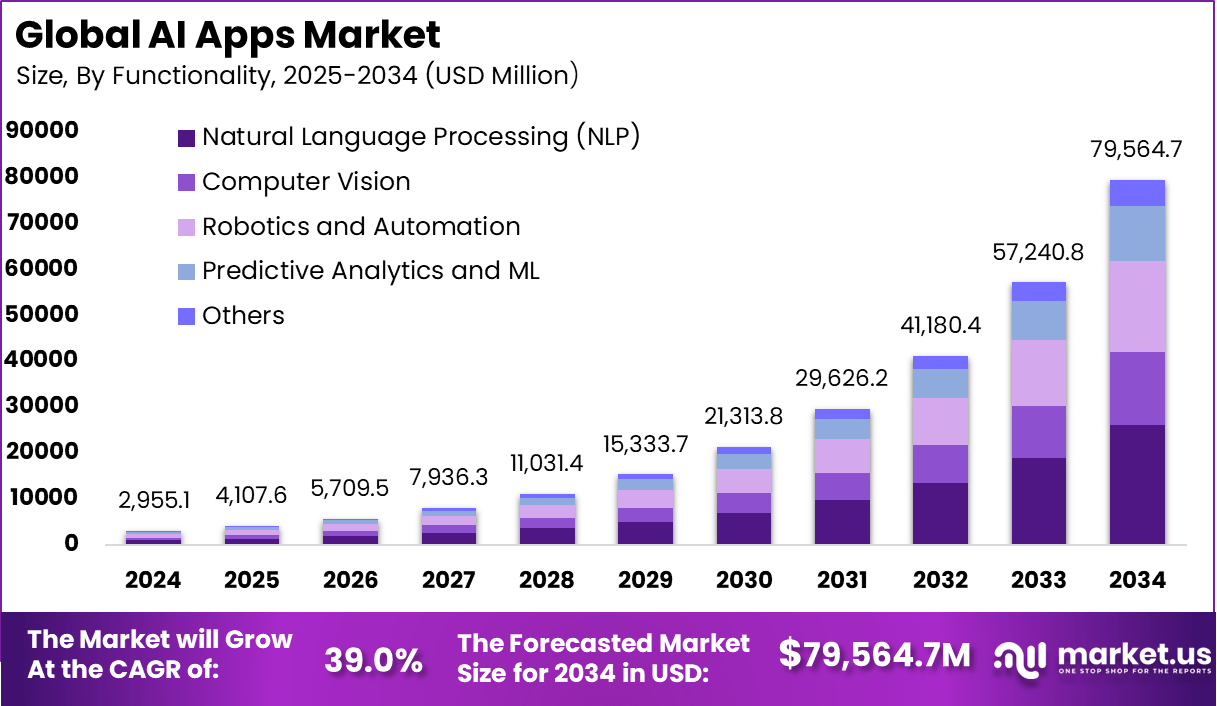
Investment opportunities in AI apps are strong from venture capital, private equity, and public markets. Startups developing novel AI solutions attract significant funding, and mature firms with proven technology draw private equity interest. Public investment options include AI-focused funds and tech stocks specializing in AI. The growing AI-as-a-Service market offers chances to invest in scalable cloud-based AI platforms that businesses adopt widely without heavy infrastructure costs.
Quick Market Facts
- The Natural Language Processing (NLP) segment led functionality adoption with 32.9%, driven by strong demand for conversational interfaces, virtual assistants, and automated text processing.
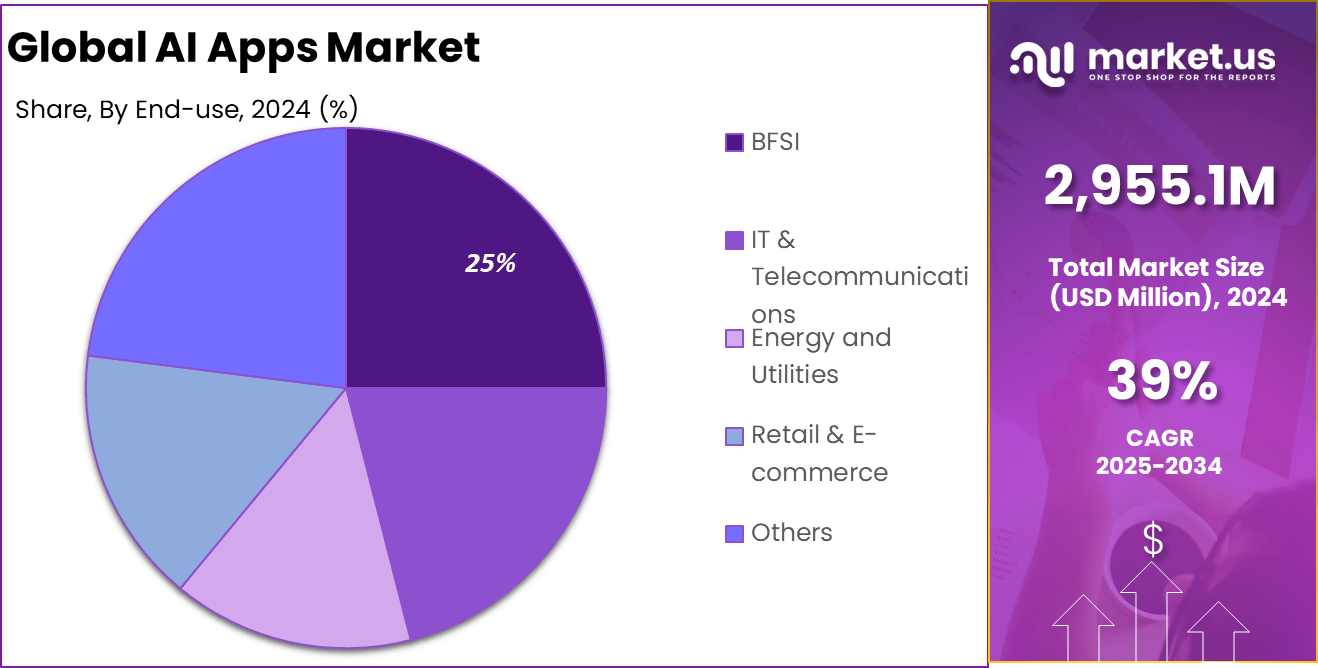
- The BFSI sector accounted for 25%, reflecting widespread use of AI apps for fraud detection, customer service automation, risk assessment, and personalized financial insights.
- North America captured 30.8% of the global market, supported by advanced digital infrastructure, high enterprise AI spending, and rapid integration of AI features in consumer and enterprise applications.
AI Apps Statistics
- As of mid-2025, over 800 million weekly users engage with AI tools like ChatGPT, representing nearly half the global internet population.
- 35.5% of people report using AI tools daily, with 84.6% increasing their usage over the past year.
- ChatGPT’s mobile app recorded over 546 million monthly active users and 52 million downloads by early 2025.
- AI-powered apps have grown consumer spending massively, with gross monthly revenue increasing 37 times in just two years.
- Around 78% of companies now use AI in some capacity to improve business functions.
Business AI Adoption and Usage
- Organizational adoption: The share of organizations using AI in at least one business function increased to 88% in 2025, rising from 78% in 2024, indicating rapid mainstream adoption.
- Generative AI in business: Adoption of generative AI more than doubled within one year, growing from 33% in 2023 to 71% in 2024. More than 70% of companies now use GenAI across multiple business functions.
- Top industries: Leading industries include aerospace at 85%, IT and telecom at 83%, and agriculture at 80%, reflecting broad cross-sector reliance on AI tools.
- Most common business functions: Customer service remains the top use case at 56%, followed by cybersecurity and fraud management at 51%, underscoring AI’s expanding operational role.
- Workforce impact: About 74% of AI users globally rely on these tools in their daily work. In contrast, only 14% of employees report daily use of generative AI as of late 2025, showing significant potential for deeper adoption.
Top 9 AI Apps
| AI App / Model | Description |
|---|---|
| ChatGPT | OpenAI’s chatbot recognized as the most widely used AI app globally, with over 300 million active users. |
| Google Gemini | Google’s flagship chatbot and rival to ChatGPT, powered by the company’s leading search engine infrastructure. |
| Microsoft Copilot | Microsoft’s assistant that uses OpenAI’s GPT technology combined with Bing search integration. |
| DeepSeek | A major chatbot emerging from China, known for dramatically lowering AI development costs. |
| Perplexity | A chatbot-search hybrid known for providing conversational answers backed by real-time information retrieval. |
| Claude | A leading chatbot developed by Anthropic, viewed as a strong competitor to OpenAI models. |
| Grok | The AI chatbot built into the X platform (formerly Twitter), designed for real-time conversational responses. |
| Character.ai | A platform offering customizable chatbots, including fictional characters and celebrities. |
| Midjourney | A popular AI image generation tool originally launched through Discord, known for high-quality visual outputs. |
By Functionality: NLP
The Natural Language Processing (NLP) segment leads the AI applications market by functionality with a notable 32.9% share. NLP enables machines to understand and interpret human language, which is crucial for applications like chatbots, virtual assistants, sentiment analysis, and speech recognition. This technology is widely adopted across various industries to enhance customer interactions, automate communication processes, and deliver personalized experiences effectively.
Growing use cases in healthcare, finance, and e-commerce along with advances in AI models continue to drive NLP’s prominence. Businesses increasingly rely on NLP capabilities to manage large volumes of unstructured data, improving decision-making and operational efficiency with human-like communication.
By End-Use: BFSI
The Banking, Financial Services, and Insurance (BFSI) sector dominates the AI apps market by end-use, holding a 25% share. The BFSI industry uses AI extensively to enhance risk management, fraud detection, customer support, and regulatory compliance. AI technologies streamline complex financial operations and help institutions stay competitive by delivering faster, more accurate insights.
As digital transformation reshapes the BFSI landscape, AI adoption grows rapidly to meet evolving customer expectations and regulatory mandates. BFSI’s heavy reliance on data-driven technologies sustains its leadership position in AI application across industries.
By Geography: North America
North America controls a significant 30.8% share of the global AI apps market. The region’s leadership stems from a strong technology ecosystem, advanced digital infrastructure, and high investment levels in AI innovation. The presence of major AI vendors and research centers supports the widespread adoption of AI applications across healthcare, finance, retail, and other industries.
The United States, in particular, drives AI growth through enterprise deployments and government initiatives promoting AI research and ethical frameworks. North America’s focus on AI integration for improved business outcomes and customer experiences keeps it at the forefront of the global AI apps market.
Emerging Trends in AI Apps
One of the key trends in AI apps is the rise of AI-powered personalized experiences. Apps are increasingly using real-time data to tailor content, interfaces, and services to individual users’ habits and preferences. Voice interfaces are becoming more natural, enabling easier accessibility and hands-free control. Additionally, AI assistants are evolving to handle multi-step tasks with greater autonomy, making app interaction smoother and more intuitive.
Another emerging trend is the integration of multimodal AI, which combines speech, vision, and sensor data to create richer experiences. This allows apps to understand context, emotions, and user intent better, providing highly interactive and intelligent responses. Multilingual natural language processing is expanding the reach of AI apps, making them accessible worldwide. Continuous learning ensures that these AI systems improve and adapt to user needs over time.
Growth Factors in AI Apps
The growth of AI apps is driven by the rapid adoption of smartphones equipped with advanced processors capable of handling complex AI tasks locally. This shift toward on-device AI improves responsiveness and privacy, encouraging wider user acceptance. Another factor is the increasing demand for AI automation in industries like healthcare, finance, and retail, where efficiency and accuracy are critical.
Supportive government policies and investment in AI research also accelerate growth by fostering innovation and expanding the talent pool. Furthermore, the widespread availability of diverse, high-quality data enables better AI model training, making apps more effective. Active developer communities and open-source AI projects also contribute by lowering the barrier to developm
Key Market Segments
By Functionality
- Natural Language Processing (NLP)
- Computer Vision
- Robotics and Automation
- Predictive Analytics and Machine Learning
- Others
By End-use
- BFSI
- IT & Telecommunications
- Energy and Utilities
- Retail & E-commerce
- Entertainment
- Automotive
- Manufacturing
- Finance
- Others
Regional Analysis and Coverage
- North America
- US
- Canada
- Europe
- Germany
- France
- The UK
- Spain
- Italy
- Russia
- Netherlands
- Rest of Europe
- Asia Pacific
- China
- Japan
- South Korea
- India
- Australia
- Singapore
- Thailand
- Vietnam
- Rest of Latin America
- Latin America
- Brazil
- Mexico
- Rest of Latin America
- Middle East & Africa
- South Africa
- Saudi Arabia
- UAE
- Rest of MEA
Driver
Rising Demand for Personalized User Experiences
One major driver of AI apps is the growing demand for personalized user experiences. AI apps can analyze individual user data and deliver customized content, recommendations, and features tailored to specific preferences and behaviors. This level of personalization increases user engagement and satisfaction, helping businesses to improve customer retention and loyalty.
Personalization in AI apps is powered by technologies like machine learning that continuously learn from user interactions. This capability allows apps to adapt in real-time, making experiences more relevant and enjoyable. The widespread use of smartphones and digital devices fuels this demand, as users expect apps to anticipate their needs and offer seamless interactions across platforms.
Restraint
Data Privacy and Security Concerns
A significant restraint in the AI app market is heightened concern over data privacy and security. AI apps often require access to large amounts of personal and sensitive data to function effectively. This raises worries about data breaches, unauthorized access, and misuse of information, especially as regulatory frameworks tighten.
Complying with laws such as GDPR and other privacy regulations forces developers to implement robust encryption, transparent data handling protocols, and user control mechanisms. These measures can increase development complexity and costs, potentially slowing down adoption and market growth. User trust hinges on how well AI apps protect their data.
Opportunity
Expansion Through Automation and Increased Productivity
Automation powered by AI offers a significant market opportunity. Businesses see AI apps as tools to enhance workforce productivity by automating repetitive tasks and processes. This helps companies save time and reduce operational costs, allowing employees to focus on higher-value activities.
The rising adoption of AI-powered automation in sectors such as healthcare, finance, retail, and manufacturing creates demand for specialized applications. Additionally, advances in AI models and broader developer support make it easier to build and deploy automation-focused apps that cater to diverse business needs.
Challenge
High Development Costs and Technical Complexity
Developing AI apps that perform well in real-world scenarios presents technical and financial challenges. Creating accurate AI models requires substantial investment in skilled talent like data scientists and machine learning engineers, who are in short supply and command high salaries.
Moreover, the process involves acquiring, cleaning, and labeling large volumes of data to train models effectively, which adds to costs and delays. Scaling apps to work reliably across varying environments while maintaining performance and user experience is another complexity that slows down market progress.
Competitive Analysis
FaceApp, Google, IBM, Microsoft, OpenAI, and Amazon shape the AI apps market through strong capabilities in computer vision, natural language processing, and cloud-based intelligence. Their platforms support large-scale model training, real-time inference, and advanced personalization features. These companies drive adoption by integrating AI into consumer services, productivity tools, and enterprise workflows.
AssemblyAI, C3.ai, DataRobot, and ELSA contribute to market expansion with specialized AI applications designed for speech intelligence, enterprise automation, predictive analytics, and language learning. Their solutions address focused use cases where targeted models generate measurable value. Strong demand for domain-specific AI supports their growth. These companies help organizations deploy reliable AI workflows without extensive infrastructure investment.
A wider set of emerging participants and other providers add diversity by building niche AI apps that support creativity, productivity, and personalized user experiences. These players leverage pretrained models, APIs, and lightweight architectures to scale quickly. Their offerings focus on easy onboarding, low complexity, and rapid output generation. Rising interest in AI-assisted daily tasks strengthens their relevance.
Top Key Players in the Market
- FaceApp
- Google LLC
- IBM Corporation
- Microsoft Corporation
- OpenAI
- Amazon
- AssemblyAI, Inc.
- C3.ai
- DataRobot, Inc
- ELSA
- Others
Key Commercial Applications Across Various Industries
| Company Name | Use Case | Benefits |
|---|---|---|
| FaceApp | Photo transformation with age, style, and gender filters. | Fast edits, unique content, instant visual change, more user engagement, saves time. |
| Google LLC | Workspace AI tools for documents/emails, cloud analytics, prediction. | Quick automation, translation, better collaboration, business insights. |
| IBM Corporation | Virtual assistants, analytics, supply chain optimization, generative AI. | Lower cost, more accuracy, better accessibility, faster service. |
| Microsoft Corporation | Office 365 Copilot, workflow and security automation on Azure AI. | Automated docs/emails, data security, productivity gain, intelligent support. |
| OpenAI | Generative models for chatbots, coding, content, research automation. | Fast prototyping, better interaction, coding efficiency, research boosts. |
| Amazon | Alexa, AWS AI for retail/logistics, predictive analytics. | Voice convenience, smarter logistics, targeted recommendations. |
| AssemblyAI, Inc. | Speech-to-text APIs for media and transcription automation. | Quick transcription, reliable extraction, easier repurposing. |
| C3.ai | Industry AI for predictive maintenance, workflow analytics. | Less downtime, better asset health, fast risk review, data insights. |
| DataRobot, Inc. | Auto machine learning for forecasting and business analytics. | Time savings, better accuracy, easier analytics. |
Recent Developments
- In March 2025, DataRobot strengthened its position in AI through targeted expansion. The acquisition of Agnostiq supported the development of Agentic AI applications, while a survey showed that over 50% of AI leaders plan to increase investments in hyperscaler AI, indicating demand for flexible AI platforms. Key product advances include an Enterprise AI Suite for generative AI applications and AI observability features with real time intervention.
- In March 2025, OpenAI introduced new developer tools and models that focus on complex reasoning and practical deployment. The latest OpenAI o1 model supports structured outputs, vision, and function calling. An updated Realtime API with WebRTC integration enables low latency multimodal experiences, alongside a 60% price reduction for audio services. Developers can also use preference fine tuning and early Go and Java SDKs to adapt OpenAI models more closely to their specific use cases.









