


Report Overview
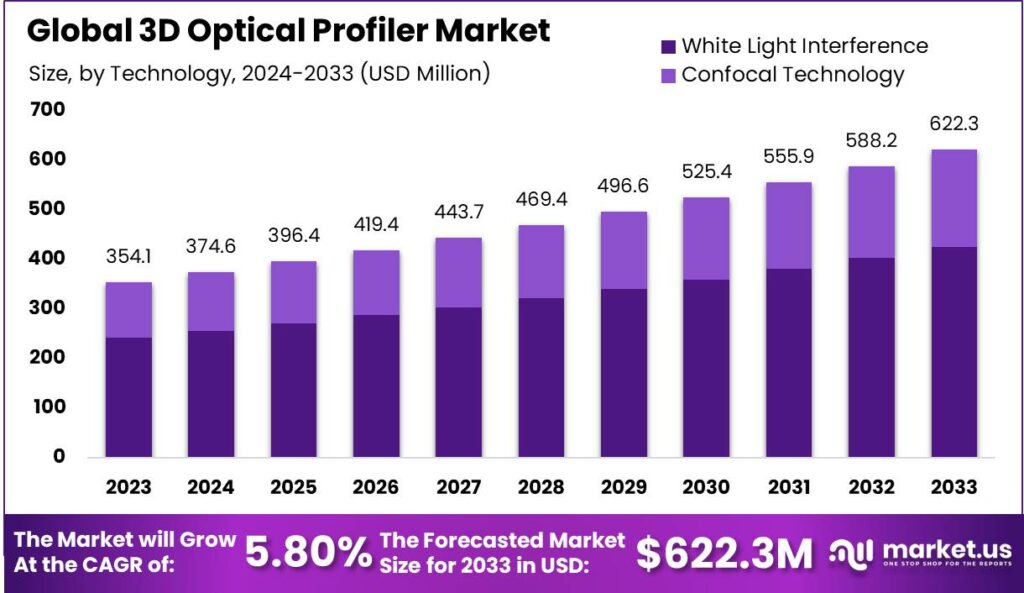
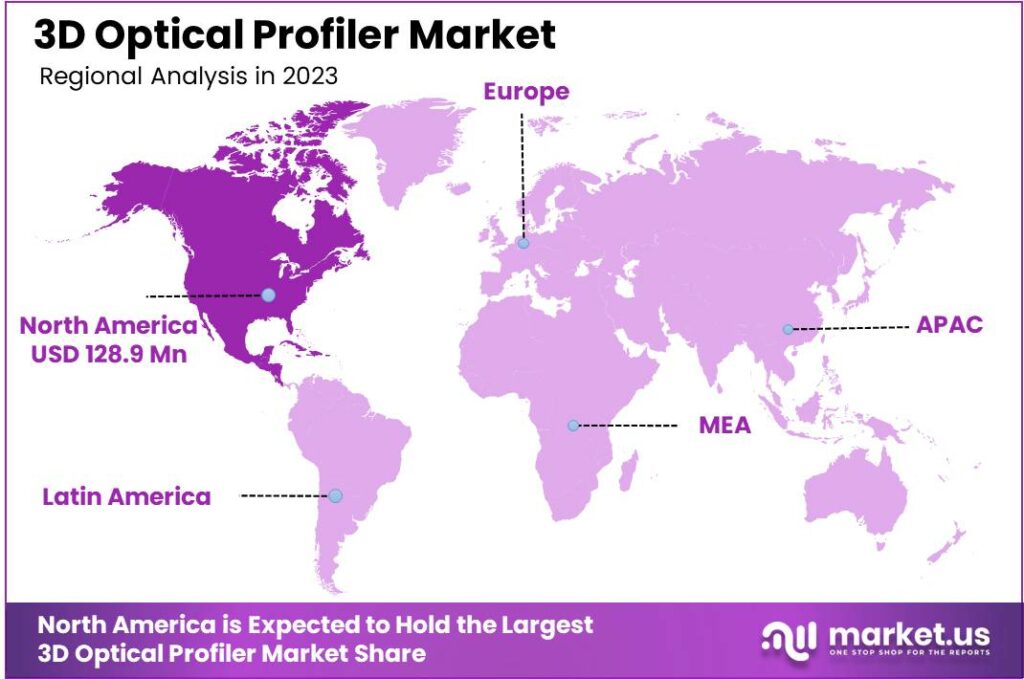
The Global 3D Optical Profiler Market size is expected to be worth around USD 622.3 Million By 2033, from USD 374.6 Million in 2024, growing at a CAGR of 5.80% during the forecast period from 2024 to 2033. In 2023, North America captured over 36.4% of the 3D Optical Profiler market, with revenues totaling USD 128.9 Million, securing a dominant market position.
A 3D optical profiler is an advanced measurement instrument used to capture the topography of surfaces at micro and nano scales. This device employs non-contact optical technology to measure surface roughness, texture, and other detailed features with high precision. It works by using light to scan surfaces and then analyzes the interaction between the light and the surface to create a detailed three-dimensional map.
The 3D Optical Profiler market encompasses the sales and development of these devices, servicing sectors such as semiconductor manufacturing, precision engineering, automotive, and aerospace. The adoption of these profilers is growing, fueled by the increasing demand for high-quality and precision in product manufacturing.
The growth of the 3D Optical Profiler market can be attributed to several key factors. Advancements in manufacturing technologies require more precise inspection systems to ensure product quality, driving demand for 3D optical profilers. Additionally, the expanding semiconductor industry, which requires highly accurate surface measurement for wafers and other components, significantly contributes to market growth.
The increasing adoption of microelectronics and miniaturization of devices also propels the need for precise metrology tools. Furthermore, government regulations and quality standards across various industries enforce stringent quality checks, thereby boosting the adoption of these profilers. Ongoing technological innovations in optics and metrology, coupled with improvements in software that enhance measurement capabilities and user experience, are poised to further propel the market forward.
The popularity of 3D optical profilers is growing not only due to their essential role in quality assurance but also because of their advancing technology. Improvements in resolution, speed, and user-friendliness, coupled with decreasing costs, are making these instruments more accessible and appealing across a broader range of industries. This popularity is also supported by the expansion of digital manufacturing practices, where precise measurements are indispensable.
Significant opportunities within the 3D optical profiler market lie in the expansion of their application areas. Beyond traditional sectors, there is increasing potential in fields such as biotechnology, renewable energy, and electronics, where innovation often hinges on the ability to develop and maintain highly precise components and materials. Furthermore, the integration of artificial intelligence and machine learning for data analysis in optical profiling opens new avenues for enhanced efficiency and new product features.
The market expansion for 3D optical profilers is set to continue as global industries push for more advanced and reliable manufacturing processes. Emerging markets, particularly in Asia-Pacific, are poised to contribute substantially to this growth due to rapid industrialization and investments in technology infrastructure.
Key Takeaways
- The Global 3D Optical Profiler Market is projected to reach USD 622.3 Million by 2033, up from USD 374.6 Million in 2024, growing at a CAGR of 5.80% during the forecast period from 2024 to 2033.
- In 2023, the White Light Interference segment dominated the market, holding over 68.5% of the market share.
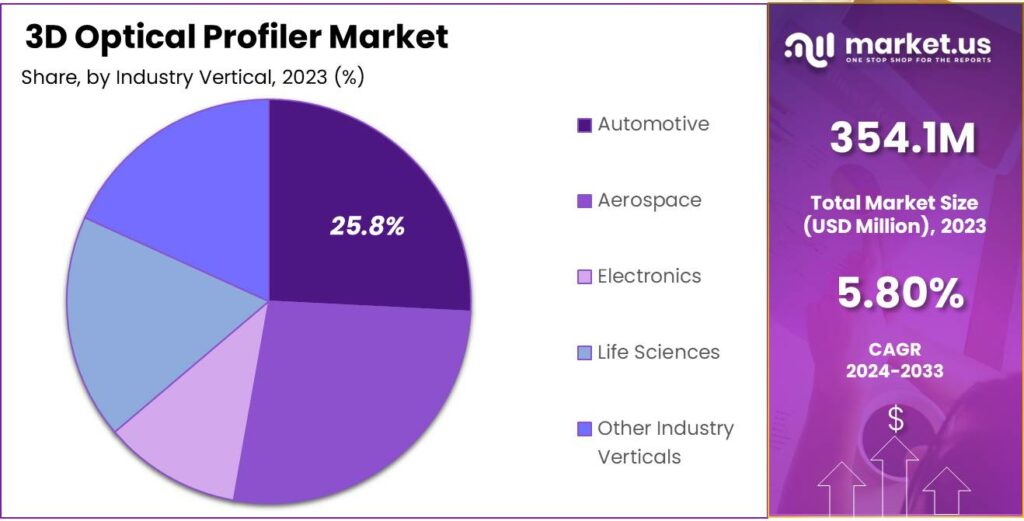
- The automotive segment led the 3D optical profiler market in 2023, capturing more than 25.8% of the market share, driven by the industry’s rigorous quality control standards and the increasing demand for complex, precision-engineered components.
- North America held the largest market share in 2023, accounting for over 36.4%, with revenues reaching USD 128.9 Million.
Technology Analysis
In 2023, the White Light Interference segment held a dominant market position in the 3D Optical Profiler market, capturing more than a 68.5% share. This technology is favored for its versatility and ability to provide high-resolution, accurate measurements across a wide range of surface types.
The prominence of the White Light Interference technology in the market can also be attributed to its robust performance in complex measurement scenarios. It is highly efficient in dealing with surface discontinuities and provides reliable data critical for quality control in manufacturing environments.
Moreover, advancements in White Light Interference technology have kept it at the forefront of the 3D optical profiling industry. Continuous improvements in sensor technology, software algorithms and system design enhance its capability to deliver precise measurements.
The broader acceptance of White Light Interference is also bolstered by its integration into automated production lines, where rapid and accurate surface measurement is crucial. As industries increasingly adopt automation to enhance productivity and reduce errors, the demand for reliable and efficient profiling technologies like White Light Interference is expected to remain strong, reinforcing its leading position in the market.
Industry Vertical Analysis
In 2023, the automotive segment held a dominant position in the 3D optical profiler market, capturing more than a 25.8% share. This leadership stems primarily from the automotive industry’s stringent quality control requirements and the shift towards more complex, precision-engineered components.
As vehicles increasingly incorporate advanced materials and electronics, the need for meticulous surface inspection to ensure durability and performance has become critical. Automotive manufacturers rely on 3D optical profilers to maintain high production standards and innovate in product design, driving substantial demand within this segment.
The automotive industry’s focus on innovation and safety significantly contributes to its leading role in the market for 3D optical profilers. These devices are crucial for the precise measurement and inspection of automotive components like engine parts, brake systems, and electronic connectors.
Moreover, the regulatory environment surrounding the automotive industry further bolsters the demand for 3D optical profilers. Regulations concerning vehicle safety and emissions necessitate high precision in manufacturing processes, where even minor defects can lead to significant repercussions. Thus, the ability of 3D optical profilers to provide accurate and repeatable measurements makes them invaluable in adhering to these stringent standards.
Key Market Segments
By Technology
- White Light Interference
- Confocal Technology
By Industry Vertical
- Automotive
- Aerospace
- Electronics
- Life Sciences
- Other Industry Verticals
Driver
Growing Demand in Automotive and Aerospace Industries
The automotive and aerospace sectors are increasingly adopting 3D optical profilers to enhance precision in manufacturing and quality control. These instruments provide accurate, non-contact surface measurements, essential for inspecting complex mechanical parts and ensuring adherence to stringent industry standards.
In the automotive industry, 3D optical profilers are utilized to assess engine cleanliness, measure surface roughness, and inspect components like fuel injectors and valves. Similarly, in aerospace, they help in evaluating surface textures and detecting defects in critical components, thereby ensuring safety and performance.
The rising complexity of parts and the need for miniaturization in these industries further drive the demand for advanced metrology solutions, positioning 3D optical profilers as indispensable tools in modern manufacturing processes.
Restraint
High Initial Investment Costs
Despite their advantages, the adoption of 3D optical profilers is often hindered by high initial investment costs. These sophisticated instruments require significant capital expenditure, which can be a barrier, especially for small and medium-sized enterprises (SMEs).
Additionally, integrating these systems into existing manufacturing processes may necessitate further investments in infrastructure and software, adding to the financial burden. Consequently, while large corporations may readily absorb these costs, SMEs might find it challenging, potentially slowing the widespread adoption of 3D optical profilers across various industries.
Opportunity
Integration with Industry 4.0 and Smart Manufacturing
The advent of Industry 4.0 and the shift towards smart manufacturing present significant opportunities for the 3D optical profiler market. As industries embrace automation and digitalization, there is a growing need for advanced metrology solutions that can seamlessly integrate into intelligent production systems.
3D optical profilers, with their ability to provide real-time, precise measurements, are well-suited for inline metrology applications, reducing inspection delays and enhancing production efficiency. Furthermore, the integration of artificial intelligence (AI) and machine learning (ML) algorithms into these profilers can enhance data analysis capabilities.
These enables predictive maintenance and quality assurance. This alignment with modern manufacturing paradigms positions 3D optical profilers to capitalize on the increasing demand for smart, connected measurement solutions.
Challenge
Technical Limitations in Measuring Complex Geometries
While 3D optical profilers offer high precision, they face challenges when measuring complex geometries or surfaces with steep angles and deep recesses. The optical nature of these instruments can lead to measurement inaccuracies due to limited depth of field.
Additionally, surfaces with varying reflectivity can pose difficulties, as highly reflective or transparent materials may result in erroneous data. Addressing these technical limitations requires ongoing research and development to enhance the versatility and accuracy of 3D optical profilers, ensuring they can effectively meet the diverse measurement needs across different industries.
Emerging Trends
The field of 3D optical profilers is witnessing significant advancements, driven by the increasing demand for precise, non-contact surface measurements across various industries. One notable trend is the integration of artificial intelligence (AI) and machine learning algorithms, enhancing the capabilities of these instruments to enable automated surface analysis.
Additionally, the adoption of 3D printing technology has underscored the importance of quality assurance, with 3D optical profilers playing a vital role in ensuring the accuracy of printed objects. In the automotive and aerospace sectors, the demand for miniaturized electronic components has increased, boosting the need for high-precision measurement tools.
Furthermore, the integration of 3D optical profilers into automated production lines is becoming more prevalent. This integration facilitates real-time, in-line metrology solutions, reducing inspection delays during manufacturing processes.
Business Benefits
Implementing 3D optical profilers in business operations offers numerous advantages, particularly in enhancing product quality and operational efficiency. These non-contact measurement tools provide precise surface topography data, enabling businesses to maintain stringent quality control standards.
In the manufacturing sector, 3D optical profilers facilitate the detection of surface defects and irregularities, ensuring that products meet exact specifications. This capability is crucial in industries such as automotive and aerospace, where component precision directly impacts safety and performance.
The versatility of 3D optical profilers extends to research and development, where they assist in the rapid prototyping and testing of new products. By providing detailed surface measurements, these instruments enable engineers to refine designs efficiently, accelerating time-to-market for innovative solutions.
Additionally, the non-destructive nature of 3D optical profiling ensures that delicate components remain intact during inspection, preserving their integrity and reducing material waste. This aspect is particularly beneficial in the electronics industry, where components are often sensitive and require careful handling.
Regional Analysis
In 2023, North America held a dominant market position in the 3D Optical Profiler market, capturing more than a 36.4% share with revenues reaching USD 128.9 Million. This region leads due to several pivotal factors.
The strong presence of leading semiconductor companies and advanced manufacturing sectors that extensively use 3D optical profiling technologies to ensure high-quality standards. The concentration of high-tech industries in the United States, along with substantial investments in research and development, has driven the adoption of advanced metrological equipment like 3D optical profilers.
The leadership of North America in this market is also reinforced by robust governmental support for technological advancements and the implementation of stringent quality standards across various industries, including automotive, aerospace, and healthcare. These standards necessitate precise and reliable measurement technologies, thus fostering the growth of the 3D optical profiler market in the region.
Furthermore, North America benefits from a well-established industrial base and a push towards automating manufacturing processes, which integrates 3D optical profiling for quality control and inspection and manufacturers seek to minimize defects and optimize production efficiency. Additionally, the presence of several leading market players in this region, who consistently innovate and improve 3D optical profiler technologies, contributes to the high market share and revenue figures reported.
Key Regions and Countries
- North America
- US
- Canada
- Europe
- Germany
- France
- The UK
- Spain
- Italy
- Rest of Europe
- Asia Pacific
- China
- Japan
- South Korea
- India
- Australia
- Singapore
- Rest of Asia Pacific
- Latin America
- Brazil
- Mexico
- Rest of Latin America
- Middle East & Africa
- South Africa
- Saudi Arabia
- UAE
- Rest of MEA
Key Player Analysis
In the realm of 3D optical profilers, AMETEK, Inc. is a leading provider of precision instruments, known for its innovative solutions that improve productivity and accuracy in industrial measurements. With a strong focus on research and development, the company offers advanced optical profiling systems for industries such as automotive and aerospace.
Bruker Corporation is another prominent name in the 3D optical profiler market, renowned for its high-quality scientific instruments. Bruker’s optical profilers are distinguished by their precision and reliability and the company’s dedication to technological advancement and its strong customer service framework enable it to meet the evolving needs of researchers and manufacturers alike.
KLA Corporation completes the trio of key players with its specialized focus on process control and yield management solutions. KLA’s 3D optical profilers are integral to the semiconductor industry, where they are used to inspect wafers and other components with high precision. The company’s advanced technology supports critical production processes in electronics manufacturing.
Top Key Players in the Market
- AMETEK, Inc.
- Bruker Corporation
- KLA Corporation
- Keyence Corporation
- Sensofar
- NANOVEA Inc.
- 4D Technology Corporation
- Mahr GmbH
- Rtec Instruments
- Other Key Players
Top Opportunities Awaiting for Players
The 3D optical profiler market is poised for significant growth and offers a variety of opportunities for industry players.
- Expansion into Emerging Markets: There’s a burgeoning demand for advanced measurement technologies in rapidly industrializing regions like Asia Pacific, Latin America, and the Middle East & Africa. Companies can capitalize on this by expanding their presence and offering tailored solutions that meet the specific needs of these local industries.
- Integration of AI and Machine Learning: Incorporating advanced technologies such as AI and machine learning can enhance the capabilities of 3D optical profilers, making them more efficient, accurate, and user-friendly. This technological integration not only improves the functionality of the devices but also expands their application scope, attracting new customers and markets.
- Development of Portable and Handheld Devices: The market sees a growing need for portable and handheld 3D optical profilers, particularly for field inspections and on-site quality control. Developing these mobile solutions could open new applications and customer bases, particularly in sectors where traditional, larger systems are impractical.
- Focus on High Accuracy and Non-Contact Profilers: As industries such as semiconductor manufacturing and material science require high precision, there is an increasing demand for non-contact measurement systems. These systems are valued for their ability to deliver fast, accurate, and detailed surface topography without physical contact with the sample, presenting a substantial growth opportunity for companies specializing in non-contact 3D optical profilers.
- Technological Advancements in 3D Profiling: Continuous innovation is crucial in this market. By advancing the technology in 3D optical profilers to increase resolution and measurement capabilities, companies can stay competitive and meet the evolving needs of various industries. The ongoing development of technologies, such as high-resolution cameras and sensors, supports the production of more precise 3D images and thus enhances the market appeal of these instruments.
Recent Developments
- In February 2024, Zygo Corporation, a global leader in precision 3D optical metrology, is expanding its presence in India with a new sales and marketing team. This move reinforces Zygo’s commitment to the fast-growing Indian manufacturing sector, enhancing support for local customers.
- Sensofar introduced two advanced profilometers in 2024, the S neox Grand Format and the S lynx 2, each designed to set new standards in metrology with technologies like Active Illumination Focus Variation, Confocal, and Interferometry. These products were unveiled at the Control 24 event and featured on Sensofar’s website.









