


Report Overview
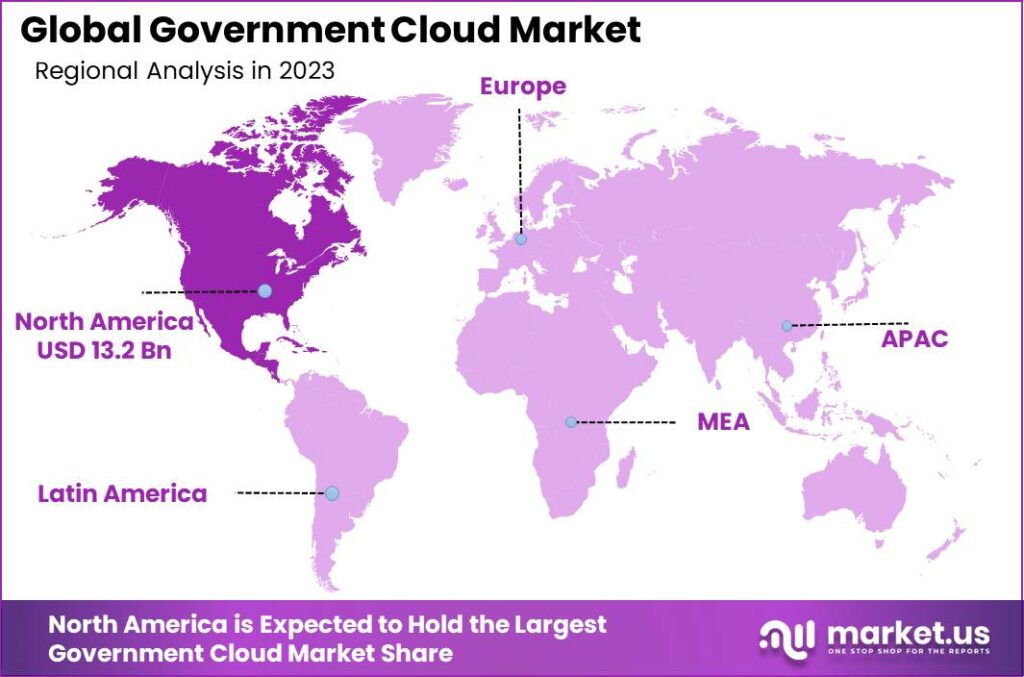
The Global Government Cloud Market size is expected to be worth around USD 140.2 Billion By 2033, from USD 33.21 Billion in 2023, growing at a CAGR of 15.49% during the forecast period from 2024 to 2033. In 2023, North America held a dominant position in the Government Cloud market, capturing over 40% of the market share, with revenues totaling USD 13.2 billion.
Government Cloud refers to specialized cloud computing services designed to meet the specific needs of government agencies. It encompasses various services including Infrastructure as a Service (IaaS), Platform as a Service (PaaS), and Software as a Service (SaaS), all tailored to enhance governmental operations through improved security, compliance, and efficiency.
The main appeal of Government Cloud lies in its ability to facilitate secure, cost-efficient, and scalable data management and processing solutions that are crucial for government operations. The growth of the Government Cloud market is primarily driven by the increasing need for robust data security and the growing requirement for scalable and flexible IT resources that can adapt to dynamic public sector needs.
Governments are adopting cloud technologies to improve efficiency, reduce costs, and offer better services to the public. The integration of technologies such as the Internet of Things (IoT) and artificial intelligence (AI) into these cloud solutions further enhances their capability by enabling advanced data analytics and smarter resource management.

Market demand in the Government Cloud sector is particularly strong for solutions that offer enhanced data security, improved disaster recovery capabilities, and robust compliance management. These solutions are crucial in helping government agencies manage their data securely and in compliance with strict regulations, thereby driving the continuous growth of the market
There is a significant demand in the government sector for cloud solutions that provide high security and compliance with regulatory standards. This demand is driven by the need to handle sensitive data securely and to ensure data integrity and availability across various government departments. The ability to quickly deploy and scale services as needed while maintaining cost efficiency is also a critical factor contributing to the growing demand for Government Cloud services.
A recent survey highlights that companies, on average, allocate 20.4% of their IT budgets to cloud services. The level of cloud adoption varies among government organizations based on their operational scale. Local governments tend to spend 20.6% of their IT budgets on cloud solutions, while national governments allocate a slightly higher percentage, at 22%.
Opportunities in the Government Cloud market are vast, particularly in areas involving digital transformation initiatives and the need to modernize legacy IT infrastructure. The market is expanding into areas that require enhanced disaster recovery capabilities and more sophisticated data analytics tools. Additionally, as governments look to improve citizen engagement and service delivery, there is increasing interest in solutions that can integrate seamlessly with existing technologies and support new digital services.
The Government Cloud market is continually evolving with advancements in cloud computing technologies that offer improved security, better data management, and enhanced operational efficiencies. Innovations in hybrid and multi-cloud environments are particularly promising as they provide the flexibility to manage data and applications across multiple cloud platforms, which is ideal for meeting various governmental security and compliance requirements.
Key Takeaways
- The Global Government Cloud Market size is projected to reach USD 140.2 billion by 2033, up from USD 33.21 billion in 2023, growing at a CAGR of 15.49% from 2024 to 2033.
- In 2023, the Solutions segment dominated the Government Cloud market, accounting for more than 65% of the market share.
- The Public Cloud segment held the largest share of the market in 2023, with over 38% of the total market.
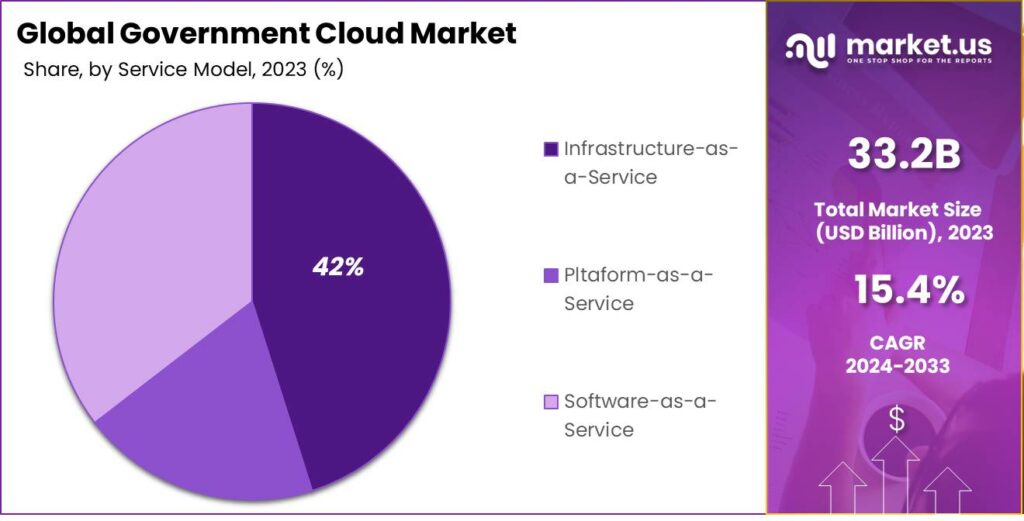
- The Infrastructure-as-a-Service (IaaS) segment led the market in 2023, capturing more than 42% of the share.
- North America held a dominant position in the Government Cloud market in 2023, with over 40% of the market share and revenues totaling USD 13.2 billion.
Component Analysis
In 2023, the Solutions segment held a dominant position in the Government Cloud market, capturing more than a 65% share. This segment comprises various cloud-based software and platforms tailored specifically for government use.
These solutions are tailored to meet public sector needs, offering high security, regulatory compliance, and seamless integration with existing systems. Their growing adoption stems from their ability to provide secure, comprehensive IT infrastructure, reducing the complexity and cost of traditional government systems.
The leadership of the Solutions segment in the Government Cloud market can also be attributed to the growing demand for digital transformation within the public sector. Governments worldwide are increasingly looking to leverage technology to enhance their service delivery and operational efficiencies.
Furthermore, the Solutions segment benefits from the increasing focus on data security and compliance in government operations. Cloud solutions designed for government use are equipped with advanced security protocols to protect sensitive information against cyber threats. These solutions comply with strict data protection laws, which is crucial for government agencies handling confidential data.
Deployment Mode Analysis
In 2023, the Public Cloud segment held a dominant market position in the government cloud market, capturing more than a 38% share. This prominence is largely attributed to its cost-effectiveness and ease of scalability, which are critical factors for government agencies facing budget constraints and variable workloads.
The appeal of the public cloud in the government sector is also enhanced by its extensive network of data centers, which ensures reduced latency and higher performance of cloud services. This is particularly important for government agencies that need to process large volumes of data quickly and reliably.
Another significant factor contributing to the popularity of the public cloud among government entities is its ability to facilitate collaboration. With data and applications readily accessible via the internet, agencies can collaborate more easily without the need for complex infrastructure setups.
However, the leading position of the public cloud does not overshadow the critical need for security and compliance, which are paramount in the government sector. Providers have addressed these concerns by offering tailored solutions that meet strict government standards for security and data protection.
Service Model Analysis
In 2023, the Infrastructure-as-a-Service (IaaS) segment held a dominant market position in the government cloud market, capturing more than a 42% share. This leadership can be attributed to IaaS’s fundamental role in providing basic computing infrastructure—servers, storage, and networking resources—on demand.
The IaaS model offers unparalleled flexibility and scalability which is essential for government operations that experience fluctuating demands. Agencies can quickly scale their infrastructure up or down based on real-time needs without undergoing the lengthy processes of purchasing and installing physical hardware.
Security is a paramount concern for the government sector, and IaaS providers have made significant strides in offering secure cloud environments that comply with stringent government standards. Enhanced security features, including advanced encryption and dedicated firewalls, ensure that sensitive data is protected while being accessible from a centralized platform.
Additionally, the IaaS segment is instrumental in fostering innovation within government operations. By offloading the burden of managing physical infrastructure, agencies can focus more on deploying and improving applications and services for the public.
Key Market Segments
By Component
- Solutions
- Services
By Deployment Mode
- Public Cloud
- Private Cloud
- Hybrid Cloud
By Service Model
- Infrastructure-as-a-Service
- Platform-as-a-Service
- Software-as-a-Service
Driver
Enhanced Operational Efficiency
The adoption of cloud computing in government agencies significantly enhances operational efficiency. By migrating to cloud platforms, agencies can access scalable and flexible computing resources, enabling them to respond swiftly to changing demands without the constraints of traditional IT infrastructure.
This scalability allows for the efficient allocation of resources, reducing both underutilization and overprovisioning. Additionally, cloud services facilitate improved collaboration among departments through centralized data access, leading to more coordinated and effective public service delivery.
Cloud computing reduces the need for physical data centers, cutting costs and letting agencies focus on their missions. Federal agencies plan to spend billions on IT and cybersecurity, including transitioning to secure cloud services.
Restraint
Security and Compliance Concerns
Despite the benefits, security and compliance remain significant concerns hindering the adoption of cloud computing in government sectors. Agencies are responsible for ensuring that sensitive data is protected against unauthorized access and breaches, which can be challenging when relying on third-party cloud service providers.
Compliance with regulations such as the Federal Information Security Management Act (FISMA) and the Health Insurance Portability and Accountability Act (HIPAA) adds complexity to cloud adoption. The U.S. Government Accountability Office highlights that federal agencies face challenges in ensuring cybersecurity when transitioning to cloud services.
Opportunity
Leveraging Advanced Technologies
Cloud computing presents government agencies with the opportunity to leverage advanced technologies such as artificial intelligence (AI), machine learning, and big data analytics. By utilizing cloud platforms, agencies can process and analyze large datasets more efficiently, leading to improved decision-making and the development of innovative public services.
The scalability of cloud resources ensures that agencies can experiment with and deploy these technologies without substantial upfront investments in infrastructure. As reported by Bacancy Technology, cloud adoption in government allows for the integration of advanced technologies, transforming public services for the digital age.
Challenge
Managing Legacy Systems
Transitioning to cloud computing poses the challenge of integrating or replacing legacy systems that are deeply embedded in government operations. Many agencies rely on outdated infrastructure that may not be compatible with modern cloud environments, making migration complex and resource-intensive.
Additionally, there may be resistance to change within the organization, as personnel are accustomed to existing systems and processes. Addressing this challenge requires comprehensive planning, investment in training for staff, and potentially redesigning workflows to align with cloud capabilities.
Emerging Trends
Governments are adopting cloud computing to improve services and efficiency, with AI and machine learning integration enhancing automation and decision-making. This enables more responsive and personalized citizen services.
Another emerging trend is the shift towards hybrid and multi-cloud strategies. By combining private and public cloud services, governments gain flexibility and can better comply with regulatory requirements. This approach also enhances resilience and ensures continuity in service delivery.
Cloud computing enables the use of advanced technologies like IoT and blockchain. IoT supports smart city initiatives, improving infrastructure and resource management, while blockchain ensures secure, transparent record-keeping, boosting trust in government transactions.
Business Benefits
The adoption of cloud computing offers numerous benefits to government operations. One of the primary advantages is cost efficiency. By utilizing cloud services, governments can reduce expenses related to maintaining physical IT infrastructure, as cloud providers handle hardware and software maintenance.
Enhanced collaboration is facilitated through cloud platforms, enabling multiple departments to access and work on shared data seamlessly. This interconnectedness leads to more coordinated efforts and efficient service delivery.
Data security is a critical concern for governments, and cloud computing addresses this by offering robust security measures implemented by cloud service providers. These measures help protect sensitive information from unauthorized access and cyber threats.
Disaster recovery and business continuity are also improved through cloud adoption. Cloud services provide reliable backup and recovery solutions, ensuring that critical data is preserved and services can continue in the event of a disaster.
Regional Analysis
In 2023, North America held a dominant market position in the Government Cloud market, capturing more than a 40% share with revenues amounting to USD 13.2 billion. This leading position can be attributed primarily to the advanced IT infrastructure and the rapid adoption of new technologies by government bodies in the region.
North American government agencies have led cloud computing adoption to improve service delivery and operational efficiency, boosting the region’s market share. The presence of major cloud providers like Amazon Web Services, Microsoft, and Google, along with a strong tech ecosystem, further supports this growth by offering tailored cloud solutions for the public sector.
These providers continuously innovate and invest in developing secure and compliant cloud services that address the unique challenges faced by government agencies, including data security and regulatory compliance. This innovation leadership fortifies North America’s position at the forefront of the Government Cloud market.
Additionally, the region’s stringent regulations regarding data protection and cybersecurity drive the need for compliant and secure cloud solutions. Government organizations in North America are increasingly mandated to ensure that their data handling practices comply with national security standards and regulations. This regulatory environment has propelled the adoption of government-specific cloud solutions that offer enhanced security measures, further supporting market dominance.
Key Regions and Countries
- North America
- US
- Canada
- Europe
- Germany
- France
- The UK
- Spain
- Italy
- Rest of Europe
- Asia Pacific
- China
- Japan
- South Korea
- India
- Australia
- Singapore
- Rest of Asia Pacific
- Latin America
- Brazil
- Mexico
- Rest of Latin America
- Middle East & Africa
- South Africa
- Saudi Arabia
- UAE
- Rest of MEA
Key Player Analysis
In the landscape of the Government Cloud market, several key players dominate and each of these companies brings unique strengths and strategic approaches to the market.
Amazon Web Services Inc. (AWS) stands as a pivotal force in the Government Cloud market. AWS provides a comprehensive suite of cloud services, including computing power, storage options, and various other cloud solutions that cater specifically to government agencies.
CGI Inc. is a key player in Government Cloud, providing tailored cloud solutions for public sector digital transformation. Their expertise in IT services and management consulting allows them to offer integrated solutions, including cloud infrastructure and application services.
Cisco Systems Inc. contributes to the Government Cloud market with its robust networking and cybersecurity solutions. Cisco’s cloud offerings are deeply integrated with its security products, providing an added layer of protection for government communications and data storage.
Top Key Players in the Market
- Amazon Web Services Inc.
- CGI Inc.
- Cisco Systems Inc.
- Dell Inc.
- Google Inc.
- IBM Corporation
- Microsoft Corporation
- NetApp Inc.
- Oracle Corporation
- Rackspace Inc.
- Salesforce.com Inc.
- VMWare Inc.
- Other Key Players
Top Opportunities Awaiting for Players
The government cloud market is positioned for substantial growth, offering numerous opportunities for market players to expand their offerings and enhance their market presence.
- Adoption of Hybrid and Multi-Cloud Solutions: The demand for hybrid and multi-cloud architectures is growing as government agencies seek flexible, scalable cloud solutions. These models enable secure data management on private clouds while using public clouds for less critical tasks, offering a strong market potential.
- Enhanced Cybersecurity Services: With governments globally prioritizing data security to protect sensitive information from cyber threats, there is a growing demand for cloud solutions that offer robust security features. Market players can capitalize on this by developing cloud services that meet stringent compliance standards and offer advanced security protocols and encryption.
- Integration of AI and Machine Learning: Leveraging artificial intelligence (AI) and machine learning (ML) within government cloud platforms can significantly improve the efficiency of data processing and decision-making for public sector agencies. These technologies enable predictive analytics, threat detection, and process automation, offering a clear competitive edge to cloud providers who integrate these tools into their offerings.
- Disaster Recovery and Data Resilience: The need for robust disaster recovery and data backup solutions is critical in the government sector to ensure continuity and security of operations during unforeseen disruptions. Offering tailored cloud solutions that focus on data resilience can help in securing long-term contracts with government agencies.
- Geographical Expansion: With regions like North America leading in cloud adoption, other areas such as Asia Pacific, Latin America, and the Middle East are emerging as high-growth markets. Market players can look to expand their geographic footprint by addressing regional needs and compliance requirements, thereby tapping into new customer bases.
Recent Developments
- In May 2024, Google Cloud partnered with Airtel to deliver cloud solutions to Indian businesses, enhancing AI capabilities and cloud adoption in the region.
- In October 2024, Salesforce announced Government Cloud Premium, a new SaaS and PaaS offering with Top Secret authorization from the U.S. Government, designed to support national security and intelligence agencies in their mission-critical operations.
- In October 2024, Google Cloud announced the integration of its Gemini AI models into a comprehensive, enterprise-grade generative AI stack tailored for public sector clients, aiming to transform government services and decision-making processes.
- In November 2024, CGI Federal was recognized as a Leader in the IDC MarketScape report for U.S. Federal Government Cloud Professional Services, underscoring its capabilities in delivering innovative cloud solutions tailored to government needs.

- 蓝茶市场(2026—2031)
0评论2026-09-15

- 泡沫材料市场(2026—2031)
0评论2026-09-15

- 重铬酸钠市场(2026—2031)
0评论2026-09-15

- 家族性淀粉样多发性神经病(FAP)市场(2026—2031)
0评论2026-09-15

- 次氯酸钙市场(2026—2031)
0评论2026-09-15

- 海上储能市场(2026—2031)
0评论2026-09-12

- 混凝土市场(2026—2031)
0评论2026-09-12

- 矫形器械市场(2026—2031)
0评论2026-09-12

- 木质素基树脂市场(2026—2031)
0评论2026-09-12

- 聚碳酸酯二元醇市场(2026—2031)
0评论2026-09-12