


Edtech Market Size
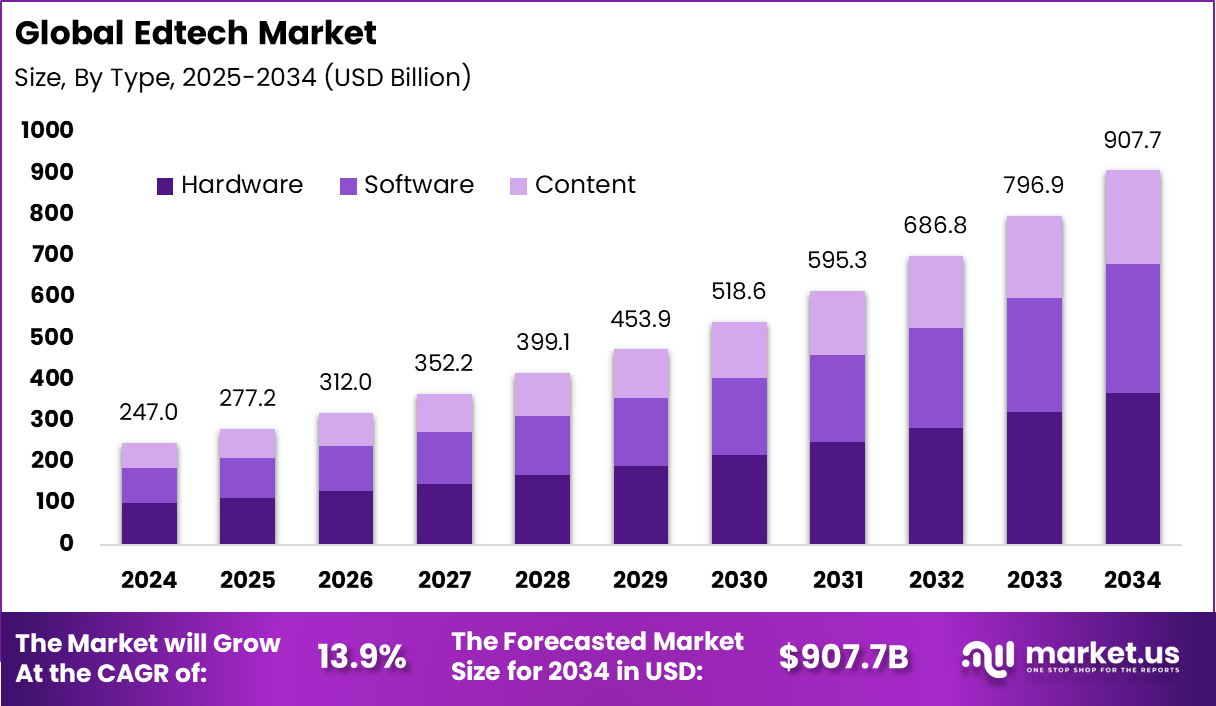
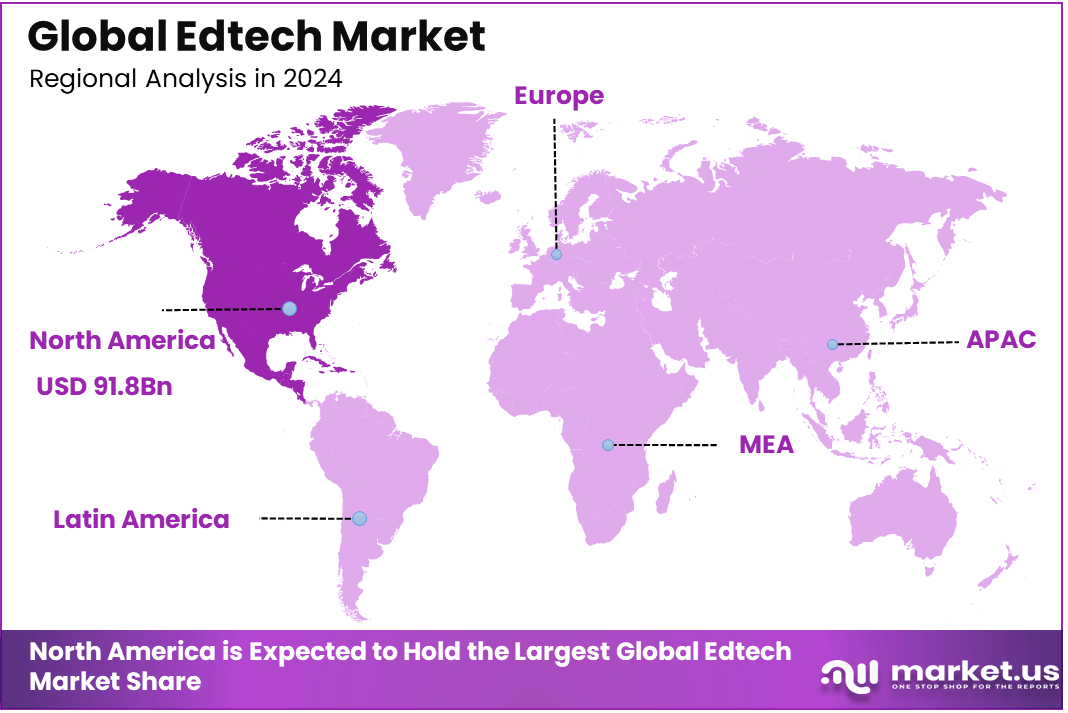
The Global Edtech Market generated USD 247 billion in 2024 and is predicted to register growth from USD 277.2 billion in 2025 to about USD 907.7 billion by 2034, recording a CAGR of 13.9% throughout the forecast span. In 2024, North America held a dominan market position, capturing more than a 37.2% share, holding USD 91.8 Billion revenue.
The education technology (EdTech) market is rapidly evolving into a vital part of the global education landscape. It encompasses a broad range of digital solutions used to enhance teaching and learning for students of all ages, from early education to corporate training. In 2025, the EdTech sector is marked by steady growth, driven by advances in technology and expanding access to digital devices and internet connectivity.
Key forces driving the EdTech market include the push for personalized learning, the growth of mobile and remote education, and higher engagement through gamification and immersive tools. Data-driven insights and AI-based adaptive systems enable tailored content delivery, while broader broadband access and device availability expand digital learning to students across different regions and income levels.
According to data reported by the World Economic Forum, the next decade is expected to witness the graduation of approximately 800 million K-12 students and 350 million post-secondary students globally. At the same time, global expenditure on education is forecasted to reach an estimated USD 10 trillion by 2030, reflecting the rising importance of education in supporting economic development and societal advancement.
Based on the research findings from PIE News, the Indian edtech sector has demonstrated resilience despite a funding crunch in 2024. In the first nine months of the year, the sector managed to raise $278 million, marking a modest 3% increase from the $269 million raised during the same period in 2023. This slight growth reflects the sector’s ability to attract investment, even in a challenging economic environment.
According to data analysis conducted by Inc42, PhysicsWallah, a leading edtech unicorn, has emerged as the dominant player in the sector. The Noida-based platform alone accounted for $210 million of the total funding in the first three quarters of 2024. This significant contribution highlights PhysicsWallah’s strong market position and its ability to secure investor confidence amid a broader funding slowdown.
Top Market Takeaways
- By deployment mode, on-premise solutions dominate with 70.3%, reflecting institutions’ preference for control and data security.
- By type, hardware accounts for 40.5%, driven by demand for smart devices, interactive panels, and connected classroom tools.
- By sector, K-12 leads with 56.1%, highlighting early adoption of digital learning platforms in schools.
- By end-user, businesses represent 67.8%, showcasing corporate investment in training and upskilling through digital learning tools.
- North America holds 37.2%, supported by mature EdTech ecosystems and strong institutional adoption.
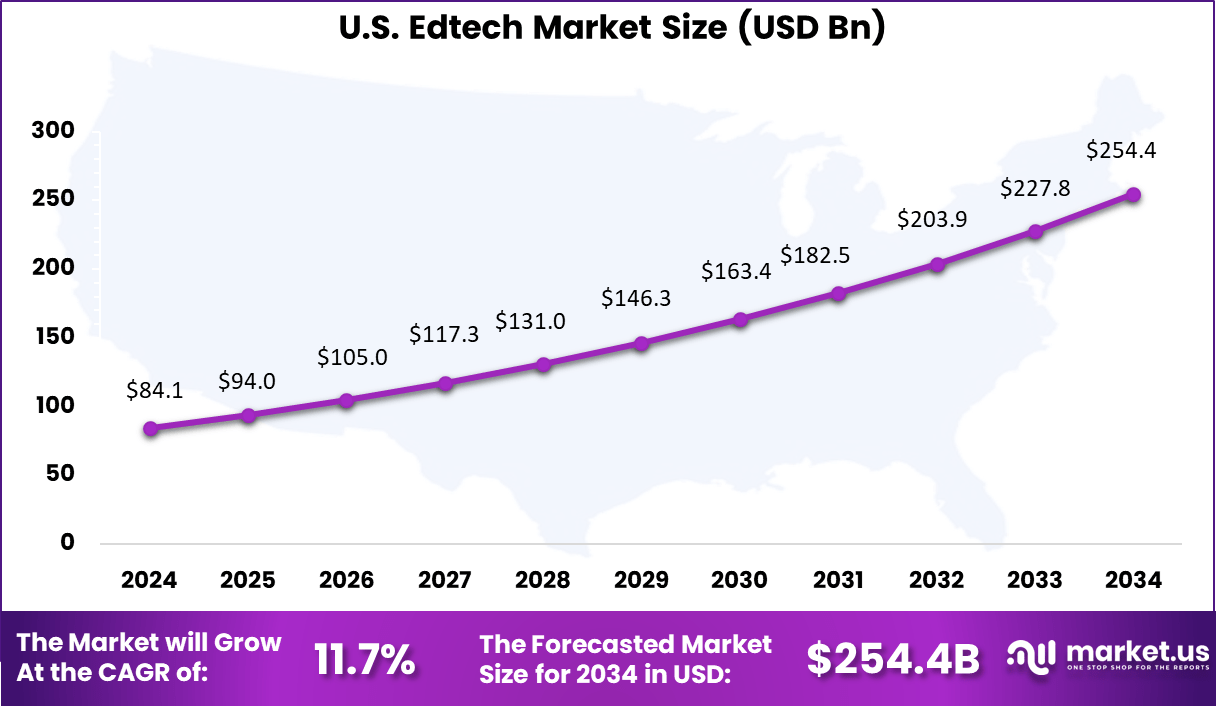
- The US market reached USD 84.14 billion and is expanding at a steady CAGR of 11.7%, underscoring sustained investment in digital education infrastructure.
Quick Market Facts
- Cloud deployment is gradually increasing from 28.1% in 2019 to 29.4% in 2024.
- On-Premise deployment is slowly declining from 71.9% to 70.6% in the same period.
- Overall, On-Premise remains dominant, but Cloud adoption is steadily growing.
- Hardware is gradually declining from 41.5% in 2019 to 40.5% in 2024.
- Software shows steady growth, increasing from 27.9% to 29.0%.
- Content remains almost stable, around 30.6% across the years.
- K-12 steadily increases from 54.2% in 2019 to 56.1% in 2024, remaining the largest sector.
- Preschool stays almost stable, moving slightly from 11.3% to 11.4%.
- Higher Education shows a gradual decline from 20.0% to 19.2%.
- Other Sectors also decline steadily from 14.5% to 13.3%.
- Business end-users show a gradual decline from 68.6% in 2019 to 67.8% in 2024.
- Consumer end-users steadily increase from 31.4% to 32.2% during the same period.
- Overall, business remains dominant, but consumer share is slowly rising.
- North America share is declining from 39.9% in 2019 to 37.2% in 2024.
- Europe is also showing a slow decline from 30.2% to 29.4%.
- Asia-Pacific is growing steadily, rising from 20.9% to 24.2%.
- Latin America remains stable around 6%.
- Middle East & Africa shows slight growth from 3.0% to 3.2%.
Edtech Statistics
- United States: Students engaging with devices for over 60 minutes per week demonstrate superior academic outcomes, highlighting the effective integration of technology in education.
- Skillademia’s Research: eLearning through EdTech platforms enhances information retention rates by 25% to 40%, underscoring the efficiency of digital learning tools. Additionally, 84% of learners report increased engagement with gamified EdTech solutions, suggesting the effectiveness of interactive learning formats.
- Human Resources Perspective: A significant 61% of HR leaders view online credentials as equivalent to those obtained through traditional, in-person educational programs, validating the credibility of online education in professional settings.
- Market Growth Projection: The EdTech sector is anticipated to expand at a compounded annual growth rate (CAGR) of 15% in the coming years, reflecting robust sectoral momentum.
- Corporate EdTech Market: Currently valued at $27.5 billion, this segment of the EdTech industry caters predominantly to business and corporate clients, indicating a substantial market for professional and continuous education.
- Higher Education Trends: Over 70% of colleges are planning to introduce new online undergraduate programs within the next three years, which points to a growing shift towards online higher education offerings.
According to exploding topics, Corporate EdTech is a rapidly growing industry, currently valued at $27.5 billion. The sector’s expansion is reflected in the fact that over 70% of colleges plan to launch one or more online undergraduate programs within the next three years. Additionally, digital learning has become the most popular strategy for corporate skill-building, indicating a strong demand for EdTech solutions.
Indian EdTech giant Byju’s raised $800 million in its latest funding round, highlighting the significant investment in the sector. In the U.S., BetterUp stands as the most valuable EdTech unicorn, offering professional learning and development solutions. The growth of these companies underscores the increasing reliance on technology in education.
However, the learning curve associated with EdTech has posed challenges. During the pandemic, 71% of teachers reported spending more time troubleshooting technology, leading to less time for student instruction. Despite these challenges, 87% of K-12 educators noted an improvement in their tech skills, though around 60% still feel there is inadequate training for EdTech.
Market Overview
Demand analysis reveals strong uptake in technologies like AI-driven personalized learning, virtual and augmented reality (VR/AR) for immersive experiences, and gamified learning platforms. AI systems can analyze individual learning patterns to customize educational content, enhancing retention and motivation. VR and AR create hands-on experiential learning environments, significantly increasing student engagement.
Gamification elements foster friendly competition and improve participation, especially among younger learners. These technologies combine to transform traditional classrooms into vibrant, interactive learning spaces. The key reasons for adopting these technologies revolve around improving learning effectiveness, increasing accessibility, and reducing teacher workload.
Personalized AI learning helps ensure no student is left behind by offering custom pathways tailored to individual progress. VR and AR bring subjects to life, making complex topics easier to grasp. The reduction in administrative tasks through automation allows educators to focus more on teaching. Furthermore, digital platforms offer flexibility with anytime-anywhere learning, reaching students in remote or underserved regions.
Role of Generative AI
Generative AI is increasingly becoming a critical tool in the education technology space. Around 86% of education organizations have adopted generative AI, marking the highest adoption rate among industries. This technology is transforming learning by providing tailored educational experiences that adapt to each student’s pace and style.
With AI-powered tools like personalized learning companions and intelligent chatbots, students receive real-time feedback and support that helps address their individual learning gaps. These capabilities not only improve student engagement but also support inclusivity by assisting learners with disabilities through speech-to-text and text-to-speech adaptations.
The role of generative AI goes beyond content creation; it supports emotional recognition to adapt learning material based on students’ sentiments and delivers inclusive educational resources for diverse learning needs. This level of customization has increased the daily use of AI in classrooms, with about 58% of university instructors integrating generative AI into their teaching practices.
Government Initiatives
The U.S. Department of Education has recently allocated a substantial ~$277 million in new grant funding through the Education Innovation and Research (EIR) program, aimed at enhancing educational equity and innovation. This allocation underscores a strategic approach towards accelerating academic recovery following the significant disruptions caused by the COVID-19 pandemic.
Analysis of state-administered test scores from the academic years 2021-2022 and 2022-2023 reveals modest improvements in student performance in math and reading. However, these gains have not universally returned to pre-pandemic levels, highlighting a partial and uneven recovery across different student demographics.
This funding is strategically distributed among various critical areas: $90.3 million is dedicated to STEM (Science, Technology, Engineering, and Math) education, reflecting an emphasis on key skills that are crucial for future competitiveness and innovation. A further $87.2 million is aimed at enhancing social emotional well-being, including aspects of student engagement, an area that is vital for holistic educational outcomes.
Additionally, $76.5 million is allocated specifically for educational projects in rural areas, addressing the unique challenges faced by these communities. The distribution of these funds represents a targeted effort to bridge the gap for those students who have been most significantly affected by the pandemic and who are traditionally exposed to systemic inequalities in education.
India is emerging as the world’s second-largest online education market, trailing only the USA. This growth is largely supported by substantial government investments, as evidenced by the INR 73,498 Cr allocation for the Department of School Education and Literacy in the Interim Budget of 2024-25. This significant budget underscores the government’s commitment to enhancing educational infrastructure and access, positioning India as a global leader in the online education sector.
In addition to general education funding, the Interim Budget of 2024-25 has also earmarked INR 255 Cr for the establishment of three Artificial Intelligence Centres of Excellence (CoE). This investment is expected to catalyze innovation and technological advancements in the education sector, further solidifying India’s position in the global online education market.
U.S. Edtech Market Size
The U.S. Edtech market is a major contributor within North America, valued at over USD 84 billion with a strong growth pace of 11.7% CAGR. The country’s leadership is built on a robust K-12 sector and widespread adoption of Edtech in corporate training programs. Federal and state-level initiatives promote digital learning infrastructure, supporting broad use of AI-enhanced tools and content management systems.
In the U.S., investments focus on improving educational outcomes through personalized, technology-enabled instruction combined with data analytics. Emphasis on flexible, accessible learning options aligns with rising demand for lifelong learning and workforce development, further bolstering the market’s expansion.
In 2024, North America holds a commanding 37.2% stake in the global Edtech market, driven by high internet penetration, advanced infrastructure, and significant investments in digital learning. The region is marked by widespread adoption of on-premise solutions due to strict data privacy concerns and a preference for customized educational technologies.
Edtech Market by Regional Analysis (%), 2020-2024
| Region | 2019 | 2020 | 2021 | 2022 | 2023 | 2024 |
|---|---|---|---|---|---|---|
| North America | 39.9% | 39.3% | 38.8% | 38.2% | 37.3% | 37.2% |
| Europe | 30.2% | 30.1% | 29.9% | 29.8% | 29.6% | 29.4% |
| Asia-Pacific | 20.9% | 21.6% | 22.3% | 22.9% | 24.1% | 24.2% |
| Latin America | 5.9% | 5.9% | 5.9% | 6.0% | 5.9% | 6.0% |
| Middle East & Africa | 3.0% | 3.0% | 3.1% | 3.2% | 3.1% | 3.2% |
The region also benefits from a mature market for innovative educational tools, including AI-powered learning platforms and immersive technologies. Educational institutions and businesses alike are key demand drivers, fueling sustained growth in digital education ecosystems.
By Deployment Mode
In 2024, the on-premise deployment mode dominates the Edtech market with a 70.3% share. Its appeal lies in the ability to provide educational institutions and businesses with control over their data and infrastructure, which is crucial for maintaining privacy and complying with regulatory standards.
On-premise solutions offer reliability and customization, supporting stable operations for schools and enterprises investing in digital learning technologies. Institutions prefer on-premise systems for their security advantages, especially where sensitive data handling, like student records or proprietary training content, is paramount.
Edtech Market Share By Deployment Mode (%), 2019-2024
By End-User
In 2024, Business users represent the largest end-user segment with 67.8% of the market share. Corporations are investing heavily in Edtech to enhance workforce training, skills development, and professional learning. Digital learning platforms provide scalable solutions to meet evolving business needs for upskilling and reskilling employees effectively, boosting productivity and competitiveness.
Edtech Market Share By End-User (%), 2019-2024
| End-User | 2019 | 2020 | 2021 | 2022 | 2023 | 2024 |
|---|---|---|---|---|---|---|
| Business | 68.6% | 68.5% | 68.3% | 68.1% | 67.9% | 67.8% |
| Consumer | 31.4% | 31.5% | 31.7% | 31.9% | 32.1% | 32.2% |
Businesses benefit from Edtech’s ability to offer adaptive learning experiences tailored to individual employee needs, supported by AI-driven analytics and machine learning. These technologies enable targeted content delivery and progress tracking that optimize learning outcomes, making training more efficient and aligned with corporate goals.
EdTech Tools and Applications
Here are some specific examples of EdTech tools and applications:
- Learning management systems (LMS): LMSs are online platforms that can be used to deliver content, track student progress, and provide communication tools. Some popular LMSs include Canvas, Blackboard, and Moodle.
- Virtual reality (VR): VR can be used to create immersive learning experiences that allow students to learn in a more realistic way. For example, VR can be used to teach students about anatomy or to simulate a historical event.
- Gamification: Gamification is the use of game-like elements in non-game contexts. This can be used to make learning more fun and engaging. For example, a teacher might create a quiz game to help students learn about a new topic.
- Adaptive learning: Adaptive learning is a type of personalized learning that uses technology to tailor instruction to each student’s individual needs. This can be done by providing different levels of difficulty, different types of content, or different feedback.
- Artificial intelligence (AI): AI is being used in a variety of ways in education, such as to grade essays, provide personalized tutoring, and create virtual assistants.
Key Market Segments
Deployment Mode
- Cloud
- On-Premise
Type
- Hardware
- Software
- Content
Sector
- K-12
- Preschool
- Higher Education
- Other Sectors
End-User
- Business
- Consumer
Key Regions and Countries
North America
- US
- Canada
Europe
- Germany
- France
- The UK
- Spain
- Italy
- Rest of Europe
Asia Pacific
- China
- Japan
- South Korea
- India
- Australia
- Rest of APAC
Latin America
- Brazil
- Mexico
- Rest of Latin America
Middle East & Africa
- South Africa
- Saudi Arabia
- UAE
- Rest of MEA
Driver
Rising Mobile Learning Adoption
The growth of mobile learning is a key driver for the EdTech market in 2025. Increasing smartphone penetration and improved internet connectivity are enabling learners to access educational content anytime and anywhere.
Many countries, especially in Asia and Europe, are seeing strong adoption of Bring Your Own Device (BYOD) policies in schools and universities, which further supports EdTech platform usage through mobile-friendly solutions. This convenience and accessibility are pushing institutions to invest more in mobile learning technologies.
Mobile learning helps widen reach, particularly in regions where physical infrastructure is limited, making education more inclusive. The ability for students to learn on personal devices boosts engagement and flexibility, encouraging continuous learning beyond classroom walls. This trend is expected to sustain strong growth momentum for EdTech companies as they focus on optimizing mobile platforms and apps.
Restraint
Market Saturation
One restraint in the EdTech sector is the growing market saturation with numerous startups and platforms competing for user attention. The proliferation of EdTech companies creates a crowded marketplace, which can lead to customer confusion and diminished brand loyalty. This intense competition makes it harder for companies to differentiate themselves and acquire new customers effectively.
Moreover, many regions have fragmented access and differing education standards, making scalability and standardization challenging. Investors and stakeholders also face difficulties navigating a market with overlapping solutions and frequent new entrants. Such saturation may slow growth for certain players and push some companies toward consolidation or exit strategies.
Opportunity
Expansion in Emerging Markets
Emerging markets present a significant opportunity for EdTech expansion in the coming years. Countries in Asia, Africa, and Latin America are rapidly adopting digital education initiatives, driven by government investments and efforts to bridge access gaps. These regions have growing populations of young learners and increasing internet and mobile penetration, creating a fertile environment for EdTech deployment.
The push for digital literacy, skill development, and affordable education solutions positions EdTech providers well to capture these markets. Partnerships with local governments and telecom operators enable wider reach and contextualized content offerings. As emerging economies continue to modernize education infrastructures, the demand for scalable and mobile-friendly EdTech solutions will likely increase substantially.
Challenge
Talent Shortage in EdTech
A critical challenge for the EdTech industry is the shortage of skilled talent, including experts in AI, instructional design, and curriculum development. Rapid technological advancements require a workforce with combined knowledge of education theory and cutting-edge digital tools. However, many EdTech companies report difficulty in recruiting and retaining specialists who can build and maintain effective learning solutions.
This talent gap hinders product innovation and adaptation to evolving learner needs. Without sufficient skilled professionals, EdTech firms risk slower time-to-market and reduced competitiveness. The industry must invest in training programs and collaborations to develop the necessary skills internally and in the education ecosystem to overcome this bottleneck.
Latest Trends
Several emerging trends are shaping the edtech landscape in 2025. AI-driven personalized learning systems have become mainstream, used by 60% of educators daily to analyze student strengths and weaknesses and customize learning paths accordingly. Another notable trend is the rise of gamification and immersive learning through AR and VR, which offer engaging, hands-on learning experiences beyond traditional methods.
The cost of AR and VR technology is dropping, further encouraging its adoption in classrooms worldwide. Additionally, hybrid learning models are gaining traction by blending online and in-person education to offer flexibility and accessibility. Micro-learning and digital credentialing are also transforming education by allowing learners and employers to access stackable certifications that meet specific skill demands.
Growth Factors of edtech
The growth of edtech is being driven by factors such as widespread internet access, increasing smartphone penetration, and the demand for personalized learning solutions. In India specifically, over 900 million active internet users in 2025 have significantly boosted the online education market. Nearly 90% of these users access the internet daily, often using it for learning purposes alongside entertainment and communication.
This digital connectivity enables a broad user base for edtech platforms, facilitating rapid adoption and innovation in the sector. Moreover, government support plays a major role in the expansion of edtech. Significant funding is being allocated to improve digital infrastructure, smart classrooms, and online learning platforms.
Governments are also promoting AI and skill development programs to prepare students and professionals for evolving industry needs. In India, initiatives like the National Educational Alliance for Technology make adaptive learning solutions accessible to economically disadvantaged students, while investments in AI Centers of Excellence foster innovation and a skilled AI workforce.
Technological Innovations
- AI for Creator Productivity: AI tools are increasingly used to augment content creation, helping educators and creators draft lesson plans and manage communications more efficiently.
- Immersive Learning Technologies: Virtual Reality (VR) and Augmented Reality (AR) are transforming traditional learning environments by providing immersive educational experiences that enhance student engagement and understanding.
- Hybrid Learning Models: Combining online and offline education, hybrid learning supports flexibility in learning styles and enhances students’ management and organization skills.
- Quantum Computing in Education: This emerging technology is being explored for its potential to analyze vast amounts of educational data, providing new insights into student performance and learning gaps.
- Personalized Learning: Advanced algorithms and data analytics are enabling more tailored educational experiences that adapt to the individual needs of students, improving outcomes.
Top Use Cases
- Artificial Intelligence for Content Creation: AI is increasingly being used to enhance productivity for content creators in the educational sector. It assists in tasks such as generating lesson plans and drafting communications to students, thereby freeing up time for educators to focus on more personalized student interactions.
- Gamification and Immersive Learning: The integration of game elements and immersive technologies such as VR (Virtual Reality) and AR (Augmented Reality) in learning environments is transforming education. These tools make learning more engaging by adding elements of competition and interactive experiences that mirror real-life scenarios.
- Mobile Learning and Microlearning: With the ubiquitous nature of mobile devices, learning has become more accessible. Mobile learning allows students to access educational materials from anywhere, while microlearning breaks down content into small, manageable segments, making it easier for learners to absorb and retain information.
- Data Analytics and Learning Analytics: Utilizing data to tailor educational experiences and improve outcomes is a growing trend. Data analytics in education can help in personalizing instruction and measuring student engagement and performance, providing insights that help educators enhance learning processes.
- Chatbots for Personalized Learning: AI-powered chatbots are being used to provide personalized tutoring and support, helping students with everything from homework assistance to administrative tasks. These chatbots improve engagement and learning outcomes by offering tailored help and maintaining communication with students.
Business Benefits of EdTech
- Cost Reduction: By digitizing and automating administrative tasks, EdTech platforms reduce operational costs and make educational resources more affordable.
- Increased Engagement and Retention: Technologies like AI and VR improve engagement through interactive and personalized learning experiences, which can lead to higher course completion rates and better knowledge retention.
- Scalability: Online platforms enable educational institutions and businesses to scale their offerings globally without significant increases in costs.
- Accessibility: EdTech makes education more accessible to people worldwide, including those in remote or underserved regions.
- Data-Driven Insights: The use of analytics in EdTech allows educators to track progress and tailor instruction to meet the needs of each student, thereby optimizing learning outcomes.
Key Players Analysis
The EdTech market is shaped by dynamic and innovative companies, with Coursera Inc., BYJU’S, and Chegg Inc. at the forefront.
Coursera Inc. has distinguished itself as a leader by providing a broad spectrum of online courses, professional certificates, and degree programs in partnership with top universities and companies worldwide. The platform is known for its extensive course offerings that cater to a diverse range of professional and educational needs, helping individuals enhance their skills and careers in a flexible learning environment.
BYJU’S is another dominant player, originating from India and rapidly expanding globally. It specializes in offering highly engaging and personalized learning programs for K-12 students. BYJU’S has made significant headlines with its innovative use of animation for teaching complex subjects and its aggressive expansion strategy through acquisitions of various educational platforms, broadening its international presence.
Chegg Inc. focuses on providing digital and physical textbook rentals, online tutoring, and other student services. It has become essential to college students in the United States and beyond, by offering solutions to academic challenges and helping students save on textbook costs. Chegg’s services are designed to assist students in navigating their educational journeys more effectively, making it a key resource in the academic success of millions.
Top Market Leaders
- Coursera Inc.
- BYJU’S
- Chegg Inc.
- 2U Inc.
- Amazon Inc.
- Blackboard Inc.
- Edutech
- Alphabet Inc. (Google LLC)
- edX Inc.
- Instructure, Inc.
- Udacity, Inc.
- upGrad Education Private Limited
- Other Key Players.
Recent Developments
- In March 2025, CleverTap partnered with upGrad to add a deep-learning module to upGrad’s Digital Marketing and Product Management courses. These courses are run with Duke CE and MICA. The goal is to help students learn more about customer retention, AI-based marketing, and engagement through practical learning and academic content.
- In March 2025, the Delhi government signed an MoU with the BIG Institute, which includes the National Skill Development Corporation International and ed-tech company Physics Wallah. This program will provide free online coaching to over 1.63 lakh government school students for NEET and CUET exams.
- In March 2025, Microsoft Education and Adobe teamed up to bring Adobe Creative Cloud apps into Microsoft Teams for Education. This move is meant to give teachers and students better tools to create and learn inside the digital classroom.
- In January 2025, Banco Santander joined with Coursera to offer 10,000 scholarships. These scholarships provide one-year access to more than 13,000 courses in 13 countries. Learners can also earn certificates from companies like IBM, Microsoft, Google, and AWS. The goal is to help people build skills in areas like data science, cybersecurity, and marketing.
- In May 2025, the European Commission approved Google’s plan to buy Duolingo for USD 1.1 billion. The deal was allowed after regulatory review and is expected to help Google grow its education-related services.

- 蓝茶市场(2026—2031)
0评论2026-09-15

- 泡沫材料市场(2026—2031)
0评论2026-09-15

- 重铬酸钠市场(2026—2031)
0评论2026-09-15

- 家族性淀粉样多发性神经病(FAP)市场(2026—2031)
0评论2026-09-15

- 次氯酸钙市场(2026—2031)
0评论2026-09-15

- 海上储能市场(2026—2031)
0评论2026-09-12

- 混凝土市场(2026—2031)
0评论2026-09-12

- 矫形器械市场(2026—2031)
0评论2026-09-12

- 木质素基树脂市场(2026—2031)
0评论2026-09-12

- 聚碳酸酯二元醇市场(2026—2031)
0评论2026-09-12