


Report Overview
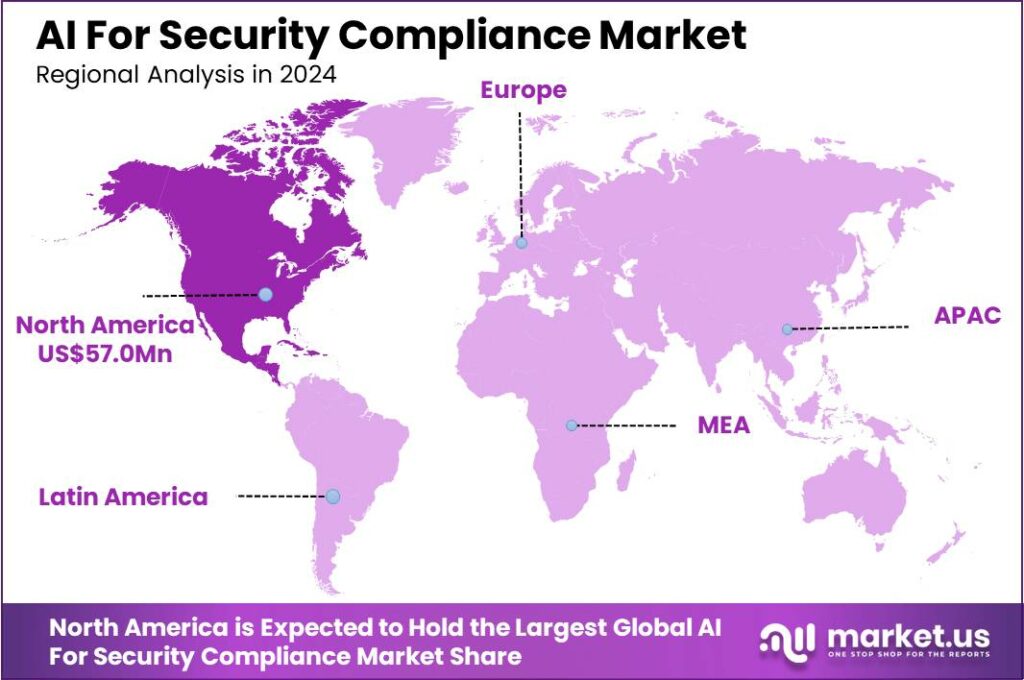
The Global AI For Security Compliance Market size is expected to be worth around USD 1,331.7 Million By 2034, from USD 188.4 Million in 2024, growing at a CAGR of 21.6% during the forecast period from 2025 to 2034. In 2024, North America dominated the market with a 30.3% share, generating USD 57 million in revenue. The United States led the region, accounting for an impressive 89.2% of the market, solidifying its leadership position.
Artificial Intelligence (AI) for security compliance involves utilizing AI technologies to automate and enhance the processes that ensure organizations adhere to regulatory standards and internal policies. By analyzing vast datasets, AI systems can identify compliance risks, monitor for policy violations, and streamline reporting procedures, thereby reducing manual workloads and improving accuracy.
The market for AI for Security Compliance is expanding rapidly as businesses across various sectors recognize the importance of maintaining rigorous security protocols in the face of increasing digital threats. This market is driven by the growing complexity of regulatory environments and the escalating volume of data that organizations need to manage securely.
Companies are investing in AI solutions to streamline compliance processes, which in turn enhances operational efficiency and security effectiveness. This sector is seeing significant growth due to the high demand for solutions that can adapt and respond to evolving security challenges and compliance requirements.
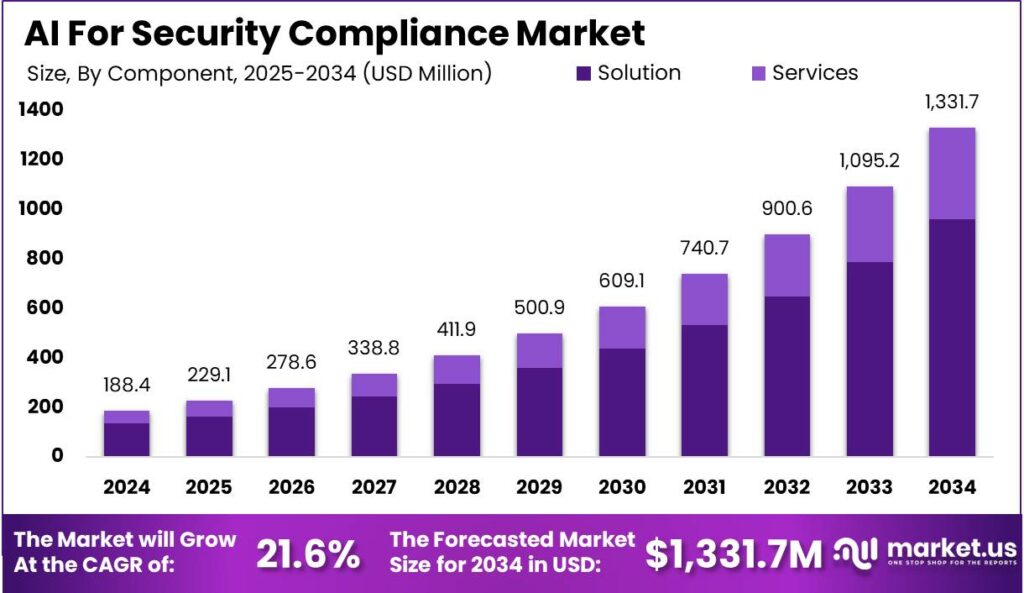
Several factors are propelling this market expansion. The rising frequency and sophistication of cyber threats necessitate advanced compliance measures. Additionally, stringent regulatory requirements across various industries compel organizations to adopt AI-driven compliance solutions to ensure adherence and avoid penalties.
The demand for AI in security compliance is further amplified by the increasing adoption of digital technologies and the subsequent rise in data volumes. Organizations seek efficient tools to manage compliance across complex IT infrastructures, driving the need for AI-powered solutions capable of real-time monitoring and analysis.
A recent study by Deloitte reveals that 69% of businesses consider artificial intelligence to be a critical tool in strengthening their cybersecurity defenses. This growing reliance on AI stems from the rapid evolution of cyber threats, which are becoming more complex and harder to combat using traditional methods alone.
Based on data from Compunnel,70% of tasks involving the classification of Personally Identifiable Information (PII) are expected to be automated by AI-powered tools by 2024. This shift highlights the growing role of AI in compliance processes, where 60% of compliance officers plan to invest in AI-powered RegTech solutions by 2025.
Among organizations using Azure, nearly 40% leverage Azure OpenAI for compliance-related tasks, showing strong adoption in this space. According to lakera, 93% of security professionals recognize AI’s potential to enhance cybersecurity, 77% of organizations feel unprepared to defend against AI-driven threats. Immuta’s 2024 State of Data Security Report adds that 80% of data experts believe AI increases challenges in securing data.
Adoption of large language models (LLMs) is surging, with 90% of organizations actively exploring their use cases. However, only 5% feel highly confident in their AI security readiness. The usage of AI/ML tools has soared by 594%, from 521 million transactions in April 2023 to a staggering 3.1 billion per month by January 2024, reflecting the exponential growth in AI-driven operations.
Opportunities within this market are abundant. The integration of AI with emerging technologies such as cloud computing and the Internet of Things (IoT) presents avenues for developing comprehensive compliance solutions. Moreover, small and medium-sized enterprises (SMEs) are increasingly recognizing the benefits of AI in streamlining compliance processes, indicating a growing market segment.
Technological advancements play a crucial role in shaping the AI for security compliance landscape. Developments in machine learning algorithms and natural language processing enhance the ability of AI systems to interpret complex regulatory texts and adapt to evolving compliance requirements. Furthermore, improvements in AI hardware, such as GPUs and TPUs, facilitate the deployment of more efficient and scalable compliance solutions.
Key Takeaways
- The global AI for Security Compliance market is projected to grow significantly, reaching a valuation of USD 1,331.7 million by 2034, compared to USD 188.4 million in 2024. This remarkable growth is driven by a compound annual growth rate (CAGR) of 21.6% during the forecast period from 2025 to 2034.
- In 2024, North America emerged as the leading region, holding a 30.3% market share and generating revenue of approximately USD 57 million. Within the region, the United States dominated, accounting for a substantial 89.2% of North America’s market share, further solidifying its leadership position globally.
- The solutions segment played a pivotal role in the AI for Security Compliance market in 2024, capturing over 72.4% of the total market share. This dominance reflects the increasing demand for AI-powered tools that help organizations meet stringent regulatory requirements.
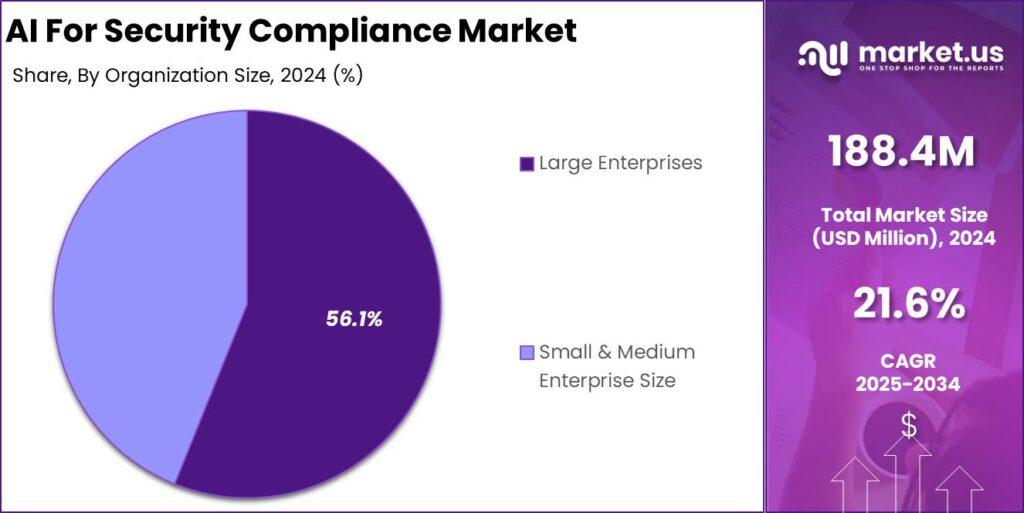
- Large enterprises led the market, contributing more than 56.1% of the total revenue in 2024. Their significant investment in AI technologies to enhance compliance processes underscores their dominance in the sector.
- The BFSI (Banking, Financial Services, and Insurance) sector stood out as a key contributor, accounting for over 23.6% of the market share in 2024. This highlights the critical role of AI in managing complex regulatory environments within financial institutions.
US AI for Security Compliance Market Size
In 2024, the United States maintained a dominant market share of 89.2%, solidifying its position as the leader in the sector. This overwhelming majority highlights the country’s stronghold and consistent ability to outperform competitors globally. Key drivers included robust infrastructure, innovation-driven growth, and favorable regulatory environments.
In 2024, North America held a dominant market position in the AI for Security Compliance market, capturing more than a 30.3% share with revenue amounting to USD 57 million. This leading position is largely attributed to the region’s advanced technological infrastructure and the early adoption of AI technologies across various sectors.
North America’s stringent regulatory environment, particularly in industries such as healthcare, finance, and government, demands robust compliance solutions, which further drives the adoption of AI-based security measures. The presence of major technology firms and AI solution providers in North America has also contributed significantly to its dominance.
These companies are at the forefront of developing innovative AI applications that address specific compliance needs, from data protection to cybersecurity threat detection and response. This innovation hub not only fuels local market growth but also sets global trends in AI for security compliance.
Moreover, the North American market benefits from significant investments in research and development by both private and public sectors, aimed at enhancing AI capabilities in security compliance. These investments have led to the development of cutting-edge solutions that are capable of handling the increasingly sophisticated cyber threats and complex regulatory requirements faced by organizations today.
Component Analysis
In 2024, the Solution segment held a dominant market position within the AI for Security Compliance market, capturing more than a 72.4% share. This segment’s leadership can be primarily attributed to the critical need for robust, automated tools that streamline compliance processes, ensure data integrity, and enhance security protocols across various industries.
As businesses continue to expand their digital infrastructure, the demand for comprehensive solutions that can preemptively identify compliance risks and automate security measures has become indispensable. The substantial share held by the Solution segment reflects its integral role in providing the core functionalities required for effective compliance management.
These solutions include data protection and encryption, threat detection, policy management, and compliance reporting tools. With the increasing complexity of regulatory requirements, companies are prioritizing investments in solutions that not only mitigate risks but also reduce the cost and complexity of compliance operations.
Moreover, advancements in technology have bolstered the capabilities of these solutions, making them more attractive to businesses aiming to safeguard sensitive information and maintain regulatory compliance. AI-driven solutions are particularly adept at handling large volumes of data, making real-time assessments, and providing actionable insights, which are crucial for maintaining stringent compliance standards.
This has led to their accelerated adoption, further reinforcing the Solution segment’s dominant position in the market. The leadership of the Solution segment is also supported by the evolving landscape of cyber threats and the subsequent need for proactive compliance frameworks that can adapt and respond swiftly. As organizations face an ever-growing array of security challenges, the demand for advanced solutions that offer comprehensive, integrated security and compliance management capabilities continues to rise.
Organization Size Analysis
In 2024, the Large Enterprises segment held a dominant market position in the AI for Security Compliance market, capturing more than a 56.1% share. This dominance is largely due to the extensive resources that large enterprises possess, which allow them to invest in advanced AI solutions that streamline compliance across complex organizational structures.
These enterprises often face higher risks and more stringent regulatory requirements due to their size, scope of operations, and the volume of data they handle. Consequently, there is a critical need for comprehensive AI-driven solutions that can efficiently manage and mitigate these risks. The significant market share of the Large Enterprises segment reflects their priority to maintain robust compliance as a core aspect of their business strategy.
Large enterprises are more likely to adopt AI solutions that offer enhanced capabilities such as real-time monitoring, automated controls, and predictive analytics for compliance management. These features are crucial in managing the scale of data and the complexity of operations typical of large organizations, making AI solutions an indispensable tool for them.
Furthermore, the growing number of cyber threats and the increasing complexity of cyber-attack vectors targeting large enterprises have necessitated the adoption of sophisticated compliance solutions. AI technologies are particularly effective in this regard, offering dynamic and adaptive tools that can anticipate, identify, and respond to potential compliance breaches before they escalate into serious issues.
Finally, the leadership of the Large Enterprises segment in the AI for Security Compliance market is also driven by the ongoing digital transformation initiatives within such organizations. As they integrate more digital technologies into their operations, the need for compliance solutions that can handle an ever-expanding digital footprint becomes paramount.
Industry Vertical Analysis
In 2024, the BFSI (Banking, Financial Services, and Insurance) segment held a dominant market position in the AI for Security Compliance market, capturing more than a 23.6% share. This leadership stems from the inherently high-risk environment in which these institutions operate, coupled with the stringent regulatory standards imposed on them globally.
Financial institutions are prime targets for cyber-attacks due to the sensitive financial data they handle, necessitating robust security compliance measures facilitated by advanced AI technologies. The prominence of the BFSI segment can also be attributed to the sector’s need to manage vast amounts of sensitive data securely while adhering to an ever-evolving landscape of financial regulations.
AI-driven solutions are particularly valuable in this context as they provide the capabilities to automate complex compliance tasks, such as transaction monitoring, risk assessment, and fraud detection. These technologies not only enhance the efficiency and effectiveness of compliance programs but also significantly reduce the possibility of human error, a critical factor in the high-stakes financial environment.
Additionally, the integration of AI in security compliance helps BFSI institutions stay ahead of sophisticated cyber threats and adapt to new regulations quickly. AI tools can analyze patterns, detect anomalies in real-time, and predict potential compliance breaches before they occur, offering a proactive approach to compliance management. This capability is essential for maintaining trust and integrity within the financial sector, further driving the adoption of AI solutions.
Moreover, the growing adoption of digital banking services has introduced new compliance challenges, which AI is uniquely equipped to manage. As more customers embrace online and mobile banking, the need for secure, compliant digital services escalates. AI enhances the ability of BFSI institutions to offer these services safely and in compliance with global standards, solidifying its dominant position in the AI for Security Compliance market.
Key Market Segments
By Component
- Solution
- Services
By Organization Size
- Small and Medium-sized Enterprises
- Large Enterprises
By Industry Vertical
- BFSI
- Government and public utilities
- IT and Telecom
- Healthcare
- Retail
- Manufacturing
- Others
Key Regions and Countries
- North America
- US
- Canada
- Europe
- Germany
- France
- The UK
- Spain
- Italy
- Rest of Europe
- Asia Pacific
- China
- Japan
- South Korea
- India
- Australia
- Singapore
- Rest of Asia Pacific
- Latin America
- Brazil
- Mexico
- Rest of Latin America
- Middle East & Africa
- South Africa
- Saudi Arabia
- UAE
- Rest of MEA
Driver
Increasing Cybersecurity Threats
The AI for security compliance market is primarily driven by the escalating prevalence of cyber threats such as phishing and malware attacks. These cyber threats have become more sophisticated and pervasive, urging organizations to enhance their security frameworks. The integration of Artificial Intelligence (AI) into security protocols allows for advanced threat detection and response mechanisms, utilizing techniques like encryption, anomaly detection, and behavior analysis.
This adoption is crucial as it helps in maintaining the integrity and confidentiality of data across various sectors, including government, finance, and healthcare. As cyber risks intensify, the reliance on AI-enhanced solutions becomes imperative to safeguard digital assets and comply with stringent security regulations.
Major Restraint
Integration and Operational Challenges
One significant restraint in the AI for security compliance market is the complexity associated with integrating AI technologies into existing security infrastructures. Organizations often face operational hurdles when deploying new AI tools, as these systems require substantial adjustments to the current IT environment.
This includes the need for skilled personnel who can manage and optimize AI functionalities effectively. Moreover, the financial burden of upgrading legacy systems and the ongoing maintenance of AI solutions pose additional challenges. These factors can deter organizations from adopting AI-driven security measures, thus impeding market growth.
Prominent Opportunity
Adoption of Cloud-based Security Solutions
The shift towards cloud-based AI security solutions presents a significant opportunity for the market. These platforms offer scalable and cost-efficient options to handle extensive data integration and real-time threat analysis without substantial on-site hardware investments.
With the increasing adoption of remote working arrangements and the expansion of digital infrastructures, the demand for cloud-based security measures has surged. Furthermore, advancements in data encryption and privacy protocols enhance the appeal of these solutions, providing secure and flexible options for organizations to manage their security needs effectively.
Key Challenge
Evolving Regulatory Compliance Requirements
A major challenge in the AI for security compliance market is keeping pace with the rapidly evolving regulatory landscape. As governments worldwide tighten security regulations to protect consumer data and prevent cybercrimes, organizations must continually adapt their security measures to comply with new legal standards.
This dynamic regulatory environment requires frequent updates to AI security systems, which can be resource-intensive and require constant vigilance from security teams. The need for compliance can also limit the flexibility of AI implementations, as organizations must ensure that all AI-driven processes adhere to the latest regulations, adding to the complexity and cost of security operations.
Growth Factors
- Increased Adoption of Generative AI: Generative AI is revolutionizing the security compliance industry by streamlining processes such as filling out security questionnaires, mapping data, and automating compliance workflows. This integration is not only enhancing the efficiency of compliance tools but also reducing the time to achieve a return on investment (ROI) by an average of 1.4 months compared to tools without AI integration.
- Rising Cybersecurity Threats: As cybersecurity threats become more sophisticated, there’s a heightened need for robust security measures. AI is increasingly employed to enhance threat detection and response capabilities. For instance, recent advancements in AI have led to the development of systems that can anticipate and mitigate attacks more effectively, thereby supporting the security needs of businesses.
- Regulatory Dynamics: The regulatory landscape around AI and cybersecurity is becoming more complex and stringent, prompting organizations to adopt AI to stay compliant. New regulations and standards are being introduced, such as the EU AI Act, which mandates safe and ethical AI development.
Emerging Trends
- Agentic AI Workflows: These systems, which operate with a high degree of autonomy, are setting new standards for operational efficiency in security tasks. However, they also introduce new risks, such as vulnerabilities that could lead to denial-of-service attacks or manipulation of AI decision-making processes.
- Dynamic Risk Management: AI technologies are enabling more dynamic and real-time risk management and compliance monitoring. This allows organizations to quickly adapt to new threats and regulatory changes, significantly improving the agility of compliance teams.
- Integration with Cloud Services: The shift towards digital transformation and cloud services is amplifying the use of AI in security. This trend is particularly pronounced in regions like Asia-Pacific, where digital identities and cloud-based solutions are becoming more prevalent.
Business Benefits
- Operational Efficiency: AI-driven security compliance tools significantly reduce manual tasks by automating data analysis and policy management, which speeds up the compliance process and frees up resources for other critical activities.
- Enhanced Security Posture: By using AI to continuously update and adjust security measures based on emerging data and threat landscapes, organizations can maintain a more robust security posture that is proactive rather than reactive.
- Cost Reduction: AI integration helps reduce costs associated with security breaches and compliance failures by improving the accuracy and effectiveness of security operations.
Key Player Analysis
In the rapidly evolving AI for security compliance market, key players like Amazon Web Services (AWS), IBM Corporation, and Fortinet, Inc. are distinguishing themselves through strategic initiatives such as acquisitions, new product launches, and mergers.
Amazon Web Services (AWS) is making significant strides by integrating AI to bolster its cybersecurity capabilities. AWS offers tools like Amazon GuardDuty and AWS Security Hub, which utilize AI to detect and respond to threats effectively. Their approach to AI in security is about enhancing their existing cloud services, allowing businesses to scale their security measures efficiently.
IBM Corporation is another major player that leverages AI extensively within its security solutions. IBM’s portfolio, including IBM QRadar and Watson for Cyber Security, uses advanced AI techniques like natural language processing and machine learning to analyze security data, detect advanced threats, and automate incident responses. IBM’s strategy focuses on partnerships and integrating AI to offer sophisticated, industry-specific solutions.
Fortinet, Inc. stands out with its broad suite of cybersecurity solutions enhanced by AI. Fortinet integrates AI into its products to improve threat detection and response, making cybersecurity operations more proactive and efficient. Their focus on innovation and technology integration helps maintain a strong position in the market, ensuring they meet the diverse security needs of their clients.
AI for security compliance market Companies
- BigID
- Varonis
- SailPoint
- Forcepoint
- Tanium
- Darktrace
- OneTrust
- CrowdStrike
- Splunk
- Proofpoint
- CyberArk
- Other Key Players
Recent Developments
- In 2024, BigID made significant advancements in its platform by launching a new Compliance Dashboard and Data Activity Monitoring features. These tools aim to enhance organizations’ ability to manage compliance and bolster security. The dashboard simplifies tracking regulatory requirements, while the monitoring feature provides deeper visibility into data activities, helping companies identify potential risks in real-time.
- In 2024, Varonis introduced advanced data security tools tailored for Salesforce environments. The tools focus on critical areas like preventing unauthorized data exfiltration and managing API connections effectively. These enhancements are designed to address the increasing complexities of protecting sensitive customer and enterprise data within Salesforce ecosystems, a vital step for businesses prioritizing robust data governance.
- In 2024, SailPoint announced its acquisition of U.K.-based Osirium for $8.3 million. This acquisition is aimed at integrating privileged access management with identity security to provide a unified platform for protecting both privileged and non-privileged accounts. The deal underscores SailPoint’s commitment to addressing the evolving challenges of identity management in modern enterprises.









