


Report Overview
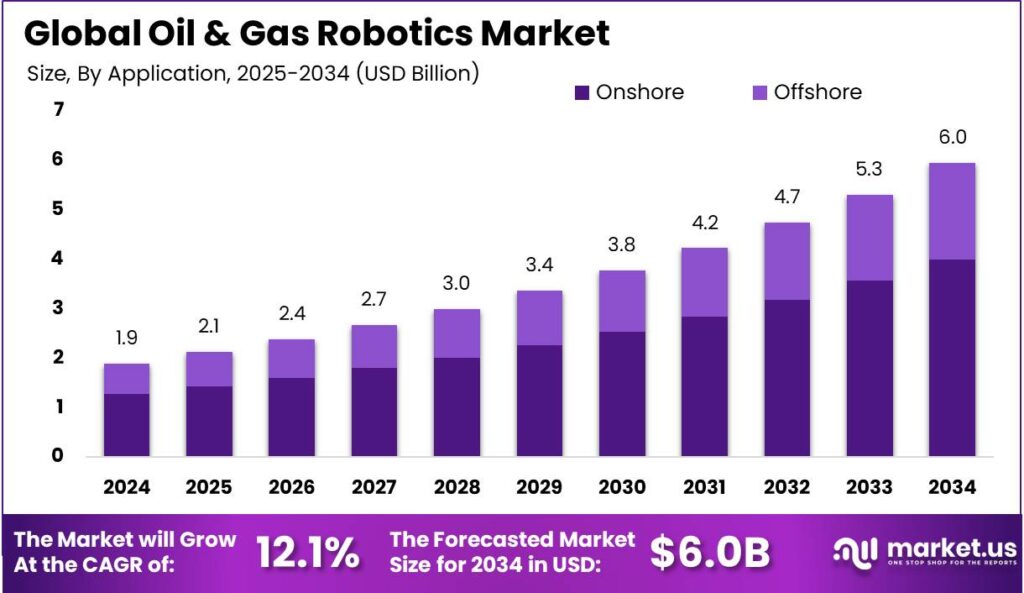
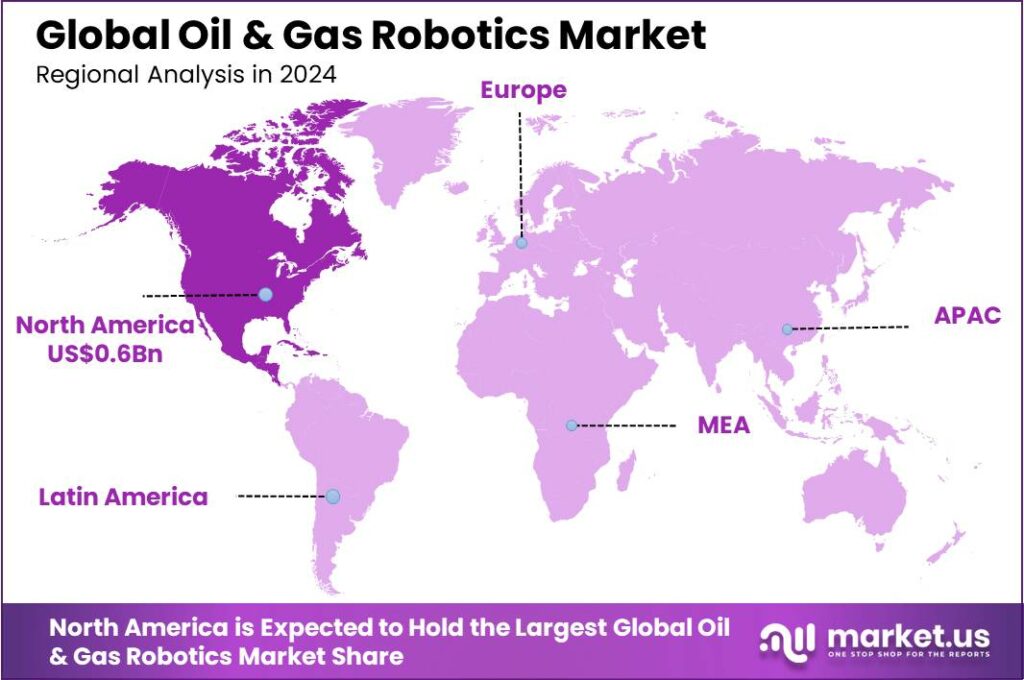
The Global Oil & Gas Robotics Market size is expected to be worth around USD 6.0 Billion By 2034, from USD 1.9 Billion in 2024, growing at a CAGR of 12.10% during the forecast period from 2025 to 2034. In 2024, North America dominated the Oil & Gas Robotics market, accounting for more than 33.8% of the market share, with revenues reaching USD 0.6 billion.
Oil & gas robotics refers to the application of robotic systems to the oil and gas industry, which encompasses both onshore and offshore operations. These robots are designed to perform a variety of tasks traditionally handled by humans but are particularly valuable in environments that are dangerous or difficult to access. Robotics in this sector can range from drones used for inspection purposes to fully autonomous underwater vehicles (AUVs) that monitor and maintain pipelines.
The oil & gas robotics market is a dynamic segment within the broader robotics industry, characterized by its focus on innovation and safety enhancement in oil and gas operations. This market includes the development, production, and deployment of robots that can perform drilling, welding, inspection, and maintenance tasks. The increasing need for operational efficiency and worker safety drives the adoption of robotic systems in the oil and gas industry, contributing to the growth of this market.
The major driving factors for the oil & gas robotics market include the imperative to enhance safety in highly hazardous environments, the drive to increase efficiency, and the need to reduce operational costs. Robotics technology minimizes human intervention in dangerous tasks, thereby reducing accident rates and ensuring consistent performance.
Additionally, as the complexity and remoteness of oil and gas sites increase, robots are increasingly seen as essential for performing complex tasks in these challenging conditions. Market demand for oil & gas robotics is driven by the continual push for technological advancement in the energy sector. As oil and gas exploration moves into deeper waters and more inaccessible regions, the necessity for advanced robotic assistance escalates.
The demand is also supported by regulatory pressures, where governments require higher safety and environmental standards, which robotics can help achieve by providing more precise and reliable operational capabilities. Significant market opportunities exist in the development of robots that can provide enhanced data collection, real-time monitoring, and autonomous decision-making capabilities.
Innovations that offer solutions for extreme conditions, such as deep-sea environments or high-pressure zones, are particularly valuable. Additionally, there is an increasing trend towards integrating IoT with robotics to enable better predictive maintenance, which could open new avenues for growth in the sector.
Technological advancements in the oil & gas robotics market are focused on increasing the autonomy, precision, and versatility of robots. Developments in artificial intelligence, machine learning, and computer vision are key enablers that allow robots to perform more complex tasks with greater accuracy. Enhancements in battery technology and materials science also contribute to building more durable and efficient robots capable of operating in extreme conditions typical of the oil and gas industry.
Key Takeaways
- The Global Oil & Gas Robotics Market is expected to reach USD 6.0 Billion by 2034, growing from USD 1.9 Billion in 2024, with a CAGR of 12.10% during the forecast period from 2025 to 2034.
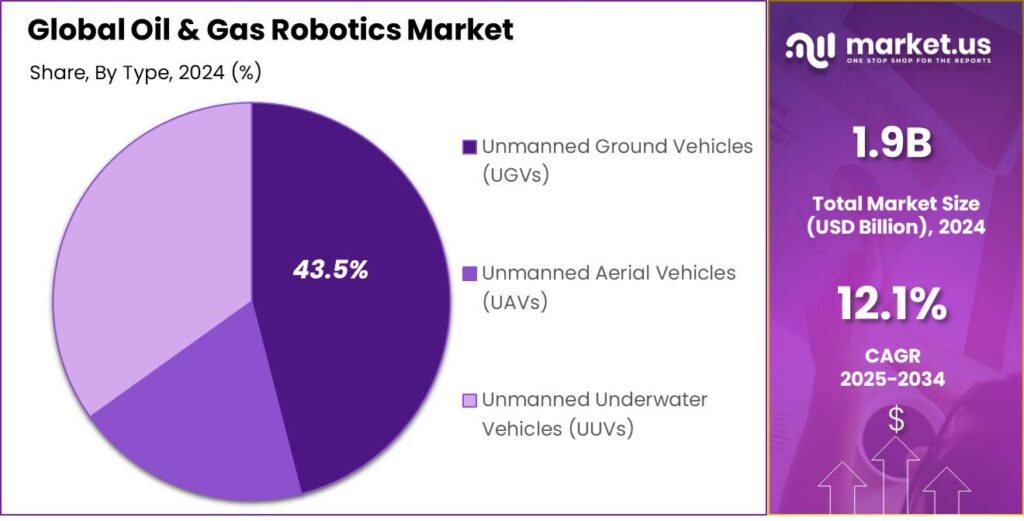
- In 2024, the Unmanned Ground Vehicles (UGVs) segment held a dominant position in the Oil & Gas Robotics market, capturing more than 43.5% of the market share.
- The Onshore segment was the leader in the Oil & Gas Robotics Market in 2024, capturing more than 67.2% of the market share.
- In 2024, North America dominated the Oil & Gas Robotics market, holding more than 33.8% of the market share, with revenues amounting to USD 0.6 billion.
U.S. Oil & Gas Robotics Market Size
The U.S. oil and gas robotics market, valued at USD 0.5 billion in 2024, leads due to several factors that emphasize operational efficiency and technological advancement. This market dominance is underpinned by America’s robust energy infrastructure and strategic investments in digital transformation, which have paved the way for widespread adoption of robotics across various operational sectors from exploration to maintenance.
Key technologies such as inspection robots and predictive maintenance systems are particularly prominent, featuring advancements in AI-driven analytics and sensor integration. These innovations enable precise monitoring and maintenance, thus reducing downtime and operational costs. Additionally, the integration of augmented reality (AR) and virtual reality (VR) with digital twins has revolutionized training and operational planning, allowing for safer and more efficient workforce operations.
In 2024, North America held a dominant position in the Oil & Gas Robotics market, capturing more than a 33.8% share with revenues amounting to USD 0.6 billion. This leading status can be attributed primarily to the substantial investments in technological advancements and the strong presence of leading robotics manufacturers in the region.
The U.S., in particular, has been at the forefront of developing innovative robotic solutions tailored for the oil and gas industry, driven by the need to enhance operational efficiencies and safety in response to the region’s stringent regulatory standards.
The market dominance of North America is further bolstered by the extensive shale gas exploration and production activities, especially in the U.S. and Canada. These operations require advanced monitoring and maintenance, where robotics play a crucial role in ensuring precision, reducing human exposure to dangerous environments, and optimizing the overall production process.
Moreover, the push towards digital transformation in North America’s oil and gas sector has fostered a conducive environment for the adoption of robotics. Companies in this region are increasingly integrating IoT, AI, and machine learning with robotic systems to enhance data collection, analytics, and automated decision-making processes.
Type Analysis
In 2024, the Unmanned Ground Vehicles (UGVs) segment held a dominant position within the Oil & Gas Robotics market, capturing more than a 43.5% share. This segment’s leadership can be attributed to its extensive application across onshore oilfields where automation of inspection, drilling, and maintenance tasks is critical.
The significant share of UGVs is also driven by their adaptability in a variety of operational settings, from early exploration to decommissioning.Equipped with advanced sensors and navigation systems, these vehicles enable precise monitoring and data collection, optimizing extraction and infrastructure maintenance.
Furthermore, technological advancements in robotics have enabled UGVs to perform complex tasks autonomously or with minimal human oversight. Innovations such as AI integration have enhanced the decision-making capabilities of UGVs, enabling them to respond to dynamic environmental changes and unforeseen operational challenges.
As companies seek to leverage data-driven decisions, UGVs serve as critical data collection points that feed into larger analytical models used to forecast maintenance needs, monitor asset health, and optimize resource allocation. This strategic importance of data collection and analysis reinforces the leading position of UGVs in the Oil & Gas Robotics market.
Application Analysis
In 2024, the Onshore segment held a dominant market position in the Oil and Gas Robotics Market, capturing more than a 67.2% share. This substantial market share can be attributed to several factors that underscore the segment’s critical role in onshore operations.
The prevalence of onshore activities in major oil-producing regions necessitates robust and efficient operational technologies. Onshore oil fields, being more accessible than offshore sites, have a higher deployment of robotics for a variety of applications, including exploration, drilling, and pipeline maintenance.
Moreover, the onshore segment benefits from a longer history of technology adoption, with established infrastructure that supports the integration of advanced robotics. This established base facilitates continual innovations and refinements in robotic solutions tailored to onshore needs, driving further adoption.
Regulatory and safety requirements play a significant role in this segment’s growth. Onshore oil and gas operations face stringent regulations regarding safety and environmental impact, driving the adoption of robotics to comply with these standards while maintaining high productivity. Robotics help mitigate the risks associated with human labor in these settings, further promoting their adoption in onshore applications.
Key Market Segments
By Type
- Unmanned Ground Vehicles (UGVs)
- Unmanned Aerial Vehicles (UAVs)
- Unmanned Underwater Vehicles (UUVs)
By Application
- Onshore
- Offshore
Key Regions and Countries
- North America
- US
- Canada
- Europe
- Germany
- France
- The UK
- Spain
- Italy
- Rest of Europe
- Asia Pacific
- China
- Japan
- South Korea
- India
- Australia
- Singapore
- Rest of Asia Pacific
- Latin America
- Brazil
- Mexico
- Rest of Latin America
- Middle East & Africa
- South Africa
- Saudi Arabia
- UAE
- Rest of MEA
Driver
Enhancing Safety and Efficiency
The integration of robotics in the oil and gas industry significantly enhances safety and operational efficiency. Robots are capable of performing tasks in hazardous environments, such as deep-water drilling sites and areas with toxic gases, thereby reducing the risk to human workers.
Additionally, robots equipped with advanced sensors can detect leaks, structural weaknesses, and gas concentrations, enabling prompt preventive measures and reducing the likelihood of accidents. This technological advancement not only safeguards human life but also ensures continuous and efficient operations, leading to increased productivity and cost savings for companies in the sector.
Restraint
High Initial Investment Costs
Despite the benefits, the adoption of robotics in the oil and gas industry is often hindered by substantial initial investment costs. The development, procurement, and implementation of advanced robotic systems require significant capital expenditure. Acquiring a single remotely operated vehicle (ROV) for underwater inspections can cost millions, excluding expenses for personnel training and technology integration.
These high upfront costs can be a deterrent, especially for smaller companies or those operating under tight budget constraints. Furthermore, the rapid pace of technological advancement may lead to concerns about the obsolescence of expensive equipment, adding to the financial apprehensions surrounding the adoption of robotics in the industry.
Opportunity
Advancements in Autonomous Systems
The ongoing advancements in autonomous systems present a significant opportunity for the oil and gas industry. Advancements in AI and machine learning have enabled robots, like the ARGONAUT, to perform complex tasks with minimal human intervention, including routine inspections in hazardous environments with extreme temperatures, humidity, and sea spray.
These robots can operate continuously, providing real-time data and analysis, which enhances decision-making processes and operational efficiency. The ability to deploy autonomous systems reduces the need for human presence in dangerous locations, thereby improving safety and potentially lowering operational costs over time.
Challenge
Technical Limitations in Harsh Environments
Implementing robotics in the oil and gas sector faces significant challenges due to technical limitations in harsh environments. Robots must withstand extreme conditions, including high pressures, corrosive substances, and temperature variations, which can affect their functionality and durability.
Additionally, ensuring reliable communication and control of robots in remote or underwater locations poses technical difficulties. Developing robots that can navigate complex terrains, perform precise operations, and maintain consistent performance under such conditions requires continuous innovation and substantial investment in research and development.
Emerging Trends
The oil and gas industry is increasingly adopting robotics to enhance safety, efficiency, and sustainability. A notable trend is the use of autonomous underwater vehicles (AUVs) for subsea pipeline inspections. The demand for such technologies is rising due to the growing complexity of offshore oil and gas operations, with companies seeking to improve efficiency.
Another advancement is the deployment of mobile robots for onshore and offshore facility inspections. These robots are designed to carry out routine and complex inspection tasks that traditionally required human workers, especially in hazardous or hard-to-reach environments.
Integration of artificial intelligence (AI) with robotics is also transforming operations. AI-driven robots are being utilized for tasks such as drilling optimization, predictive maintenance, and real-time data analysis, leading to more informed decision-making and operational efficiency.
Business Benefits
The integration of robotics into oil and gas operations offers several business advantages. It enhances worker safety by taking over hazardous tasks, thereby reducing the risk of accidents and associated downtime. Robots can operate in extreme environments, such as deep-sea locations or areas with toxic gases, minimizing human exposure to danger.
Robotics improves operational efficiency. Autonomous robots can perform inspections, maintenance, and monitoring tasks continuously without fatigue, leading to increased productivity. For example, pipeline inspection robots can detect anomalies early, preventing costly leaks and ensuring uninterrupted operations.
Moreover, robotics contributes to environmental sustainability. Drones and robotic systems equipped with sensors can monitor emissions and detect leaks, aiding in compliance with environmental regulations and reducing the ecological footprint of oil and gas operations.
Key Player Analysis
The Oil & Gas Robotics market is supported by several prominent companies that lead the innovation and deployment of robotic solutions in the industry.
FANUC America Corporation has established itself as a leader in the supply of robotic solutions specifically designed for the oil and gas industry. Known for their reliability and precision, FANUC’s robotic systems are adept at performing complex tasks such as assembly, material handling, and welding with minimal human intervention.
Energy Robotics GmbH specializes in autonomous mobile robots equipped with advanced sensory technology, making it a pivotal player in the sector. Their robots are primarily used for inspection and data collection in hazardous or hard-to-reach areas within oil and gas facilities.
ANYbotics is another significant contributor, pioneering in the development of four-legged robots that provide automated industrial inspection. Their flagship robot, ANYmal, is renowned for its ability to navigate complex terrains and perform monitoring tasks under adverse conditions.
Top Key Players in the Market
- FANUC America Corporation
- Energy Robotics GmbH
- ANYbotics
- Saab Seaeye Ltd
- SMP Robotics Systems Corp.
- Boston Dynamics
- SLB
- Teledyne Marine Technologies Incorporated
- Equinox Drones
- Flyability
- Other Key Players
Top Opportunities Awaiting for Players
In the evolving landscape of the oil and gas industry, the integration of robotics offers significant growth opportunities for market players. Here are the top five opportunities identified through market research:
- Enhanced Inspection and Maintenance: Robotics, particularly inspection robots, are playing a pivotal role in transforming the maintenance operations within the industry. These robots offer advanced capabilities for pipeline monitoring and equipment inspection, leading to reduced operational downtime and enhanced safety in hazardous environments.
- Automation in Onshore Operations: The onshore oil and gas sector is increasingly adopting automation to tackle challenges like harsh terrain and equipment wear. This shift not only improves operational reliability but also protects the workforce by minimizing exposure to hazardous conditions.
- Predictive Maintenance: Leveraging AI and IoT technologies, predictive maintenance stands out as a key growth area. This technology allows for real-time monitoring and maintenance, potentially preventing failures before they occur, thus saving costs and enhancing efficiency.
- Remote Operations and Monitoring: The ability to remotely monitor and control operations is increasingly crucial, especially in offshore and hard-to-access areas. Robotics and digital technologies enable remote management, reducing the need for human presence and thereby increasing safety and efficiency.
- Supporting Sustainability Goals: As the industry moves towards sustainable practices, robotics and automation technologies are critical in reducing environmental impact. These technologies help in managing energy use more efficiently and support the industry’s shift towards renewable energy sources.
Recent Developments
- In October 2024, ANYbotics, a leader in autonomous mobile robotics, has formed a long-term partnership with energy tech giant SLB to offer advanced robotics solutions for the oil & gas industry. This collaboration will revolutionize inspections, predictive maintenance, and safety, transforming global operations.
- In July 2024, Honeywell agreed to acquire the liquefied natural gas (LNG) process technology and equipment business from Air Products for $1.81 billion. This acquisition is set to expand Honeywell’s offerings amid a projected increase in global LNG demand.









