


Report Overview
The Global Biometric Vehicle Access Systems Market size is expected to be worth around USD 1,565.2 Million by 2034, from USD 546.3 Million in 2024, growing at a CAGR of 11.1% during the forecast period from 2025 to 2034.
Biometric vehicle access systems use unique biological characteristics, such as fingerprints or facial recognition, to authorize vehicle entry and ignition. This technology enhances vehicle security by ensuring that only registered users can access and start the vehicle.
The biometric vehicle access systems market comprises the development, production, and sale of biometric recognition technologies for vehicles. This market aims to provide advanced security solutions that prevent unauthorized access and offer convenience to vehicle owners.

Biometric vehicle access systems use advanced technologies like fingerprint, facial recognition, and iris scanning for secure entry. According to Upstream, cyber-attacks on cars have soared by 225% in the last three years, emphasizing the need for robust cybersecurity. Car thefts surged by over 23% in the past year, with more than 58,000 cases reported. These trends highlight the growing demand for secure, keyless entry and start systems.
The market is expanding due to rising consumer interest in smart technologies and secure access solutions. Governments are implementing safety regulations to enhance adoption, particularly in high-risk regions. According to the National Association of City Transportation Officials, shared micromobility services in North America recorded 130 million trips in 2022, showcasing a broader shift towards smart mobility ecosystems. This highlights an alignment with biometric access technologies, which enhance vehicle safety and user convenience.
Rising vehicle thefts and cybersecurity concerns are significant growth factors. High-end car manufacturers are integrating biometric systems to meet increasing consumer demand for advanced safety features. Governments in Asia-Pacific and Europe are investing in smart city projects, creating untapped opportunities for market growth. Emerging economies offer potential due to lower saturation levels, particularly in mid-tier vehicle segments.
Biometric systems also support sustainable development. According to the National Association of City Transportation Officials, shared micromobility services in North America offset 74 million pounds of CO₂ emissions in 2022 by replacing car trips. This highlights the role of these systems in reducing environmental impacts while contributing to urban safety.
Key Takeaways
- The Biometric Vehicle Access Systems Market was valued at USD 546.3 million in 2024 and is expected to reach USD 1,565.2 million by 2034, with a CAGR of 11.1%.
- In 2024, Fingerprint Recognition led the authentication type segment with 43.6%, driven by its accuracy and reliability in vehicle security.
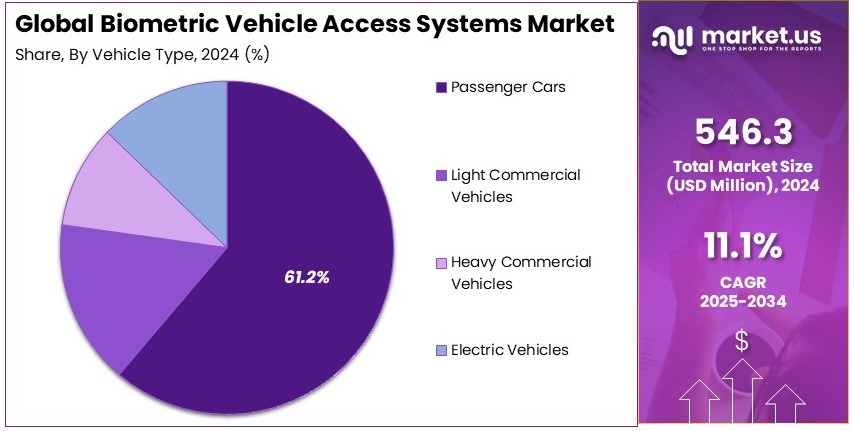
- In 2024, Passenger Cars dominated the vehicle type segment with 61.2%, reflecting high adoption in the consumer vehicle market.
- In 2024, Sensors led the component segment with 52.4%, showcasing their importance in biometric authentication systems.
- In 2024, Original Equipment Manufacturers (OEMs) accounted for 75.8%, indicating their dominance in incorporating biometric features into vehicles.
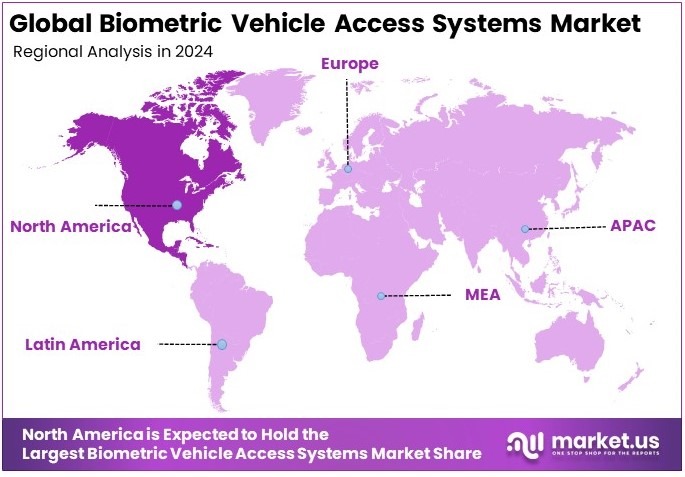
- In 2024, North America dominated the market due to advanced automotive technologies and strong demand for secure vehicle access systems.
Business Environment Analysis
The biometric vehicle access systems market is moderately saturated in developed regions, with emerging markets presenting new opportunities. Rising car thefts, up by 23% in 2023, and growing demand for secure, keyless entry solutions drive adoption. These systems align with the global shift toward smart and connected vehicle technologies.
Target demographics include high-end car owners, fleet operators, and tech-savvy consumers. Luxury automakers lead adoption, integrating fingerprint and facial recognition features. Fleet operators seek these systems to enhance security, particularly in regions with high vehicle theft rates. This expanding customer base boosts market growth.
Product differentiation is a key competitive factor. Advanced systems offering multi-factor authentication and seamless integration with connected vehicle platforms stand out. Additionally, features like remote access control and personalized driver settings appeal to consumers, further driving market interest.
Value chain analysis highlights opportunities for innovation in software and hardware components. Collaborations between automakers and biometric technology firms accelerate development. Localized production and regional compliance strengthen the supply chain, ensuring affordability and accessibility in various markets.
Investment opportunities are growing, supported by government regulations and rising consumer interest. For example, the European Union’s General Safety Regulation mandates advanced security features in vehicles, encouraging the use of biometrics. Emerging markets, particularly in Asia-Pacific, also show potential due to increasing vehicle ownership.
Adjacent markets such as connected vehicles and automotive cybersecurity align with biometric systems. Enhanced vehicle security solutions integrate seamlessly with broader mobility ecosystems. This synergy fosters innovation, reduces theft risks, and positions biometrics as a cornerstone of future automotive advancements.
Authentication Type Analysis
Fingerprint Recognition dominates with 43.6% due to its high reliability and ease of integration into vehicle systems.
The Biometric Vehicle Access Systems Market is primarily segmented by authentication type, including Fingerprint Recognition, Voice Recognition, Facial Recognition, and Iris Recognition.
Fingerprint Recognition leads, favored for its proven reliability and ease of integration into existing vehicle access systems. This technology has been widely adopted due to its quick response time and high accuracy, enhancing vehicle security by limiting access to authorized users only.
Voice Recognition is appreciated for its hands-free operation and increasing sophistication in voice command technology. Facial Recognition is growing due to advancements in artificial intelligence, which improve its accuracy and the speed of identification. Iris Recognition offers one of the most secure biometric technologies, though its higher cost and complexity in implementation make it less common than other types.
Vehicle Type Analysis
Passenger Cars lead with 61.2% due to the high volume of personal vehicle sales globally.
Segmentation by vehicle type in the Biometric Vehicle Access Systems Market includes Passenger Cars, Light Commercial Vehicles, Heavy Commercial Vehicles, and Electric Vehicles. Passenger Cars dominate the market, driven by the significant volume of personal vehicle sales worldwide and the increasing demand for enhanced security features in personal transportation.
Light Commercial Vehicles are driven by the need for securing goods and services during transport. Heavy Commercial Vehicles are valued for controlling access to valuable commercial assets. Electric Vehicles are an emerging segment that increasingly incorporates advanced technologies, including biometrics, for improved security and user experience.
Component Analysis
Sensors dominate with 52.4% due to their critical role in detecting and processing biometric data.
Components in the Biometric Vehicle Access Systems Market are categorized into Hardware and Software. Within Hardware, sub-segments include Sensors, Cameras, and Scanners.
Sensors hold the largest share due to their essential role in detecting physical traits for biometric identification. These devices are integral to the functionality of biometric systems, ensuring accurate data capture for processing.
Cameras are used primarily in facial recognition systems and are driven by their ability to capture detailed images necessary for identifying distinguishing features. Scanners are particularly relevant in fingerprint and iris recognition systems, essential for the accurate capture and interpretation of biometric data.
End-User Analysis
Original Equipment Manufacturers (OEMs) lead with 75.8% due to their direct integration of systems during vehicle assembly.
The End-User segment of the Biometric Vehicle Access Systems Market includes Original Equipment Manufacturers (OEMs) and Aftermarket.
OEMs dominate this segment, attributed to the integration of biometric systems during the assembly of new vehicles, ensuring seamless functionality and design. This integration helps manufacturers offer advanced security features as standard or optional enhancements, appealing to security-conscious consumers.
The Aftermarket offers vehicle owners the opportunity to retrofit their vehicles with advanced biometric systems. This segment caters to consumers seeking to upgrade older vehicles or those not equipped with such technology from the factory, highlighting a significant area of growth as consumer awareness and demand for vehicle security increase.
Key Market Segments
By Authentication Type
- Fingerprint Recognition
- Voice Recognition
- Facial Recognition
- Iris Recognition
By Vehicle Type
- Passenger Cars
- Light Commercial Vehicles
- Heavy Commercial Vehicles
- Electric Vehicles
By Component
- Hardware
- Sensors
- Cameras
- Scanners
- Software
- Biometric Authentication Software
- Data Management Software
By End-User
- Original Equipment Manufacturers (OEMs)
- Aftermarket
Driving Factors
Demand for Advanced Security Drives Market Growth
The Biometric Vehicle Access Systems Market is propelled by strong demand for advanced vehicle security solutions. Increasing demand for such systems arises due to rising incidences of vehicle theft, prompting manufacturers to integrate cutting-edge biometric technology.
Rising adoption of contactless technologies for convenience and safety further fuels growth. For instance, premium car brands like BMW and Audi are exploring fingerprint and facial recognition features to enhance security.
Growing consumer preference for personalized vehicle access and experience adds to the demand. Companies are merging technology trends with user needs to create secure and seamless vehicle entry systems. Such integration not only improves safety but also offers an effortless user experience. Biometric systems reduce the risk of unauthorized access and vehicle theft.
As these systems become more intuitive, drivers gain confidence in using advanced technology. The convenience of contactless access appeals to urban drivers who seek hygiene and ease. The market is set to expand as technology matures and becomes more affordable.
Restraining Factors
High Costs and Privacy Concerns Restrain Market Growth
The Biometric Vehicle Access Systems Market encounters several restraints that may slow its growth. High initial costs for implementation and system integration create financial barriers, particularly for smaller manufacturers.
Privacy concerns over personal data storage and security raise questions among potential users. Limited consumer awareness of biometric vehicle access solutions makes market penetration challenging.
Complexity and time-consuming processes for system installation discourage rapid adoption. For example, car owners might hesitate to install systems that require extensive setup or fear data breaches. These factors can reduce the pace at which new customers embrace the technology. The complexity of integrating multi-biometric systems adds to the cost and technical difficulties.
Consumers worry that sensitive data like fingerprints or facial scans may be vulnerable to hacking. This reluctance affects overall market growth. Manufacturers face challenges in simplifying installation and reducing costs while maintaining high security. Clear guidelines and robust data protection measures are necessary to address privacy fears.
Growth Opportunities
Integration with Smartphones Provides Opportunities
The Biometric Vehicle Access Systems Market presents numerous growth opportunities that stakeholders can leverage. Rising adoption of biometric authentication in mass market vehicles broadens the potential customer base.
Integration of biometric systems with smartphone-based access enhances user convenience, allowing drivers to unlock their vehicles using their mobile devices. For example, BMW’s ConnectedDrive system enables drivers to use their smartphones for secure vehicle access.
Expansion of biometric solutions for fleet management and shared mobility offers new avenues for growth. Companies like Fleet Complete are incorporating biometric access to improve fleet security and efficiency. Additionally, the development of multi-biometric systems combining fingerprint, face, and voice recognition provides higher security and flexibility. These systems cater to diverse user preferences and enhance overall vehicle security.
The rise of Mobility-as-a-Service (MaaS) integrates vehicle-to-vehicle communication with biometric access, creating seamless and secure transportation solutions. Moreover, advancements in biometric technology reduce costs and improve system reliability, making these solutions more accessible to a broader market.
Emerging Trends
Multi-Biometric Systems Are Latest Trending Factor
The Biometric Vehicle Access Systems Market is witnessing significant trends that are shaping its future. Increasing integration of biometric systems in connected car ecosystems enhances overall vehicle functionality and security.
For instance, Tesla is exploring facial recognition to complement existing security features. Adoption of facial recognition and iris scanning for vehicle access provides higher levels of security and user convenience. Companies like Mercedes-Benz are incorporating these technologies to offer seamless and secure access to their vehicles.
Additionally, the rising popularity of touchless and gesture-based authentication methods caters to the demand for hygienic and user-friendly solutions. These methods allow drivers to unlock and start their vehicles without physical contact, enhancing convenience and safety.
Growing interest in multi-modal authentication systems, which combine multiple biometric inputs such as fingerprint, face, and voice recognition, ensures higher security and reduces the likelihood of unauthorized access. This trend is evident in models from brands like Audi, which are integrating multiple biometric sensors to enhance vehicle security.
Furthermore, the integration of biometric systems with augmented reality dashboards provides drivers with real-time feedback and enhanced user experiences. Over-the-air (OTA) updates for vehicle communication systems ensure that biometric technologies remain up-to-date and secure without requiring physical interventions.
Regional Analysis
North America Dominates with Major Market Share
North America leads the Biometric Vehicle Access Systems Market with a significant share. This prominence is driven by high consumer demand for advanced security features, a strong presence of major automotive manufacturers, and increasing investments in biometric technology.
The region’s robust economic status and a high focus on security innovation contribute to the rapid adoption of biometric systems in vehicles. The presence of key technology companies and cutting-edge research in biometrics play crucial roles in developing and refining these systems, ensuring their integration into new vehicle models is both seamless and scalable.
The future role of North America in the Biometric Vehicle Access Systems Market looks increasingly significant. With rising concerns about vehicle security and technological advancements, the demand for biometric access systems is expected to grow, further cementing the region’s leading position. Innovations in biometric technology, such as facial recognition and real-time authentication, are likely to drive this growth.
Regional Mentions:
- Europe: Europe maintains a robust market share in the Biometric Vehicle Access Systems Market, supported by stringent security regulations and a high adoption rate of advanced vehicle technologies. The region’s focus on automotive safety and security is a significant growth driver.
- Asia Pacific: Asia Pacific is quickly advancing in the Biometric Vehicle Access Systems Market due to fast technological adoption and increasing automotive sales, particularly in China and Japan. The region benefits from strong government support for security technologies in transportation.
- Middle East & Africa: The Middle East and Africa are experiencing gradual growth in the Biometric Vehicle Access Systems Market. Increased focus on luxury vehicles and the integration of advanced technologies are key factors contributing to this trend.
- Latin America: Latin America shows potential in the Biometric Vehicle Access Systems Market as awareness about vehicle security grows and consumers show greater interest in advanced automotive technologies. Market development is still nascent but promising due to improving economic conditions.
Key Regions and Countries Covered in the Report
- North America
- US
- Canada
- Europe
- Germany
- France
- The UK
- Spain
- Italy
- Rest of Europe
- Asia Pacific
- China
- Japan
- South Korea
- India
- Australia
- Rest of APAC
- Latin America
- Brazil
- Mexico
- Rest of Latin America
- Middle East & Africa
- South Africa
- Saudi Arabia
- UAE
- Rest of MEA
Competitive Landscape
In the rapidly evolving Biometric Vehicle Access Systems Market, four major players are pivotal in driving technological advancements and market growth: Robert Bosch GmbH, Continental AG, Valeo SA, and Synaptics Incorporated.
Robert Bosch GmbH is a leading figure in the automotive industry, renowned for its high-quality engineering and innovative solutions. Bosch has successfully integrated biometric technologies, such as fingerprint and facial recognition systems, into vehicle access controls, enhancing security and user convenience in modern vehicles.
Continental AG leverages its expertise in automotive technology to develop sophisticated biometric access systems that improve vehicle security and personalization. Continental’s solutions focus on usability and integration with other in-car technologies, providing a seamless user experience that aligns with current consumer expectations.
Valeo SA specializes in automotive components and smart technology systems, including biometrics for vehicle access. Valeo’s products are designed to meet the stringent security requirements of the automotive industry, offering reliable and efficient biometric recognition that ensures vehicle safety and accessibility.
Synaptics Incorporated stands out for its focus on human interface solutions, which include advanced biometric technologies tailored for the automotive market. Synaptics brings cutting-edge fingerprint and facial recognition technology to vehicle systems, enhancing both the security and the personalized settings for drivers.
These key players contribute significantly to the advancement of biometric vehicle access technologies. Their ongoing innovations and developments in biometrics help create safer and more personalized experiences for drivers, setting high standards in the integration of biometric systems into vehicle design and functionality. Their collective efforts are crucial in driving forward the adoption of these technologies in the global automotive market.
Major Companies in the Market
- Robert Bosch GmbH
- Continental AG
- Valeo SA
- Synaptics Incorporated
- Fingerprint Cards AB
- Nuance Communications, Inc.
- HID Global Corporation
- Fujitsu Limited
- Safran S.A.
- Hitachi, Ltd.
- Muthoot Pappachan Group
- VOXX International Corporation
- Denso Corporation
Recent Developments
- Infineon’s Automotive-Qualified Fingerprint Sensors: On October 2024, Infineon Technologies AG introduced automotive-qualified fingerprint sensor ICs, the CYFP10020A00 and CYFP10020S00. These sensors support robust fingerprint identification and authentication, enabling in-vehicle personalization and secure payments for services like charging and parking.
- IDEMIA and SECURE Systems’ Biometric Access Control Solution: On November 2024, IDEMIA Public Security, in collaboration with SECURE Systems, launched a biometric access control solution featuring the MorphoWave biometric terminal. This solution meets ANSSI standards, ensuring security for Operators of Vital Importance (OIV) and critical infrastructures.
- Continental’s Intelligent Demo Car with Biometric Interaction: At CES 2025, Continental unveiled its Intelligent Vehicle Experience Car, featuring advanced biometric technologies. The vehicle employs facial recognition and movement analysis for intuitive access, user personalization, and enhanced security against unauthorized access.









