


Report Overview
The Global AI and RAN Traffic Optimization Market size is expected to be worth around USD 27.2Billion By 2034, from USD 2.2 Billion in 2024, growing at a CAGR of 28.60% during the forecast period from 2025 to 2034. In 2024, North America captured more than 44.8% of the AI and RAN Traffic Optimization market share, with revenues reaching USD 0.9 billion, holding a dominant market position.
AI and RAN Traffic Optimization refers to the application of advanced AI technologies to improve the performance, efficiency, and management of radio networks, specifically in mobile communications. The primary aim of this integration is to handle increasing traffic demands in modern cellular networks, such as 5G, by intelligently managing the distribution of data traffic across various network resources.
The AI and RAN Traffic Optimization market is undergoing significant growth due to the need for efficient network management driven by the rapid expansion of mobile data traffic and the proliferation of smart devices. Technologies such as deep learning, machine learning, and various AI algorithms are being employed to improve network operations, reducing costs and enhancing user experience. This market is characterized by its focus on developing solutions that enable more intelligent, scalable, and flexible network infrastructures.
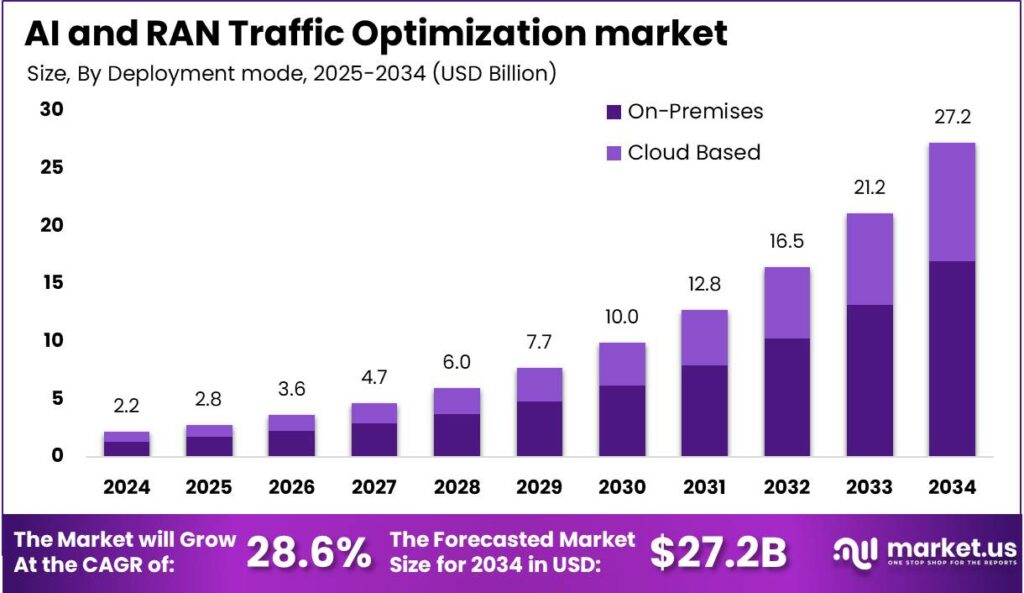
The major driving factors of the AI and RAN Traffic Optimization market include the growing demand for superior network performance and the necessity for automated and efficient operations in telecom networks. The continuous expansion of mobile networks, the introduction of new technologies like 5G and the increasing complexity of network management tasks are compelling service providers to adopt AI-driven optimization solutions.
Market demand in AI and RAN Traffic Optimization is primarily driven by the telecommunications sector’s need to manage increasing volumes of data and maintain service quality in densely populated areas. As consumers and businesses continue to expect faster and more reliable mobile services, telecom operators are investing in AI technologies to ensure their networks can meet these expectations effectively.
Technological advancements in AI and RAN Traffic Optimization include the integration of advanced algorithms like machine learning models, predictive analytics, and real-time data processing. These innovations help in anticipating network load, optimizing resource allocation, and minimizing disruptions. The adoption of cloud-native RAN architectures and virtualized network functions also marks a significant technological shift, making networks more adaptable and easier to manage.
The business benefits of implementing AI in RAN optimization are manifold. They include reduced operational costs due to automation, improved customer satisfaction from enhanced connectivity and service reliability, and increased operational efficiency. AI-driven solutions also provide telecom operators with the flexibility to scale operations and innovate their service offerings more rapidly, positioning them better in competitive markets.
Key Takeaways
- The Global AI and RAN Traffic Optimization Market size is expected to reach USD 27.2 Billion by 2034, up from USD 2.2 Billion in 2024, growing at a CAGR of 28.60% during the forecast period from 2025 to 2034.
- In 2024, the Hardware segment held a dominant market position, capturing more than 40.0% of the AI and RAN Traffic Optimization market.
- The On-Premises segment held a dominant position in 2024, capturing more than 62.4% of the AI and RAN Traffic Optimization market.
- The Traffic Load Balancing segment held a dominant market position in 2024, capturing more than 28.7% of the market share.
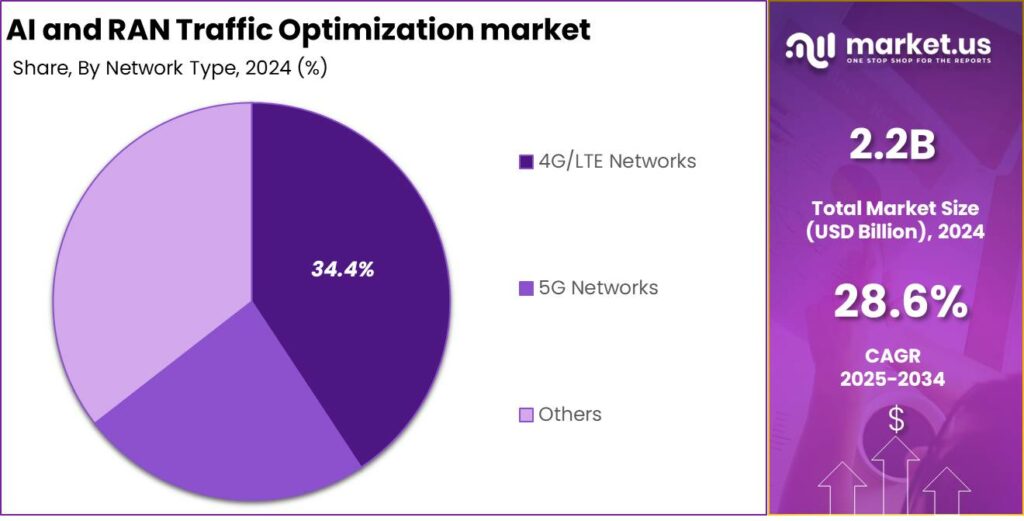
- The 4G/LTE Networks segment held a dominant market position in 2024, capturing more than 34.4% of the AI and RAN Traffic Optimization market.
- In 2024, the Telecommunication Service Providers segment held a dominant position in the market, capturing more than 62.9% of the AI and RAN Traffic Optimization market share.
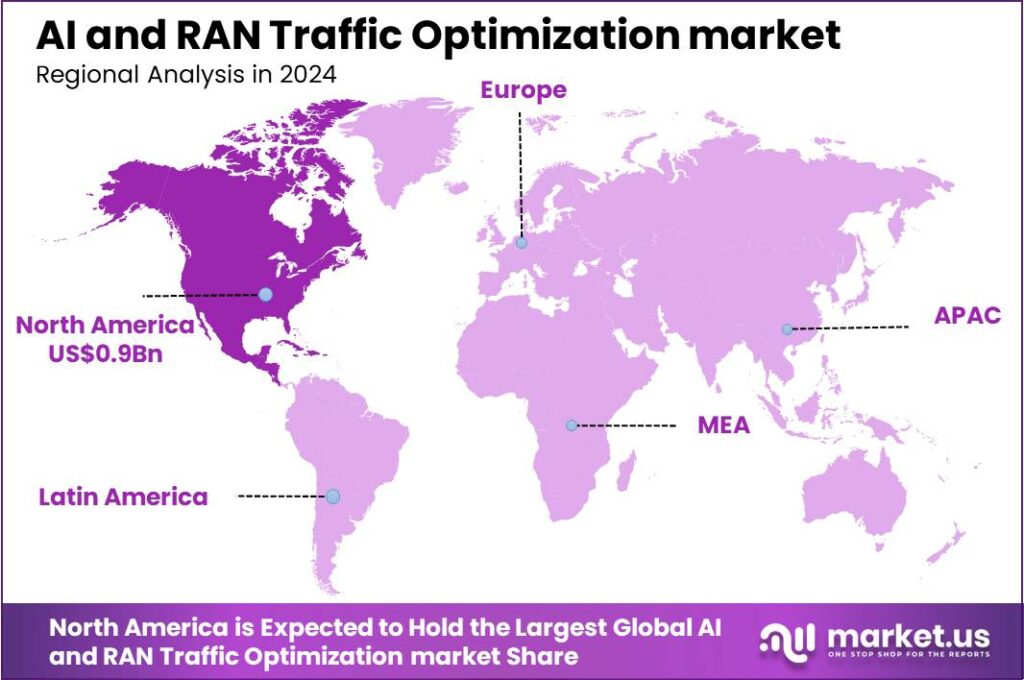
- North America dominated the AI and RAN Traffic Optimization market in 2024, capturing more than 44.8% of the market share, with revenues reaching USD 0.9 billion.
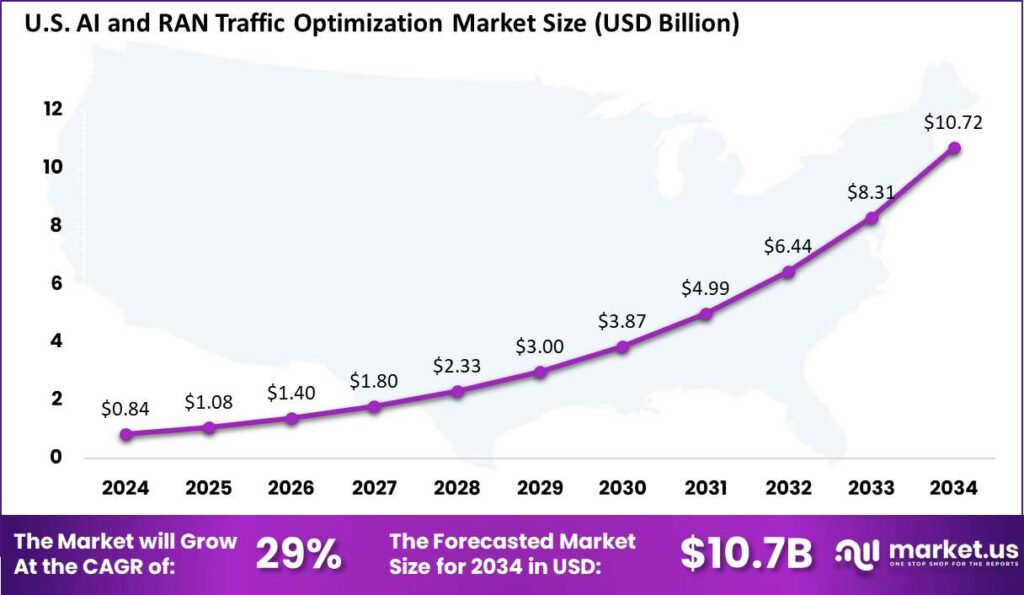
- The US AI and RAN Traffic Optimization Market size was exhibited at USD 0.84 Bn in 2024 with CAGR of 29%.
U.S. AI and RAN Traffic Optimization Market Size
The US AI and RAN Traffic Optimization Market has demonstrated notable growth, being valued at USD 0.84 billion in 2024, with a robust compound annual growth rate (CAGR) of 29%. This growth trajectory is indicative of the significant advancements and the increasing adoption of AI technologies in optimizing radio access networks (RAN) across the country.
This market’s expansion is propelled by several key factors. Firstly, the ongoing deployment and maturation of 5G networks, which require more sophisticated management solutions to handle increased data traffic and connectivity demands, play a critical role. The integration of AI facilitates more efficient management and optimization of network traffic, which is crucial in maintaining service quality in dense urban environments and during high demand periods.
Furthermore, technological advancements are driving the market forward. Innovations in AI algorithms and machine learning models are enhancing the capability of networks to predict traffic patterns and dynamically allocate resources. These advancements not only improve network efficiency but also reduce operational costs and the need for manual intervention, making the network more adaptable to changing conditions.
The business implications of these technological advancements are significant. For telecom operators, the adoption of AI-driven RAN optimization tools translates into better resource management, improved customer satisfaction due to fewer service disruptions, and lower operational costs due to automation. These benefits are crucial for maintaining competitiveness in a rapidly evolving telecommunications market.
In 2024, North America held a dominant market position in the AI and RAN Traffic Optimization market, capturing more than a 44.8% share with revenues reaching USD 0.9 billion. This leading position can primarily be attributed to the rapid deployment of 5G networks across the region and the high adoption rate of advanced technologies by telecom operators in the United States and Canada.
The presence of major telecom and technology firms in North America, which are investing heavily in AI and machine learning to optimize network operations, also contributes significantly to the region’s market dominance. Companies like AT&T and Verizon are adopting AI to improve network efficiency and customer service, boosting demand for AI-powered traffic optimization solutions.
Furthermore, the regulatory environment in North America has been supportive of technological advancements in the telecom sector. Regulatory bodies have been proactive in releasing spectrum and promoting policies that encourage the deployment of 5G and subsequent network technologies, creating a conducive environment for the growth of the AI and RAN Traffic Optimization market.
Additionally, the increasing consumer demand for high-speed and reliable internet service, driven by the surge in remote work, online education, and streaming services, has pressured network operators to continuously improve their networks. This has led to greater utilization of AI technologies for traffic management, making North America a leading region in the global AI and RAN Traffic Optimization market.
Component Analysis
In 2024, the Hardware segment held a dominant market position, capturing more than a 40.0% share of the AI and RAN Traffic Optimization market. This leadership can be attributed to the growing demand for advanced network infrastructure required to support AI-driven traffic optimization technologies.
Hardware components such as servers, network infrastructure, and AI accelerators play a crucial role in ensuring the processing power and low-latency performance needed to handle the increasing volume of mobile traffic. These hardware elements are integral to the deployment and scaling of AI/ML algorithms that optimize traffic flow, making them indispensable for operators seeking to enhance network efficiency and reliability.
The demand for specialized AI accelerators is particularly driving the growth of the hardware segment. As AI and machine learning models become more complex, the need for high-performance computing hardware, such as Graphics Processing Units (GPUs) and AI chips, has increased significantly.
These components enable faster data processing, reducing delays in traffic optimization tasks, which is vital for real-time applications like 5G. The ability to process large volumes of data quickly is becoming a competitive advantage for mobile operators, prompting more investments in hardware infrastructure.
Deployment Mode Analysis
In 2024, the On-Premises segment held a dominant position in the AI and RAN Traffic Optimization market, capturing more than a 62.4% share. This segment’s leadership can be attributed to several key factors that resonate with the current market dynamics and customer preferences.
On-premises solutions offer enhanced security and control over the data, which is a critical requirement for telecom operators managing sensitive information and seeking to comply with stringent regulatory standards. This aspect is particularly crucial in industries where data sovereignty and security are paramount.
Moreover, the on-premises deployment allows for greater customization and integration with existing network infrastructures. Many telecommunications companies have historically invested heavily in their on-site systems and prefer to build on these investments rather than transitioning to newer models.
Additionally, on-premises solutions often result in lower latency compared to cloud-based alternatives. In the context of RAN traffic optimization, where immediate response times are essential for maintaining network efficiency and quality of service, the proximity of on-premises hardware can provide a significant advantage.
Optimization Type Analysis
In 2024, the Traffic Load Balancing segment held a dominant market position within the AI and RAN Traffic Optimization market, capturing more than a 28.7% share. This segment’s leadership can be attributed to its crucial role in managing the distribution of data across networks, ensuring efficient utilization of available bandwidth and minimizing delays.
As data traffic volumes surge due to the proliferation of IoT devices and increased mobile usage, the demand for sophisticated traffic load balancing solutions has intensified. These solutions are essential in preventing network congestion and maintaining service quality, making them a pivotal component of modern network management strategies.
The Resource Allocation segment also plays a significant role in the AI and RAN Traffic Optimization market. This segment focuses on optimizing the allocation of network resources to enhance overall performance and user satisfaction.Effective resource allocation helps in reducing bottlenecks in network traffic, which is increasingly important as networks face the challenges of varied traffic types and fluctuating demand.
Solutions in this segment apply various techniques to reduce the impact of interference caused by overlapping frequencies and other sources. By improving signal clarity, these solutions enhance the reliability and efficiency of wireless networks, supporting a smoother and more stable connection for end-users.
Network Type Analysis
In 2024, the 4G/LTE Networks segment held a dominant market position in the AI and RAN Traffic Optimization market, capturing more than a 34.4% share. This leadership is primarily due to the extensive global deployment of 4G networks, which continue to be the backbone of mobile internet connectivity in many regions.
The 5G Networks segment, while still in the growth phase, represents the future of mobile telecommunications. This segment benefits from superior bandwidth and lower latency, which are essential for enabling next-generation applications such as augmented reality, virtual reality, and seamless IoT connectivity.
The ‘Others’ category encompasses various other network technologies, including legacy 3G networks and emerging next-generation network standards. While these networks collectively hold a smaller share of the market, they cater to specific needs and regions where newer network technologies have yet to make a significant impact.
The AI and RAN Traffic Optimization market is segmented by network type to address specific challenges and opportunities. The 4G/LTE segment remains dominant due to its maturity, while the growing 5G segment reflects the shift towards advanced networks, fueled by technological progress and demand for faster, more reliable services.
End-User Analysis
In 2024, the Telecommunication Service Providers segment held a dominant position in the AI and RAN Traffic Optimization Market, capturing more than a 62.9% share.This segment includes Mobile Network Operators (MNOs) and Internet Service Providers (ISPs), which are increasingly adopting AI-driven solutions to improve network efficiency and handle growing data traffic.
The Telecommunication Service Providers segment leads due to the expansion of mobile networks and rising demand for high-speed internet. MNOs and ISPs are using AI to automate network operations and enable real-time data analysis for traffic management.
The segment’s dominance is driven by significant investments in 5G and IoT, which demand advanced traffic management solutions. Telecommunication providers are leading in implementing AI algorithms to predict traffic patterns, optimize bandwidth.
The Telecommunication Service Providers segment’s leadership is strengthened by regulatory support and digital transformation initiatives. Governments and regulatory bodies are creating a favorable environment for digital infrastructure growth, driving AI-based traffic optimization adoption among MNOs and ISPs.
Key Market Segments
By Component
- Hardware
- Servers
- Network Infrastructure
- AI Accelerators
- Others
- Software
- Traffic Optimization Algorithms
- AI/ML-Driven Platforms
- RAN Intelligent Controllers (RICs)
- Others
- Services
- Professional Services
- Implementation & Integration
- Consulting & Training
- Support & Maintenance
- Managed Services
- Professional Services
By Deployment Mode
- On-Premises
- Cloud-Based
By Optimization Type
- Traffic Load Balancing
- Resource Allocation
- Spectrum Optimization
- Interference Mitigation
- Energy Optimization
- Others (Coverage and Capacity Optimization,Latency Reduction, etc.)
By Network Type
- 4G/LTE Networks
- 5G Networks
- Others
By End-User
- Telecommunication Service Providers
- Mobile Network Operators (MNOs)
- Internet Service Providers (ISPs)
- Enterprises
- Manufacturing
- Retail
- Healthcare
- IT & Telecom
- Media & Entertainment
- Others (Energy & Utilities, etc.)
Driver
Enhanced Network Efficiency through AI Integration
Integrating Artificial Intelligence (AI) into Radio Access Networks (RAN) significantly enhances network efficiency. AI-driven algorithms analyze vast amounts of real-time data, enabling dynamic resource allocation and optimization of traffic flows.
This leads to improved user experiences and operational cost savings. Additionally, AI facilitates energy management by transitioning base stations into energy-saving modes during low-traffic periods, reducing power consumption. The adoption of AI in RAN is a strategic move for operators aiming to deliver high-quality services while maintaining cost-effective and sustainable operations.
Restraint
High Implementation Costs and Resource Requirements
Implementing AI solutions in RAN involves substantial costs and resource demands. Developing and maintaining customized AI models tailored to specific network scenarios require significant investment in computational power, data storage, and specialized personnel. The resource-intensive nature of AI, especially during the training phase, can lead to high operational expenses.
These financial and resource constraints may hinder the widespread adoption of AI in RAN, particularly for smaller operators with limited budgets. To mitigate these challenges, operators can explore open-source AI frameworks and collaborative efforts with industry consortia to share resources and expertise, thereby reducing individual burdens.
Opportunity
Development of Intelligent Traffic Management Systems
The integration of AI into RAN presents a significant opportunity to develop intelligent traffic management systems. By leveraging advanced algorithms, networks can analyze real-time data from various sources, including traffic cameras, sensors, and GPS data from vehicles.
This data-driven approach enables the prediction of congestion patterns and the adjustment of traffic signals accordingly, leading to optimized traffic flows and reduced congestion. Implementing such AI-driven traffic management systems can enhance user experiences, improve safety, and contribute to environmental sustainability by reducing emissions associated with traffic congestion.
Challenge
Data Quality and Standardization Issues
A significant challenge in applying AI to RAN is ensuring data quality and standardization. The diverse and often non-standardized nature of telecom data creates isolated information silos, complicating comprehensive analysis and AI application.
Inconsistent data quality can lead to inaccurate AI predictions, resulting in suboptimal network performance and inefficient resource allocation. To address this challenge, implementing data governance frameworks and standardization protocols is essential. This ensures data consistency and reliability across various sources and formats, facilitating effective AI integration and operation within RAN.
Emerging Trends
One emerging trend is the integration of AI-driven algorithms directly into the baseband units of RAN infrastructure. This approach enables real-time management of radio frequencies and traffic, ensuring consistent 5G coverage and an improved user experience.
Another development is the use of AI in Open RAN architectures. By deploying AI applications on RAN Intelligent Controllers (RICs), networks can achieve intelligent energy optimization, adaptive mobility management, and strategic traffic handling.
The convergence of AI with 5G networks is also noteworthy. AI enhances RAN capabilities by optimizing network performance and efficiency. As AI-powered applications for consumers and enterprises proliferate, mobile networks are preparing for a significant increase in data traffic, particularly in the uplink direction.
In the context of 6G, AI is expected to play a central role in network management and performance optimization. The concept of a distributed AI-native platform is being explored to address challenges in deploying AI solutions within the RAN, aiming to transform network operations and support advanced applications.
Business Benefits
- Enhanced Network Performance: AI helps mobile operators automate RAN operations, boost network performance, and shorten the time to market for new features.
- Improved User Experience: AI-driven solutions can enhance user experience by providing smarter and more responsive services.
- Operational Cost Reduction: AI can automate network management and optimization tasks, reducing the need for manual intervention and lowering operational costs.
- Energy Efficiency: AI can optimize energy consumption in RAN operations, contributing to more sustainable and cost-effective network management.
- New Revenue Streams: AI enables the creation of new business models and services, such as predictive maintenance and customer behavior analysis, opening up opportunities for telecom operators to monetize their data.
Key Regions and Countries
- North America
- US
- Canada
- Europe
- Germany
- France
- The UK
- Spain
- Italy
- Rest of Europe
- Asia Pacific
- China
- Japan
- South Korea
- India
- Australia
- Singapore
- Rest of Asia Pacific
- Latin America
- Brazil
- Mexico
- Rest of Latin America
- Middle East & Africa
- South Africa
- Saudi Arabia
- UAE
- Rest of MEA
Key Player Analysis
In the AI and RAN Traffic Optimization market, several key players play pivotal roles in shaping the landscape.
Cisco Systems, Inc. stands as a leading figure in the AI and RAN Traffic Optimization sector. Cisco has developed a robust suite of solutions that leverage AI to enhance network management and efficiency. Their products are known for their reliability and the integration of advanced analytics, which helps telecom operators optimize traffic flow and network performance.
Qualcomm Technologies is another major player, renowned for its technological advancements in wireless technology. Qualcomm’s innovations in AI accelerators and chipsets for mobile devices and infrastructure enable high-speed, efficient, and intelligent RAN operations.
Nokia Corporation has also carved out a strong position in the AI and RAN Traffic Optimization market with its comprehensive array of network products and services. Nokia’s focus on the integration of AI into their network offerings allows for enhanced automation, improved operational efficiency, and better resource management.
Top Key Players in the Market
- Cisco Systems, Inc.
- Qualcomm Technologies
- Nokia Corporation
- Telefonaktiebolaget LM Ericsson
- Huawei Technologies Co., Ltd.
- Samsung Electronics
- ZTE Corporation
- Mavenir
- Intel Corporation
- NEC Corporation
- Juniper Networks
- Amdocs
- Others
Top Opportunities Awaiting for Players
- Enhanced Network Efficiency and Cost Reduction: As AI continues to integrate with RAN, there is significant potential for improving network efficiency and reducing operational costs. AI algorithms optimize network traffic and resources dynamically, leading to lower energy consumption and improved service delivery.
- Vendor Diversification and Innovation: With the advent of AI-driven RAN solutions, traditional vendors face challenges but also opportunities to innovate. Companies like Nvidia and Qualcomm are pushing the envelope with AI integration, compelling traditional vendors like Ericsson and Nokia to either adapt or develop new solutions to stay competitive. This shift encourages a diversification of vendor offerings and innovation in AI applications within the RAN.
- Regulatory and Geopolitical Influence: The global push towards AI integration in RAN comes with increased regulatory and geopolitical attention. Market players can leverage this by influencing policy development and adapting to new standards that favor sustainable and secure AI implementations in telecom infrastructures.
- Advanced Capabilities in Emerging Networks (5G and 6G): AI is set to play a crucial role in the evolution of 5G and the upcoming 6G networks, introducing capabilities such as predictive analytics, intelligent traffic management, and automated network solutions. These advancements present substantial market opportunities for network operators and equipment manufacturers to offer new services and improve network reliability and user experience.
- Collaborative Ecosystems and Alliances: The formation of alliances like the AI-RAN Alliance underscores the importance of collaborative efforts in the industry. By participating in such initiatives, companies can share knowledge, reduce research and development costs, and accelerate the deployment of AI solutions across global markets.
Recent Developments
- In September 2024, NVIDIA introduced AI Aerial, a platform designed to optimize wireless networks by integrating AI into RAN infrastructure. This platform enables telecommunications providers to enhance network performance and support new AI-driven services.
- In September 2024, T-Mobile, in collaboration with NVIDIA, Ericsson, and Nokia, launched an AI-RAN Innovation Center. This initiative focuses on designing and advancing mobile networks with AI at the core, aiming to revolutionize RAN capabilities to better serve customers.
- In November 2024, SoftBank Corp. announced the development of AITRAS, a converged AI-RAN solution capable of hosting both AI and RAN workloads on the same NVIDIA-accelerated computing platform. SoftBank plans to implement AITRAS across its commercial network and aims to expand the solution to telecom operators globally from 2026 onwards.









