


Report Overview
The Global Building Twin Market size is expected to be worth around USD 35.6 Billion By 2034, from USD 2.3 Billion in 2024, growing at a CAGR of 31.50% during the forecast period from 2025 to 2034. In 2024, North America led the Building Twin market with a dominant share of over 37.1%, generating revenues of approximately USD 0.8 billion.
A Building Twin is a digital representation of a physical building, integrating dynamic and static data from various sources into comprehensive 2D/3D models. This technology enables informed decision-making by bridging the physical and digital realms through sensors that gather real-time data, thus providing a current snapshot of a building’s status and performance.
Building Twins are utilized to optimize building management, maintenance, and energy consumption by leveraging data from connected systems and environmental factors. The Building Twin market is emerging as a significant segment within the construction and real estate industries, driven by the increasing integration of IoT and smart technology in building management.
This market focuses on technologies that create precise simulations of physical buildings to improve efficiency, reduce costs, and enhance the sustainability of building operations. The adoption of Building Twins is seen as a part of the broader trend towards digital transformation in construction and facilities management

Major driving factors for the Building Twin market include the need for enhanced building efficiency and sustainability, the growing demand for intelligent building solutions, and the push towards reducing operational costs. Digital Twins allow for predictive maintenance and optimized energy management, which are crucial in today’s energy-conscious environment.
Market demand for Building Twins is driven by rapid urbanization and the consequent need for smarter building solutions. As cities grow, there is an increasing requirement for buildings that can adapt to changing environmental conditions and occupancy patterns, manage resources efficiently, and maintain high standards of occupant comfort and security.
Technological advancements are rapidly shaping the Building Twin market. Innovations in AI, machine learning, and IoT devices facilitate more detailed and accurate modeling of building operations. These technologies enable real-time analytics and decision-making, enhancing the capability of Building Twins to predict maintenance needs and optimize building systems for energy efficiency and cost savings.
Significant market opportunities lie in retrofitting existing buildings with digital twin technologies to extend their operational efficiency and lifecycle. The ability to integrate with legacy systems and provide ongoing insights into building performance and usage patterns presents a broad scope for the application of Building Twins in older infrastructure, which may not have been originally designed with such capabilities in mind.
Key Takeaways
- The Global Building Twin Market is projected to reach USD 35.6 Billion by 2034, up from USD 2.3 Billion in 2024, growing at a CAGR of 31.50% from 2025 to 2034.
- In 2024, the Software segment led the Building Twin market, holding a dominant share of more than 57.4%.
- The Commercial Buildings segment also had a major market share in 2024, capturing over 40.5% of the Building Twin market.
- North America held the largest share in the Building Twin market in 2024, accounting for more than 37.1%, with revenues around USD 0.8 billion.
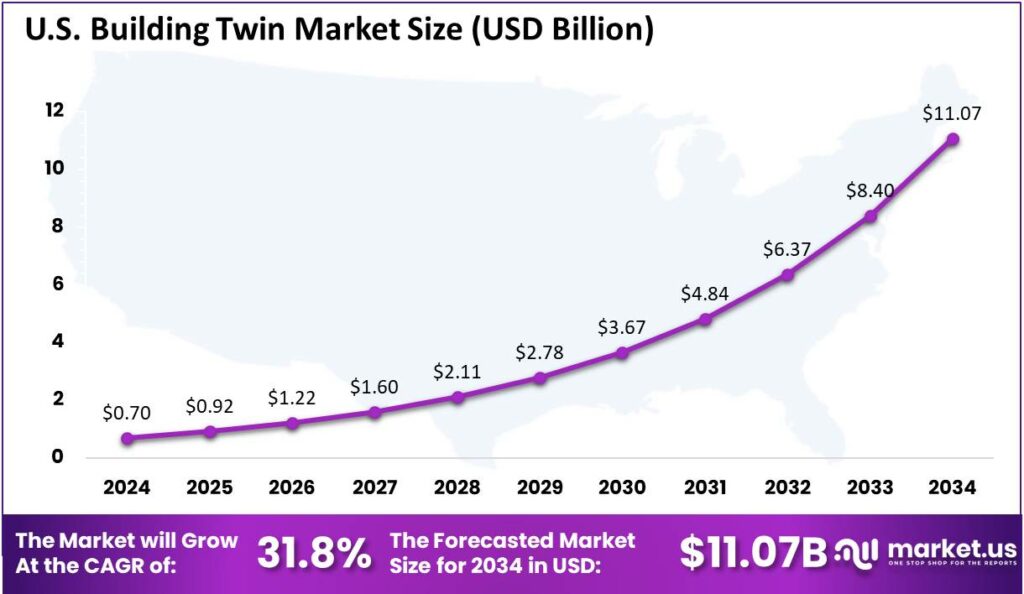
- The US Building Twin market size was exhibited at 0.7 Bn in 2024.
U.S. Building Twin Market size
The US Building Twin market was valued at US$ 0.7 billion in 2024 due to several strategic advantages and initiatives. Key among these are the presence of leading technology firms and a robust startup ecosystem, which foster innovation and drive the development of new technologies.
The U.S. has made significant investments in research and development, which enhances its capability to adopt and integrate new technologies swiftly. This early adoption is crucial in maintaining a competitive edge in the global market.
Moreover, the integration of 5G technology has been a pivotal factor in advancing the Building Twin market in the U.S. This technology supports the real-time monitoring and control of building operations, allowing for more efficient management of smart infrastructure. The ability to process and analyze vast amounts of data instantaneously is becoming increasingly important as buildings become smarter and more connected.
In 2024, North America held a dominant position in the Building Twin market, capturing more than a 37.1% share with revenues reaching approximately USD 0.8 billion. This region’s leadership is attributed to several contributing factors that underscore its advanced technological landscape and robust economic infrastructure.
North America benefits from the presence of major technology firms and innovative startups, which drive the development and adoption of Building Twin technologies. These entities not only contribute to technological advancements but also foster a competitive market environment that accelerates innovation in Building Twin solutions.
The region’s stringent regulatory standards regarding building safety, energy efficiency, and environmental sustainability further propel the adoption of Building Twin technologies. North American companies and regulatory bodies are increasingly recognizing the potential of digital twins to achieve compliance and exceed sustainability goals.
Moreover, the substantial investments in smart city projects across North American cities have significantly contributed to the market’s growth in this region. These projects often incorporate Building Twin technologies to enhance urban planning, infrastructure management, and public safety, which further drives demand within the regional market.

Component Analysis
In 2024, the Software segment held a dominant position within the Building Twin market, capturing more than a 57.4% share. This segment’s leadership is primarily due to the critical role software plays in the functionality of Building Twins.
Software solutions are the backbone of Building Twin systems, providing the essential tools for creating, managing, and manipulating the digital twins. These solutions offer a platform for integrating various data streams from physical buildings into a coherent and interactive digital model, enabling real-time analytics and decision-making.
The prominence of the Software segment is further reinforced by continuous advancements in cloud computing and AI technologies. These innovations enhance the capabilities of Building Twin software, making it not only more efficient in simulating complex real-world scenarios but also more scalable and accessible to a broader range of industries.
Moreover, the integration capabilities of Building Twin software stand out as a significant driver. Modern Building Twin software platforms are designed to be compatible with a wide array of IoT devices and existing building management systems, allowing for seamless data integration and interoperability.
End-User Analysis
In 2024, the Commercial Buildings segment held a dominant market position, capturing more than a 40.5% share in the Building Twin market. This segment benefits immensely from Building Twins due to the complex nature and high operational demands of commercial infrastructures such as malls, office buildings, and complexes.
Commercial buildings lead in adopting Building Twins due to the need for ongoing operational improvements to ensure tenant satisfaction and regulatory compliance. These systems help monitor and adjust real-time environmental conditions, especially in high-traffic areas with varying usage.
Moreover, the scale and frequency of renovations and upgrades in commercial buildings necessitate precise planning and execution, where Building Twins play a crucial role. By providing a virtual representation of physical spaces, stakeholders can predict outcomes, plan interventions more effectively, and minimize disruptions to business operations.
The growing pressure for sustainability and efficiency has made Building Twins crucial for compliance and reporting. They help commercial managers track building performance, ensuring easier adherence to environmental standards and regulations, reinforcing their market leadership.

Key Market Segments
By Component
- Software
- Hardware
- Services
By End-User
- Commercial Buildings
- Industrial Facilities
- Residential Buildings
- Government and Public Buildings
Key Regions and Countries
- North America
- US
- Canada
- Europe
- Germany
- France
- The UK
- Spain
- Italy
- Rest of Europe
- Asia Pacific
- China
- Japan
- South Korea
- India
- Australia
- Singapore
- Rest of Asia Pacific
- Latin America
- Brazil
- Mexico
- Rest of Latin America
- Middle East & Africa
- South Africa
- Saudi Arabia
- UAE
- Rest of MEA
Driver
Enhanced Decision-Making through Real-Time Data Integration
The adoption of Building Twin technology is significantly driven by its capacity to integrate real-time data from various building systems. This integration enables stakeholders to make informed decisions throughout a building’s lifecycle.
Building Twins consolidate data from IoT sensors, BIM, and historical information, offering a comprehensive view of a building’s performance. This enables scenario simulation, early issue identification, and optimization of building operations.
Additionally, the ability to visualize and analyze data in real-time fosters improved collaboration among architects, engineers, contractors, and facility managers, ensuring that all parties are aligned in their decision-making processes.
Restraint
High Initial Investment Costs
Despite its advantages, the implementation of Building Twin technology faces significant restraint due to high initial investment costs. The expenses associated with acquiring the necessary hardware, software, and training can be substantial, particularly for small and medium-sized enterprises (SMEs).
This financial barrier may deter organizations from adopting Building Twin solutions, as the return on investment may not be immediately apparent. Moreover, the integration of Building Twin technology often requires upgrading existing infrastructure, further escalating costs. The lack of standardized BIM practices can also lead to implementation complexities, potentially increasing expenses and project timelines.
Opportunity
Predictive Maintenance and Operational Efficiency
Building Twin technology presents a significant opportunity in the realm of predictive maintenance and operational efficiency. A dynamic digital replica of a building allows stakeholders to monitor real-time data on asset conditions, usage, and environmental factors. This continuous monitoring helps predict maintenance needs, reducing downtime and extending the lifespan of building systems.
Additionally, the optimization of energy consumption and resource utilization contributes to cost savings and supports sustainability initiatives. The ability to simulate various scenarios allows for proactive adjustments to building operations, enhancing occupant comfort and overall building performance.
Challenge
Data Integration and Interoperability
A significant challenge in implementing Building Twin technology lies in data integration and interoperability. The process of connecting systems, sensors, and platforms is often complex, particularly when dealing with outdated infrastructure or incompatible tools.
Ensuring seamless communication between various building systems and IoT devices is crucial for the effective functioning of a Building Twin. Without proper integration, the digital twin may not accurately reflect the physical building, leading to potential inefficiencies and errors in decision-making. To address this challenge, organizations should assess their current systems and focus on building a scalable infrastructure.
Emerging Trends
The building twin market is experiencing significant growth, driven by several emerging trends. One key factor is the increasing focus on smart buildings and digital transformation, which has led to a rising demand for building twin solutions.
The integration of Internet of Things (IoT) and Artificial Intelligence (AI) technologies is transforming the building twin industry. These technologies enable real-time data collection and analysis, enhancing building efficiency, predictive maintenance, and occupant comfort.
Another emerging trend is the adoption of 5G technology in building twins. The high-speed connectivity of 5G facilitates real-time building monitoring and control, which is essential for optimizing building performance and meeting the evolving needs of smart infrastructure.
Business Benefits
One of the primary advantages is improved facility management. Building twins provide a virtual replica of physical structures, allowing for real-time monitoring and control. This capability enables facility managers to optimize space utilization, monitor systems, and ensure that all building components function efficiently.
Predictive maintenance is another significant benefit. By analyzing data from various building systems, building twins can predict potential failures before they occur. This proactive approach reduces downtime, extends the lifespan of equipment, and lowers costs.
Energy management is also enhanced through building twins. They enable businesses to monitor energy consumption in real-time, identify inefficiencies, and implement strategies to reduce energy usage. This not only lowers operational costs but also supports sustainability initiatives by reducing the building’s carbon footprint.
Key Player Analysis
The Building Twin market is characterized by the presence of several influential key players. Each of these companies plays a significant role in shaping the dynamics of the market through innovative solutions and strategic initiatives.
Autodesk, Inc. stands out in the Building Twin market for its comprehensive suite of software solutions that facilitate the creation and management of digital twins for buildings and infrastructure. The company’s offerings, particularly AutoCAD and Revit, provide robust tools for designing, visualizing, and simulating physical structures in a digital environment.
Siemens AG is another dominant force in the Building Twin market, known for its cutting-edge digital technologies and integrated solutions. Siemens’ Digital Industries Software leverages high-fidelity data analytics and IoT integration to offer Building Twin solutions that optimize energy efficiency and operational reliability.
Dassault Systèmes excels in the Building Twin market with its 3DEXPERIENCE platform, which provides a virtual universe where physical buildings can be modeled and analyzed in exquisite detail. The company’s solutions focus on sustainability and optimization, allowing for significant advancements in resource management and structural analysis.
Top Key Players in the Market
- Autodesk, Inc.
- Siemens AG
- Dassault Systèmes
- Bosch Sicherheitssysteme GmbH
- Arup
- Amazon Web Services, Inc.
- Johnson Controls
- ACCA software
- ProptechOS
- Glider Technology ltd.
- Invicara
- Other Key Players
Top Opportunities Awaiting for Players
- Integration with 5G and Advanced IoT Technologies: As the deployment of 5G technology accelerates, it offers significant opportunities for the Building Twin market. The real-time data processing capabilities of 5G enable more dynamic and responsive Building Twin models. Coupling this with advanced IoT sensors enhances building monitoring and management systems, leading to more efficient operations and maintenance strategies.
- Expansion into Smart City Projects: The global push towards smart cities presents a lucrative avenue for growth. Building Twin technology is instrumental in planning and managing urban development efficiently.Building Twins optimize energy use, boost public safety, and enhance urban infrastructure by integrating with city-wide management systems, playing a key role in smart cities.
- Energy Management and Sustainability Initiatives: There is a growing focus on sustainability and energy efficiency in building management. Building Twins play a crucial role in this area by providing detailed insights into energy consumption and efficiency opportunities. This capability is particularly valuable in light of increasing regulatory requirements and the global push towards greener buildings.
- Advanced AI and Machine Learning Integration: The integration of AI and machine learning technologies continues to refine the capabilities of Building Twins. These technologies enhance predictive maintenance, security management, and operational efficiency. AI-powered Building Twins predict maintenance needs, optimize systems, and extend infrastructure lifespan.
- Enhanced Focus on Renovation and Retrofit Projects: In regions like Europe, there is a significant opportunity for Building Twin technologies in the renovation and preservation of historical and heritage buildings. Digital twins enable precise, minimally invasive approaches for accurate renovation planning and assessment.
Recent Developments
- In June 2024, Siemens has introduced an innovative urban development project in Berlin, featuring a digital twin and AI technology. The new neighborhood, Siemensstadt Square, will span approximately 188 acres of floor space and accommodate up to 7,000 residents.
- April 2024: Autodesk, Inc. and the Nemetschek Group announced a major interoperability agreement designed to improve collaboration and efficiency across the architecture, engineering, construction, and operations (AECO) and media and entertainment (M&E) industries. This partnership focuses on creating seamless workflows by optimizing data transfer between cloud platforms and desktop applications.









