


Report Overview
The Global Cream Separator Market size is expected to be worth around USD 943.3 Million by 2034, from USD 536.8 Million in 2024, growing at a CAGR of 5.8% during the forecast period from 2025 to 2034.
A cream separator is a device that separates cream from milk using centrifugal force. It is commonly used in dairy farms and processing plants. The equipment generally consists of a bowl, a motor, and a decanting mechanism.
The cream separator market comprises companies producing and supplying these machines. It examines the variety of models, technological features, and end-user sectors such as agriculture and dairy processing.
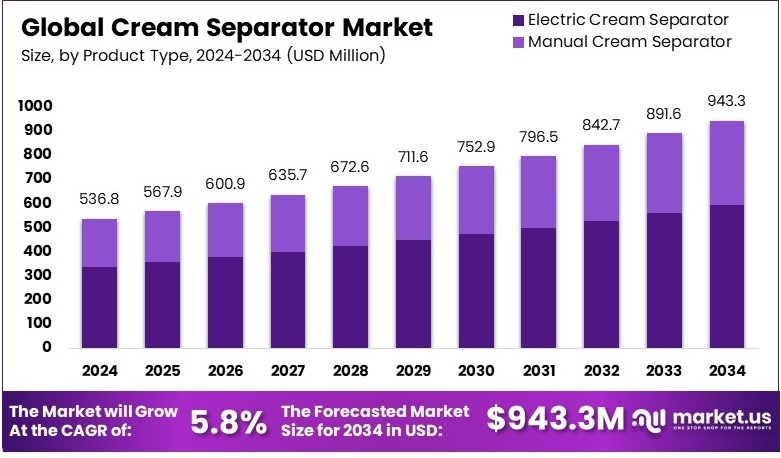
The Cream Separator market is driven by the needs of both small and large dairy operations. Manual cream separators, like the Milky FJ85, can process up to 85 liters per hour, ideal for small-scale use. Electric models, such as the Milky FJ130, handle about 130 liters per hour, catering to larger operations.
Demand for cream separators is rising, spurred by the dairy industry’s expansion and modernization. Opportunities lie in developing products that align with varying operational scales, from household to commercial dairy farms. This growth is strategically important, influencing local economies by supporting dairy production and related industries.
The market shows a competitive edge with a range of products tailored to different needs. However, saturation in mature markets presses manufacturers to innovate continuously, keeping the market dynamic. This competitive environment pushes for advancements in efficiency and technology in cream separation.
Government regulations focusing on food safety and equipment standards play a crucial role in shaping the market. These standards ensure the quality and safety of dairy products, affecting the design and functionality of cream separators. As regulations tighten, the market is expected to adapt, introducing more compliant and innovative solutions.
Key Takeaways
- The Cream Separator Market was valued at USD 536.8 Million in 2024, and is expected to reach USD 943.3 Million by 2034, with a CAGR of 5.8%.
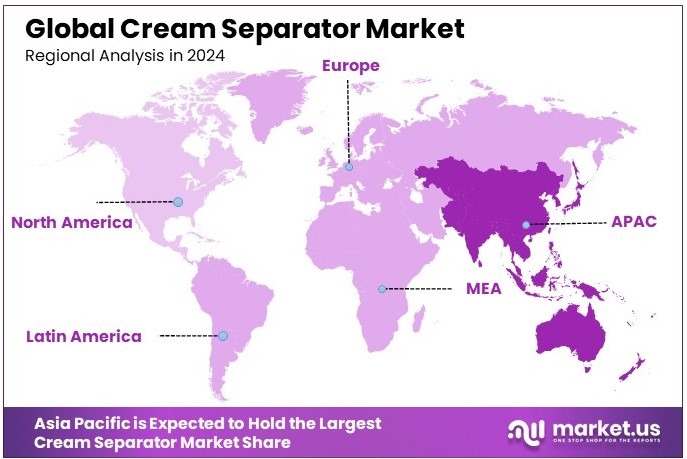
- In 2024, Asia Pacific dominates the regional market, indicating significant production and consumption growth.
- In 2024, Electric Cream Separator leads the product type segment with 62.7% due to its efficiency and technological advancement.
- In 2024, the 100-300 LPH capacity segment holds 35.8%, reflecting a balance between volume and productivity.
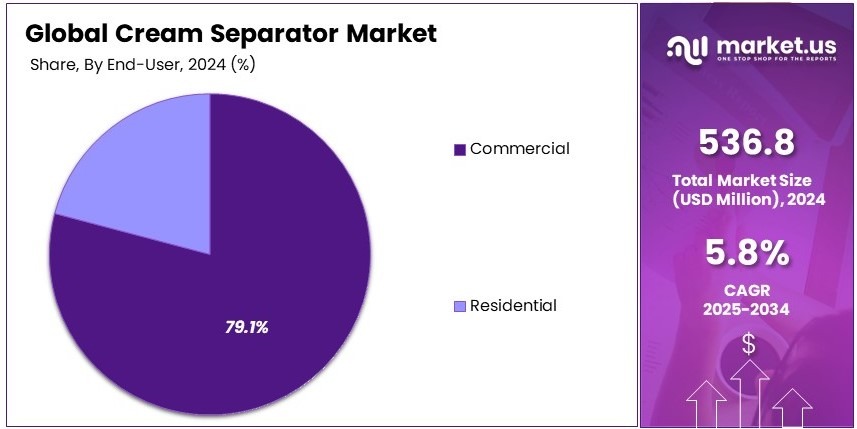
- In 2024, the Commercial end-user segment dominates with 79.1%, indicating strong industrial demand for cream separation.
Product Type Analysis
Electric Cream Separator dominates with 62.7% due to its efficiency and automation capabilities.
In the Cream Separator market, the product types are broadly categorized into Manual Cream Separators and Electric Cream Separators. The Electric Cream Separator leads with a significant market share of 62.7%, a reflection of the industry’s move towards automation and higher efficiency in dairy processing.
These devices are favored for their ability to handle large volumes of cream quickly and with minimal manual effort, making them ideal for commercial dairy operations where time and labor savings are crucial.
Manual Cream Separators still play a crucial role in smaller farms or in regions where electricity is unreliable. They offer affordability and independence from power sources, which are valued in remote areas. However, the trend towards more automated dairy processes continues to limit their market share.
Capacity Analysis
100-300 LPH dominates with 35.8% due to its optimal balance of capacity and adaptability.
When analyzing the capacity of cream separators, the ranges include Below 50 LPH, 50-100 LPH, 100-300 LPH, and Above 300 LPH. The 100-300 LPH category holds the dominant position with 35.8% of the market, primarily due to its versatility and suitability for medium-sized dairy farms.
This range provides an optimal balance, meeting the needs of most commercial operations without the extensive space and investment requirements of the largest machines.
The Below 50 LPH and 50-100 LPH segments cater primarily to small-scale operations and domestic use, offering lower throughput but greater affordability and compactness, which are important in restricted spaces. Above 300 LPH separators are targeted at large-scale industrial operations, where very high volumes of milk are processed daily, demanding significant capital investment and operational space.
End-User Analysis
Commercial dominates with 79.1% due to the large-scale dairy production needs.
The End-User segment of the Cream Separator market is divided into Commercial and Residential uses. Commercial use overwhelmingly dominates the market with a 79.1% share, underscoring the importance of cream separators in large-scale dairy production environments.
These settings require robust, efficient equipment that can operate continuously and with minimal downtime, qualities that are met by modern electric cream separators.
Residential use, while smaller, is significant for hobbyist farmers, small homesteads, or households interested in producing their own dairy products. These users typically prefer smaller capacity and manual models due to their lower cost and simpler maintenance.
Key Market Segments
By Product Type
- Manual Cream Separator
- Electric Cream Separator
By Capacity
- Below 50 LPH (Liters Per Hour)
- 50-100 LPH
- 100-300 LPH
- Above 300 LPH
By End-User
- Commercial
- Residential
Driving Factors
Increasing Demand and Efficiency Drives Market Growth
The Cream Separator Market benefits from a combination of growing demands and technological improvements. Increasing demand for dairy products worldwide encourages investments in efficient separation processes. Growth of small-scale and home-based dairy processing units expands the customer base. Rising focus on hygienic and efficient milk separation processes pushes adoption of modern equipment.
Development of portable and user-friendly cream separators supports ease of use in diverse settings. These factors collectively enhance market growth by broadening access to quality dairy processing tools. For example, a small dairy in a rural area may use a portable separator to increase production while maintaining hygiene. As a result, such equipment improves product quality and consistency.
Moreover, advancements in user-friendly designs attract new users who seek simplicity and reliability. These trends lead to higher productivity and better product outcomes, attracting more buyers. The emphasis on hygiene and efficiency becomes a key selling point, especially in regions with rising dairy demand.
Restraining Factors
Awareness and Quality Concerns Restraints Market Growth
The Cream Separator Market faces challenges that may slow its expansion. Limited awareness in rural and underdeveloped regions restricts potential customer reach. Many small producers remain unaware of the benefits of modern separators. Dependency on dairy industry growth for market expansion creates vulnerability to market fluctuations. When dairy production stalls, so does the demand for separators.
Concerns over maintenance and durability of low-cost models deter potential buyers. Lower quality products may fail to meet expectations or require frequent repairs. Risk of counterfeit and substandard products further undermines consumer trust. For instance, a farmer hesitant to invest might fear spending on a device that breaks down easily. Such worries lead to cautious purchasing decisions, hindering market progress.
Companies need to invest in education and quality assurance to overcome these restraints. By demonstrating product reliability and providing warranties, manufacturers can ease fears. Furthermore, targeting emerging markets with clear benefits and support can gradually expand awareness.
Growth Opportunities
Energy Efficiency and Compact Models Provide Opportunities
Opportunities in the Cream Separator Market emerge from innovation and diversification. Development of energy-efficient and sustainable separator models appeals to cost-conscious and eco-friendly buyers. Expansion of separator applications in non-dairy food industries opens new avenues. Increasing adoption of compact and portable cream separators meets the needs of small-scale producers.
Growth of online sales channels for dairy equipment broadens market access. These trends allow companies to explore untapped segments and enhance product lines. For example, a startup may develop a compact separator that uses less energy and serves multiple food processing needs. This flexibility attracts diverse customers. Similarly, online channels enable reaching remote areas quickly.
By focusing on sustainable design and user convenience, manufacturers can tap into the growing green movement. Opportunities also lie in customizing products for niche markets. This targeted approach can improve market penetration.
Investing in R&D to create smaller, energy-saving models strengthens competitive advantage. Through these strategies, companies not only meet current needs but also shape future demand, positioning themselves for long-term growth in the evolving market landscape.
Emerging Trends
Eco-Friendly Trends and Advanced Materials Are Latest Trending Factor
Current trends in the Cream Separator Market highlight an emphasis on eco-friendly designs and durability. Popularity of eco-friendly and low-maintenance separator designs reflects a move toward sustainable practices. Use of advanced materials for enhanced durability meets consumer demand for long-lasting equipment.
Demand for high-speed and automated cream separators indicates a push for efficiency. Growth of modular and customizable separator models allows tailored solutions for different scales. These trends show the market evolving with technological advancements and environmental considerations.
For instance, a dairy processor might choose an automated separator made of robust, eco-friendly materials to reduce waste and downtime. Such choices enhance productivity and reduce environmental impact. Companies responding to these trends invest in research to improve speed and customization.
They also focus on materials that promise longevity, thus reducing total cost of ownership. This approach appeals to both small and large operators seeking reliable and efficient solutions. By staying aligned with these latest trends, manufacturers position themselves as leaders, fostering innovation and meeting diverse market demands.
Regional Analysis
Asia Pacific Dominates with Major Market Share in the Cream Separator Market
Asia Pacific leads the Cream Separator Market with a significant share, reflecting its significant dairy production and consumption. This dominance is primarily due to the region’s vast agricultural base, rising dairy consumption, and the growing adoption of advanced dairy processing technologies.
Key factors driving this dominance include the large-scale milk production in countries like India, China, and New Zealand. These nations are key exporters of dairy products, and the adoption of cream separators is essential to maintaining product quality and efficiency in the processing chain. Additionally, the growing middle-class population and increasing demand for high-quality dairy products have bolstered the market.
Asia Pacific’s performance in the Cream Separator Market is further influenced by its focus on upgrading traditional dairy practices. Governments and private sectors are investing in modern dairy equipment, helping small-scale farmers transition to more efficient methods. This trend, coupled with increasing exports of processed dairy products, is likely to sustain the region’s market leadership in the coming years. Innovations in compact, energy-efficient separators will also drive future growth.
Regional Mentions:
- North America: North America maintains a strong position in the Cream Separator Market, driven by advanced dairy farming practices and a high focus on automation. The region benefits from consistent demand for processed dairy products.
- Europe: Europe has a significant share in the market, supported by its traditional dairy-producing nations like Germany and the Netherlands. High standards for dairy quality and sustainability are key drivers.
- Middle East & Africa: The Middle East and Africa are emerging players in the market, driven by increasing dairy consumption and investments in modernizing dairy production systems.
- Latin America: Latin America is steadily growing in the Cream Separator Market, with Brazil and Argentina leading due to their strong dairy industries and focus on exporting processed products.
Key Regions and Countries Covered in the Report
- North America
- US
- Canada
- Europe
- Germany
- France
- The UK
- Spain
- Italy
- Rest of Europe
- Asia Pacific
- China
- Japan
- South Korea
- India
- Australia
- Rest of APAC
- Latin America
- Brazil
- Mexico
- Rest of Latin America
- Middle East & Africa
- South Africa
- Saudi Arabia
- UAE
- Rest of MEA
Competitive Landscape
The Cream Separator Market is led by top companies that focus on efficiency, durability, and meeting the diverse needs of dairy producers. The top four companies dominating this market are GEA Group, Alfa Laval, SPX Flow, and Milky Day. These players excel in technological innovation, product variety, and global market reach.
GEA Group is a global leader known for its advanced cream separators designed for industrial-scale dairy processing. The company focuses on high-capacity machines that offer precision and energy efficiency, making it a preferred choice for large dairy operations. Its strong global presence and investment in R&D give it a competitive edge.
Alfa Laval specializes in high-performance cream separators that cater to both industrial and small-scale dairy producers. The company is recognized for its innovative separation technologies, which ensure maximum cream yield and minimal maintenance. Its commitment to sustainability and operational efficiency strengthens its market position.
SPX Flow offers a wide range of cream separators that are designed for reliability and performance. The company targets large-scale dairy plants with advanced solutions that optimize production processes. SPX Flow’s focus on customer-centric designs and after-sales service enhances its reputation in the market.
Milky Day, a prominent name in small and medium-scale dairy equipment, caters to individual farmers and smaller businesses. The company’s separators are compact, user-friendly, and cost-effective, making them ideal for emerging markets. Its specialization in accessible solutions allows it to capture a unique segment of the market.
These companies continue to lead the Cream Separator Market by addressing industry demands for high efficiency, durability, and customization. Their emphasis on innovation, sustainability, and global distribution ensures their sustained dominance in the market.
Major Companies in the Market
- Alfa Laval AB
- GEA Group AG
- SPX Flow, Inc.
- Tetra Pak International S.A.
- Krones AG
- Westfalia Separator
- Elecrem
- Milky Day
- Dairy Tech Inc.
- Mahesh Eng. Works
- A & B Process Systems
- Feldmeier Equipment, Inc.
- Paul Mueller Company
Recent Developments
- Milky: Milky introduced the FJ130 Electric Cream Separator, capable of processing 130 liters per hour. This stainless steel machine is designed for small to medium-sized dairy farms, enhancing efficiency in cream separation.
- Mitty Dairy: Mitty Dairy launched a stainless steel electric milk cream separator with a capacity of 50 liters per hour. This machine is suitable for both farm and home use, offering a reliable solution for separating cream from milk.









