


Report Overview
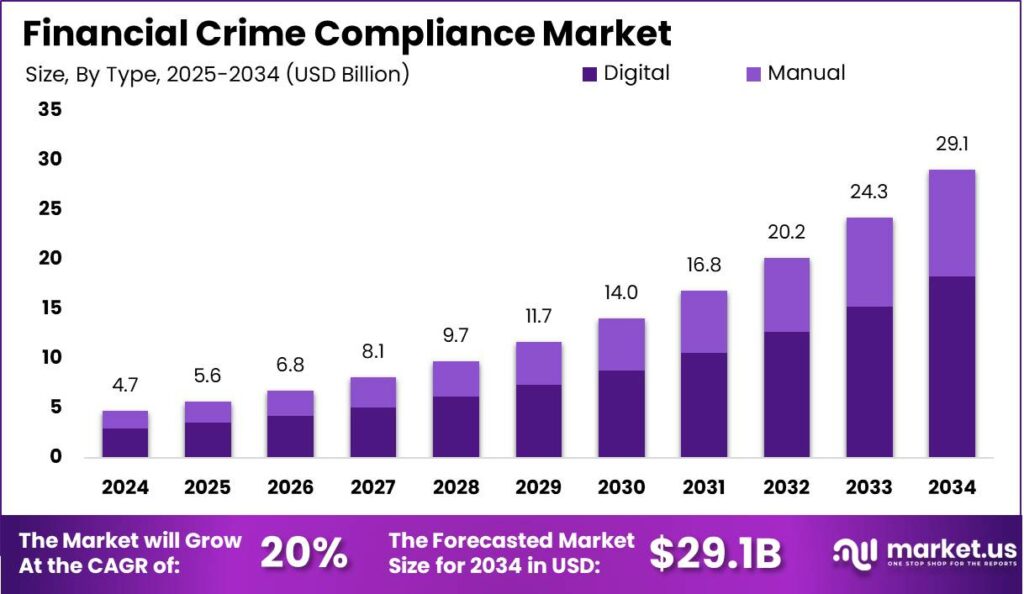
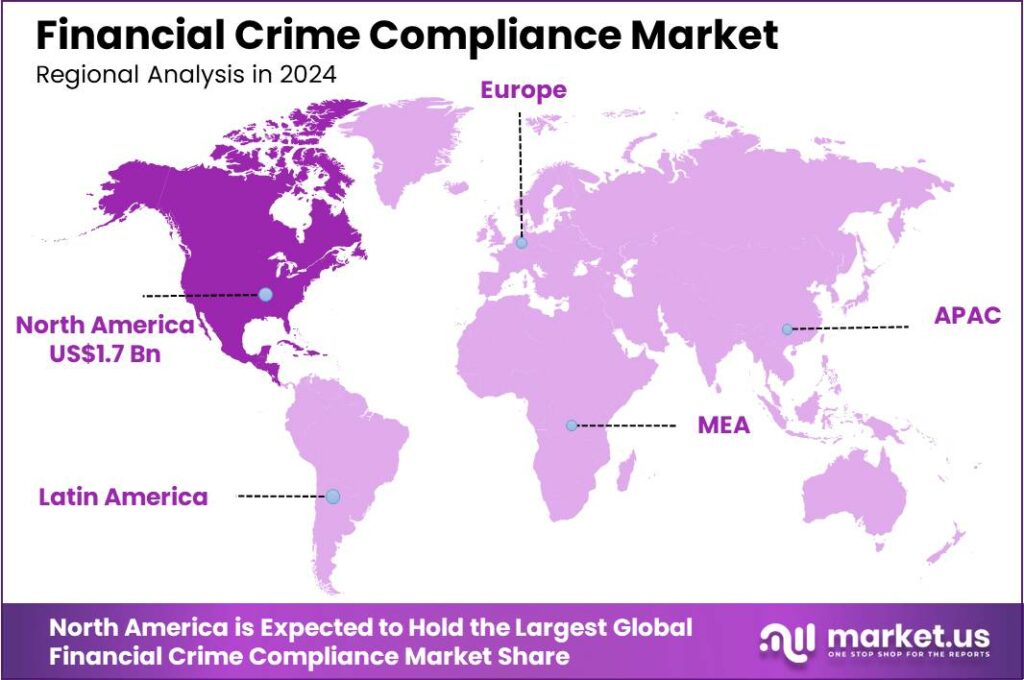
The Global Financial Crime Compliance Market size is expected to be worth around USD 29.1 Billion By 2034, from USD 4.7 Billion in 2024, growing at a CAGR of 20.00% during the forecast period from 2025 to 2034. In 2024, North America dominated the Financial Crime Compliance market, capturing over 36.5% of the market share, with revenues totaling USD 1.7 billion.
Financial Crime Compliance (FCC) refers to the policies and procedures that financial institutions implement to detect, prevent, and report illegal financial activities such as money laundering, fraud, and terrorist financing. These measures ensure adherence to laws and regulations designed to maintain the integrity of the financial system.
The Financial Crime Compliance market has experienced significant growth in recent years, driven by increasing regulatory demands and the rising sophistication of financial crimes. Financial institutions are investing heavily in advanced compliance solutions to meet stringent anti-money laundering (AML) and know your customer (KYC) requirements.
This trend is expected to continue, with the global AI in Regtech Market projected to exceed US$ 2.4 billion by mid-2025, growing at a compound annual growth rate (CAGR) of 36.7%. Several factors are propelling the growth of the FCC market. The increasing incidence of financial crimes globally has heightened the need for robust compliance measures.
Additionally, regulatory bodies worldwide are enforcing stricter AML and KYC protocols, compelling financial institutions to adopt comprehensive compliance solutions. Technological advancements, such as artificial intelligence (AI) and machine learning (ML), are also enhancing the capabilities of FCC systems, enabling more efficient detection and prevention of illicit activities.
The demand for FCC solutions is on the rise as organizations recognize the importance of safeguarding their operations against financial crimes. Financial institutions, in particular, are under pressure to comply with evolving regulations and protect their clients’ assets. This has led to increased adoption of advanced compliance technologies and services across various sectors, including banking, insurance, and fintech.
According to the latest survey, the total cost of financial crime compliance in the U.S. and Canada surged to $61 billion in 2024, highlighting the growing financial burden on organizations. Globally, financial institutions are expected to spend $34.7 billion on compliance technology and a staggering $155.3 billion on operations this year. The overall financial crime and compliance market is estimated to be worth $25.6 billion in 2024, marking a steady growth from $24.2 billion in 2023.
Shockingly, an estimated $3.1 trillion in illicit funds flowed through the global financial system in 2023, emphasizing the scale of the issue. Money laundering alone accounts for 2% to 5% of global GDP, translating to nearly €1.87 trillion annually. Fraud has also reached alarming levels, with 51% of surveyed organizations reporting fraud incidents over the past two years—the highest in two decades, according to PwC’s Global Economic Crime and Fraud Survey 2022.
The rising costs of compliance are evident, with 99% of financial institutions reporting an increase in financial crime compliance expenses. To address these challenges, 70% of institutions are prioritizing cost-cutting measures over the next year. However, concerns remain high, with 59% of firms anticipating a rise in financial crime levels and 58% planning to hire more staff to tackle the issue.
Technology is playing a pivotal role in combating financial crime, as 62% of financial institutions are already using AI and machine learning (ML) for anti-money laundering (AML) activities. This adoption is projected to rise to 90% by 2025, driven by the need for efficiency and accuracy. Escalating financial crime regulations, cited by 44% of mid and large-sized institutions, continue to be a major factor driving compliance costs higher.
The FCC market presents numerous opportunities for innovation and growth. The integration of AI and ML technologies into compliance solutions offers the potential for more accurate and efficient detection of suspicious activities. Additionally, the expansion of digital banking and fintech services creates a demand for tailored compliance solutions that address the unique challenges of these platforms.
Technological advancements are playing a pivotal role in shaping the FCC landscape. The adoption of AI and ML enables real-time analysis and more effective risk identification, enhancing the ability of financial institutions to detect and prevent financial crimes. Blockchain technology is also poised to revolutionize AML and KYC compliance by enabling greater transparency and traceability of transactions.
Key Takeaways
- The Global Financial Crime Compliance Market size is projected to reach USD 29.1 Billion by 2034, up from USD 4.7 Billion in 2024, experiencing a CAGR of 20.00% during the forecast period from 2025 to 2034.
- In 2024, the Adverse Media Screening segment held a dominant market position, capturing more than 29.5% of the market share.
- The Digital segment dominated the Financial Crime Compliance (FCC) market in 2024, securing over 62.8% of the market share.
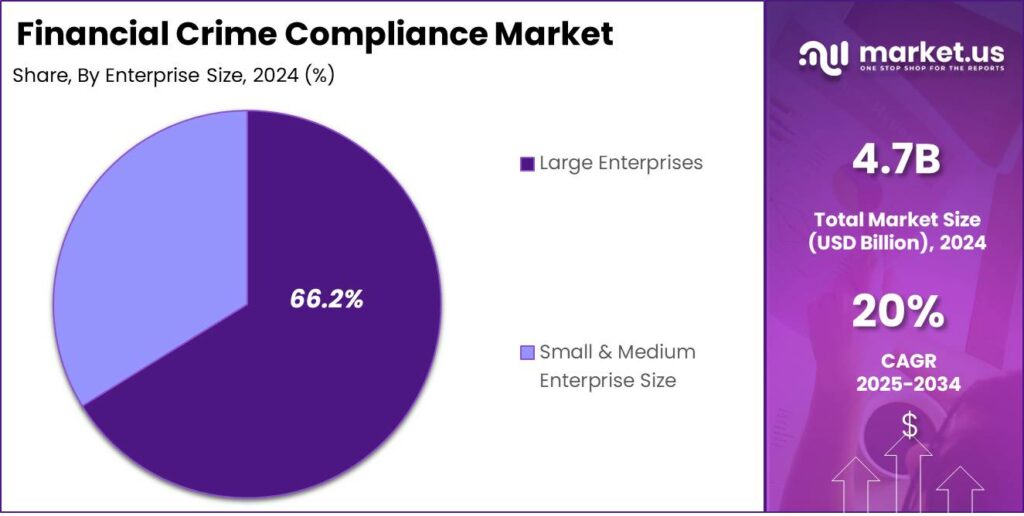
- The Large Enterprises segment led the market in 2024, capturing more than 66.2% of the market share.
- The Banking, Financial Services, and Insurance (BFSI) segment maintained a dominant position in the Financial Crime Compliance market in 2024, accounting for over 27.5% of the market share.
- North America held a leading position in the Financial Crime Compliance market in 2024, commanding more than 36.5% of the market share, with revenues reaching USD 1.7 billion.
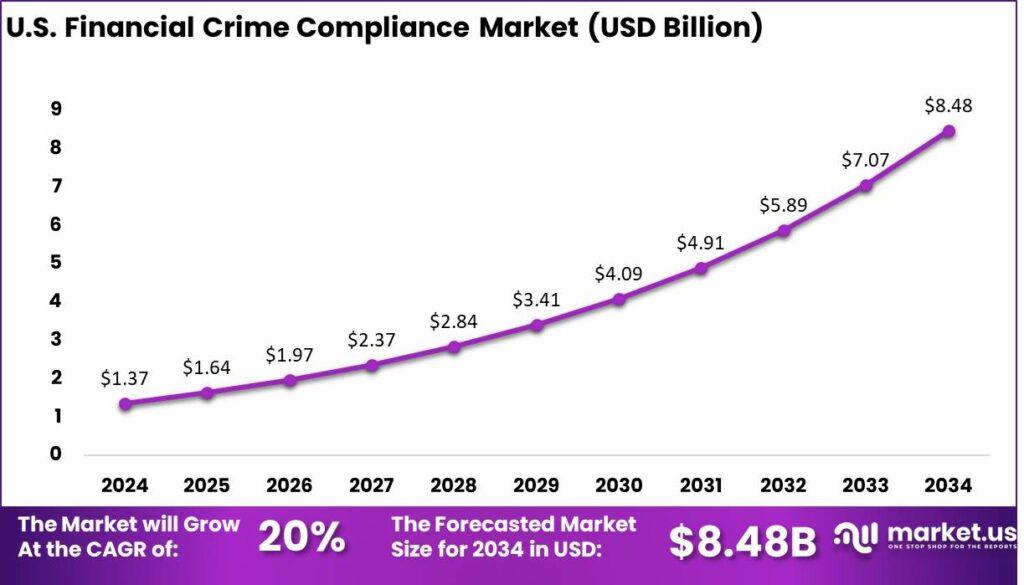
- In 2024, the U.S. market for financial crime compliance was valued at approximately USD 1.37 billion, with expectations of significant growth at a CAGR of 20.00%.
U.S. Market Size and Growth
The U.S. market for financial crime compliance was valued at approximately USD 1.37 billion. This sector is poised for significant growth, with expectations to expand at a compound annual growth rate (CAGR) of 20.00%. This robust growth projection underscores the increasing demand for financial crime prevention tools and services across various industries, reflecting heightened regulatory scrutiny and the need for more sophisticated compliance solutions.
This anticipated growth can be attributed to several factors. Firstly, the evolving nature of financial crimes, including more complex schemes facilitated by advancements in technology, compels businesses to enhance their compliance infrastructure.
Regulatory bodies are enforcing stricter penalties, prompting financial institutions to invest in advanced systems to avoid fines and reputational damage. This has led to a surge in the adoption of AI and machine learning to efficiently detect and prevent fraud at scale.
In 2024, North America held a dominant market position in the financial crime compliance market, capturing more than a 36.5% share with revenues reaching USD 1.7 billion. This leading position can be attributed to several factors that are unique to the region. The stringent regulatory environment in the United States and Canada has necessitated robust compliance solutions.
Furthermore, the presence of major financial institutions and technology firms in North America has propelled the development and adoption of advanced financial crime compliance technologies. These entities invest significantly in innovative solutions such as artificial intelligence (AI) and machine learning (ML) to stay ahead of sophisticated financial crimes like money laundering and fraud.
The market in North America is also characterized by high awareness and proactive adoption of emerging technologies which contribute to its sizeable market share. Financial institutions in this region are quick to adopt regulatory technologies (RegTech) that offer enhanced data analytics and real-time transaction monitoring capabilities.
Component Analysis
In the Financial Crime Compliance Market, the Adverse Media Screening segment held a dominant market position in 2024, capturing more than a 29.5% share. This segment’s leadership can be attributed to its critical role in identifying potential risks from negative news about individuals or companies before financial institutions engage with them.
Adverse Media Screening helps in proactive risk management by monitoring a vast array of media sources, which is essential given the fast-paced dissemination of news in the digital age. Financial institutions rely heavily on this tool to ensure compliance with global regulations and to protect against reputational damage.
The Sanctions Screening segment is key in the FCC market, filtering customer and transaction data against sanctions lists to ensure compliance with international regulations. It helps prevent financial crimes and avoid severe penalties, making it essential for effective financial crime compliance.
Risk Assessment is crucial in evaluating the risk of customer relationships and transactions. It helps financial institutions identify and mitigate threats like money laundering and terrorist financing, ensuring tailored compliance measures and improving overall efficiency.
Type Analysis
In 2024, the Digital segment held a dominant market position in the Financial Crime Compliance (FCC) market, capturing more than a 62.8% share. This segment’s leadership can be attributed to the increasing digitization of financial services and the corresponding need for automated solutions to monitor and prevent sophisticated financial crimes effectively.
Digital FCC solutions provide scalability and agility to manage high transaction volumes across multiple channels. By leveraging AI, machine learning, and big data, they enhance the detection of financial crimes with greater accuracy and speed.
The prominence of the Digital segment also stems from the growing regulatory pressures globally, which demand stringent compliance measures and robust reporting processes. Regulatory bodies have been ramping up their requirements, making it challenging for manual systems to keep pace with the detailed and frequent submissions needed.
Digital solutions streamline these processes, ensuring compliance with evolving regulations without the substantial manpower that manual processes would require. This shift is driven by the need to reduce human error and increase efficiency, making digital FCC systems more attractive to institutions looking to manage their compliance costs effectively.
Enterprise Size Analysis
In 2024, the Large Enterprises segment held a dominant position in the Financial Crime Compliance market, capturing more than a 66.2% share. This substantial market share is primarily attributed to the significant financial and resource capabilities of large enterprises, which enable them to invest in advanced compliance solutions.
Large organizations face complex regulatory requirements due to their size and global operations, requiring robust compliance programs with advanced transaction monitoring, identity management, and analytics to prevent financial crimes.
The leadership of the Large Enterprises segment can also be linked to the high risk of financial crimes in bigger operations, which drives the demand for effective compliance solutions. These enterprises are often targeted more by financial criminals due to the large volumes of transactions and international business activities.
The availability of resources in large enterprises allows them to deploy dedicated teams for the development and management of compliance programs. These teams are often equipped with skilled professionals who specialize in legal, regulatory, and technological aspects of financial crime compliance.
Industry Analysis
In 2024, the Banking, Financial Services and Insurance (BFSI) segment held a dominant market position in the Financial Crime Compliance market, capturing more than a 27.5% share. This leadership is largely driven by the inherent risk associated with the vast amounts of money and personal data managed by these institutions.
BFSI organizations are prime targets for financial crimes, requiring robust compliance measures to safeguard assets and maintain customer trust. This drives them to invest heavily in comprehensive programs that exceed regulatory requirements.
The dominance of the BFSI sector is strengthened by stringent regulatory standards from global bodies like FATF, the SEC, and the European Banking Authority, which continually update guidelines to combat evolving financial crimes.
BFSI companies must constantly adapt to these changes, investing in sophisticated technologies like artificial intelligence and machine learning to enhance their compliance frameworks. This continuous adaptation requires significant investment, contributing to the BFSI sector’s large share of the market.
Key Market Segments
By Component
- Averse Media Screening
- Sanctions Screening
- Risk Assessment
- Reporting and Record Keeping
- Training and Education
- Others
By Type
- Manual
- Digital
By Enterprise Size
- Small & Medium Enterprise Size (SME’s)
- Large Enterprises
By Industry
- Banking, Financial Services and Insurance (BFSI)
- Government and Public Sector
- Aerospace & defense
- Healthcare
- IT and Telecom
- Automotive
- Retail and E-commerce
- Others (Gaming and Entertainment, Education, etc.)
Key Regions and Countries
- North America
- US
- Canada
- Europe
- Germany
- France
- The UK
- Spain
- Italy
- Rest of Europe
- Asia Pacific
- China
- Japan
- South Korea
- India
- Australia
- Singapore
- Rest of Asia Pacific
- Latin America
- Brazil
- Mexico
- Rest of Latin America
- Middle East & Africa
- South Africa
- Saudi Arabia
- UAE
- Rest of MEA
Driver
Technological Advancements in Financial Crime Compliance
The rapid evolution of technology is a significant driver in financial crime compliance. Financial institutions are increasingly adopting advanced tools like Artificial Intelligence (AI) and Machine Learning (ML) to enhance their compliance programs. These technologies enable the detection of complex patterns in financial transactions, improving the efficiency and accuracy of identifying suspicious activities.
Moreover, the integration of AI and ML into compliance frameworks helps in reducing false positives, ensuring that compliance teams can focus on genuine threats. As financial crimes become more sophisticated, the adoption of advanced technologies becomes imperative for institutions aiming to stay ahead of illicit activities.
Restraint
Evolving Regulatory Landscape
The constantly changing regulatory environment poses a significant restraint on financial crime compliance efforts. Financial institutions must navigate a complex web of regulations that vary across jurisdictions, making compliance a challenging and resource-intensive task. The rapid pace of regulatory changes requires institutions to continuously update their compliance programs, policies, and procedures to remain compliant.
This dynamic landscape can lead to increased operational costs and necessitates ongoing training for compliance personnel to keep abreast of new requirements. Inconsistencies between international regulations create confusion and complicate compliance for institutions operating globally. Balancing compliance with multiple frameworks while maintaining operational efficiency and cost-effectiveness remains a major challenge.
Opportunity
Integration of RegTech Solutions
The rise of Regulatory Technology (RegTech) presents a substantial opportunity for enhancing financial crime compliance. RegTech solutions leverage advanced technologies to streamline compliance processes, reduce costs, and improve the effectiveness of compliance programs.
By automating tasks such as Know Your Customer (KYC) procedures, transaction monitoring, and reporting, RegTech enables financial institutions to respond more swiftly and accurately to regulatory requirements. This integration not only enhances operational efficiency but also allows compliance teams to focus on more strategic initiatives.
Furthermore, RegTech solutions can facilitate better data management and analytics, providing deeper insights into potential risks and enabling proactive measures against financial crimes. As the regulatory landscape becomes more complex, the adoption of RegTech offers a pathway for institutions to maintain compliance while optimizing resources.
Challenge
Sophistication of Financial Criminals
The increasing sophistication of financial criminals presents a formidable challenge to compliance efforts. Criminals are continually evolving their tactics, often leveraging emerging technologies to perpetrate financial crimes. This includes the use of advanced methods to obscure the origins of illicit funds, making detection and prevention more difficult.
The relentless pace of the digital economy creates a continuous challenge for regulators striving to close the door on illicit activities. Suboptimal technology processes further exacerbate the problem, as the regulated industries often lack the necessary tools to respond proactively and mitigate risks effectively. Addressing this challenge requires financial institutions to invest in advanced detection systems, continuous monitoring, and regular training to stay ahead of sophisticated financial criminals.
Emerging Trends
One significant trend is the integration of artificial intelligence (AI) and machine learning into compliance processes. These technologies help institutions detect and prevent illicit activities more efficiently by analyzing vast amounts of data to identify suspicious patterns.
Another emerging trend is the adoption of real-time monitoring systems. Traditional compliance methods often involve periodic reviews, which can delay the detection of fraudulent activities. Real-time monitoring enables financial institutions to identify and respond to suspicious transactions immediately, enhancing their ability to prevent financial crimes.
Growing regulatory complexity is driving financial institutions to adopt more coordinated compliance strategies. This often involves using advanced analytics and reporting tools to manage and interpret data across multiple jurisdictions.
Business Benefits
Implementing effective FCC measures helps organizations avoid significant financial losses that can arise from fraud and regulatory fines. As per the findings released by LexisNexis® Risk Solutions, the total cost of financial crime compliance in the U.S. and Canada has reached approximately $61 billion, indicating the scale of investment needed to combat these issues.
Maintaining compliance with financial crime regulations protects an organization’s reputation. Non-compliance can lead to severe reputational damage, which is often more costly than the fines themselves. A strong compliance program fosters trust among customers and stakeholders.
Financial institutions are increasingly prioritizing cost reduction in their compliance programs, with 81% planning to cut costs in the next year while still adhering to regulations based on LexisNexis® Risk Solutions data . This highlights a growing trend towards efficiency without compromising on compliance standards.
Organizations that effectively integrate AI into their compliance processes report higher job satisfaction among employees. By reducing the burden of manual tasks, employees can engage in more meaningful work focused on detecting and preventing financial crimes
Key Player Analysis
In the world of Financial Crime Compliance (FCC), several companies have emerged as key players, providing innovative solutions to combat financial crimes such as money laundering, fraud, and terrorism financing.
- Oracle is a prominent leader in financial crime compliance, known for offering a wide array of software solutions that integrate seamlessly with financial institutions’ existing systems. Their advanced tools use machine learning and predictive analytics to enhance fraud detection and risk management.
- Capgemini has also established itself as a key player in the financial crime compliance market. This global consulting and technology services company offers end-to-end solutions designed to streamline the detection and prevention of financial crime. Capgemini’s strong focus on innovation, combined with its deep industry expertise, helps clients automate and optimize their compliance processes.
- LexisNexis Risk Solutions stands out for its comprehensive data and analytics offerings aimed at mitigating financial crime risks. The company provides a range of compliance solutions that help financial institutions identify and manage potential threats, including anti-money laundering (AML) risks, sanctions screening, and fraud detection.
Top Key Players in the Market
- Oracle
- Capgemini
- LexisNexis Risk Solutions
- WNS (Holdings) Ltd.
- Tookitaki Holding Pte. Ltd
- Firstsource
- Genpact
- Temenos
- Accenture
- Fiserv, Inc.
- iDenfyTM
- Others
Top Opportunities Awaiting for Players
- Integration of AML and Cybersecurity: As cyber threats continue to grow, there is an increasing need for financial institutions to integrate their anti-money laundering (AML) efforts with cybersecurity measures. This integration leads to the creation of interdisciplinary teams that can more effectively tackle both security and compliance issues.
- Advancement in AI-driven Compliance Tools: The adoption of artificial intelligence (AI) in transaction monitoring is set to transform AML processes by enabling more proactive and precise detection of suspicious activities. AI helps in reducing false positives and adapting to new threats dynamically, which can significantly streamline compliance operations and reduce costs.
- Expansion of Regulatory Reach: Compliance regulations are becoming more extensive and intricate, which requires companies to adopt more sophisticated compliance frameworks. This includes adjusting to global regulations and leveraging technology to ensure compliance across different jurisdictions.
- Focus on ESG Factors: Environmental, social, and governance (ESG) factors are becoming part of financial crime risk assessments, particularly in areas like wildlife trafficking and human rights abuses. Financial institutions are expected to enhance their monitoring and reporting systems to detect and report activities related to these issues.
- Private-Public Partnerships: There is a growing trend towards collaborative efforts between the private sector and public authorities. These partnerships are crucial for sharing intelligence and resources, which enhances the overall effectiveness of financial crime prevention strategies.
Recent Developments
- In September 2024, Oracle introduced the Financial Crime and Compliance Management Monitor Cloud Service. This solution offers banks and financial institutions a centralized view of their compliance efforts, enabling quicker identification of potential issues and proactive risk management to combat financial crimes.
- In December 2024, they agreed to acquire IDVerse™, an AI-driven firm specializing in automated document authentication and fraud detection. This acquisition aims to enhance their digital identity verification capabilities.









