


Report Overview
The Global Dubbing and Voice-over Market size is expected to be worth around USD 8.6 Billion By 2034, from USD 4.2 billion in 2024, growing at a CAGR of 7.4% during the forecast period from 2025 to 2034. In 2024, North America held a dominant market position, capturing more than a 43.5% share, holding USD 1.8 Billion revenue.
Dubbing and voice-over services are crucial in media and entertainment, providing language localization for films, TV series, and digital media. These services allow content producers to offer their material in multiple languages, broadening their audience reach. The process involves voice actors replacing the original dialogue with another language, ensuring cultural and contextual appropriateness.
Voice-over, on the other hand, involves a background narration without replacing the original audio, commonly used in documentaries and news reports. The dubbing and voice-over market is witnessing significant growth driven by the global expansion of media content.
The increasing demand for streaming services and the proliferation of digital platforms have created a vast need for localized content, propelling the dubbing and voice-over industry. Companies are investing heavily in technology to streamline operations and enhance synchronization, quality, and turnaround times, making the services more efficient and accessible.

The expansion of the global entertainment industry, particularly with the proliferation of streaming platforms like Netflix and Amazon Prime, has significantly driven the demand for multilingual content. This surge is necessitated by the need to cater to a global subscriber base, making high-quality dubbing and voice-over services crucial for reaching diverse audiences worldwide.
There is a growing demand for localized content across various sectors including entertainment, marketing, and e-learning, which continues to propel the expansion of the dubbing and voice-over market. The requirement for effective communication in native languages in instructional videos, advertising content, and digital applications underlines the importance of voice-over services.
Technological advancements, particularly the integration of artificial intelligence (AI) and machine learning (ML), offer substantial opportunities within the dubbing and voice-over market. These technologies facilitate more efficient translation processes, voice modulation, and even automated voice-over production, which are set to transform the market by enhancing the quality of dubbed content and reducing production times.
AI and ML are becoming increasingly influential in the dubbing and voice-over sector. These technologies improve the speed and accuracy of translations and voice modulations, enabling more content to be processed quicker and with higher quality. Automated dubbing tools, AI-driven voice synthesis, and cloud-based recording platforms are key innovations that streamline the dubbing process.
For businesses, high-quality dubbing and voice-over services offer a competitive edge by enhancing the global reach of their content. This localization allows businesses to effectively engage with international audiences, ultimately driving higher viewership and customer satisfaction. Additionally, technological enhancements in the sector reduce production costs and operational barriers, making it feasible for even smaller creators to produce localized content efficiently.
Key Takeaways
- The global dubbing and voice-over market is projected to grow significantly over the next decade. Valued at USD 4.2 billion in 2024, the market is expected to reach a remarkable USD 8.6 billion by 2034, with a compound annual growth rate (CAGR) of 7.4% between 2025 and 2034.
- In 2024, North America held the leading position, generating USD 1.8 billion in revenue and accounting for over 43.5% of the global market share. This dominance is driven by the region’s advanced media infrastructure and increasing demand for localized content.
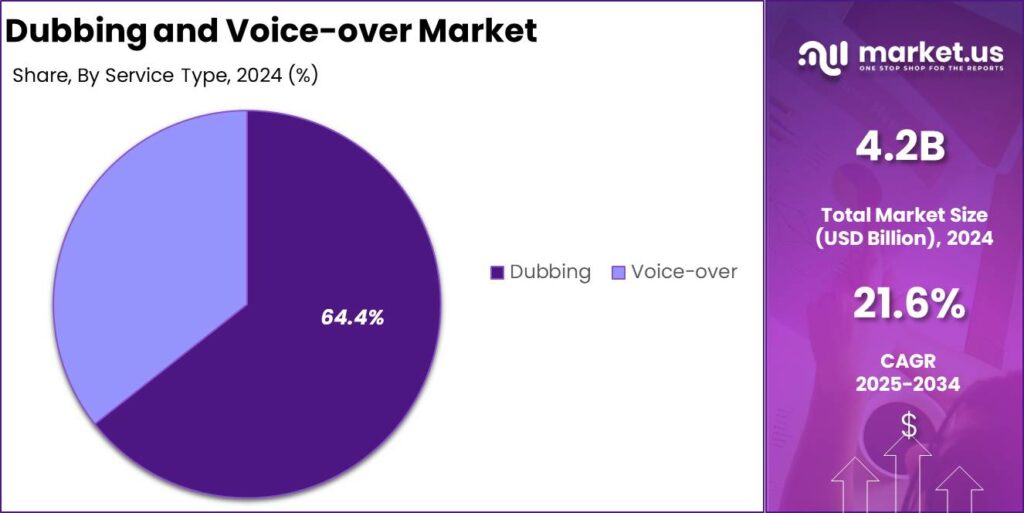
- The dubbing segment emerged as the market leader in 2024, contributing to over 64.4% of the total market share. This trend highlights the growing demand for high-quality dubbing services in entertainment, media, and other sectors.
- Human-based voice-over and dubbing services continued to dominate the industry in 2024, holding a 58.2% share of the market. This preference underscores the importance of authentic and relatable voice performances, which AI-driven solutions are yet to replicate fully.
- The entertainment and media sector played a crucial role in driving market growth in 2024, accounting for over 32.5% of the total market share. The demand for multilingual content in films, TV shows, and streaming platforms has been a major factor in this segment’s dominance.
U.S. Dubbing and Voice-Over Market Size
In 2024, the U.S. dubbing and voice-over market was valued at $1.56 million and is forecasted to grow at a compound annual growth rate (CAGR) of 8.3%. The U.S. market leads in this sector due to several factors. Firstly, the presence of major entertainment industries, including Hollywood, drives demand for high-quality dubbing and voice-over services to cater to a global audience.
Additionally, technological advancements and the proliferation of streaming platforms have expanded the reach of American media, necessitating extensive localization to engage diverse audiences worldwide. Furthermore, the U.S. boasts a large pool of talented voice actors whose skills contribute significantly to the industry’s growth.

In 2024, North America held a dominant position in the dubbing and voice-over market, capturing more than a 43.5% share with revenues reaching approximately USD 1.8 billion. This significant market share can be attributed to several key factors that underscore the region’s leadership in this sector.
Firstly, North America’s advanced technological infrastructure plays a pivotal role. The region is home to some of the leading tech companies that are at the forefront of innovations in artificial intelligence and machine learning, technologies that are integral to modernizing dubbing and voice-over services.
These advancements facilitate not only higher efficiency in voice-over and dubbing processes but also ensure superior quality in voice synchronization and translation accuracy, catering effectively to diverse linguistic needs.
Moreover, the strong entertainment industry, particularly in the United States, with Hollywood being a global content powerhouse, drives substantial demand for dubbing and voice-over services. The need to distribute content globally necessitates extensive localization services to make films, TV shows, and digital content accessible and relatable to international audiences.
The presence of major streaming platforms headquartered in this region, such as Netflix, Amazon Prime, and Disney+, further boosts the demand as they continuously expand their subscriber base worldwide with localized content offerings.
Additionally, the cultural diversity within North America itself necessitates a robust market for dubbing and voice-over services to cater to its multilingual population. This demographic factor ensures a steady domestic demand for localized entertainment and informational content, which in turn supports the growth of the dubbing and voice-over industry.

Service Type Analysis
In 2024, the dubbing segment held a dominant position in the market, capturing more than 64.4% share, as indicated by recent industry reports. This commanding presence can be attributed to several key factors driving the demand and growth of dubbing services globally.
Firstly, the expansion of the global entertainment industry, particularly streaming platforms such as Netflix, Amazon Prime, and Disney+, has significantly increased the need for multilingual content. These platforms are aggressively expanding their international subscriber base by offering localized content in various languages, which necessitates extensive dubbing services to cater to diverse linguistic audiences.
Additionally, technological advancements in AI and machine learning have revolutionized the dubbing process, making it more efficient and cost-effective. AI-driven tools now facilitate automated translation and voice modulation, which enhances the scalability of dubbing services. These technologies not only speed up the process but also help in maintaining consistency and quality across multiple languages, thereby reducing the dependency on extensive human resources.
However, despite these technological advancements, the emotional depth and cultural nuances still demand human expertise in critical areas of voice acting. The challenge remains to balance the use of technology with the need for authentic, culturally resonant voice-overs that capture the original tone and intent of the content.
The dominance of the dubbing segment is further supported by its critical role in various applications. From films and TV series to digital applications and recorded videos, dubbing is essential for ensuring that content is accessible and engaging to global audiences. Each of these applications requires tailored voice-over solutions to meet the specific needs of different markets, further underscoring the significance of dubbing in today’s media landscape.
Technology Analysis
In 2024, the human-based voice-over and dubbing segment maintained its market supremacy in the dubbing and voice-over industry, accounting for over 58.2% of the market share. This dominant position is bolstered by several compelling factors that highlight the irreplaceable value of human touch in the industry.
Firstly, despite the technological advancements and the introduction of AI in the field, the demand for human-based voice-over and dubbing remains robust due to the unparalleled emotional depth and nuance that human voice actors bring to performances. Human voice actors are capable of conveying subtle emotional cues that AI and synthesized voices are yet to fully replicate.
This is crucial in genres where the emotional delivery impacts the audience’s connection to the content, such as in dramatic films, animated features, and interactive media. Additionally, the human voice is essential for handling diverse linguistic and cultural nuances, which are often lost in automated processes.
In global markets, particularly those with high linguistic diversity like Europe and Asia, the authenticity of language delivery plays a significant role in the audience’s reception of dubbed content. Human dubbers are adept at adapting dialogues to fit cultural contexts, making content more relatable and engaging for specific audiences.
Moreover, the industry’s reliance on human talent is supported by the infrastructure of recording studios and the tradition of artistic performance, which maintains a high standard of quality and fidelity in voice-over and dubbing work. This segment’s dominance is also a testament to the industry’s recognition of voice actors’ skills, which are increasingly celebrated and valued, akin to on-screen performances.
Industry Vertical Analysis
In 2024, the Entertainment and Media segment of the dubbing and voice-over market held a dominant position, capturing more than a 32.5% market share. This segment leads due to several influential factors within the global landscape of media consumption and production.
The Entertainment and Media sector has been a significant consumer of dubbing and voice-over services due to the continuous expansion and global reach of media content. Major streaming platforms like Netflix, Amazon Prime, and Disney+ have been pivotal in pushing for high-quality, multilingual content to cater to diverse global audiences.
The demand for content that resonates across different cultural and linguistic boundaries has grown, making dubbing and voice-over services essential for maintaining viewer engagement and expanding audience bases.
Furthermore, the rise of digital media consumption has led to increased production rates of films, TV series, and digital applications requiring professional dubbing to meet the expectations of a global audience. The focus on cultural adaptation and emotional expression in dubbing ensures that the content remains relatable and engaging regardless of the viewer’s native language.
Moreover, the Entertainment and Media segment benefits from technological advancements in AI and machine learning, which enhance the efficiency and quality of voice-over services. These innovations help meet the quick turnaround demands of the industry, supporting the segment’s substantial market share and ongoing growth.
Key Market Segments
By Service Type
- Dubbing
- Timed Audio
- UN Voice Over
- Phrase-Sync
- Lip-Sync
- Voice-over
- Film Voice Over
- TV series Voice Over
- Documentary Voice Over
- Live-action Voice Over
- Others (Theatrical Voice Over, Promotional Voice Over, etc.)
By Technology
- Human-based Voice-over and Dubbing
- AI-driven Voice-over and Dubbing
By Industry Vertical
- Entertainment and Media
- Gaming
- Education
- IT & Telecom
- Healthcare
- Travel and Hospitality
- Retail and E-commerce
- Others
Driver
Globalization of Entertainment Content
The dubbing and voice-over market is significantly driven by the globalization of entertainment content. With the expansion of media services like Netflix, Amazon Prime, and Disney+, there is a heightened demand for multilingual content that resonates across various cultural demographics globally.
This surge in demand facilitates broader audience reach, ensuring that films, TV series, and other digital content are accessible in multiple languages. This globalization trend is further amplified by the digital revolution, which has made content readily available across geographical boundaries, increasing the need for high-quality dubbing and voice-over services to maintain the emotional and contextual integrity of the original content.
Restraint
High Production Costs
A major restraint in the dubbing and voice-over market is the high cost associated with producing high-quality localized content. This includes expenses related to hiring talented voice actors, sound engineers, and acquiring the right technological tools and translations.
These high production costs can be particularly prohibitive for smaller production houses or independent content creators, which may limit their ability to engage in extensive localization of their offerings. This financial barrier can impede the growth of the market, as it restricts the ability of producers to provide localized content across various languages and regions.
Opportunity
Technological Advancements in AI and Machine Learning
The dubbing and voice-over industry stands at the cusp of transformation with the integration of advanced technologies like AI and machine learning. These technologies are revolutionizing the market by enhancing the efficiency of translation processes, voice modulation, and even enabling automated dubbing, which can significantly reduce production times and costs. AI and machine learning also improve the accuracy and quality of voice-over products, thereby expanding the potential for scaling operations and exploring new linguistic territories without substantial investments.
Challenge
Scarcity of Skilled Voice Talent
One of the significant challenges in the dubbing and voice-over market is the scarcity of skilled voice actors who can effectively convey the nuances of the original performances in multiple languages. Finding voice talent with the right emotional depth, vocal range, and language skills is crucial for maintaining the authenticity of the dubbed content.
This challenge is compounded by the need for actors who are also familiar with the cultural nuances of the target audience, which is essential for the successful localization of content. The limited availability of such talent can hinder the market’s ability to meet the growing demand for localized entertainment.
Growth Factors
The dubbing and voice-over industry is currently witnessing a significant growth phase driven by several factors. Key among these is the global expansion of content consumption, fueled by the proliferation of streaming platforms like Netflix and Amazon Prime. These platforms demand localized content for diverse global markets, which increases the need for high-quality dubbing services.
Advancements in technology also play a crucial role. AI and machine learning innovations have led to more efficient workflows in dubbing and voice-overs. AI tools can now handle tasks like automatic speech recognition (ASR), machine translation, and even voice synthesis with increasing sophistication, making the dubbing process faster and less costly while maintaining high quality.
Moreover, the push towards more personalized and emotionally resonant content is shaping the industry. As audiences crave authentic experiences, the demand for voice-overs that can convey deep emotional and cultural nuances continues to rise, ensuring that skilled human voice actors remain in high demand despite the technological shifts.
Emerging Trends
Emerging trends within the dubbing and voice-over industry underscore the integration of technology and the increasing importance of cultural nuance in content. AI is profoundly influencing the industry, with text-to-speech and speech-to-speech technologies achieving new levels of realism and emotional intelligence.
This has made AI-driven voice-overs more acceptable and prevalent across various applications, from entertainment to e-learning platforms. Remote recording technologies have also become a staple, adapting to changes in work environments and allowing voice actors to deliver high-quality work from virtually anywhere.
This flexibility has helped maintain production flow even in challenging circumstances, such as those imposed by global health crises. Additionally, there’s a growing trend of using AI for real-time voice translation and dubbing, which could revolutionize live broadcasts and real-time streaming content, making them accessible to a global audience without delays.
Impact of AI
The impact of AI on the dubbing and voice-over industry is multifaceted. On the one hand, AI technologies offer cost-effective, efficient solutions for content localization, supporting multilingual capabilities that can adapt content for global audiences at an unprecedented scale.
However, the use of AI also brings challenges, particularly in achieving the emotional depth and cultural sensitivity that human voice actors provide. While AI can significantly speed up the production process and reduce costs, it struggles with the subtleties of emotional expression and cultural nuances that are crucial for authentic dubbing.
Despite these challenges, the future of dubbing and voice-over is likely to see a hybrid model where AI supports human creativity, enhancing productivity without completely replacing the artistry that only humans can bring to nuanced performances.
Key Regions and Countries
- North America
- US
- Canada
- Europe
- Germany
- France
- The UK
- Spain
- Italy
- Rest of Europe
- Asia Pacific
- China
- Japan
- South Korea
- India
- Australia
- Singapore
- Rest of Asia Pacific
- Latin America
- Brazil
- Mexico
- Rest of Latin America
- Middle East & Africa
- South Africa
- Saudi Arabia
- UAE
- Rest of MEA
Key Players Analysis
The dubbing and voice-over market is vibrant and competitive, with several key players driving innovation and market growth through strategic expansions and technological advancements. Here’s an overview of the key developments from three major companies in this industry:
- SDI Media: SDI Media is renowned for its comprehensive dubbing, subtitling, and media localization services. The company has expanded its global reach with a network of studios around the world, catering to the entertainment sector by providing high-quality localization solutions that meet the diverse needs of global audiences. SDI Media continues to lead with innovations in technology and service offerings that enhance the efficiency and quality of dubbing services.
- ZOO Digital Group: Based in the UK, ZOO Digital Group specializes in providing advanced dubbing, subtitling, and digital distribution services. The company is known for its cutting-edge approach to media localization, utilizing cloud-based technologies to offer scalable solutions that support global content creators. ZOO Digital Group’s innovative practices not only streamline production processes but also ensure that content is culturally and linguistically tailored to different markets.
- IYUNO Media Group: IYUNO Media Group, headquartered in South Korea, offers extensive dubbing and subtitling services geared towards making content accessible on a global scale. Their focus on integrating AI and machine learning into their processes has set them apart in the industry. This technology-driven approach helps in speeding up the localization process while maintaining high quality, thus enabling faster market penetration and enhancing viewer experiences across various platforms.
Top Key Players in the Market
- VerboLabs
- Cosmic Sounds
- Voyzapp
- LinguaShine
- Crystal Hues
- TridIndia
- Parikh info Solutions Pvt. Ltd.
- Voquent
- All Translation Services Private Limited
- Vananservices.com
- Language Preside
- TridIndia
- BLEND
- Voicecription
- Others
Recent Developments
- In January 2024, AI voice and dubbing startup ElevenLabs secured $80 million in a Series B funding round led by Andreessen Horowitz, Nat Friedman, and Daniel Gross. This funding elevated the company’s valuation to over $1 billion. ElevenLabs introduced “Dubbing Studio,” a tool designed for movie dubbing, and expanded its partnerships across various sectors, including collaborations with The Washington Post and Ollang.
- In September 2024, Salesforce announced its agreement to acquire Tenyx, a startup specializing in AI-powered voice agents. This strategic move aims to advance Salesforce’s AI-driven solutions and underscores the growing competition for AI tools and talent among tech giants.

- 蓝茶市场(2026—2031)
0评论2026-09-15

- 泡沫材料市场(2026—2031)
0评论2026-09-15

- 重铬酸钠市场(2026—2031)
0评论2026-09-15

- 家族性淀粉样多发性神经病(FAP)市场(2026—2031)
0评论2026-09-15

- 次氯酸钙市场(2026—2031)
0评论2026-09-15

- 海上储能市场(2026—2031)
0评论2026-09-12

- 混凝土市场(2026—2031)
0评论2026-09-12

- 矫形器械市场(2026—2031)
0评论2026-09-12

- 木质素基树脂市场(2026—2031)
0评论2026-09-12

- 聚碳酸酯二元醇市场(2026—2031)
0评论2026-09-12