


Report Overview
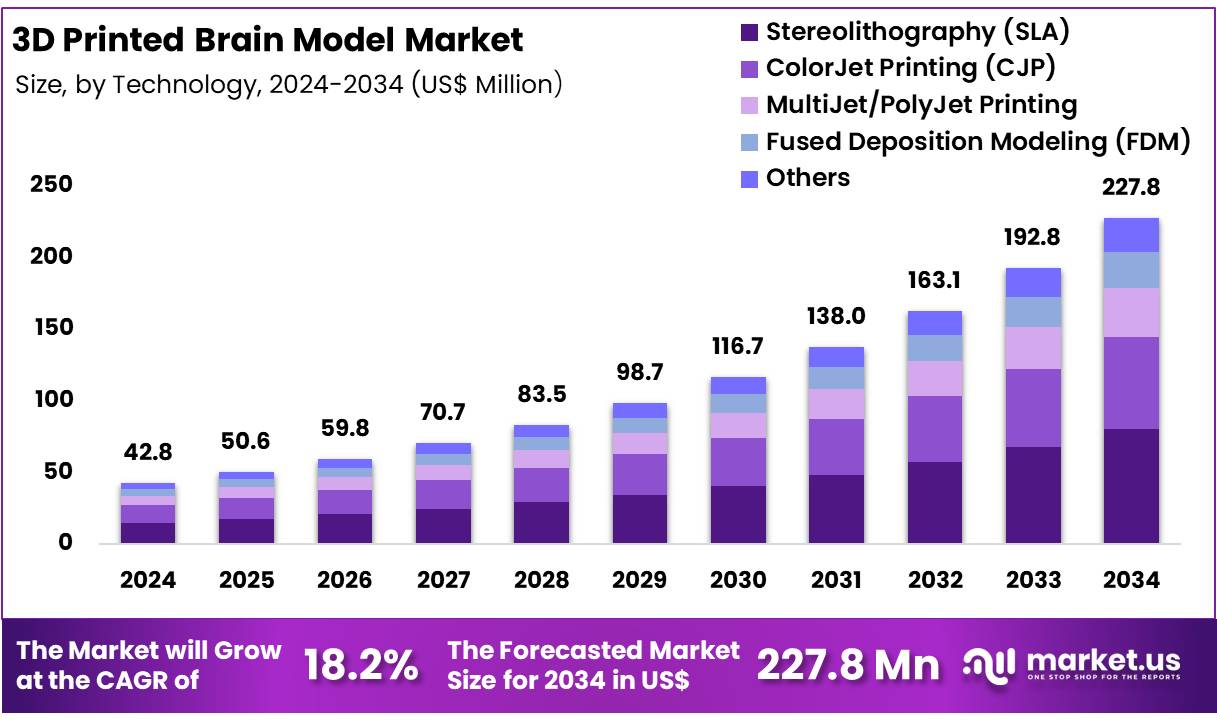
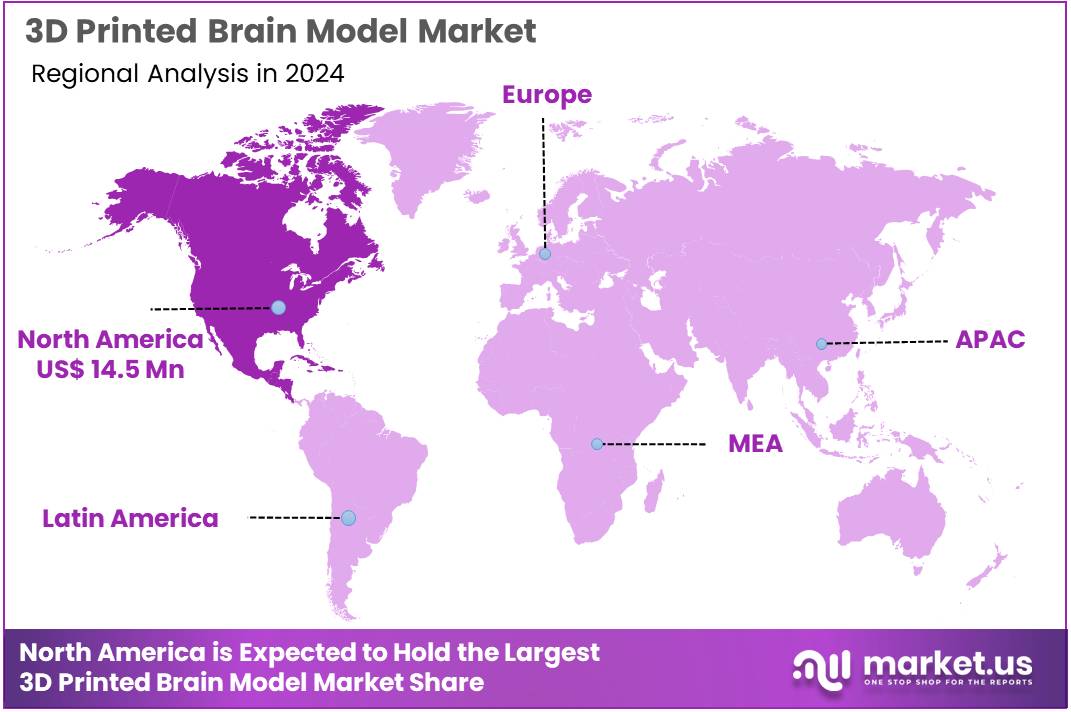
Global 3D Printed Brain Model Market was valued at USD 42.8 million in 2024 and is anticipated to register substantial growth of USD 227.8 million by 2034, with 18.2% CAGR. In 2023, North America led the market, achieving over 34% share with a revenue of US$ 14.5 Million.
The global 3D printed brain model market is driven by advancements in healthcare and education, alongside increasing demand for precise anatomical models for medical training and research. Rising investments in 3D printing technologies, particularly in the fields of neuroscience and bioprinting, are fostering innovation in creating highly detailed, patient-specific brain models.
These models are crucial for studying brain structure, disorders, and surgical planning, offering significant improvements over traditional methods. The growing prevalence of neurological disorders, coupled with the increasing adoption of 3D printing in pharmaceutical and medical device industries, further propels market growth. Additionally, government initiatives and collaborations between universities and healthcare providers are accelerating the integration of 3D printing in research and medical applications.
However, challenges such as high production costs, regulatory hurdles, and limited availability of 3D printing materials tailored for brain modeling may restrict market expansion. Nonetheless, the market is poised for continued growth due to technological advancements and rising demand for personalized medicine.
Key Takeaways
- The global 3D printed brain model market was valued at USD 42.8 million in 2024 and is anticipated to register substantial growth of USD 227.8 million by 2034, with 18.2% CAGR.
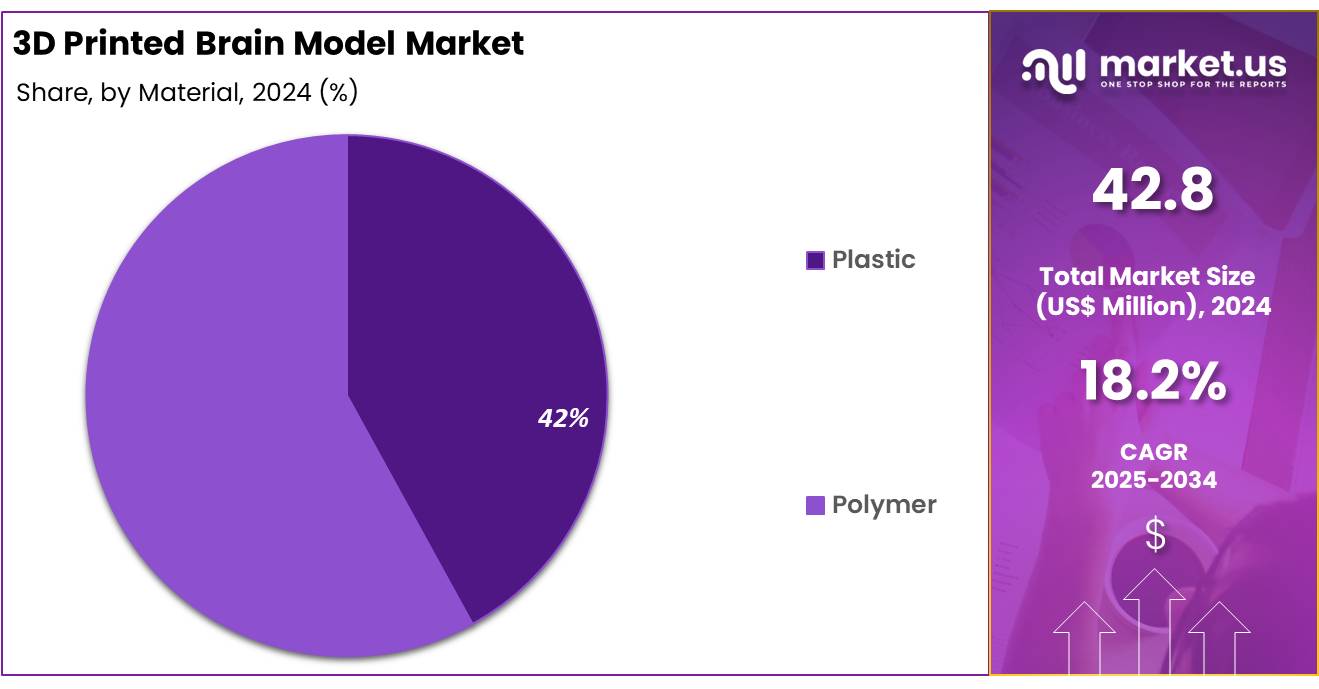
- In 2024, the plastic segment took the lead in the global market, securing 42% of the total revenue share.
- The fused deposition modeling (FDM) segment took the lead in the global market, securing 26% of the total revenue share.
- North America maintained its leading position in the global market with a share of over 34% of the total revenue.
By Material Analysis
Based on material the market is fragmented into polymer and plastic. Amongst these, plastic segment is capturing a significant market share of 42% in 2024 due to its versatility, affordability, and ease of use in the production of detailed anatomical models. Plastics such as PLA (Polylactic Acid) and ABS (Acrylonitrile Butadiene Styrene) are commonly used in 3D printing for their durability, lightweight properties, and ability to accurately replicate complex brain structures.
These materials offer a cost-effective solution for creating models used in medical education, surgical planning, and research. Plastic brain models provide a high degree of customization, allowing for the reproduction of specific patient anatomy, which is particularly valuable in personalized medicine.
Additionally, the widespread availability of 3D printers capable of working with plastic materials and the growing adoption of additive manufacturing technologies in the healthcare sector contribute to the segment’s expansion. As demand for more precise and affordable 3D printed models increases, plastics will continue to dominate in the creation of brain models for medical and educational purposes.
By Technology Analysis
The market is fragmented by technology into stereolithography (SLA), colorjet printing (CJP), multijet/polyjet printing, fused deposition modeling (FDM), and others. Fused deposition modeling (FDM) dominated the global 3D printed brain model market capturing a significant market share of 26% in 2024. Fused Deposition Modeling (FDM) has dominated the global 3D printed brain model market due to its affordability, accessibility, and efficiency in producing detailed and precise models.
FDM is a widely used additive manufacturing technique that melts and extrudes thermoplastic materials, such as PLA and ABS, to create 3D structures layer by layer. This method is particularly advantageous for creating complex anatomical models like brain structures, as it allows for rapid prototyping, cost-effective production, and high customization. FDM technology is also compatible with a wide range of materials, making it ideal for medical applications where precision and material versatility are key.
Key Segments Analysis
By Material
- Polymer
- Plastic
By Technology
- Stereolithography (SLA)
- ColorJet Printing (CJP)
- MultiJet/PolyJet Printing
- Fused Deposition Modeling (FDM)
- Others
Driving Factors
Advancements in 3D Printing Technology
Advancements in 3D printing technology are significantly driving the growth of the 3D printed brain model market by enabling more precise, cost-effective, and customizable models. Continuous improvements in printing resolutions, material compatibility, and speed have enhanced the accuracy and detail of brain models, making them more useful for medical research, education, and surgical planning.
New materials, including biocompatible and flexible substances, allow for more realistic brain replicas that closely resemble human tissue, crucial for studying neurological diseases and disorders. Additionally, innovations like multi-material and multi-color printing enable the creation of highly detailed, patient-specific models, which are invaluable for personalized medicine.
The development of faster and more affordable 3D printing technologies has made these models accessible to a broader range of healthcare providers, researchers, and educational institutions. As 3D printing continues to evolve, it is increasingly being adopted for complex applications, thereby expanding its role in the study and treatment of brain-related conditions, thus propelling market growth.
Market Restraints
High Production Cost
High cost of production is restraining the growth of 3D printed brain model market. This can limit widespread adoption, especially in developing regions or smaller institutions. The creation of high-quality, detailed brain models requires advanced 3D printing technologies, specialized materials, and considerable expertise, all of which contribute to the overall expense.
While the prices of 3D printers have been decreasing, the costs for high-resolution models, particularly those that replicate intricate neurological structures or require biocompatible materials for medical use, remain prohibitively high for many smaller medical facilities, educational institutions, and research organizations.
Additionally, the need for skilled operators and ongoing maintenance of 3D printing equipment further adds to the financial burden. These high costs may delay or restrict the integration of 3D printed brain models in routine clinical practice and research, particularly in underfunded or resource-constrained settings, potentially hindering broader market growth.
Opportunities
Growing Advanced Research for Neurodegenerative Diseases
The growing focus on advanced research for neurodegenerative diseases, such as Alzheimer’s and Parkinson’s, is significantly driving the growth of the 3D printed brain model market. With Alzheimer’s being the fifth-leading cause of death in the U.S., as highlighted by the National Center for Biotechnology Information in April 2023, there is a rising demand for innovative research tools to explore effective treatments. In this context, 3D printed brain models have emerged as a crucial technology, providing highly detailed, accurate representations of brain structures that are essential for studying these complex diseases.
- For example, the collaboration between TU Wien (Vienna University of Technology) and the Medical University of Vienna in March 2024 resulted in the development of a high-resolution brain-phantom using 3D printing, specifically designed to facilitate research on neurodegenerative diseases such as Alzheimer’s and Parkinson’s.
These 3D models enable researchers to better understand the progression of such diseases, test potential treatments, and simulate surgical interventions. The ability to create personalized, patient-specific brain models further enhances research capabilities, fostering the development of tailored therapeutic strategies.
Impact of macroeconomic factors / Geopolitical factors
- Macroeconomic and geopolitical factors can significantly impact the 3D printed brain model market by influencing investment, research funding, and global supply chains. Economic downturns or recessions can lead to reduced healthcare and research budgets, limiting the adoption of advanced technologies like 3D printing in the medical field. Geopolitical instability, such as trade tensions or conflicts, can disrupt the supply of essential materials and components for 3D printing, leading to delays in production or increased costs.
- Additionally, changes in government policies, such as healthcare reforms or regulatory restrictions, can either foster or hinder the market’s growth. For instance, stringent regulations on medical device manufacturing or data privacy laws could increase compliance costs for companies developing 3D printed brain models. On the other hand, economic growth and favorable policies in emerging markets may create new opportunities, expanding access to advanced healthcare technologies and boosting demand for personalized 3D brain models. Thus, these factors play a crucial role in shaping market dynamics.
Latest Trends
The 3D printed brain model market is experiencing several key trends that are shaping its growth. One prominent trend is the increasing adoption of laser therapy for non-invasive pain management, particularly in treating conditions like arthritis, soft tissue injuries, and post-surgical recovery.
With a growing emphasis on animal wellness and holistic care, many veterinary clinics are incorporating laser therapy into their routine treatments. Another trend is the integration of portable and user-friendly laser devices, making it easier for smaller clinics and even mobile veterinary practices to offer laser treatments.
Additionally, there is a rising focus on laser therapies for both companion animals and livestock, with expanding applications in treating chronic conditions and improving healing times. The market is also seeing advancements in laser technology, with devices becoming more efficient, precise, and affordable. Finally, growing awareness among pet owners about the benefits of laser therapy is further driving market demand, particularly in developed markets.
Regional Analysis
North America held a significant 34% share of the 3D printed brain model market due to several factors, including advanced healthcare infrastructure, high investment in medical technologies, and a growing demand for personalized healthcare solutions.
The U.S. and Canada, with their well-established healthcare systems, have seen rapid adoption of 3D printing in medical applications, including brain models used for research, education, and surgical planning. The region’s focus on innovative research, coupled with significant funding from both government and private sectors, accelerates the development and integration of cutting-edge technologies.
- For example, in February 2024, scientists at the University of Wisconsin developed functional 3D printed brain tissue, marking a significant advancement in understanding brain functions and studying neurological disorders.
This breakthrough enables more accurate models for investigating diseases such as Alzheimer’s and Parkinson’s, further driving market growth. As the prevalence of neurological conditions rises, North America’s leadership in healthcare technology and research is expected to continue fuelling the demand for 3D printed brain models.
Key Regions and Countries
North America
- US
- Canada
Europe
- Germany
- France
- The UK
- Spain
- Italy
- Russia
- Netherland
- Rest of Europe
Asia Pacific
- China
- Japan
- South Korea
- India
- New Zealand
- Singapore
- Thailand
- Vietnam
- Rest of APAC
Latin America
- Brazil
- Mexico
- Rest of Latin America
Middle East & Africa
- South Africa
- Saudi Arabia
- UAE
- Rest of MEA
Key Players Analysis
The market involve presence of key players across bioprinting, medical device manufacturing, and healthcare technology sectors. Leading companies like CELLINK, Stratasys, and 3D Systems are at the forefront, providing advanced 3D printing solutions tailored for medical and research applications. These companies are focusing on enhancing the accuracy, resolution, and material diversity of 3D printed brain models, crucial for neurological research, surgical planning, and education.
Additionally, smaller, specialized firms are emerging, offering niche solutions, such as biocompatible and patient-specific models, often incorporating artificial intelligence to improve customization. Collaboration between academic institutions, research organizations, and commercial entities further intensifies competition, as these partnerships enable the development of highly detailed, functional brain models.
As the market evolves, factors like technological advancements, cost-effectiveness, regulatory compliance, and the ability to offer personalized medical solutions will determine competitive positioning and market share.
ROKIT HEALTHCARE, INC. is a biotechnology firm specializing in hyper-personalized organ regenerative healthcare solutions. The company leverages regenerative medicine, autologous cells, cell sheet technology, and 4D fabrication to provide cutting-edge organ regeneration services. CELLINK, a subsidiary of BICO, is a bioprinting company offering advanced 3D bioprinting products and services.
The company is dedicated to transforming global healthcare by accelerating drug development, providing innovative life science solutions that integrate biology and technology, and addressing the organ shortage issue, ultimately revolutionizing the healthcare industry worldwide.
Top Key Players
- SpectraVET
- Stratasys
- CELLINK
- CYFUSE BIOMEDICAL K.K
- ROKIT HEALTHCARE, INC.
- MedPrin
- 3D Systems, Inc.
- Formlabs
- voxeljet AG
- SLM Solutions
- HP Inc.
- EnvisionTEC
Recent Developments
- In September 2023, CELLINK, one of the global leader in 3D bioprinting technologies, is announced a strategic distribution partnership with Paralab, marking a major step in expanding its presence in Portugal and Spain. This collaboration will make CELLINK’s cutting-edge bioprinting solutions accessible to a wider audience across Southern Europe, further reinforcing the company’s dedication to advancing regenerative medicine while adapting to regional specificities.
- In January 2024, the German service bureau PartsToGo made an investment in four Stratasys stereolithography (SLA) 3D printers to meet the growing demand for industrial-grade prototyping, product testing, and end-use components.









