


Report Overview
The Global Thin Client Market size is expected to be worth around USD 1.7 Billion By 2032, from USD 1.45 billion in 2024, growing at a CAGR of 2.0% during the forecast period from 2023 to 2032.
A thin client is a lightweight computing device that depends on a central server for processing and data storage. Unlike traditional personal computers, which handle applications and data locally, thin clients serve primarily as interfaces, transmitting user inputs to the server and displaying the resulting outputs. This architecture centralizes computing resources, facilitating easier management and enhanced security.
The thin client market is experiencing growth driven by several key factors. Organizations are increasingly adopting thin clients to reduce costs, as these devices have minimal hardware requirements, leading to lower energy consumption and maintenance expenses. Additionally, the rise in remote work and the need for secure, centralized data management have heightened demand for thin client solutions.
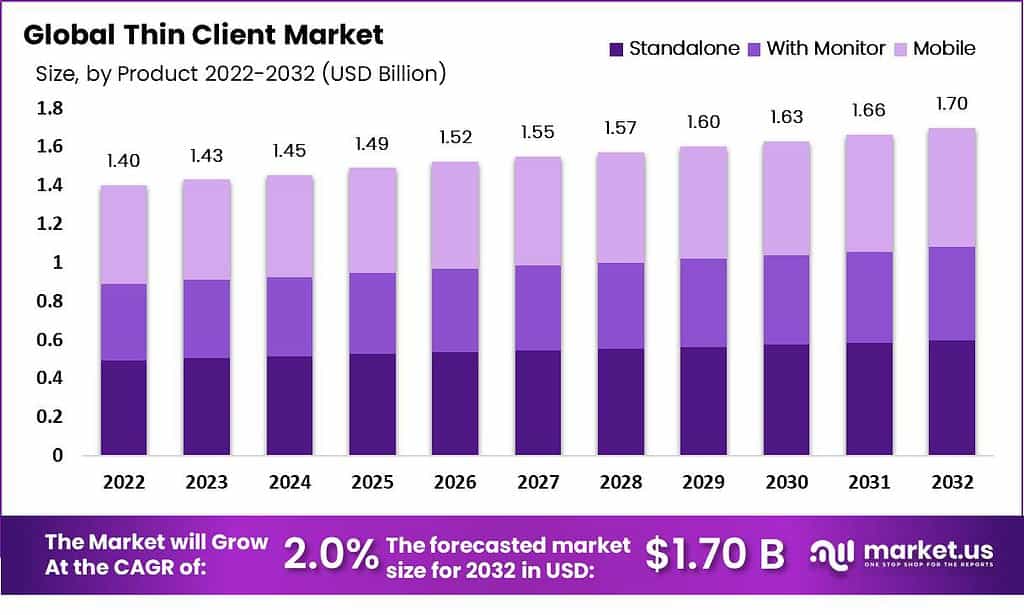
Several factors are propelling the thin client market forward. Organizations are increasingly adopting thin clients to reduce hardware costs and energy consumption. The centralized management of applications and data enhances security and simplifies IT administration. Additionally, the rise of remote work and the need for scalable solutions contribute to the growing popularity of thin client technology.
The demand for thin clients is particularly strong in sectors such as healthcare, finance, education, and retail. These industries prioritize data security, scalability, and ease of management—areas where thin clients excel. The ability to centralize data and applications ensures consistent performance and compliance with industry regulations.
Technological advancements are continually enhancing thin client capabilities. Modern thin clients support high-definition multimedia, multiple displays, and seamless integration with virtual desktop infrastructures. Improvements in network bandwidth and cloud computing have also reduced latency issues, making thin clients more efficient and user-friendly.
The business benefits of implementing thin clients are substantial. Centralized management simplifies IT administration, allowing for streamlined software updates and consistent security protocols. Moreover, the reduced hardware complexity of thin clients contributes to lower total cost of ownership and extends device lifespan, making them a cost-effective choice for organizations seeking efficient and secure computing solutions.
Key Takeaways
- Projected Market Growth: The thin client market is anticipated to grow at a CAGR of 2.0%, reaching USD 1.7 billion by 2032, showcasing its significant potential.
- Driving Factors: The rising popularity of remote working is one of the key drivers for the growth of the thin client market, as they can be easily accessed from anywhere with an internet connection, reducing overall costs for businesses.
- Security Concerns: While thin clients are considered more secure than traditional desktop computers, they can become non-operational if the network connection is disrupted, limiting their application in businesses requiring uninterrupted access to applications and data.
- Form Factor Analysis: Standalone thin clients are dominating the market due to their cost-effectiveness, high productivity, and management simplicity, especially in the IT industry. The mobile segment is expected to grow rapidly, driven by the increasing trend of remote working.
- Application Analysis: The retail sector holds a significant share in the thin client market due to its use in managing point-of-sale (POS) systems and aiding in inventory management and customer relationship management (CRM).
- Growth Opportunities: The increasing demand for cloud-based thin clients is expected to create lucrative opportunities as they provide cost-effective access to cloud-based applications and data, reducing hardware costs and enhancing security.
- Latest Trends: Technological advancements, including virtualization technologies and the rising trend of bring your own device (BYOD) policies in workplaces, are driving the demand for thin clients, indicating a growing market potential.
- Regional Analysis: North America dominated the market in 2022, driven by technological advancements and the adoption of thin clients in various sectors, particularly in healthcare and education. The Asia Pacific region is expected to witness the fastest growth due to increasing technological advancements in the IT industry.
- Key Players: Major industry players in the thin client market include Dell, HP Inc., IGEL Technology, NComputing, Fujitsu, Lenovo, Stratodesk Corporation, VXL Technology, ClearCube Technology, and Centerm Information Co. Ltd., among others.
Driving Factors
Rising Popularity for Remote Working Driving the Market Growth
Thin clients are more cost-effective than traditional servers used in organizations because they require less hardware and maintenance, which helps in reducing the overall costs of business. Thin clients are more secure as compared to traditional desktop computers because they rely on central servers for data storage and processing. This allows storing in a centralized location and makes data easy to secure and control. They are highly customization and help users ease operations, which makes them the ideal choice in various industries and settings.
Thin clients have a smaller carbon footprint than PCs because they have fewer moving parts. Hard drives are complex mechanical devices. Thin clients have smaller processors and less memory. Thus, they generate less waste heat and consume less power. The popularity of remote working is rising. Thus the demand for thin clients is increasing because they can be easily accessed from anywhere with an internet connection. With the potential to help businesses meet budget, energy, and security goals through consistent and easy management solutions, thin clients are becoming more popular and competitive in end-user industries.
Restraining Factors
High Maintenance Costs and Rising Security Concerns Hampering the Market Growth
Thin clients have lower processing power as compared to traditional servers. They are totally dependent on network connectivity and can stop working if the network connection is disrupted, thus limiting the demand for thin clients in businesses that require reliable access to their applications and data. Thin clients are less expensive than traditional desktops and laptops, but their maintenance and initial implementation costs are high, which has a negative impact on the market.
By Form Factor Analysis
Standalone Segment is Dominant in Market Owing to Rising Adoption in IT Industries
Based on form factor, the thin client market is classified into standalone, with monitor, and mobile. The standalone thin client segment dominated the market with the largest market revenue share of 40% in 2022. The standalone thin clients are small embedded Java SE clients that provide unique features that provide flexible solutions. This thin client is cost-effective as compared to other thin clients. This increases productivity & flexibility and helps in simplifying management; thus, they have high demand in IT industries.
The mobile thin client segment is expected to grow at the fastest CAGR during the forecast period. A mobile client is a thin client that can only use to access a virtual desktop. IT shops use mobile thin clients to extend virtual desktop infrastructure (VDI) deployments to employees outside the company or office. The rising popularity of remote working is expected to drive demand for mobile thin clients in the forecast period.
By Application Analysis
The Retail Segment is Dominant in Market Due to Rising Demand to Manage POS System
On the basis of application, the thin client market is segmented into ITS, education, BFSI, industrial, government, healthcare, retail, and other applications. The retail segment was dominant in the market, with the largest market revenue share of 30% in 2022.
Thin clients can be used in managing POS systems in retail stores. Thin clients play an important role in inventory management that tracks stock levels and orders in the retail industry. They are used in customer relationship management (CRM) tools that track consumer engagement and data by using deep learning techniques. The ITS segment is expected to grow at the fastest CAGR during the forecast period.
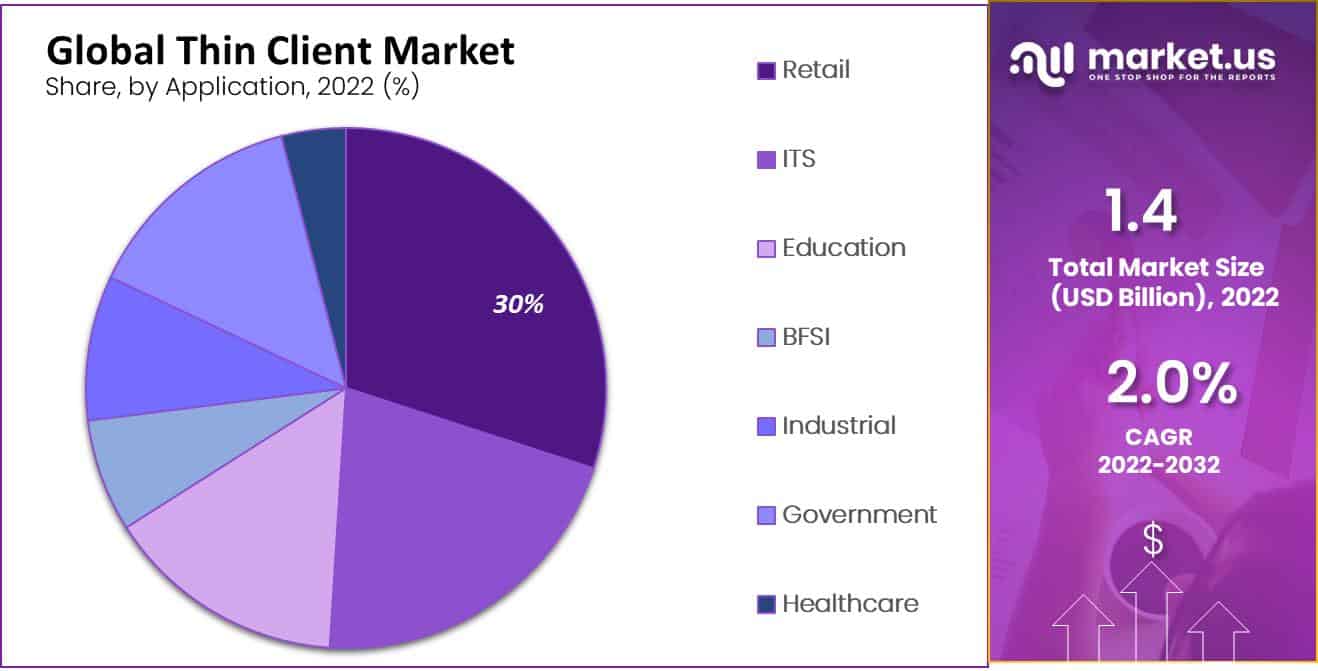
Note: Actual Numbers Might Vary In The Final Report
Key Market Segments
By Form Factor
- Standalone
- With Monitor
- Mobile
By Application
- ITS
- Education
- BFSI
- Industrial
- Government
- Healthcare
- Retail
- Other Applications
Growth Opportunity
Increasing Demand for Cloud-Based Thin Clients to Create Growth Opportunities in the Market
Cloud computing is becoming more popular because the thin client is a cost-effective way to access cloud-based applications and data. Thin clients require fewer resources than traditional desktops or laptops. Thus, many industries across the globe are adopting thin clients for accessing cloud-based resources. They allow multiple operating systems, which help in reducing hardware costs, simplify IT management, and improve security. Thin clients can provide a cost-effective solution for healthcare organizations looking to improve efficiency and reduce costs. The rising popularity of remote working and increasing demand for thin clients in educational & healthcare industries are expected to create lucrative growth opportunities in the global market.
Latest Trends
Technological Advancements in IT Industry
Virtualization technologies such as VMware and Citrix are becoming more popular. Rising technological advancements such Internet of Things (IoT) surged the demand for thin clients in the market. Thin clients are more secure than traditional desktops and laptops. So, consumers are more inclined towards the adoption of thin clients. The rising trend towards BYOD policies in the workplace propels the demand for thin clients in the market. Major key players in the thin client market are focusing on providing cost-effective thin clients to meet increasing consumer demands. The trend towards remote working is increasing, thus propelling the demand for thin clients in end-use industries.
Regional Analysis
North America Dominated the Market Due to Rising Developments in IT Industries
North America has dominated the market with the largest market share of 36% in 2022 and is expected to remain dominant during the forecast period. The growth of the market in North America is attributed to rising technological advancements. Rising revolution in healthcare and education propelling the demand for thin clients.
Rising adoption of cloud-based technologies and highly-technology oriented projects, which requires high flexibility driving the market growth. Demand for thin clients is increasing in banking, healthcare, and government organizations in developed countries such as US, Canada, and Mexico. Also, the presence of leading key players in thin client’s market such as Dell Technologies, HP Inc., IGEL Technology, and 10ZiG Technology, drives the market’s regional growth.
Asia Pacific region is expected to grow at the fastest CAGR during the forecast period. Increasing technological advancements in IT industries are expected to drive market growth during the forecast period.
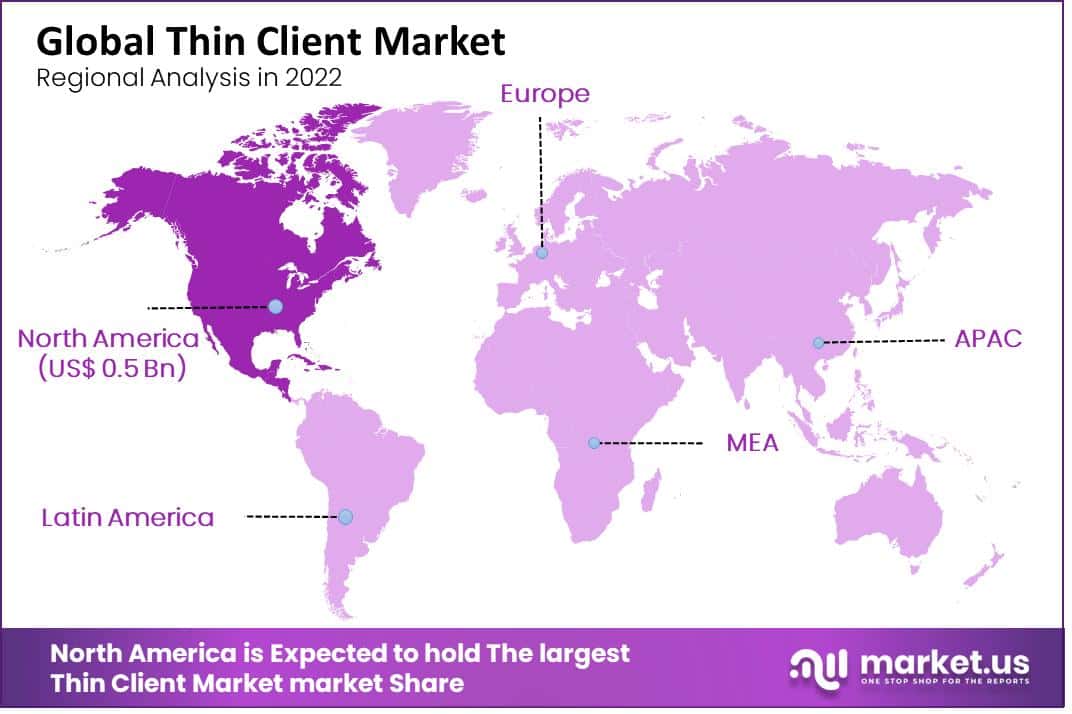
Note: Actual Numbers Might Vary In The Final Report
Key Regions and Countries
- North America
- The US
- Canada
- Mexico
- Western Europe
- Germany
- France
- The UK
- Spain
- Italy
- Portugal
- Ireland
- Austria
- Switzerland
- Benelux
- Nordic
- Rest of Western Europe
- Eastern Europe
- Russia
- Poland
- The Czech Republic
- Greece
- Rest of Eastern Europe
- APAC
- China
- Japan
- South Korea
- India
- Australia & New Zealand
- Indonesia
- Malaysia
- Philippines
- Singapore
- Thailand
- Vietnam
- Rest of APAC
- Latin America
- Brazil
- Colombia
- Chile
- Argentina
- Costa Rica
- Rest of Latin America
- Middle East & Africa
- Algeria
- Egypt
- Israel
- Kuwait
- Nigeria
- Saudi Arabia
- South Africa
- Turkey
- United Arab Emirates
- Rest of MEA
Key Players Analysis
Major key players in the thin client market are focusing on market strategies such as merging, acquisition, collaboration, and competitive pricing to stay competitive in the market. Several key players are focusing on expanding their business in foreign countries to expand their product portfolio. Dell Technologies is the leading key player in the global thin client market, which provides the Wyse Thin Client line of products. HP Inc. is another leading company that offers a wide range of thin client solutions such as HPt430, t530, and t640. The top key players in the thin client market include Dell, HP Inc., IGEL Technology, NComputing, Fujitsu, Lenovo, Stratodesk Corporation, VXL Technology, ClearCube Technology, and Centerm Information Co. Ltd., among others.
Top Key Players in the Thin Client Market
- Dell
- HP Inc.
- IGEL Technology
- NComputing
- Fujitsu
- Lenovo
- Stratodesk Corporation
- VXL Technology
- ClearCube Technology
- Centerm Information Co. Ltd.
- Other Key Players
Recent Developments
- In May 2021, Hp Inc. announced its acquisition of Teradici, which is a provider of remote access software for virtual desktops and workstations.
- In 2020, Dell announced the release of its new thin client devices, the Wyse 5470 and Wyse 5470 All-In-One.









