


Report Overview
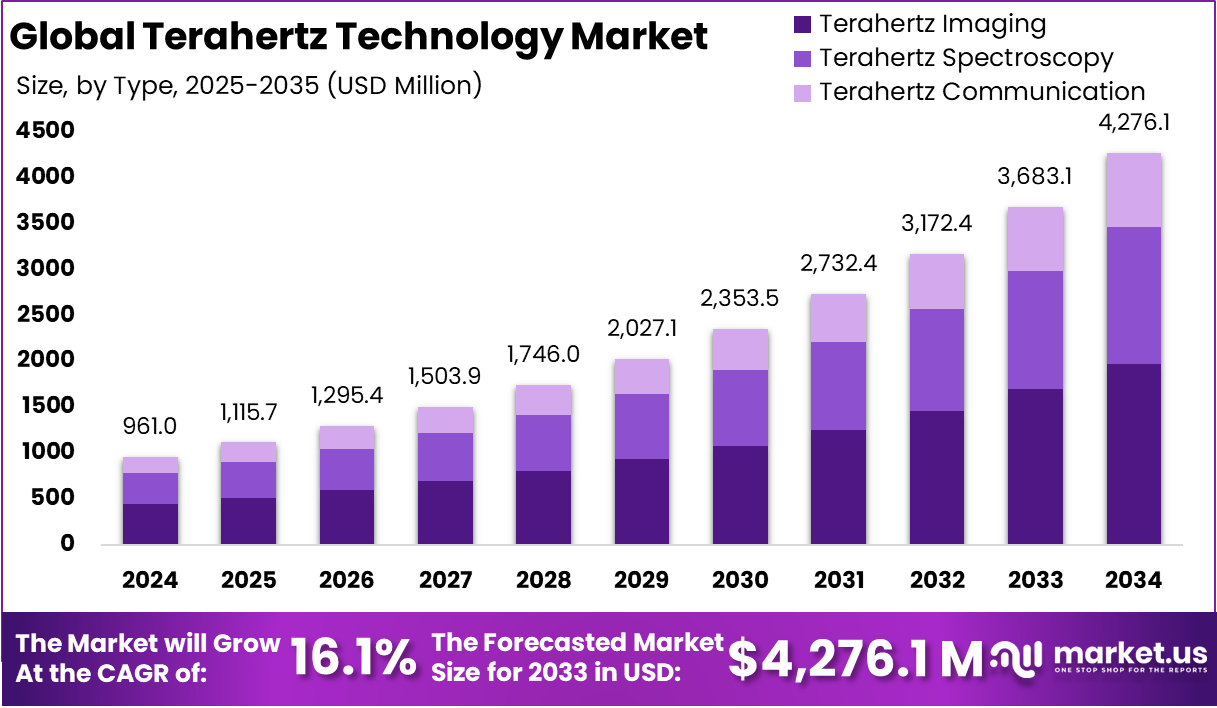
The Global Terahertz Technology Market size is expected to be worth around USD 4,276.1 million by 2034, from USD 961 million in 2024, growing at a CAGR of 16.1% during the forecast period from 2024 to 2033.
Terahertz technology refers to the application of electromagnetic waves in the terahertz region of the electromagnetic spectrum. This is also known as electromagnetic spectrum sub-mm wavelength or far-infrared radiation as it has frequencies between 100 GHz and 30 THz. It is used for imaging systems, spectroscopy, and communication solutions used in medical imaging, security screening, and wireless communication.
The market for Terahertz technology is growing due to various regions such as advancements in semiconductor technology and the growing need for non-invasive inspection methods. Furthermore, the rapid evolution of wireless communications has also contributed to the market growth.
The emerging applications of terahertz technology in fields such as biomedical, food processing, security checking, and others have evolved as a trend, reshaping the market growth across the globe.
Key Takeaways:
- In 2024, the Terahertz Imaging segment held a dominant market position, capturing more than a 42.1% share of the Global Terahertz Technology Market.
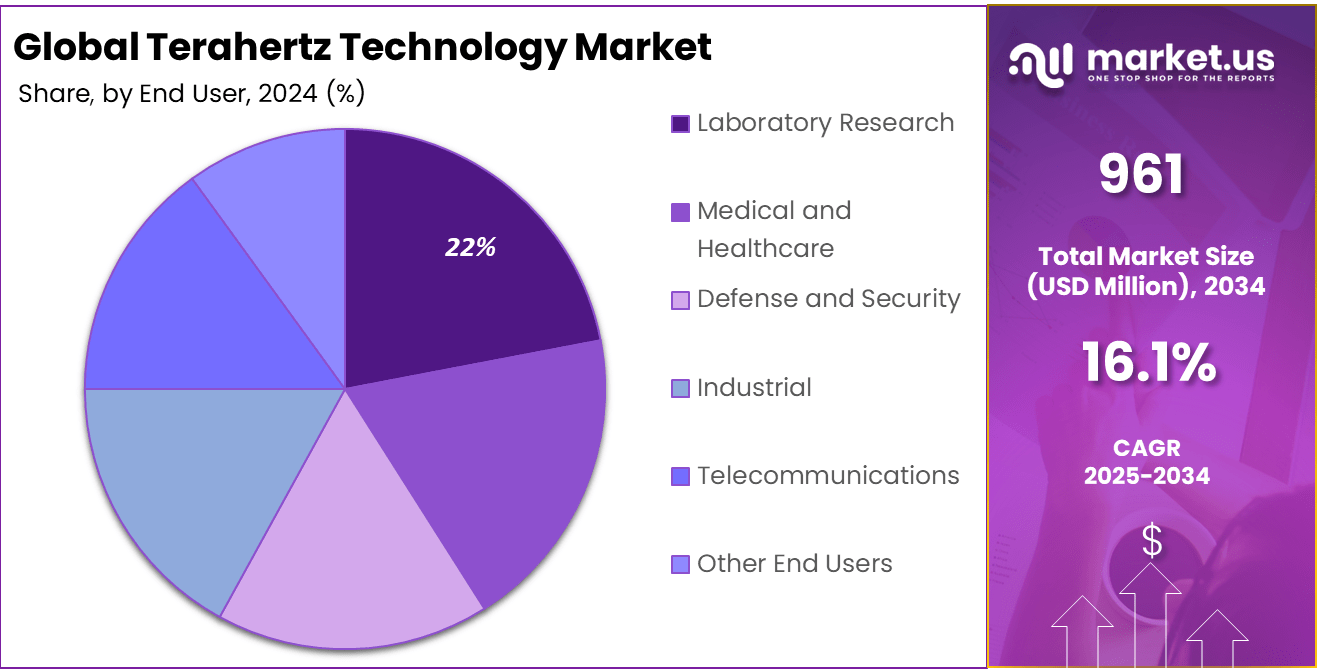
- In 2024, the Laboratory Research segment held a dominant market position, capturing more than a 22% share of the Global Terahertz Technology Market.
- The terahertz Technology Market was valued atUSD 294.5 millionin 2024, with a robust CAGR of4%.
- In 2023, North America held a dominant market position in the global Terahertz Technology Market, capturing more than a 35.4% share.
- According to NIH, Terahertz-TDS was found up to 95.5% accurate in the early diagnosis of explosive brain injuries.
U.S. Terahertz Technology Market Size
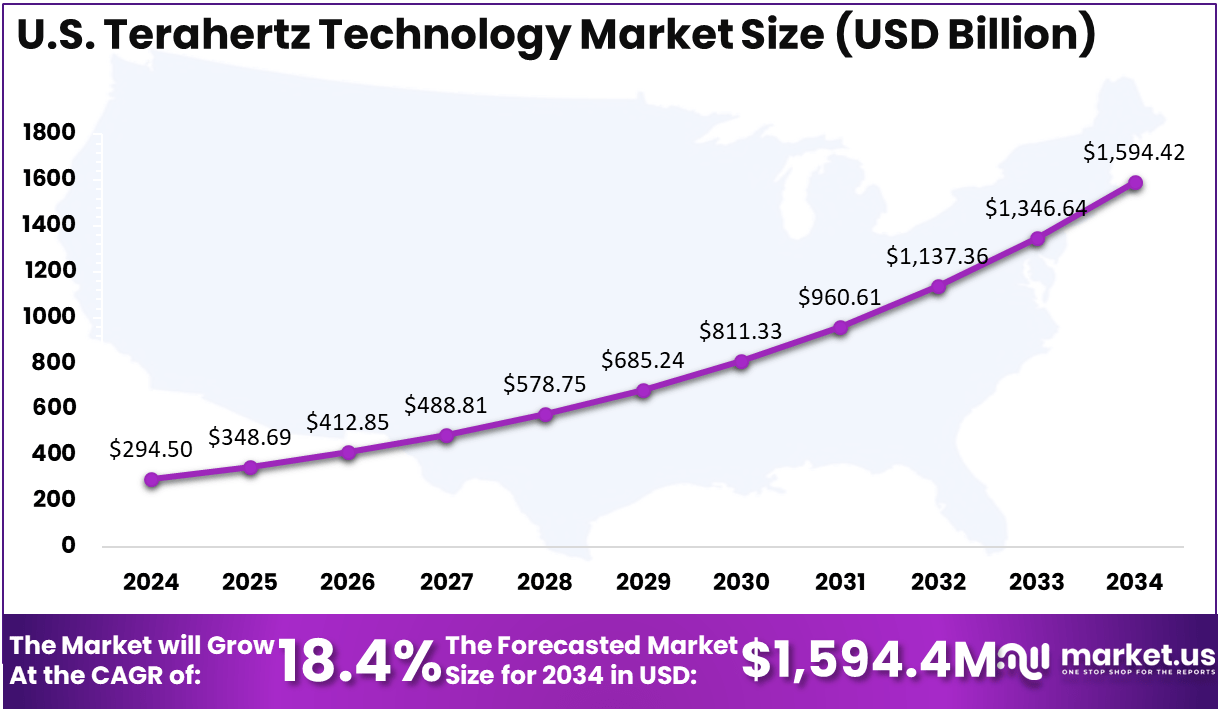
TheUS Terahertz Technology Market was valued atUSD 294.5 millionin 2024, with a robust CAGR of18.4%. This is attributed to the strong foundation of the U.S. region in scientific research and development, with the presence of numerous research institutions, universities, and government agencies.
Moreover, the ongoing government support and application of terahertz in industrial and commercial prospects have also contributed to the growth of the terahertz technology market in the U.S. region. For instance, according to AFMC, in 2023, FRL signed a CRADA with Keysight Technologies to advance communications in sub-terahertz frequencies for next-generation networks.
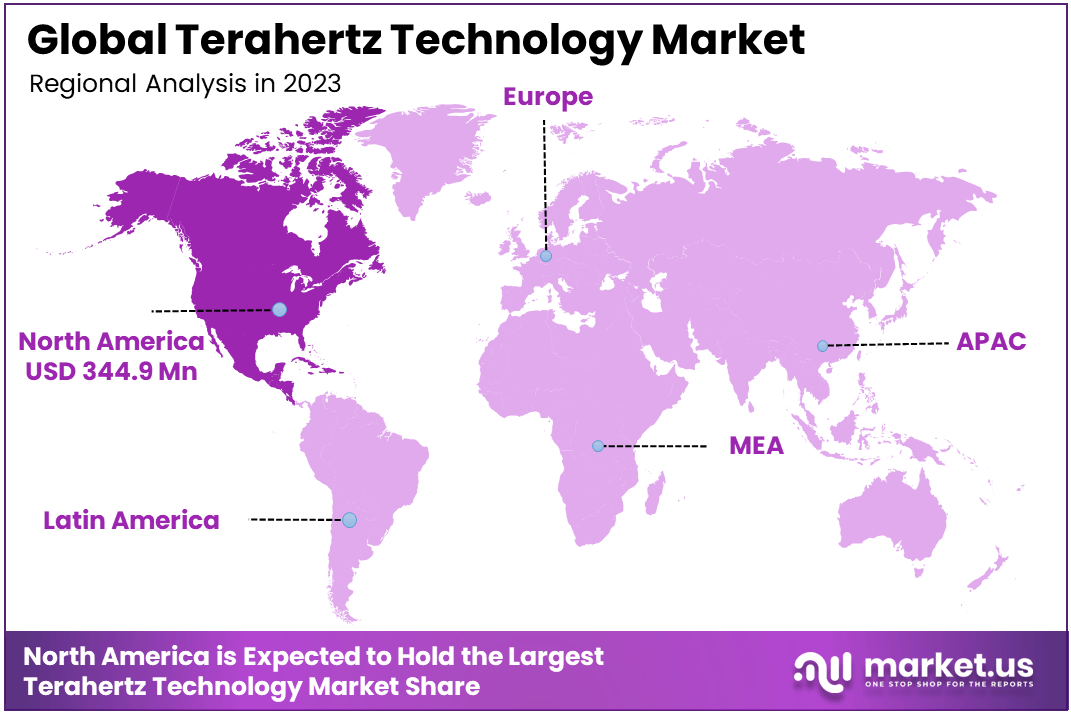
In 2023, North America held a dominant market position in the global Terahertz Technology Market, capturing more than a 35.4% share. This is attributed to the presence of major companies specializing in terahertz technology in the North American region, solidifying the region’s dominance.
Furthermore, the North American region also excels in integrating terahertz technology with other technologies such as AI, machine learning, and IoT, creating advanced applications and solutions of the technology.
For instance, The University of California, Los Angeles (UCLA) has been working on integrating terahertz technology with AI and machine learning for medical imaging. They developed a terahertz imaging system that can detect skin cancer at an early stage.
Key Regions and Countries
North America
- US
- Canada
Europe
- Germany
- France
- The UK
- Spain
- Italy
- Russia
- Netherlands
- Rest of Europe
Asia Pacific
- China
- Japan
- South Korea
- India
- Australia
- Singapore
- Thailand
- Vietnam
- Rest of APAC
Latin America
- Brazil
- Mexico
- Rest of Latin America
Middle East & Africa
- South Africa
- Saudi Arabia
- UAE
- Rest of MEA
Type Segment Analysis
In 2024, the Terahertz Imaging segment held a dominant market position, capturing more than a 42.1% share of the Global Terahertz Technology Market. This is due to the innovative diagnostic capabilities of terahertz imaging. It offers a non-invasive, high-resolution imaging, that is valuable in medical diagnostics to distinguish between different types of tissues and early detection of diseases such as cancer.
Furthermore, terahertz imaging is also extensively used for security screening at borders, airports, and other high-security areas. It is capable of searching various nonconductive materials, making it ideal for inspection. This has led to the dominance of this segment in the market.
Terahertz imaging is also highly demanded to analyze and conserve cultural heritage objects and artworks. It aids in revealing the hidden layers of painting, identifying materials, and understanding the structure of historical artifacts without harming the property. This leads to the dominance of the terahertz imaging segment in the market.
End User Segment Analysis
In 2024, the Laboratory Research segment held a dominant market position, capturing more than a 22% share of the Global Terahertz Technology Market. Terahertz technology is highly in demand during scientific research, with the ongoing advancements in terahertz sources, detectors, and imaging systems. For instance,
In February 2024, the European Union-funded ERC (European Research Council) project named TIMING, which includes Loughborough’s Emergent Photonics Research Centre members, collaborated with Exeter University’s professor Jacopo Bertolotti. This has driven the demand for laboratory research to explore new applications and improvise the existing technologies.
This technology has a wide range of applications across different scientific disciplines, including physics, chemistry, biology, and material science. This nature tends to attract researchers from various fields to explore the terahertz technology’s potential effectively.
For instance, according to the University of Cambridge, Researchers at the University of Cambridge, in collaboration with colleagues from the Universities of Augsburg and Lancaster, have discovered a new effect in two-dimensional conductive systems when exposed to terahertz waves. This discovery promises improved performance of terahertz detectors.
Key Market Segments:
By Type
- Terahertz Imaging
- Terahertz Spectroscopy
- Terahertz Communication
By End User
- Laboratory Research
- Medical and Healthcare
- Defense and Security
- Industrial
- Telecommunications
- Other End Users
Driving Factors
Growing demand for non-destructive testing
Growing demand for non-destructive testing significantly drives the market. This technology provides high-resolution imaging and precise measurements needed for detecting cracks, defects, and inconsistencies in materials without any damage. This makes it ideal for its application in non-destructive testing.
Additionally, various traditional non-destructive methods such as X-rays and ultrasound could pose safety risks or need extensive preparations. However, terahertz technology utilizes non-ionizing radiation, that is safe for operators and objects that are inspected, thus driving the demand for this technology.
For instance, researchers at RIKEN in Japan have developed a handheld terahertz device that can effectively “X-ray” objects without using harmful ionizing radiation.
Restraining Factors
Higher costs
Higher costs of terahertz technology restrain the market growth. Small and medium-sized enterprises may find it challenging to invest in this technology as it needs costs for purchasing and implementing terahertz systems, thus limiting market growth.
Additionally, the development and manufacturing of terahertz devices and systems need advanced materials, precision engineering, and specialized knowledge. These factors contribute to the high production costs and maintenance passed on to the end users. These factors collaboratively hamper the adoption of terahertz technology in start-ups and small and medium-sized businesses.
Growth Opportunities
Integration with growing technologies
Integrating AI and Machine Learning with the terahertz technology aids in improving data analysis, enhancing image processing, and enabling predictive maintenance. This could also help in automating and optimizing the terahertz imaging and spectroscopy, making it more efficient and effective. This has brought new opportunities for the market growth.
Additionally, the advances in quantum computing can also enhance the processing power and capabilities of terahertz systems. The combination of these technologies could health to breakthroughs in material science, medical diagnostics, and security applications.
For instance, IBM’s Qiskit, an open-source quantum computing software development framework, is being used in various research projects to explore the integration of quantum computing with terahertz technology.
Challenging Factors
Technical limitations
Technical limitations pose a crucial challenge for the terahertz technology market. Terahertz sources often have a limited output power, thus restricting their range, effectiveness, and application in long-range or highly sensitive measurements. Additionally, there could also be issues in the sensitivity of the detectors and significant attenuation of terahertz waves.
Moreover, terahertz components and systems could be sensitive to temperature variations, affecting their performance and reliability. Maintaining stable operating conditions is required to ensure accurate and consistent measurement.
Growth Factors
There are various factors contributing to the growth of the terahertz technology market. Terahertz technology is being used in planetary science to study the atmosphere and surface composition of their planets. This demand has driven the growth of the market.
Furthermore, the application of terahertz technology in climate and environment monitoring, cultural heritage preservation, agriculture, and food safety management as well as providing personalized medicine, has also contributed to the market growth.
For instance, Scientists from Tomsk State University (TSU) in Russia and the University of the Littoral Opal Coast in France have developed a new approach to analyzing atmospheric gases using terahertz spectroscopy and AI. This method can be used for ecological monitoring and controlling industrial pollution.
Latest Trends
Recent trends in femtosecond laser technologies and innovative approaches for terahertz wave generation and detection are reshaping the market by providing huge opportunities for market growth.
Moreover, terahertz technology is also being explored for ultra-high-speed wireless communication, which is essential for the development of 5G and future networks. Its potential to support higher data rates and improve connectivity is attracting significant interest and investments.
Key Players Analysis
One of the leading players in the market is Bruker Corporation which is a global leader in scientific instruments and solutions for molecular and materials research, as well as for industrial and applied analysis. They offer a range of terahertz (THz) spectroscopy solutions, including the VERTEX series FT-IR spectrometers and the unique verTera THz extension.
Another prominent firm operating in the market is Luna Innovations which specializes in advanced fiber optic sensing and terahertz technology for industrial and manufacturing applications. Their T-Ray 5000 platform, including the T-Ray 5600 and T-Ray 5700 models, offers precise terahertz waveform control, generation, and detection for fast, accurate measurements.
Top Key Players in the Market
- Advantest Corporation
- TOPTICA Photonics AG
- Bruker Corporation
- Luna Innovations
- TeraView Limited
- HÜBNER Photonics
- Menlo Systems GmbH
- TeraSense Group
- TeraVil Ltd
- Bakman Technologies
- BATOP GmbH
- Hamamatsu Photonics K.K.
- Other Key Players
Recent Developments
- In July 2024, TicWave Solutions GmbH announced the launch of their latest silicon-based terahertz product line, now available on their website. The new product categories include Terahertz Cameras, Terahertz Sources, and Terahertz Imaging Systems. This innovation marks a significant advancement in the terahertz frequency band, making it more accessible for various applications in research and industry.
- In July 2024, US-based wellness solution provider Viiva launched its Viiva Discovery Station (VDS) in India, introducing terahertz technology to the market. Terahertz technology is widely used for detecting defects in tablet coatings, product inspection in various industries, material characterization in physics, identifying concealed weapons at airports, and detecting cancer and dental caries.
- In June 2024, Loughborough University launched a new research center dedicated to revolutionizing science and technology through photonics – the study of lasers and light waves.









