


Report Overview
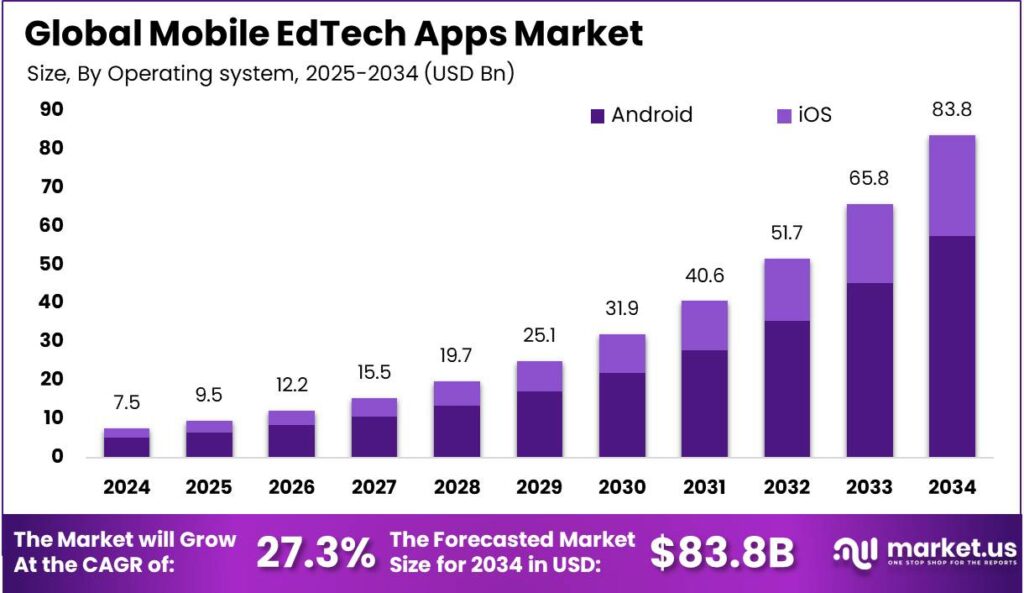
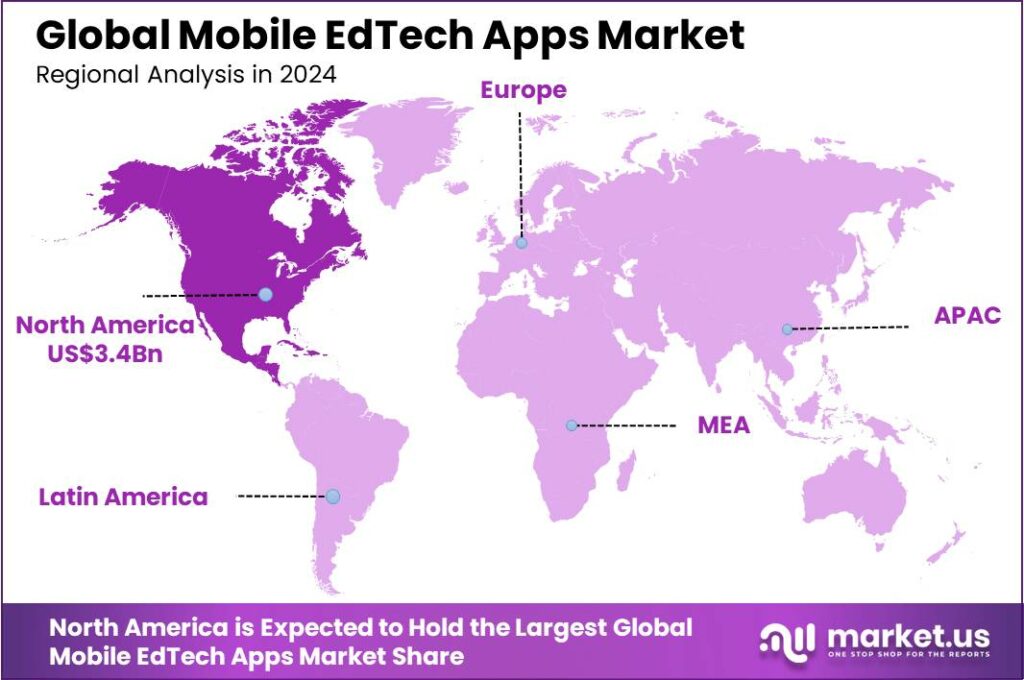
The Mobile EdTech Apps Market size is expected to be worth around USD 83.8 Bn By 2034, from USD 7.5 Bn in 2024, growing at a CAGR of 27.30% during the forecast period from 2025 to 2034. In 2024, North America led the global mobile EdTech apps market with a 45.7% share, generating USD 3.4 billion in revenue. The U.S. market was valued at $2.74 bn, highlighting its key role in the education sector.
Mobile Educational Technology (EdTech) applications are software programs designed to facilitate learning through mobile devices such as smartphones and tablets. These applications encompass a wide range of educational tools, including interactive lessons, language learning platforms, and virtual classrooms, enabling users to access educational content anytime and anywhere.
The market for Mobile EdTech apps is rapidly expanding, driven by the growing adoption of mobile technology in education and the increasing demand for accessible, flexible learning solutions. These apps are becoming a crucial part of educational strategies in schools and universities as well as in professional and personal development settings.
The primary driving factors behind the growth of the Mobile EdTech apps market include the increasing penetration of smartphones and the internet globally, the demand for personalized learning experiences, and the need for flexible learning schedules that accommodate various lifestyles. Additionally, the educational sector’s ongoing digital transformation encourages more institutions to adopt these technologies.
There is a significant demand for Mobile EdTech apps that offer scalable, customized learning experiences. Opportunities are particularly pronounced in areas such as adaptive learning technologies, which personalize content to fit individual learner’s pace and understanding, and in gamification, which uses game mechanics to increase engagement and motivation.
According to Sphinx Solutions, 89% of smartphone users download apps, with 50% of these apps focused on learning and education. Additionally, 67% of students rely on mobile devices to complete their online course tasks. For 64% of learners, being able to access training content on their mobile devices is considered essential, emphasizing the growing importance of mobile-friendly education platforms.
Data from Business of Apps reveals that the educational app market generated $5.93 billion in 2023, reflecting a significant 15.1% increase compared to the previous year. Duolingo emerged as the highest revenue-generating app, earning $315 million, according to AppMagic.
North America accounted for 44% of the global spending on education apps. In total, education apps were used by 709 million people and downloaded 939 million times in 2023. Among these, Duolingo stood out again as the most downloaded app, achieving 148 million downloads during the year.
Technological advancements are continuously shaping the Mobile EdTech apps market. Innovations in artificial intelligence, machine learning, and cloud computing are enabling more sophisticated adaptive learning platforms. Augmented reality (AR) and virtual reality (VR) are also beginning to play a role, offering immersive learning experiences that were not previously possible.
For businesses, investing in Mobile EdTech apps offers several benefits. These apps can lead to broader market reach and scalability in delivering educational content. They also provide an efficient way to gather data on user progress and engagement, which can be used to enhance learning outcomes and operational efficiency. Additionally, these apps can help reduce costs associated with physical learning materials and infrastructure.
Key Takeaways
- The global Mobile EdTech Apps market is expected to reach a value of USD 83.8 billion by 2034, up from USD 7.5 billion in 2024, growing at a CAGR of 27.30% during the forecast period from 2025 to 2034.
- In 2024, the U.S. mobile EdTech apps market was valued at $2.74 billion, highlighting the sector’s significant contribution to the country’s evolving education landscape.
- In 2024, North America dominated the global mobile EdTech apps market with a share of over 45.7%, generating approximately USD 3.4 billion in revenue.
- The Learning Management Systems (LMS) segment held a dominant market position in 2024, capturing more than a 25.4% share of the Mobile EdTech Apps market.
- In 2024, the Android segment led the market with a dominant share of over 68.7% in the mobile EdTech apps market.
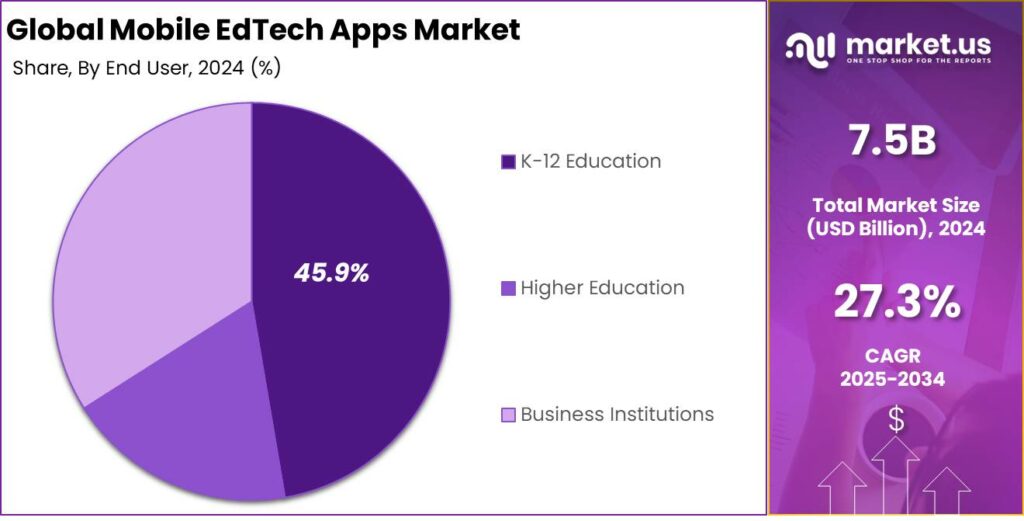
- The K-12 Education segment captured a dominant market share in 2024, with more than 45.9% of the total mobile EdTech apps market share.
U.S. Mobile EdTech Apps Market
In 2024, the U.S. mobile EdTech apps market was valued at $2.74 billion, reflecting the sector’s significant contribution to the country’s evolving education landscape. This market has been growing at an impressive compound annual growth rate (CAGR) of 28.4%, underscoring the increasing adoption of digital learning tools and technologies.
Factors such as rising smartphone penetration, a tech-savvy population, and a growing demand for flexible, on-the-go learning solutions have driven this rapid expansion. Educational institutions, corporations, and individual learners alike are leveraging mobile EdTech apps to enhance learning experiences and bridge educational gaps.
The robust growth of the U.S. market can also be attributed to innovations in technology, such as AI-driven personalization, gamification, and interactive learning models that cater to diverse learning preferences. Moreover, the pandemic-induced shift to remote and hybrid learning has permanently altered how education is delivered, creating a fertile environment for EdTech solutions to thrive.

In 2024, North America held a dominant position in the global mobile EdTech apps market, capturing more than a 45.7% share and generating approximately USD 3.4 billion in revenue.The U.S. leads the mobile EdTech market due to advanced technology, high smartphone use, and widespread adoption in education and workplaces. Strong demand for personalized learning and corporate upskilling drives this growth.
One key factor behind North America’s leadership is its well-established education system, which has been quick to integrate technology into learning environments. Schools, colleges, and universities in the region actively invest in mobile EdTech apps to supplement traditional teaching methods, offering students greater flexibility and interactive learning experiences.
North America’s dominance in mobile EdTech is fueled by strong government and private sector investments in education technology.Digital literacy programs, venture capital funding, high disposable incomes, and a tech-savvy population in the U.S. and Canada have all fueled mobile EdTech market growth.
Type Analysis
In 2024, the Learning Management Systems (LMS) segment held a dominant market position, capturing more than a 25.4% share of the Mobile EdTech Apps market. This growth can be attributed to the widespread adoption of LMS platforms by educational institutions and organizations to manage, track, and deliver online learning programs.
LMS solutions offer a centralized platform for educators and students, streamlining course management, performance tracking, and content delivery. This has led to a surge in demand for LMS apps, essential for both education and corporate training in the digital learning era.
The increasing shift towards remote and hybrid learning models has also significantly fueled the growth of LMS apps. With educational institutions seeking efficient ways to manage online coursework and students demanding flexible learning options, LMS solutions have emerged as the preferred tool.
Their ability to streamline administrative tasks, enhance communication between instructors and learners, and provide real-time analytics on learner performance positions LMS apps as a crucial player in the educational ecosystem. Moreover, their scalability allows them to cater to a wide range of users, from K-12 students to adult learners and corporate trainees.
Operating system Analysis
In 2024, the Android segment held a dominant market position, capturing more than a 68.7% share of the mobile EdTech apps market. This supremacy can be attributed to the widespread accessibility of Android devices, which are available at a wide range of price points, making them more affordable for users across different income groups.
The affordability and variety of Android smartphones also play a critical role in its dominance. Unlike iOS devices, which tend to be more premium-priced, Android smartphones come in various models, catering to a broader demographic.
Android’s flexibility and open-source nature allow developers to customize and optimize educational apps for various devices. This cost-effective platform fosters innovation, resulting in a diverse range of learning tools tailored to different needs and regions.
Android’s strong presence in regions with limited iOS access, such as Asia, Africa, and Latin America, combined with affordable smartphones, makes it the preferred platform for mobile EdTech apps. With growing smartphone usage and internet access, Android is set to maintain its leadership in the mobile EdTech market.
End User Analysis
In 2024, the K-12 Education segment held a dominant market position in the mobile EdTech apps market, capturing more than 45.9% of the total market share. This significant share can be attributed to the increasing integration of digital learning solutions in primary and secondary education.
With the rapid adoption of mobile devices in schools, K-12 institutions are actively incorporating EdTech apps to enhance student engagement and improve learning outcomes. The availability of tailored educational content, interactive tools, and easy access to resources through mobile platforms has made EdTech apps particularly appealing for this segment.
The rise of personalized learning and gamification in K-12 education drives the growth of mobile EdTech apps. These apps allow teachers to create tailored learning experiences, catering to diverse student needs, and supporting various learning paces and styles.
Government initiatives and educational reforms promoting digital literacy have boosted the adoption of mobile EdTech apps in K-12 education. Investments in tools and infrastructure, along with the global shift to remote and hybrid learning, have driven demand for flexible, scalable mobile learning solutions.
Key Market Segments
By Type
- Learning management systems (LMS)
- Virtual reality (VR) and augmented reality (AR) Apps
- Language Learning Apps
- Interactive Learning Apps
- Study Aid and Exam Preparation Apps
- Others
By Operating system
- iOS
- Android
By End User
- K-12 Education
- Higher Education
- Business Institutions
Key Regions and Countries
- North America
- US
- Canada
- Europe
- Germany
- France
- The UK
- Spain
- Italy
- Rest of Europe
- Asia Pacific
- China
- Japan
- South Korea
- India
- Australia
- Singapore
- Rest of Asia Pacific
- Latin America
- Brazil
- Mexico
- Rest of Latin America
- Middle East & Africa
- South Africa
- Saudi Arabia
- UAE
- Rest of MEA
Driver
Increasing Penetration of Mobile Devices
The widespread adoption of smartphones and tablets has significantly propelled the growth of mobile educational technology (EdTech) applications. As mobile devices become more affordable and internet connectivity improves globally, learners can access educational content anytime and anywhere.
This accessibility has democratized education, allowing individuals from diverse backgrounds to engage in learning opportunities previously unavailable to them.Moreover, the familiarity and convenience of mobile devices encourage consistent usage, fostering continuous learning habits.
Interactive features like gamified lessons and real-time feedback boost user engagement, making learning more effective and enjoyable. The rise of mobile devices fuels EdTech innovation, catering to the evolving needs of modern learners.
Restraint
Data Privacy and Security Concerns
Despite the numerous benefits of mobile EdTech apps, data privacy and security remain significant concerns. Educational applications often collect sensitive information, including personal details and learning behaviors. Without stringent data protection measures, this information can be vulnerable to unauthorized access or misuse.
Instances of data breaches not only compromise user trust but also pose legal and ethical challenges for EdTech providers. Ensuring compliance with global data protection regulations necessitates substantial investment in secure infrastructure and continuous monitoring. Consequently, addressing data privacy and security issues is imperative to maintain user confidence and uphold the integrity of educational platforms.
Opportunity
Integration of Advanced Technologies
The integration of advanced technologies, such as artificial intelligence (AI), augmented reality (AR), and virtual reality (VR), presents a significant opportunity for the EdTech sector. AI can facilitate personalized learning experiences by adapting content to individual learner’s needs, thereby enhancing engagement and efficacy.
AR and VR technologies can create immersive learning environments, allowing learners to interact with educational material in innovative ways. For instance, virtual laboratories and 3D explorations can make complex subjects more comprehensible. Embracing these technologies can differentiate EdTech offerings in a competitive market, attract a broader user base, and ultimately improve learning outcomes.
Challenge
Ensuring Content Quality and Effectiveness
With the rapid expansion of the EdTech market, ensuring the quality and effectiveness of educational content has become a pressing challenge. The influx of numerous applications has led to a disparity in content standards, with some apps lacking rigorous educational value. This inconsistency can hinder learning outcomes and diminish user trust in EdTech solutions.
Additionally, implementing comprehensive evaluation mechanisms to assess and update content regularly is essential. Establishing industry-wide standards and certifications can also guide users in selecting high-quality educational tools, thereby promoting a more effective and reliable EdTech ecosystem.
Emerging Trends
Mobile educational technology (EdTech) apps are transforming how we learn, making education more accessible and engaging. One significant trend is the integration of artificial intelligence (AI) to personalize learning experiences. AI tailors educational content to individual student needs, enhancing understanding and retention.
Another trend is the use of gamification to boost student engagement. By incorporating game-like elements such as rewards and challenges, these apps make learning more interactive and enjoyable. For instance, language-learning apps like Duolingo use streaks and notifications to motivate users to practice daily.
Microlearning is gaining popularity, offering content in small, manageable segments. This approach caters to shorter attention spans and enables learners to absorb information at their own pace. Mobile apps deliver bite-sized lessons that fit seamlessly into daily routines.
Business Benefits
For businesses, investing in mobile EdTech apps offers numerous advantages. These apps provide flexible learning solutions, enabling employees to access training materials anytime, anywhere. This flexibility leads to more efficient learning and better knowledge retention.
Mobile learning can be cost-effective. It reduces the need for physical training materials and in-person sessions, cutting down on expenses related to travel and venue hire. Digital content can be updated easily, ensuring that learners always have access to the most current information.
Data analytics is another significant benefit. Mobile EdTech apps can track learners’ progress, providing valuable insights into areas where employees excel or may need additional support. This data-driven approach allows businesses to tailor training programs to meet specific needs effectively.
Key Player Analysis
The mobile EdTech industry has rapidly evolved, offering convenient, interactive tools for learning. Key players with unique, innovative offerings are making education more accessible and engaging for all ages.
- Age of Learning Inc. is a key player in the mobile EdTech sector, best known for its platform, ABCmouse. The app is widely popular among young children and aims to foster early childhood education through interactive games, activities, and lessons.
- BrainPOP LLC is another major player in the mobile EdTech space, offering engaging educational content across a variety of subjects such as science, math, and social studies. The company’s mobile app provides animated videos, quizzes, and interactive activities designed to engage students and make learning fun.
- BYJU’S (Think and Learn Pvt. Ltd.) has emerged as one of the largest and most influential mobile EdTech companies in the world. Known for its innovative app that combines video lessons, interactive quizzes, and personalized learning, BYJU’S has expanded its offerings to cater to students across various age groups, from elementary school to competitive exam preparation.
Top Key Players in the Market
- Age of Learning Inc.
- BrainPOP LLC
- BYJU’S (Think and Learn Pvt. Ltd.)
- Coursera Inc.
- Blackboard Inc.
- Duolingo Inc.
- Educomp Solutions Ltd
- Khan Academy Inc.
- Lesson Nine GmbH
- Edx Inc.
- Lumos Labs Inc.
- MyScript, Rosetta Stone Inc.
- WizIQ, Inc.
Top Opportunities Awaiting for Players
- Microlearning for On-the-Go Education: EdTech apps that offer short, focused lessons or tips for quick learning sessions are likely to be more successful in the current mobile-first education environment. Microlearning allows users to learn in short bursts, making it ideal for busy professionals, students, or anyone looking to learn on the go.
- Increased Demand for Remote Learning Tools: With the rise of hybrid learning in schools, universities, and businesses, there’s a significant opportunity for EdTech players to create mobile apps that enhance remote learning. Features like interactive video lessons, live collaboration tools, and real-time assessments can greatly improve user engagement. Mobile apps that offer seamless, engaging, and accessible remote learning experiences will be in high demand.
- Gamification and Interactive Learning: By blending education with entertainment, mobile EdTech apps can create a more immersive learning experience, which is particularly appealing for younger learners. Opportunities exist for EdTech players to develop innovative game-based learning models that encourage students to keep learning while having fun.
- Expansion in Emerging Markets: In regions such as Southeast Asia, Latin America, and Africa, mobile devices are becoming the primary source of internet access. This presents a significant opportunity for EdTech companies to create mobile learning solutions tailored to these markets. Offering localized content, language support, and offline capabilities can help meet the needs of underserved learners and expand the reach of mobile learning platforms.
- Enhanced Analytics and Progress Tracking: Mobile apps that offer detailed analytics on a learner’s progress, strengths, and weaknesses can help personalize the learning journey even further. By providing real-time feedback and actionable data, EdTech apps can empower users to take control of their learning experience. Additionally, analytics can help educators better understand how students are performing and where improvements are needed.
Recent Developments
- In June 2024, Coursera is launching genAI-powered features like AI-Assisted Grading, Proctoring with a lockdown browser, and AI-driven Viva Exams to enhance assessment, grading, and academic integrity, offering campuses scalable, authentic online evaluations and boosting course and certificate value.
- In August 2024, Climb Global Solutions acquired Douglas Stewart Software & Services, focusing on SaaS solutions tailored for education, for $20.3 million.









