


Report Overview
The Global Voice Assistants in Learning Market size is expected to be worth around USD 43.5 Billion By 2034, from USD 1.8 Billion in 2024, growing at a CAGR of 37.50% during the forecast period from 2025 to 2034. In 2024, North America emerged as a key player in the voice assistants in learning market, commanding more than 35.8% of the market share and generating USD 0.6 billion in revenue.
Voice assistants in learning refer to the application of AI-powered voice recognition technologies within educational settings. These tools are designed to enhance the learning experience by facilitating interactive and accessible educational processes. Voice assistants support various educational activities, including answering queries, reading content for visually impaired students, aiding in language learning, and assisting with pronunciation.
The market for voice assistants in education is expanding as these technologies become integral to modern eLearning strategies. They are increasingly used to facilitate language learning, provide scalable and cost-effective training solutions, and support personalized learning paths. As education systems continue to embrace digital transformation, voice assistants are being integrated into classrooms to provide tailored educational experiences, thereby driving market growth

The key drivers for the growth of the voice assistant market include advancements in AI and machine learning technologies, which enhance the accuracy and efficiency of voice assistants. The increasing adoption of smart home devices and the broader IoT ecosystem also contribute to their widespread use.
There’s a significant demand for voice assistants across multiple sectors, including education, where they offer substantial opportunities for enhancing learning and teaching processes. The healthcare sector, for example, presents vast potential for voice technology, aiding in patient management and care. Continuous improvements in AI enhance the functionality of voice assistants, making them more versatile and capable of handling complex tasks across different industries.
According to eLearning Industry, smart speakers have become a common part of daily life in the U.S. In 2018, about 25% of U.S. citizens using Wi-Fi owned a smart speaker, highlighting their growing popularity. Voice search is also becoming increasingly common. As per Google Reports, over 27% of total internet users use voice search on mobile devices. Additionally, Google’s Voice Recognition tool now supports up to 119 languages, making it accessible to users worldwide.
Smart speakers are particularly popular among children. In the U.S., 8 out of 10 children have access to smart speakers, and over 44% of them have used these devices to answer questions. A study found that 38% of participants who initially refused the COVID-19 vaccine changed their minds after engaging with a voice assistant. These assistants, customized to match users’ personalities, played a role in shifting opinions, even when sharing COVID-related misinformation.
Technological advancements in natural language processing, machine learning, and AI are pivotal in refining the capabilities of voice assistants. These improvements help voice assistants understand and respond to a wide array of commands more accurately, making them essential tools in consumer electronics, automotive, and especially in education and healthcare sectors. Their ability to adapt to the user’s language and respond contextually enhances user experience significantly.
For businesses, voice assistants offer enhanced customer engagement, operational efficiency, and cost savings by automating routine tasks and providing a hands-free way to interact with technology. They improve accessibility and user experience, leading to increased customer satisfaction and retention. In educational settings, they reduce the need for extensive manual resources, enabling institutions to allocate their resources more effectively.
Key Takeaways
- The Global Voice Assistants in Learning Market size is expected to grow from USD 1.8 Billion in 2024 to USD 43.5 Billion by 2034, with a CAGR of 37.50% during the forecast period from 2025 to 2034.
- In 2024, the Solutions segment held a dominant position in the market, capturing more than 74.6% of the market share.
- The On-premises deployment mode of voice assistants in the learning market dominated in 2024, holding over 65.7% of the market share.
- In 2024, Large Enterprises held a leading market position, capturing more than 69.4% of the market share.
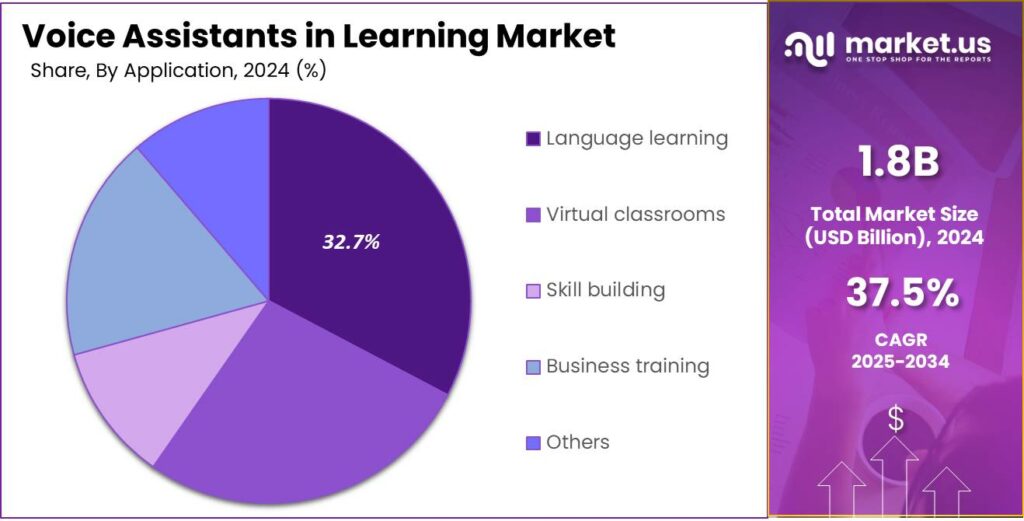
- The Language learning segment also led in 2024, holding over 32.7% of the market share.
- North America held a dominant position in the Voice Assistants in Learning Market in 2024, capturing more than 35.8% of the market, with revenues reaching USD 0.6 billion.
- In 2024, the U.S. market for voice assistants in learning reached a valuation of USD 0.52 billion, and it is projected to experience rapid growth, with an estimated CAGR of 38.5%.
U.S. Market Size and Growth
In 2024, the U.S. market for voice assistants in learning reached a valuation of USD 0.52 billion. This market segment is poised for rapid growth, with projections indicating a compound annual growth rate (CAGR) of 38.5%.
This robust expansion is driven by increasing adoption in educational settings, from primary schools to higher education institutions, as these technologies offer unique opportunities for enhancing teaching methods and improving student engagement.
As these tools become more sophisticated, they can provide more personalized learning experiences and more accurately respond to student queries, making them integral to modern educational environments. Additionally, the rise in smart device penetration in classrooms and homes provides a fertile ground for the expansion of voice-assisted learning applications, further fueling the market’s growth prospects.

In 2024, North America held a dominant position in the voice assistants in learning market, capturing more than a 35.8% share with revenues reaching USD 0.6 billion. This leadership stems primarily from the region’s strong technological infrastructure and the early adoption of digital and AI technologies in educational sectors.
The substantial investment in education technology by North American educational institutions and government bodies further fuels the adoption of voice assistants. Schools, colleges, and universities in this region are increasingly integrating digital tools into their teaching methodologies, seeking to enhance educational outcomes and cater to the needs of a diverse student population.
Moreover, the high level of connectivity and the widespread use of smart devices in North American households provide an ideal environment for the expansion of learning-related applications for voice assistants. Students and educators’ familiarity with technology drives smoother integration of advanced tools into learning.

Component Analysis
In 2024, the Solutions segment of the Voice Assistants in Learning Market held a dominant position, capturing more than a 74.6% share. This segment is broadly categorized into Standalone and Integrated solutions.
The lead of the Solutions segment over Services in the Voice Assistants in Learning Market is primarily due to the direct impact these technologies have on the learning process. Educational institutions and learners are keen on adopting solutions that provide immediate enhancements to the way educational content is delivered and consumed.
Solutions like voice-activated educational software allow for innovative approaches to learning, such as interactive quizzes, voice-driven content retrieval, and personalized feedback, which are highly valued for their ability to engage students more deeply than traditional learning methods.
The dominance of the Solutions segment reflects the market’s maturity in regions with higher tech penetration in education. As schools become more familiar with voice assistants and technology advances, there’s an increasing focus on acquiring innovative, easily integrable solutions.
Deployment Mode Analysis
In 2024, the On-premises deployment mode of voice assistants in the learning market held a dominant position, capturing more than a 65.7% share. This leading segment benefits significantly from its inherent control over data security and customization capabilities.
Schools prefer on-premises solutions to maintain control over integration and data management, ensuring sensitive student information stays within the institution and reducing risks of data breaches common with cloud solutions.
The preference for on-premises voice assistants in educational settings is further bolstered by the reliability and performance stability it offers. Institutions with on-premises infrastructure can manage and maintain their systems directly, ensuring consistent uptime and immediate attention to any technical issues.
Moreover, the on-premises deployment mode allows for a high degree of customization to better fit specific educational needs and integration with existing IT infrastructures. Educational institutions often have unique requirements and legacy systems, making the adaptable nature of on-premises solutions a key advantage.
Enterprise size Analysis
In 2024, the Large Enterprises segment held a dominant market position in the Voice Assistants in Learning market, capturing more than a 69.4% share. This market share is driven by large enterprises’ significant investments and focus on integrating advanced technologies to improve efficiency and employee training.
Large corporations typically have more extensive resources to allocate towards innovative tools, including voice assistants, to facilitate a more interactive and engaging learning environment. This allows them to implement these technologies at scale, effectively transforming corporate training and development programs across various departments.
The growth of voice assistant technology in large enterprises is driven by the need for scalable, flexible learning solutions that can be customized for a diverse workforce. With operations across multiple locations or globally, these companies require consistent and accessible training platforms.
Moreover, large enterprises are typically at the forefront of adopting emerging technologies to maintain a competitive edge. By integrating voice assistants into their learning systems, these enterprises not only enhance employee skills and knowledge more effectively but also leverage these tools to attract and retain top talent.
Application Analysis
In 2024, the Language learning segment held a dominant market position in the Voice Assistants in Learning market, capturing more than a 32.7% share. This leading position can be attributed to the global surge in demand for multilingual proficiency among professionals and students alike, spurred by globalization and the increasing interconnectivity of markets.
Voice assistants provide a highly interactive and accessible platform for users to practice and improve their language skills, offering real-time feedback and personalized learning paths that adapt to the proficiency level of each learner.
Voice assistants enhance language learning by simulating natural conversation using advanced natural language processing. They engage users in dialogue, correct pronunciation, and assess linguistic nuances, making them valuable tools for improving speaking skills.
The flexibility and convenience of voice-assisted language learning drive its popularity, allowing learners to engage anytime, anywhere during commutes, at home, or between meetings. This on-the-go learning fits the busy lifestyles of individuals who lack time for traditional classes.
Key Market Segments
By Component
- Solutions
- Standalone
- Integrated
- Services
- Consulting
- Implementation
- Support and maintenance
By Deployment Mode
- On-premises
- Cloud
By Enterprise size
- Small and Medium-sized Enterprises (SMEs)
- Large Enterprises
By Application
- Language learning
- Virtual classrooms
- Skill building
- Business training
- Others
Key Regions and Countries
- North America
- US
- Canada
- Europe
- Germany
- France
- The UK
- Spain
- Italy
- Rest of Europe
- Asia Pacific
- China
- Japan
- South Korea
- India
- Australia
- Singapore
- Rest of Asia Pacific
- Latin America
- Brazil
- Mexico
- Rest of Latin America
- Middle East & Africa
- South Africa
- Saudi Arabia
- UAE
- Rest of MEA
Driver
Enhanced Student Engagement
Voice assistants have the potential to significantly boost student engagement in educational settings. By providing instant answers to queries and facilitating interactive learning experiences, these tools can make learning more dynamic and accessible. For instance, students can ask questions and receive immediate responses, promoting a more inquisitive and self-directed learning environment.
This immediacy not only satisfies curiosity but also encourages continuous exploration of subjects. Moreover, the conversational nature of voice assistants can help in breaking down complex topics into understandable segments, making learning less intimidating and more approachable for students of varying ages and abilities.
Restraint
Privacy and Data Security Concerns
Despite their benefits, the integration of voice assistants in education raises significant privacy and data security issues. These devices often collect and store vast amounts of personal data, including voice recordings and usage patterns.
In educational environments, this becomes particularly sensitive as it involves minors. There is a risk that such data could be accessed by unauthorized parties or used for unintended purposes, leading to potential breaches of student privacy. Ensuring compliance with data protection regulations and implementing robust security measures are essential to mitigate these concerns.
Opportunity
Personalized Learning Experiences
Voice assistants offer a unique opportunity to tailor educational content to individual student needs. By analyzing interactions, these tools can adapt to the learning pace and style of each student, providing customized support and resources.
Additionally, a voice assistant can provide real-time feedback and guidance, allowing students to correct mistakes instantly and learn from them. This immediate support fosters a more interactive learning experience, encouraging active participation and boosting student confidence. By adapting to individual paces and offering tailored resources, voice assistants can further facilitate mastery of difficult concepts.
Challenge
Technological Limitations and Accessibility
Implementing voice assistants in educational settings is not without challenges. One significant hurdle is the technological limitation related to language recognition and accents. Many voice assistants may not accurately recognize or process diverse accents or dialects, leading to misunderstandings or frustration among users.
Additionally, the effectiveness of voice recognition can be compromised in noisy classroom environments, where background noise interferes with the assistant’s ability to accurately interpret commands. Addressing these technological limitations is crucial to ensure that voice assistants can be effectively utilized as educational tools across diverse settings.
Emerging Trends
Voice assistants are transforming education by offering interactive, personalized learning. Students can ask questions and receive instant answers, creating a tutor-like experience that makes learning more engaging and enjoyable.
These assistants also help teachers by taking over routine tasks like tracking attendance and grading. This automation gives teachers more time to focus on students and teaching. Additionally, voice assistants can keep track of a student’s learning progress and suggest areas to work on, making learning more efficient.
For students with disabilities, voice assistants are a great help. They make learning materials more accessible, supporting students who might have difficulties with traditional learning methods. This inclusivity ensures that all students have equal opportunities to learn.
Moreover, voice assistants can handle many students at once, providing personalized learning to each without losing quality. This scalability is cost-effective, as it reduces the need for one-on-one instruction and allows teachers to focus on more important teaching activities.
Business Benefits
- Enhanced Accessibility: Voice assistants enable students with disabilities to interact with educational content through voice commands, making learning more inclusive.
- Personalized Learning Experiences: These tools adapt to individual student needs, providing customized support and resources, which can lead to improved learning outcomes.
- Improved Time Management: By automating routine tasks like attendance tracking and grading, voice assistants free up educators to focus more on teaching and student engagement.
- Increased Student Engagement: The interactive nature of voice assistants fosters a more engaging learning environment, encouraging active participation and curiosity among students.
- Cost-Effective Scalability: Implementing voice assistants can reduce the need for one-on-one instruction, allowing educational institutions to efficiently scale personalized learning experiences to a larger student body.
Key Player Analysis
Voice assistants have revolutionized sectors like education by offering interactive and accessible learning solutions. Major players such as Amazon, Google, Apple, and Microsoft are integrating voice technology into their platforms to enhance educational experiences.
- Amazon is a major player in the voice assistant space, with its Alexa-powered devices dominating the market. Amazon has extended Alexa’s capabilities into education, providing tools for both K-12 schools and higher education institutions.
- Artificial Solutions is a leader in conversational AI, focusing on creating intelligent voice assistants that can understand and respond in natural language. Their solutions are highly customizable, offering businesses and educational institutions a chance to integrate voice-based AI into their learning environments.
- Apple Inc. continues to be a key player with its Siri voice assistant, which is integrated into a variety of Apple devices like iPhones, iPads, and Macs. Apple has seamlessly blended its voice assistant into the educational ecosystem by enabling students to use Siri to find educational resources, manage study schedules, and dictate notes.
Top Key Players in the Market
- Amazon.com, Inc.
- Artificial Solutions
- Apple Inc.
- Honeywell Corporation
- Samsung Electronics Co., Ltd.
- Google Corporation
- Interactive Voice Inc.
- Athom B.V.
- IBM Corporation
- Nuance Communications, Inc.
- Others
Top Opportunities Awaiting for Players
The voice assistant market is growing quickly, with strong potential in education. As learning becomes more personalized and tech-focused, voice assistants present a valuable opportunity for industry players.
- Personalized Learning Solutions: Voice assistants revolutionize learning by personalizing education to a student’s pace, style, and needs. This tailored approach boosts engagement, encourages self-paced progress, and makes education more inclusive and accessible. By integrating AI-driven voice technology, companies can provide precise support tailored to learners, thereby enhancing both educational outcomes and student satisfaction.
- Assistive Technology for Special Education: Voice assistants can greatly assist learners with special needs by offering personalized, readily accessible support. This integration of voice technology fosters an inclusive educational environment, removing barriers that students in traditional settings may face.
- Enhancements in Language Learning: Voice assistants are transforming language learning by using speech recognition and AI, allowing learners to practice skills through interactive dialogue, improving pronunciation, grammar, and vocabulary. Industry players have the opportunity to innovate further by developing voice assistants specifically designed for immersive language practice, enriching the learning experience and offering real-time feedback.
- Engaging and Motivating Students: Voice assistants can boost student engagement through gamified learning, offering interactive quizzes, flashcards, and real-time feedback. Integrating storytelling, challenges, and virtual tutoring enhances motivation and deepens engagement with educational content. This opens avenues for developers to craft specialized learning tools across various subjects and age groups.
- 24/7 Learning Support: Voice assistants provide essential on-demand support outside traditional classroom hours. They enable students to access learning materials anytime, addressing queries, clarifying concepts, or offering supplementary resources. Incorporating voice technology into e-learning platforms ensures round-the-clock access to educational resources, encouraging continuous learning beyond the confines of school environments.
Recent Developments
- In May 2024, Samsung launched the Interactive Display WAD series, featuring the Samsung AI Class Assistant. This AI-powered tool offers automatic transcriptions, generative class summaries, quizzes, and voice-enabled whiteboard functions to enhance classroom engagement.
- In November 2024, IBM demonstrated the integration of its Watsonx Assistant with IBM Rapid Network Automation (RNA) to create a voice bot capable of automating tasks like creating AWS EC2 instances. This showcases the potential of voice assistants in streamlining IT operations and educational administrative tasks.









