


Report Overview
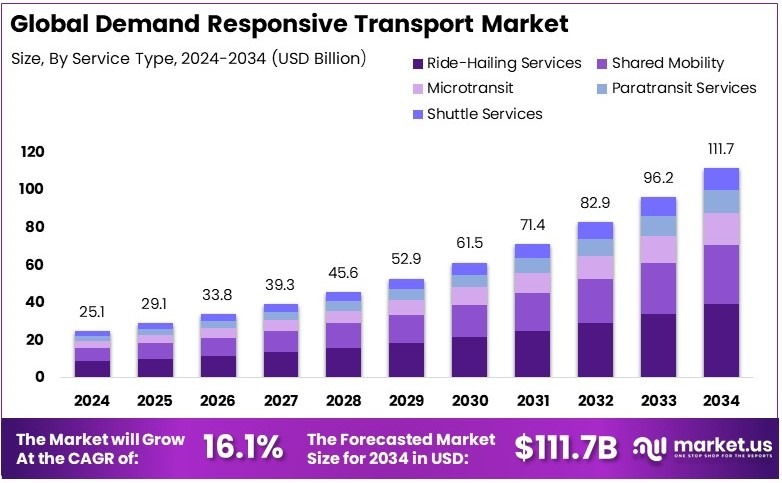
The Global Demand Responsive Transport Market size is expected to be worth around USD 111.7 Billion by 2034, from USD 25.1 Billion in 2024, growing at a CAGR of 16.1% during the forecast period from 2025 to 2034.
Demand Responsive Transport (DRT) is a flexible public transportation service that adapts to passenger demand rather than following a fixed route or schedule. It uses vehicles that are dispatched according to user requests, often coordinated through apps or phone calls.
The demand responsive transport market involves the provision of adaptable transport services that optimize routing and scheduling based on real-time user demand. This market includes technology providers, transportation companies, and public agencies coordinating DRT services.
Demand Responsive Transport (DRT) systems are gaining traction globally by offering flexible and user-oriented transportation services. In Australia, the Gold Coast’s On-Demand Transport (ODT) trial exemplifies the effectiveness of DRT, having completed over 184,000 trips since its inception in 2022.
The success of the ODT service in connecting key locations like Helensvale Station to Pacific Pines Town Centre at an affordable fare of just 50 cents highlights the potential for DRT to offer cost-effective and convenient alternatives to traditional public transport systems. The affordability and flexibility of DRT make it an attractive option, leading to considerations for expanding the service into new areas such as Carrara, Mount Nathan, and Gaven, driven by strong community demand and support.
Moreover, the economic impact of similar flexible transportation solutions, such as the app-based rideshare and delivery industry in the U.S., which contributes over $200 billion annually to the economy, underscores the broader economic benefits of investing in DRT. This sector not only provides flexible earning opportunities to more than 7.3 million app-based workers but also caters to a growing consumer preference for responsive and adaptable transport options.
Key Takeaways
- The Demand Responsive Transport Market was valued at USD 25.1 Billion in 2024, and is expected to reach USD 111.7 Billion by 2034, with a CAGR of 16.1%.
- In 2024, Ride-Hailing Services dominate the service type segment with 52.3%, driven by the growing preference for on-demand transportation solutions.
- In 2024, Electric Vehicles lead the mode of transport with 47.6%, reflecting the shift towards sustainable and eco-friendly transportation options.
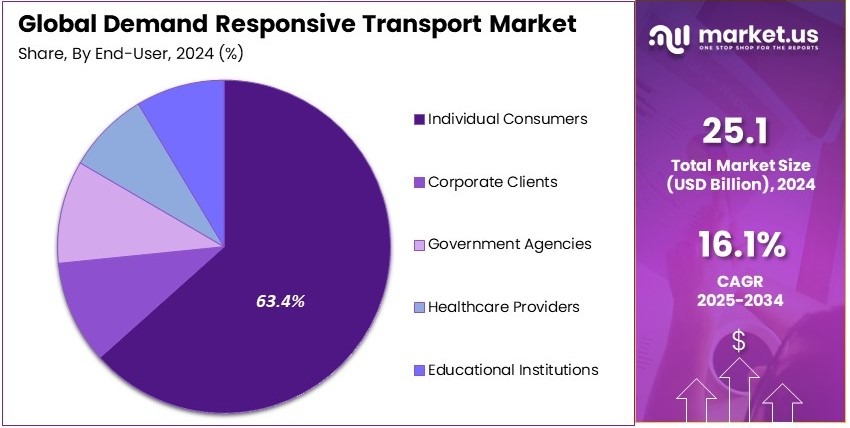
- In 2024, Individual Consumers hold 63.4% of the end-user segment, indicating high demand from personal transportation needs.
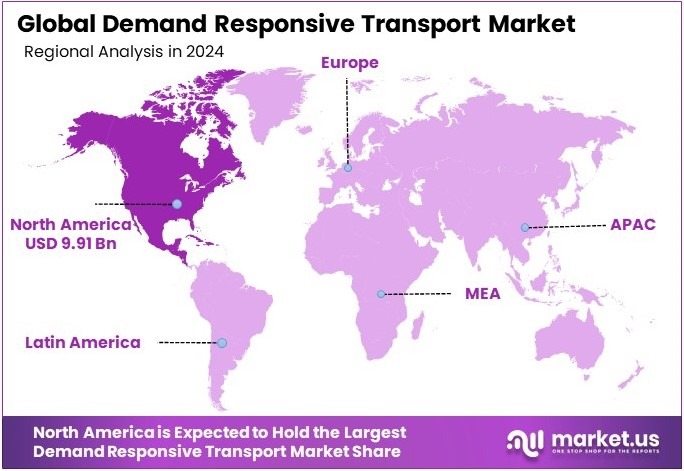
- In 2024, North America dominates the regional segment with 39.5% and a value of USD 9.91 Billion, propelling significant market expansion.
Service Type Analysis
Ride-Hailing Services dominate with 52.3% due to their convenience and widespread availability.
The service type segment in the Demand Responsive Transport Market is crucial, with Ride-Hailing Services leading significantly. This dominance is largely due to the convenience these services offer, allowing users to book rides on-demand through smartphone apps, making transportation accessible at virtually any time and place.
Shared Mobility, though not the leading segment, plays a significant role by providing cost-effective travel options where passengers share rides, reducing the cost per individual. Microtransit offers flexible routing and scheduling, which is increasingly popular in suburban areas lacking robust public transport.
Paratransit Services cater specifically to passengers with disabilities, ensuring that transportation barriers are minimized for this important demographic, reflecting the inclusive nature of demand-responsive transport. Shuttle Services are tailored mainly for fixed routes like airport transfers or between fixed points in urban centers, complementing the broader public transport network.
Mode of Transport Analysis
Electric Vehicles dominate with 47.6% due to their environmental benefits and lower operational costs.
Within the Mode of Transport segment, Electric Vehicles (EVs) take precedence, driven by the global push towards sustainability. The appeal of EVs in the demand responsive transport sector stems from their lower greenhouse emissions and reduced noise pollution, aligning with increasing environmental regulations.
Hybrid Vehicles are essential for transition strategies, blending conventional engines with electric power to offer range flexibility and fuel efficiency. Conventional Combustion Engine Vehicles, while being phased out, still exist in markets where electric infrastructure is underdeveloped.
Autonomous Vehicles represent the future of demand responsive transport, promising revolutionary changes with self-driving capabilities that could drastically improve efficiency and safety. Their integration into fleets is still in early stages but is anticipated to grow as technology advances.
End-User Analysis
Individual Consumers dominate with 63.4% due to the personalized and flexible nature of services offered.
The end-user segment is predominantly made up of Individual Consumers, reflecting the personalized and flexible nature of demand responsive transport services which cater to personal travel needs, from daily commutes to special occasions.
Corporate Clients use these services for business travel needs, appreciating the reliability and efficiency of on-demand transport for employees. Government Agencies increasingly partner with providers to fill gaps in public transport services, enhancing connectivity for all citizens.
Healthcare Providers utilize these services for patient transport, particularly for non-emergency medical visits, ensuring patients receive timely medical care without the stress of transportation logistics. Educational Institutions are adopting these services for safe and reliable student transport, especially in areas lacking sufficient public transport infrastructure.
Key Market Segments
By Service Type
- Ride-Hailing Services
- Shared Mobility
- Microtransit
- Paratransit Services
- Shuttle Services
By Mode of Transport
- Electric Vehicles
- Hybrid Vehicles
- Conventional Combustion Engine Vehicles
- Autonomous Vehicles
By End-User
- Individual Consumers
- Corporate Clients
- Government Agencies
- Healthcare Providers
- Educational Institutions
Driving Factors
Rising Demand for Sustainable and Flexible Transportation Solutions Drives Market Growth
The growing need for more sustainable and flexible transportation options is a major factor fueling the Demand Responsive Transport (DRT) market. As cities aim to reduce traffic congestion and lower carbon emissions, DRT offers an eco-friendly alternative to traditional transport modes. This shift is particularly visible in urban areas where there’s a demand for more efficient, on-demand transit services.
Additionally, advancements in mobile technology have made it easier for users to access DRT services, increasing their adoption. Cities looking to modernize their transport systems are also adopting DRT to provide more flexible services, making it easier for commuters to travel without being restricted by fixed routes or schedules.
For example, cities like London and New York have introduced DRT services to reduce traffic and improve accessibility in underserved areas. This flexibility, combined with the desire for greener transportation options, is pushing the demand for DRT solutions, which are seen as a solution to modern urban transportation challenges.
Restraining Factors
High Operational Costs and Technological Limitations Restraint Market Growth
Despite its many advantages, several factors hinder the growth of the DRT market. High operational costs, including vehicle maintenance, staffing, and fuel, can limit the ability of companies to scale their services. The need for continuous investment in technology infrastructure also adds to the costs, especially for small and medium-sized providers.
Furthermore, many DRT services rely heavily on advanced routing software and data systems, which can be complex to implement and maintain. Technological limitations, particularly in rural or less-developed areas, also pose a challenge.
In these locations, limited access to high-speed internet or mobile devices can make it difficult for users to interact with DRT platforms. As such, these factors slow down market growth, preventing DRT from reaching its full potential in certain regions and limiting its scalability.
Growth Opportunities
Expansion in Rural Areas and Collaboration with Public Transit Provides Opportunities
The Demand Responsive Transport market holds substantial opportunities, especially in rural areas and through collaboration with public transit systems. As more rural areas seek efficient transportation alternatives, DRT services can fill the gap left by traditional fixed-route buses.
For example, rural communities in the U.S. and Europe have started adopting DRT to connect residents with nearby cities, improving mobility. Additionally, partnerships between private DRT providers and public transport systems create opportunities for integrated services. These collaborations help to increase the accessibility of DRT and expand its market presence.
The growing trend of offering “mobility as a service” (MaaS) also contributes to market opportunities, with DRT becoming a critical component of multi-modal transport networks. By offering customers greater flexibility and cost-efficiency, these opportunities can attract more investment in the DRT sector.
Emerging Trends
Technological Advancements and Data-Driven Operations Are Latest Trending Factors
Technological advancements and data-driven operations are reshaping the Demand Responsive Transport market. Innovations in Artificial Intelligence (AI) and machine learning are making it possible to optimize routes in real time, reducing delays and improving overall service efficiency.
By using data analytics, DRT operators can better predict demand patterns and plan more effective services, creating a more responsive system. Furthermore, with the increasing availability of smartphones and mobile apps, passengers can easily book rides and track vehicles. The integration of autonomous vehicles is another emerging trend in the DRT market.
Companies are exploring driverless technology to reduce operational costs and increase service availability. These technological developments are driving market growth by improving the reliability, efficiency, and accessibility of DRT services, appealing to both passengers and operators.
Regional Analysis
North America Dominates with 39.5% Market Share in the Demand Responsive Transport Market
North America leads the Demand Responsive Transport Market with a 39.5% share, totaling USD 9.91 billion. This significant market presence is underpinned by advanced technological infrastructure and a highly adaptive transportation sector that readily embraces innovative mobility solutions.
Key factors contributing to this dominance include a high rate of technology adoption among public transportation agencies, a robust regulatory environment that supports flexible transportation solutions, and substantial investments in smart city initiatives. Moreover, the presence of numerous technology companies that collaborate with local governments and transportation agencies enhances service offerings and operational efficiencies.
Regional Mentions:
- Europe: Europe’s Demand Responsive Transport Market thrives on extensive public-private partnerships and a strong emphasis on reducing carbon emissions. The region’s commitment to integrating technology with public transport infrastructure continues to drive steady growth.
- Asia Pacific: Asia Pacific is seeing rapid growth in the Demand Responsive Transport Market due to urban expansion and the need for flexible transportation solutions in densely populated cities. Technological integration and increasing environmental concerns are key growth drivers.
- Middle East & Africa: The Demand Responsive Transport Market in the Middle East and Africa is expanding as the regions invest in improving public transport facilities and infrastructure. The market’s growth is further supported by the increasing adoption of smart transportation solutions.
- Latin America: Latin America is gradually advancing in the Demand Responsive Transport Market with increasing investments in transport infrastructure and growing urban populations seeking efficient and flexible transit solutions.
Key Regions and Countries Covered in the Report
- North America
- US
- Canada
- Europe
- Germany
- France
- The UK
- Spain
- Italy
- Rest of Europe
- Asia Pacific
- China
- Japan
- South Korea
- India
- Australia
- Rest of APAC
- Latin America
- Brazil
- Mexico
- Rest of Latin America
- Middle East & Africa
- South Africa
- Saudi Arabia
- UAE
- Rest of MEA
Competitive Landscape
In the Demand Responsive Transport Market, key players such as Uber Technologies Inc., Lyft Inc., Via Transportation Inc., and Arriva are transforming urban mobility with innovative solutions that tailor public transport to real-time user demand.
Uber Technologies Inc. leads with its versatile platform that integrates various transportation modes, including on-demand rides, carpooling, and public transit options, into one seamless service. Uber’s technology enables users to efficiently plan their routes while allowing cities to adjust transport resources according to real-time demand.
Lyft Inc. complements its ride-sharing services with partnerships and pilot programs that incorporate on-demand public transit solutions. This strategic integration helps reduce urban congestion and provides more personalized transit options, enhancing user experience and city planning.
Via Transportation Inc. focuses on redefining public transit with technology that routes multiple passengers into a single shared vehicle. Via’s platform is pivotal in optimizing traffic flow and reducing transit times, making public transport more appealing and environmentally friendly.
Arriva, one of Europe’s leading transport operators, integrates demand-responsive transport services into its broader portfolio of bus and rail services. By doing so, Arriva provides flexible and efficient travel options, particularly in rural areas or off-peak times, thus enhancing connectivity and accessibility.
These top companies are not only advancing technological innovation in the Demand Responsive Transport market but are also significantly influencing how cities envision and implement sustainable transportation strategies. Their contributions are vital in making public transport systems more adaptable, efficient, and aligned with the evolving needs of modern urban populations.
Major Companies in the Market
- Uber Technologies Inc.
- Lyft Inc.
- Via Transportation Inc.
- Arriva
- Go-Ahead Group
- Keolis
- RATP Dev
- Transdev
- Chariot
- Bridj
- Moia
- Kutsuplus
- Citymapper
- RideCell
- Spare Labs
Recent Developments
- Ireland’s National Transport Authority: On January 2025, the National Transport Authority of Ireland initiated a pilot program called ‘Smart Demand Responsive Transport,’ allowing users to order buses to pick them up near their homes, similar to taxi services. The trial is being conducted on three Local Link routes: Achill/Mallaranny in County Mayo, Killarney Town in County Kerry, and Mill Road/Rhebogue in Limerick City.
- Via Transportation: On October 2023, Via Transportation took over the operations of 10 on-demand public transport services in Germany, previously managed by CleverShuttle. This expansion strengthens Via’s presence in the European DRT market, enabling the company to offer efficient, app-based ride services across multiple German cities.









