


Report Overview
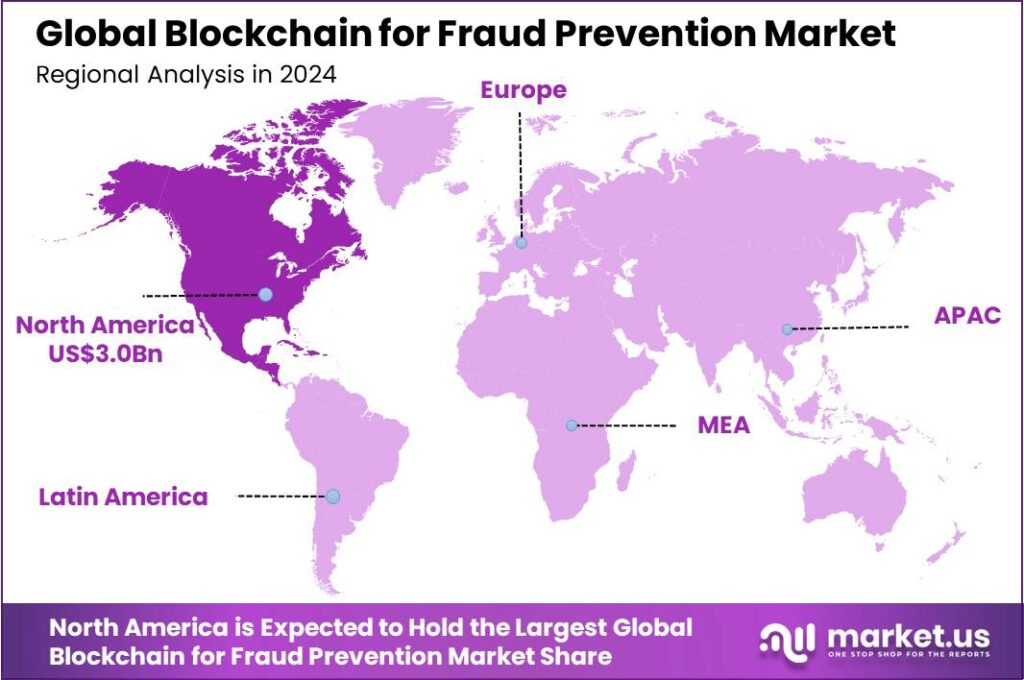
The Global Blockchain for Fraud Prevention Market size is expected to be worth around USD 77.6Billion By 2034, from USD 7.4 Billion in 2024, growing at a CAGR of 26.50% during the forecast period from 2025 to 2034. In 2024, North America dominated the market, accounting for over 41.5% of the market share, with a revenue of USD 3.0 billion.
Blockchain technology is increasingly being adopted as a powerful tool for fraud prevention across industries. By leveraging its decentralized, immutable, and transparent nature, blockchain ensures that data and transactions cannot be altered or tampered with, reducing the risk of fraudulent activities. Industries like finance, healthcare, supply chain, and e-commerce are using blockchain to create secure, traceable systems that enhance trust and accountability.
The blockchain for fraud prevention market is experiencing rapid growth, driven by the rising need for secure and transparent systems in a digital-first world. This market includes solutions like identity verification, transaction monitoring, and supply chain tracking, all powered by blockchain. With increasing cyber threats and regulatory pressures, organizations are investing heavily in blockchain-based fraud prevention tools.
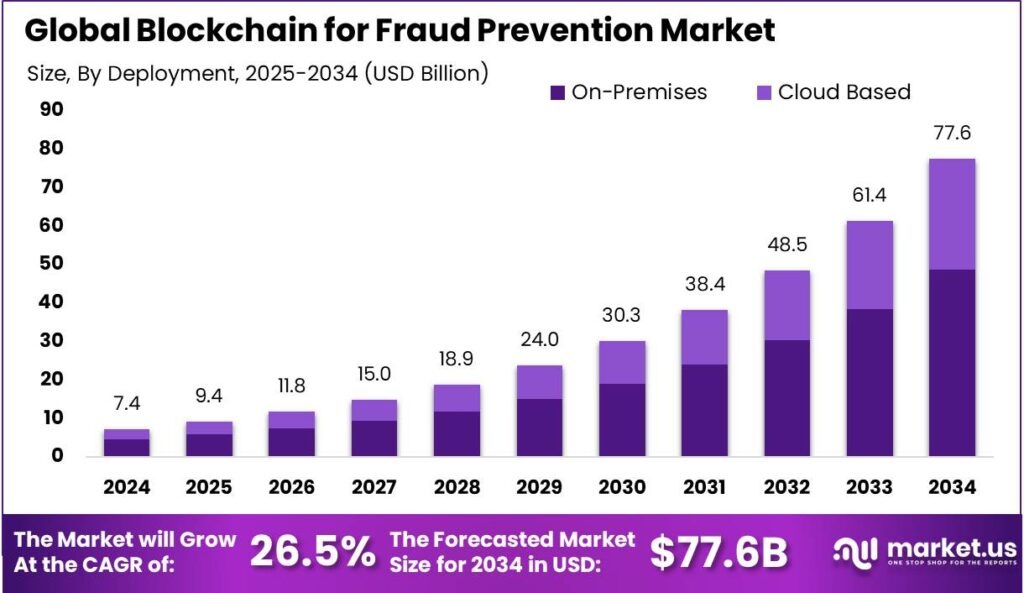
Moreover, the rise in the adoption of blockchain services by various sectors, including banking, healthcare, and government, for identity management and secure transactions further fuels market growth. Additionally, advancements in blockchain technology and its integration with artificial intelligence and machine learning for enhanced fraud detection capabilities are likely to propel the market forward.
Blockchain for fraud prevention has gained popularity thanks to successful implementations in high-stakes environments. Endorsements from major financial institutions and tech companies have boosted its credibility. As more success stories emerge, highlighting its effectiveness in reducing fraud, more organizations are exploring its adoption.
The market offers significant opportunities for innovation. As fraud tactics evolve, there’s a growing demand for solutions that can adapt and integrate with existing systems. Blockchain companies have the potential to lead advancements, setting new benchmarks for security and efficiency in fraud management.
The potential for market expansion in blockchain for fraud prevention is substantial. As technology advances and becomes more accessible, new markets across the globe are opening up. Emerging economies, where fraud prevention is crucial to economic development, are particularly ripe for this technology.
Key Takeaways
- The Blockchain for Fraud Prevention Market size is expected to reach USD 77.6 billion by 2034, growing from USD 7.4 billion in 2024, with a CAGR of 26.50% during the forecast period from 2025 to 2034.
- In 2024, the Check Fraud segment held a dominant position, capturing more than 27.3% of the market share.
- In 2024, the Solution segment dominated the market, holding more than 76.8% of the share.
- In 2024, the On-Premises segment had a dominant market position, capturing more than 62.9% of the share.
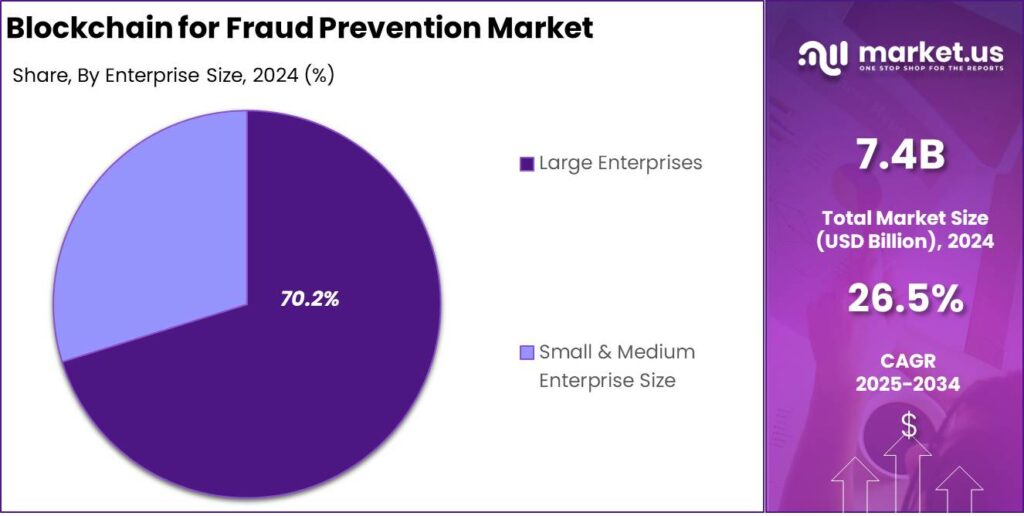
- In 2024, Large Enterprises dominated the market, holding more than 70.2% of the market share.
- In 2024, the Banking, Financial Services, and Insurance (BFSI) sector captured more than 33.7% of the market share in the blockchain for fraud prevention market.
- In 2024, North America held a dominant market position, capturing more than 41.5% of the market share, with revenue totaling USD 3.0 billion.
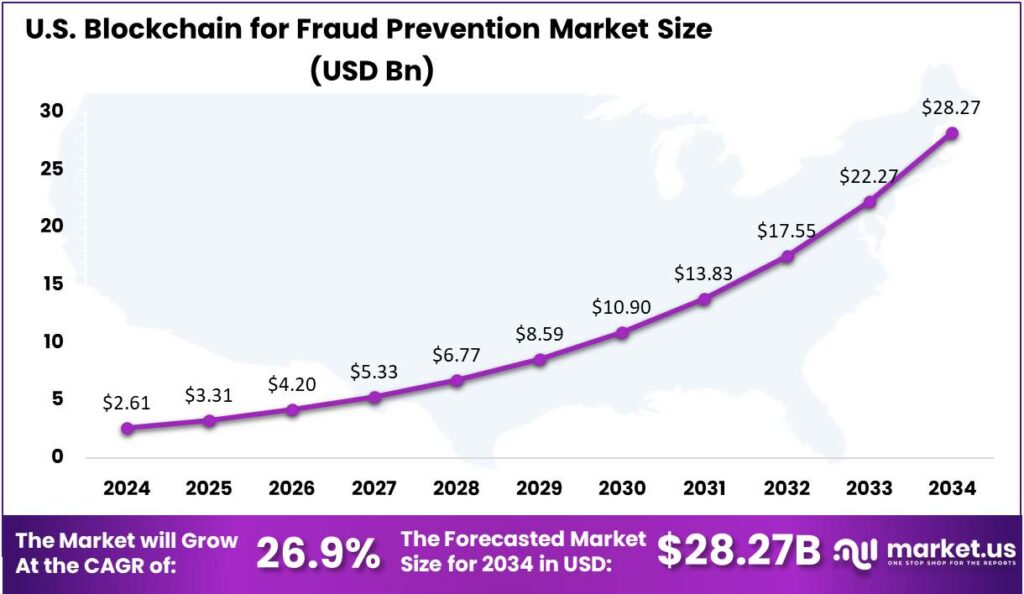
- The U.S. market for blockchain technology in fraud prevention, valued at USD 2.61 billion in 2024, is projected to experience significant growth, expanding at a CAGR of 26.9%.
U.S. Market Size and Growth
The U.S. market for blockchain technology used in fraud prevention is expected to experience significant growth in the coming years. Valued at USD 2.61 billion in 2024, it is projected to expand at a compound annual growth rate (CAGR) of 26.9%.
Blockchain technology offers a decentralized and transparent way to record transactions, making it extremely difficult for fraudulent activities to occur unnoticed. Its application in fraud prevention is becoming increasingly vital as industries seek more robust mechanisms to safeguard data integrity and ensure transaction security.
As blockchain technology continues to evolve, its integration into fraud prevention strategies is expected to become more sophisticated. This includes the development of advanced algorithms for real-time fraud detection and the implementation of cross-industry platforms that can provide more comprehensive risk assessments.
In 2024, North America held a dominant market position in the blockchain for fraud prevention market, capturing more than a 41.5% share with revenue totaling USD 3.0 billion. This leading stance can be attributed to several factors that underscore the region’s advanced technological landscape and robust financial sectors that actively seek innovative fraud prevention solutions.
North America’s strong IT infrastructure and concentration of tech and financial firms make it a prime region for blockchain adoption. Its commitment to improving transaction security in sectors like banking, healthcare, and government, along with strict data protection regulations, drives the market for blockchain solutions.
Governments and private sectors in the U.S. and Canada are actively driving blockchain adoption through initiatives that integrate the technology into their operations. Collaborations between blockchain startups and major financial institutions to develop decentralized apps (DApps) for real-time fraud detection highlight the region’s proactive stance on fraud prevention.
As blockchain technology matures, North America’s market share is set to expand, fueled by ongoing research, growing investments in blockchain startups, and greater awareness of its benefits.The integration of AI and machine learning with blockchain for fraud detection is gaining momentum, further solidifying North America’s leadership in the market.
Fraud Type Analysis
In 2024, the Check Fraud segment held a dominant position in the Blockchain for Fraud Prevention market, capturing more than a 27.3% share. This segment’s leadership can be attributed to the persistent vulnerability of check transactions to fraud, despite declining usage in the face of digital payment methods.
Checks often involve multiple parties and lengthy processing times, which provides ample opportunities for fraudsters to alter amounts or forge signatures. Blockchain technology addresses these issues by offering an immutable and transparent record-keeping system, which ensures the authenticity of every transaction and significantly reduces the incidence of fraud.
The Identity Fraud segment also represents a significant portion of the market, as this type of fraud continues to escalate with increasing digital interactions. Blockchain technology offers robust solutions in identity verification by creating decentralized and tamper-proof records.
The Insider Fraud segment benefits from blockchain’s transparency and immutability. By providing a complete transaction history and real-time monitoring, blockchain helps detect unusual patterns and prevent fraudulent activities before they result in losses.
Offering Analysis
In 2024, the Solution segment held a dominant position in the blockchain for fraud prevention market, capturing more than a 76.8% share. This segment encompasses a variety of analytics solutions, including fraud, predictive, descriptive, prescriptive, social network, text, and behavioral analytics.
These tools are integral in identifying, analyzing, and preventing fraudulent activities by enabling real-time data analysis and decision-making. The robust demand for these analytics solutions is primarily due to their effectiveness in detecting patterns and anomalies that may indicate fraudulent behavior, making them a crucial first line of defense for organizations across industries.
The authentication solutions within the Solution segment, particularly Single-factor Authentication (SFA) and Multi-factor Authentication (MFA), also significantly contribute to its dominance. As digital transactions increase, so does the complexity of security requirements.
MFA, in particular, offers an enhanced security level by requiring multiple methods of identity verification, which is becoming a standard security practice in sensitive industries like finance and healthcare. This shift towards higher security standards drives the adoption of advanced authentication methods, further reinforcing the strength of the Solution segment.
Deployment Analysis
In 2024, the On-Premises segment held a dominant market position in the blockchain for fraud prevention sector, capturing more than a 62.9% share. This significant market share is primarily due to several key factors that align with the specific needs and concerns of industries requiring high levels of security and control over their data.
One of the primary reasons for the preference for on-premises deployment is the enhanced security it offers. Organizations opting for on-premises blockchain solutions retain full control over their infrastructure, data storage, and security protocols. This is particularly appealing to sectors such as banking, government, and healthcare, where the protection of sensitive information is paramount.
Additionally, on-premises deployment allows organizations to customize their blockchain solutions to fit specific operational requirements and integrate seamlessly with existing IT systems. This customization is crucial for large enterprises that have complex systems and stringent compliance requirements that might not be fully met by cloud-based solutions.
Moreover, organizations with on-premises blockchain solutions benefit from consistent performance without reliance on internet connectivity. This is essential for businesses operating in regions with unstable internet services or those who prioritize uninterrupted access to their blockchain systems for real-time fraud monitoring and prevention.
Enterprise Size Analysis
In 2024, the Large Enterprises segment held a dominant market position in the Blockchain for Fraud Prevention market, capturing more than a 70.2% share. This dominance can be attributed primarily to the substantial financial resources and infrastructural capabilities that large enterprises possess, which allow them to invest in advanced blockchain technologies.
Large enterprises also benefit from a broader scope of blockchain applications, utilizing the technology not only for fraud prevention but also for enhancing transparency and efficiency across various operational processes. This multipurpose deployment encourages further integration of blockchain technologies, deepening their impact and driving sector-wide adoption.
Blockchain helps large enterprises navigate complex compliance requirements by providing immutable, transparent transaction records. This streamlines compliance, reduces costs, and encourages companies to invest in blockchain solutions.
Large enterprises maintain a leading position in the Blockchain for Fraud Prevention market by setting industry trends. Their adoption of blockchain serves as a benchmark for smaller players, driving broader industry shifts toward more innovative and secure practices. This trend-setting role solidifies their dominance and advances the market as a whole.
Industry Analysis
In 2024, the Banking, Financial Services, and Insurance (BFSI) segment held a dominant market position in the Blockchain for Fraud Prevention market, capturing more than a 33.7% share.The BFSI sector’s large market share in blockchain adoption is driven by its need for secure, transparent transactions.
The BFSI industry faces stringent regulatory requirements designed to prevent fraud and protect customer data. Blockchain technology helps financial institutions meet these compliance demands more efficiently by providing a secure platform for recording transactions that cannot be altered retroactively.
Blockchain adoption in the BFSI sector is fueled by the need to cut operational costs and boost efficiency. It enables faster transactions, reduces intermediaries, lowers costs, and improves customer satisfaction, all of which are key to staying competitive in the evolving financial services landscape.
The trust and security offered by blockchain technology are invaluable in reinforcing customer confidence in financial systems. As cyber threats become more sophisticated, the BFSI sector continues to leverage blockchain to ensure the integrity and security of its transactions, further consolidating its lead in the Blockchain for Fraud Prevention market.
Key Market Segments
By Fraud Type
- Check Fraud
- Identity Fraud
- Insider Fraud
- Investment Fraud
- Payment Fraud
- Insurance Fraud
- Friendly Fraud
- Others
By Offering
- Solution
- Fraud Analytics
- Predictive Analytics
- Descriptive Analytics
- Prescriptive Analytics
- SNA
- Text Analytics
- Behavioral analytics
- Authentication
- Single-factor Authentication (SFA)
- Multi-factor Authentication (MFA)
- Governance, Risk, and Compliance
- Fraud Analytics
- Services
- Professional Services
- Risk Assessment
- Consulting and Training
- Implementation and Support
- Professional Services
- Managed Services
By Deployment
- Cloud-Based
- On-Premises
By Enterprise Size
- Small & Medium Enterprise Size (SME’s)
- Large Enterprises
By Industry
- Banking, Financial Services and Insurance (BFSI)
- Government and Defense
- Healthcare
- IT and Telecom
- Automotive
- Retail and E-commerce
- Others (Oil & Gas, Education, etc.)
Key Regions and Countries
- North America
- US
- Canada
- Europe
- Germany
- France
- The UK
- Spain
- Italy
- Rest of Europe
- Asia Pacific
- China
- Japan
- South Korea
- India
- Australia
- Singapore
- Rest of Asia Pacific
- Latin America
- Brazil
- Mexico
- Rest of Latin America
- Middle East & Africa
- South Africa
- Saudi Arabia
- UAE
- Rest of MEA
Driver
Enhanced Transparency and Traceability
Blockchain’s decentralized ledger offers a transparent and immutable record of transactions, making it a powerful tool against fraud. In supply chains, for instance, every product’s journey from origin to consumer is documented on the blockchain. This transparency ensures that all stakeholders can verify the authenticity and movement of goods, reducing the risk of counterfeit products entering the market.
By providing a single source of truth, blockchain minimizes discrepancies and unauthorized alterations, thereby enhancing trust among participants. Moreover, blockchain’s transparency and immutability allow for real-time auditing and traceability of transactions, making it easier to verify actions and resolve disputes quickly. This fosters greater accountability and strengthens the overall integrity of processes across various industries.
Restraint
Regulatory and Legal Challenges
Despite its advantages, blockchain faces significant regulatory hurdles. The evolving legal landscape struggles to keep pace with this rapidly developing technology. Issues such as data privacy, anti-money laundering (AML) compliance, and cross-border transaction regulations pose challenges.
For instance, the inherent transparency of blockchain can conflict with data protection laws that mandate user privacy. Additionally, the decentralized nature of blockchain complicates jurisdictional authority, making it difficult to enforce regulations uniformly. These legal ambiguities can deter businesses from adopting blockchain solutions due to concerns over compliance and potential legal repercussions.
Opportunity
Strengthening Identity Verification
Blockchain presents a significant opportunity to enhance identity verification processes. Traditional identity systems are prone to fraud and data breaches, but blockchain can offer a secure and decentralized method of managing identities.
By leveraging blockchain, organizations can create tamper-proof digital identities, reducing the risk of identity theft and associated fraudulent activities. Additionally, blockchain can provide individuals with greater control over their own personal data, allowing them to share only the necessary information for specific transactions while maintaining privacy and security. This decentralized approach reduces reliance on centralized authorities and minimizes the risk of data breaches.
Challenge
Scalability and Performance Issues
Implementing blockchain technology on a large scale presents challenges related to scalability and performance. As the number of transactions increases, the blockchain can become congested, leading to slower transaction times and higher fees.
This limitation is particularly problematic for applications requiring high transaction throughput, such as financial services or large-scale supply chains. Addressing these scalability issues is crucial for the widespread adoption of blockchain in fraud prevention. Ongoing research into solutions like sharding and off-chain transactions aims to mitigate these challenges, but practical, widely-accepted implementations are still in development.
Emerging Trends
Blockchain technology is making significant strides in preventing fraud across various sectors. Its decentralized and transparent nature ensures that once information is recorded, it cannot be altered, providing a trustworthy system for transactions.
In the financial industry, blockchain offers a secure ledger that maintains data integrity and prevents unauthorized changes. This means that financial transactions can be conducted with a higher level of trust, reducing the chances of fraudulent activities.
Supply chains benefit from blockchain by enhancing transparency. Every product’s journey from its origin to the consumer is recorded on the blockchain, making it easier to trace and verify authenticity. This traceability helps in detecting counterfeit products.
Identity verification is another area where blockchain is proving valuable. By using blockchain, individuals can have a secure and unchangeable digital identity. This reduces the risk of identity theft and ensures that personal information is handled safely.
Business Benefits
- Enhanced Transparency: Blockchain’s open ledger allows all participants to view and verify transactions, reducing the chances of fraudulent activities.
- Improved Traceability: Every transaction is recorded and linked to the previous one, creating an audit trail that is easy to follow and verify.
- Increased Security: Transactions are encrypted and linked to previous transactions, making it difficult for unauthorized alterations to occur.
- Cost Efficiency: By eliminating the need for intermediaries and reducing the risk of fraud, blockchain can lead to significant cost savings for businesses.
- Enhanced Trust: The decentralized nature of blockchain ensures that no single entity controls the entire system, fostering trust among participants.
Key Player Analysis
As more industries explore blockchain’s capabilities to combat fraud, key players are leading the charge in integrating this technology into their solutions.
- Fiserv is a global leader in financial services technology, providing a wide range of solutions for payments, banking, and risk management. The company has successfully incorporated blockchain into its fraud prevention tools to enhance the security and traceability of transactions.
- FIS Global is another prominent player in the fintech space, offering a range of financial services and technology solutions, including fraud prevention mechanisms. Their blockchain initiatives focus on creating secure, real-time transaction networks that help detect and prevent fraud.
- LexisNexis Risk Solutions specializes in providing data analytics and fraud prevention services to a wide range of industries, from finance to healthcare. The company uses blockchain technology to enhance its fraud detection capabilities by offering more secure and accurate ways to track and verify transactions.
Top Key Players in the Market
- Fiserv
- FIS Global
- LexisNexis Risk Solutions
- TransUnion
- Experian
- NICE Actimize
- ACI Worldwide
- SAS Institute
- RSA Security
- SAP
- FICO
- Software AG
- Microsoft
- F5
- AWS
- Bottomline Technologies
- ClearSale
- Genpact
- Securonix
- Accertify
- Feedzai
- Caseware
- OneSpan
- Signifyd
- BioCatch
- Friss
- MaxMind
- DataVisor
- Cleafy
- Gurucul
- Riskified
- Thomson Reuters
- Sift
- Others
Top Opportunities Awaiting for Players
- Enhanced Transparency & Trust: Blockchain’s decentralized nature can eliminate fraud by ensuring transparent and immutable transactions. Companies across sectors like finance and supply chain can adopt blockchain for verifiable, tamper-proof records, boosting consumer trust.
- Smart Contracts for Automation: By using smart contracts, businesses can automate compliance and fraud detection processes, reducing human error and delays. This is particularly valuable in industries such as insurance and banking, where secure, automated transactions are critical.
- Identity Verification Solutions: Blockchain can provide secure, decentralized identity management systems, reducing identity theft and ensuring only authorized access. This can be crucial for industries such as healthcare and financial services, where personal data protection is a priority.
- Cross-Border Payment Security: Blockchain can offer a more secure alternative to traditional cross-border payments, reducing the risk of fraud in international transactions. Companies involved in global trade or remittance services can tap into this opportunity.
- Data Integrity & Auditability: Blockchain can ensure data integrity by providing an auditable, immutable ledger of all transactions. This is particularly useful for companies in highly regulated industries, like pharmaceuticals and government sectors, where fraud prevention and compliance are critical.
Recent Developments
- In January 2025, Chainalysis, a blockchain data platform, has acquired Alterya, an AI-powered fraud detection solution. This acquisition aims to enhance real-time fraud protection for payments and improve fraud detection during KYC processes for exchanges, blockchains, and wallet providers.
- In December 2024, LexisNexis Risk Solutions announced plans to acquire IDVerse, an AI-powered document authentication and fraud prevention company. This acquisition is expected to strengthen LexisNexis’ ability to combat fraud and deepfakes, enhancing identity verification and liveness detection capabilities.









