


Report Overview
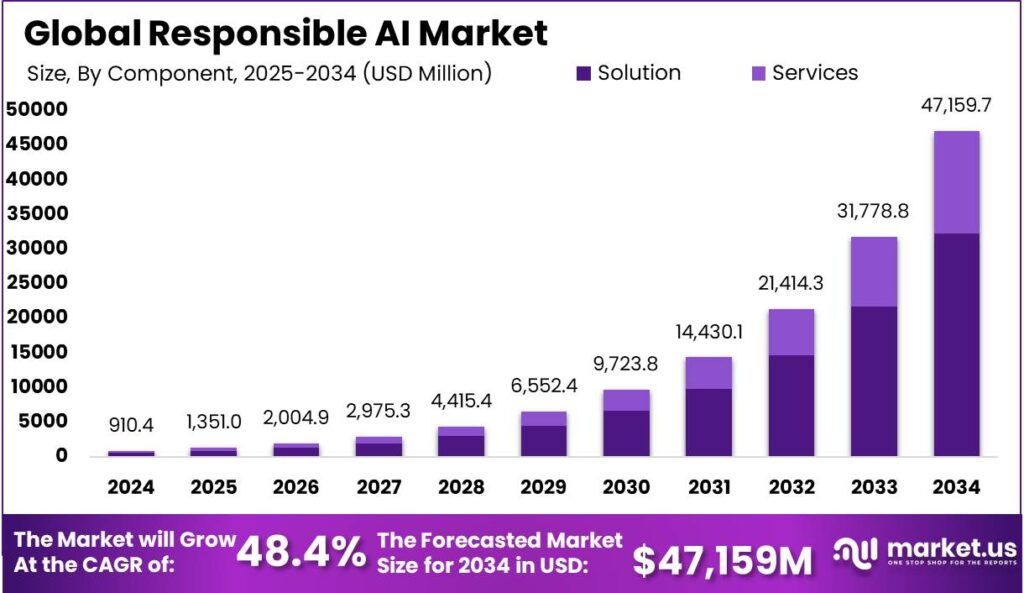
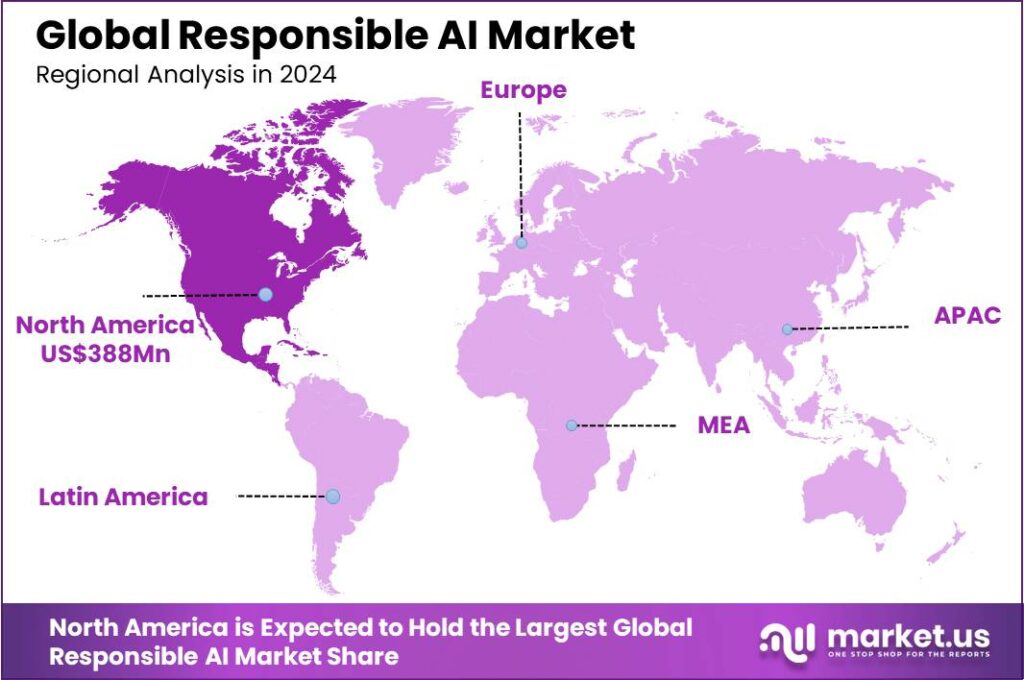
The Global Responsible AI Market size is expected to be worth around USD 47,159 Million By 2034, from USD 910.4 Million in 2024, growing at a CAGR of 48.40% during the forecast period from 2025 to 2034. In 2024, North America is expected to dominate the Responsible AI market, holding over 42.7% of the global share, with revenues reaching USD 388 Million.
Responsible AI refers to the development and deployment of artificial intelligence systems in a way that is ethical, transparent, accountable, and aligns with human values. Responsible AI focuses on ensuring fairness, privacy, diversity, and security in AI systems. Its goal is to reduce bias, build trust, and create an inclusive environment where AI benefits society while minimizing harm.
The growth of the Responsible AI market is fueled by increasing awareness of AI’s ethical implications, leading to stricter regulations and standards. As AI becomes integral to sectors like healthcare, finance, and public services, there is a rising demand for transparency and accountability in these systems.
Additionally, data privacy laws like GDPR are pushing companies to adopt responsible AI practices to ensure compliance and safeguard consumer data. Businesses are also realizing that ethical AI practices can boost brand reputation and customer trust, which are key to long-term success in a competitive market.
The growing popularity of responsible AI is driven by consumers and regulators demanding higher ethical standards in technology. This shift is evident in the rise of forums, workshops, and conferences focused on ethical AI, creating a stronger community of technologists and policymakers. With increasing public scrutiny, companies are more motivated to embrace responsible AI principles to protect their reputation and foster customer loyalty.
The responsible AI market offers significant opportunities, especially in AI auditing, performance monitoring, and transparency tools. Companies developing these solutions can gain first-mover advantages as the market becomes more regulated. There’s also growing demand for consultants and legal experts specializing in responsible AI, creating new opportunities for professional services.
According to PwC, only 11% of executives say they have fully implemented essential responsible AI practices. However, more than 80% of companies are making progress in key areas like upskilling teams, embedding AI risk specialists, running periodic training, and strengthening data privacy, governance, and cybersecurity. Many are also focusing on model testing and continuous monitoring. Meanwhile, 73% of businesses are either using or planning to use both traditional AI and generative AI.
On the consumer side, IBM reports that only 35% of people worldwide trust how organizations are using AI. Concerns about ethical AI are strong, with 77% of consumers believing companies should be held accountable for any misuse of the technology. This growing gap between corporate adoption and public trust highlights the urgent need for businesses to focus on transparency, responsible AI governance, and ethical implementation
Technological advancements are continuously shaping the Responsible AI landscape. New tools and methodologies are being developed to improve the fairness and transparency of AI systems. For instance, advancements in explainable AI (XAI) technologies allow stakeholders to understand and trust AI decision-making processes better.
Market expansion in responsible AI is expected to continue as technologies evolve and integration capabilities improve. The integration of AI with emerging technologies like blockchain for secure data and IoT for better data collection will accelerate market growth. These synergies enable the development of more advanced, transparent, and ethical AI systems, expanding the market’s impact globally.
Key Takeaways
- The Global Responsible AI Market is expected to reach a value of approximately USD 47,159 Million by 2034, up from USD 910.4 Million in 2024, reflecting a significant growth trajectory at a CAGR of 48.40% from 2025 to 2034.
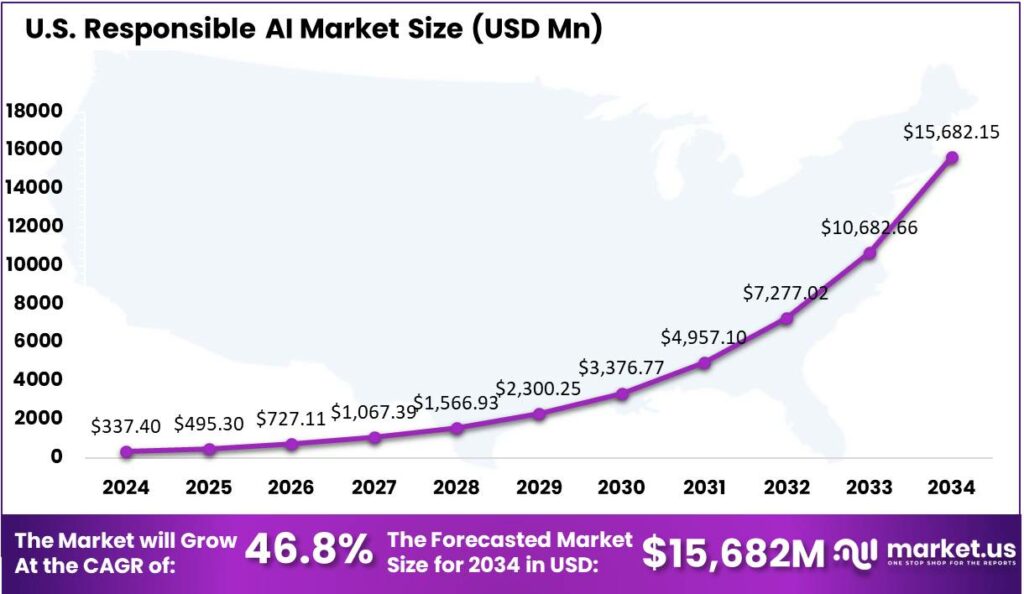
- In 2024, the U.S. Responsible AI market is projected to reach $337.4 million, experiencing a strong growth phase with an anticipated CAGR of 46.8%.
- North America is predicted to maintain a dominant position in the Responsible AI market in 2024, accounting for over 42.7% of the global market share, with revenues estimated at USD 388 Million.
- In 2024, the Solution segment leads the market in Responsible AI, capturing more than 68.6% of the total market share.
- The On-Premises segment is expected to dominate in 2024, representing over 62.5% of the Responsible AI market share.
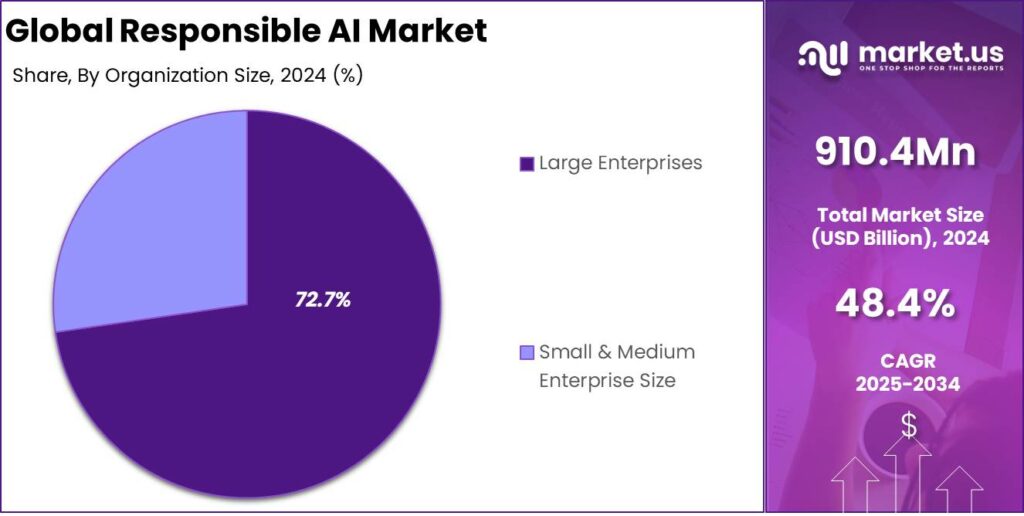
- The Large Enterprise segment is projected to hold a dominant position, comprising over 72.7% of the Responsible AI market share in 2024.
- The BFSI (Banking, Financial Services, and Insurance) segment is anticipated to lead the Responsible AI market in 2024, accounting for more than 34.7% of the market share.
- The US Responsible AI Market size was exhibited at USD 337.4 Million in 2024 with CAGR of 46.8%.
U.S. Responsible AI Market Size
In 2024, the value of the U.S. market for Responsible AI is projected to reach $337.4 million. This market is experiencing a robust growth phase, with an expected compound annual growth rate (CAGR) of 46.8%. This significant growth underscores the increasing integration of AI technologies across various sectors, driven by the growing awareness and implementation of ethical standards in AI systems.
This rapid growth is driven by technological advancements, regulatory pressures, and a stronger focus on ethics in digital operations. As businesses and governments increasingly rely on AI for efficiency and decision-making, the demand for AI solutions that align with ethical standards continues to rise.
This ensures not only compliance with evolving regulations but also builds public trust in AI applications. The substantial CAGR highlights the urgency and priority that the U.S. market is placing on developing AI responsibly, reflecting a broader commitment to ethical technology deployment.
In 2024, North America held a dominant position in the Responsible AI market, capturing more than a 42.7% share with revenues reaching USD 388 Million. This significant market share can be attributed to several key factors that underscore the region’s leadership in the adoption and implementation of responsible AI technologies.
North America is home to some of the world’s leading technology companies and innovation hubs such as Silicon Valley, which play a crucial role in developing and deploying AI solutions. These entities prioritize the integration of ethics in AI to maintain their global reputation and influence.
Moreover, the regulatory environment in North America, particularly in the United States and Canada, strongly supports the advancement of responsible AI. Regulatory agencies in these countries are actively setting frameworks that mandate the ethical development of AI technologies.
This includes guidelines and policies that require AI applications to be developed and used in a manner that is compliant with data protection laws and ethical norms, promoting trust and safety in AI applications across commercial and public sectors.
Component Analysis
In 2024, the Solution segment held a dominant market position in the responsible AI market, capturing more than a 68.6% share. This substantial market share can primarily be attributed to the increasing adoption of AI solutions across various industries seeking to ensure ethical standards and accountability.
Solutions in responsible AI are designed to enhance transparency, provide robust AI governance, and ensure that AI systems are fair, interpretable, and auditable. Industries such as finance, healthcare, and automotive are heavily investing in these solutions to mitigate risks associated with AI deployments, thereby driving the segment’s growth.
The preeminence of the Solution segment also stems from the surge in regulatory and compliance requirements. Governments and regulatory bodies worldwide are tightening guidelines around AI to prevent biases and protect privacy, compelling companies to adopt responsible AI solutions that can effectively manage compliance risks.
Moreover, the development of advanced technologies and frameworks within the Solution segment has been crucial. Innovations such as explainable AI (XAI) frameworks, fairness tools, and auditing protocols are increasingly integrated into AI systems. These advancements are critical for organizations aiming to deploy AI that adheres to ethical practices, further fueling the demand for responsible AI solutions.
Deployment Analysis
In 2024, the On-Premises segment held a dominant market position in the responsible AI market, capturing more than a 62.5% share. This leadership is largely due to organizations’ preference for maintaining control over their AI systems and data.
On-premises deployment allows companies to implement AI solutions within their own IT infrastructure, giving them complete oversight over the security, usage, and management of AI applications. This is particularly important in industries like healthcare and finance, where data sensitivity and compliance with stringent regulatory standards are paramount.
The On-Premises segment benefits from the enhanced security it offers. Many organizations are wary of potential vulnerabilities associated with cloud deployments, such as data breaches or unauthorized access. By keeping AI systems on-premises, they can leverage existing security protocols and infrastructure to protect sensitive information, thereby reducing the risk of external threats.
Additionally, the On-Premises deployment segment allows for greater customization and integration with existing systems. Organizations can tailor AI solutions to fit their specific operational needs and seamlessly integrate them with legacy systems without significant disruptions.
Organization Size Analysis
In 2024, the Large Enterprise segment held a dominant position in the Responsible AI market, capturing more than 72.7% of the market share. This segment’s leadership is attributed primarily to the substantial investments large enterprises are capable of making in advanced AI technologies.
These organizations typically have the financial resources to integrate AI across multiple departments and projects, which is often a significant financial undertaking beyond the reach of smaller businesses. Moreover, large enterprises are usually more equipped to handle the complexities of implementing and maintaining AI solutions, including adhering to ethical standards and responsible usage guidelines.
Large enterprises also lead in this segment due to their ability to attract top talent and expert personnel in the field of artificial intelligence, including specialists in AI ethics and governance. This expertise allows them to pioneer innovative practices in responsible AI, setting benchmarks for the industry.
Another reason for the dominance of large enterprises in the Responsible AI market is their global operational scope, which often requires the deployment of AI solutions that adhere to a wide variety of regulatory standards across different regions.
Industry Analysis
In 2024, the BFSI (Banking, Financial Services, and Insurance) segment held a dominant market position in the Responsible AI market, capturing more than 34.7% of the market share. This segment’s leadership is largely driven by the critical need for AI to manage vast amounts of data and complex transactions while ensuring compliance with strict regulatory requirements.
Banks and financial institutions are increasingly deploying AI solutions to enhance customer experience, risk management, fraud detection, and back-end operations, all while adhering to ethical AI practices to maintain trust and integrity.
The BFSI sector’s emphasis on security and ethical handling of sensitive financial data further bolsters its investment in responsible AI technologies. These institutions require AI systems that not only predict and analyze trends but do so within the framework of stringent data protection laws and ethical guidelines.
Additionally, the competitive nature of the BFSI sector pushes companies to adopt the latest technologies that can provide them with a strategic advantage. Responsible AI systems offer such an advantage by enabling more personalized financial advice, better customer segmentation, and tailored insurance models, all designed within the parameters of ethical AI use.
Key Market Segments
By Component
- Solution
- Services
By Deployment
- On-Premises
- Cloud
By Organization Size
- Large Enterprise
- SMEs
By Industry
- BFSI
- Government and Defense
- Healthcare and life sciences
- Media and Entertainment
- Retail
- IT and Telecommunication
- Automotive
- Others
Key Regions and Countries
- North America
- US
- Canada
- Europe
- Germany
- France
- The UK
- Spain
- Italy
- Rest of Europe
- Asia Pacific
- China
- Japan
- South Korea
- India
- Australia
- Singapore
- Rest of Asia Pacific
- Latin America
- Brazil
- Mexico
- Rest of Latin America
- Middle East & Africa
- South Africa
- Saudi Arabia
- UAE
- Rest of MEA
Driver
Ethical Imperatives in AI Development
The increasing integration of artificial intelligence (AI) into various sectors has heightened awareness of its ethical implications. Society now demands that AI systems operate transparently, fairly, and without bias. This ethical imperative is a significant driver for responsible AI development.
Organizations are recognizing that adhering to ethical standards not only aligns with societal values but also enhances public trust. By prioritizing ethical considerations, companies can ensure that their AI applications respect individual rights and promote fairness. This approach not only mitigates potential risks but also fosters innovation by building systems that are both effective and aligned with societal expectations.
Restraint
Regulatory Challenges and Compliance
Navigating the complex landscape of AI regulations poses a significant restraint for organizations. Different regions have varying standards and guidelines, making it challenging for companies to develop AI systems that comply universally.
For instance, the European Union’s comprehensive AI Act emphasizes regulation and classification based on risk, promoting public trust but potentially stifling innovation due to bureaucratic obstacles. This regulatory complexity can slow down the deployment of AI solutions, as organizations must invest time and resources to ensure compliance across jurisdictions. Balancing innovation with adherence to diverse regulatory frameworks remains a critical challenge in the responsible development of AI.
Opportunity
Enhancing Decision-Making Processes
Responsible AI offers the opportunity to significantly improve decision-making across various industries. By leveraging AI systems designed with ethical considerations, organizations can make more informed and unbiased decisions. For example, in healthcare, AI can assist in diagnosing diseases by analyzing vast amounts of data, leading to earlier detection and better patient outcomes.
Similarly, in finance, AI can help in assessing creditworthiness more fairly, reducing human biases. By integrating responsible AI, industries can enhance efficiency, accuracy, and fairness in their decision-making processes, ultimately benefiting society as a whole.
Challenge
Addressing Bias and Ensuring Fairness
One of the significant challenges in implementing responsible AI is addressing inherent biases in AI systems. AI models trained on historical data may inadvertently learn and perpetuate existing biases, leading to unfair outcomes. For instance, an AI recruiting tool used by Amazon was found to discriminate against female applicants, highlighting the potential for AI to reinforce societal inequalities.
Ensuring fairness requires continuous monitoring and updating of AI systems, as well as the development of robust frameworks to detect and mitigate bias. This challenge underscores the need for ongoing research and collaboration to develop methodologies that ensure AI systems operate equitably.
Emerging Trends
One key trend is the push for “explainable AI,” which aims to make AI decisions easier to understand. This helps build trust and ensures that AI behaves in ways we expect. Another important trend is involving people from different backgrounds in AI development.
By including diverse perspectives, we can create AI systems that are more fair and less biased. Governments and organizations are also working together to set guidelines and rules for AI use, ensuring it benefits everyone.
Additionally, there’s a focus on predicting how AI will be used and its potential effects, so we can address any issues before they become problems. These efforts aim to make AI a positive force in society.
Business Benefits
- Building Trust: When companies use AI responsibly, it shows they care about fairness and transparency. This builds trust with customers, partners, and the public, which is crucial for long-term success.
- Managing Risks: Responsible AI helps companies identify and address potential issues early on, reducing the chance of failures and protecting the company’s reputation.
- Gaining a Competitive Edge: Companies that prioritize responsible AI can stand out in the market. This approach can lead to better products and services, attracting more customers.
- Improving Products and Services: By focusing on responsible AI, companies can enhance the quality of their offerings, leading to increased customer satisfaction and loyalty.
- Attracting and Keeping Talent: Employees want to work for companies that act ethically. A commitment to responsible AI can help attract and retain skilled workers who value integrity.
Key Player Analysis
Several global companies are taking a leading role in promoting responsible AI practices, blending innovation with strong ethical foundations.
IBM is a pioneer in responsible AI practices, integrating ethical considerations into the heart of its AI solutions. The company’s AI initiatives, like IBM Watson, are grounded in transparency, fairness, and privacy. IBM has launched frameworks and tools, such as the AI Fairness 360 toolkit, to help developers identify and mitigate bias in AI models.
Accenture is another major player dedicated to advancing responsible AI. The global consulting firm focuses on delivering AI solutions that align with ethical guidelines and societal values. Accenture’s approach involves creating AI systems that are not only efficient but also inclusive, transparent, and free of bias.
DXC Technology is making significant strides in responsible AI by combining advanced technologies with ethical considerations. The company offers AI-driven solutions that help clients navigate the challenges of bias, fairness, and transparency in machine learning.
Top Key Players in the Market
- IBM Corporation
- Accenture
- DXC Technology Company
- Infosys Ltd
- Microsoft Corporation
- NTT Data
- Oracle Inc
- SAP SE
- Siemens SA
- Tata Consultancy Services (TCS) Ltd
- TIBCO
- EPAM Systems, Inc.
- Kyndryl Inc.
- Fractal Analytics Inc.
- Cognizant
- Others
Top Opportunities Awaiting for Players
- AI Ethics Consulting and Auditing Services: As more companies integrate AI into their operations, there’s a rising demand for expert advice on how to ensure AI systems are ethical, transparent, and non-biased.AI consultancy firms, legal experts, and third-party audit services have a growing market as organizations seek to avoid costly legal issues and negative PR by ensuring their AI solutions are ethically sound.
- AI Governance Frameworks and Policy Development: With government regulations around AI still catching up to the rapid pace of technological development, there is a growing need for businesses to develop robust AI governance frameworks. Companies specializing in AI governance, compliance solutions, and policy development have a significant opportunity to lead in this space as global regulations around AI, such as the EU’s AI Act, begin to tighten.
- Responsible AI Tools and Platforms: As demand for AI grows, there’s a need for tools and platforms that can help organizations build responsible AI systems. AI software developers, technology providers, and startups that focus on building responsible AI platforms have a unique opportunity to create solutions that support companies in designing and deploying AI systems with ethical standards in mind.
- Consumer Trust and Education Initiatives: The general public remains skeptical about the use of AI, especially when it comes to privacy concerns, job displacement, and algorithmic bias.Companies that focus on consumer education, transparency, and trust-building initiatives can position themselves as responsible leaders in the AI space, which can enhance their brand reputation and customer loyalty.
- Sustainability and Environmental Impact of AI: AI technologies, especially in large-scale operations, can have a significant environmental impact due to their energy consumption.Firms developing AI solutions that are both powerful and energy-efficient, as well as those focused on sustainability, will be able to meet the growing demand for environmentally conscious technologies. Companies that invest in green AI practices will appeal to both eco-conscious consumers and regulators.
Recent Developments
- In February 2024, Infosys launched its Responsible AI Suite as part of the Infosys Topaz initiative. This suite is designed to help enterprises navigate the regulatory and ethical complexities surrounding AI, ensuring that solutions align with emerging global standards for responsible AI usage.
- In September 2024, Microsoft announced the establishment of two new centers in Abu Dhabi to advance responsible AI practices. These centers aim to develop best practices and industry standards for responsible AI usage in the Middle East and the Global South, reflecting a commitment to ethical AI development.
- In January 2025, NTT Data was recognized as a leader in the ISG Provider Lens for Generative AI Services, highlighting its commitment to ethical frameworks in AI deployment and its expertise in delivering tailored solutions that prioritize responsible use of AI technologies.









