


Report Overview
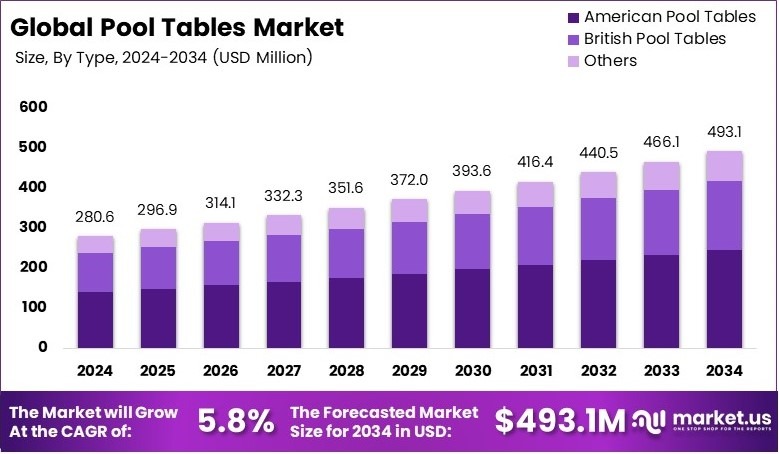
The Global Pool Tables Market size is expected to be worth around USD 493.1 Million by 2034, from USD 280.6 Million in 2024, growing at a CAGR of 5.8% during the forecast period from 2025 to 2034.
Pool Tables are flat surfaces used for playing billiards, pool, or snooker. They come in various sizes, with the most common being 8-foot and 9-foot tables. The surface is covered with felt, and the table includes six pockets for the balls. Pool tables are used in homes, bars, and professional settings.
Pool Tables Market refers to the industry that manufactures and sells pool tables. It covers both recreational and professional segments, with products ranging from budget-friendly models to high-end, competition-grade tables.
The pool tables market is growing due to rising interest in recreational activities. With the increasing popularity of home entertainment, demand for quality pool tables is rising. A 9-foot pool table, for example, has a surface size of 2.54m by 1.27m, making it a standard choice for many players.
The demand for pool tables is strong, especially in countries with a deep history of billiards and snooker. Opportunities exist in offering customizable products, such as fabric choices with 85% worsted wool and 15% nylon. Innovations in table design and materials will help brands expand their market reach, especially in home and commercial spaces.
Market saturation is moderate, with many players already established in key regions. However, competition remains fierce, especially with high-end models offering unique features. Local markets may see new entrants targeting different customer segments, such as smaller tables for compact spaces or affordable options for first-time buyers.
Governments typically do not heavily regulate the pool table market, but they can support it indirectly through investments in sports facilities and public recreation. For example, government-backed pool competitions and events increase the visibility of pool sports, which in turn drives demand for professional-grade tables, boosting local sales and regional growth.
Key Takeaways
- The Pool Tables Market was valued at USD 280.6 million in 2024 and is expected to reach USD 493.1 million by 2034, with a CAGR of 5.8%.
- In 2024, American Pool Tables dominate the type segment with 50.2% due to their widespread use in home and commercial settings.
- In 2024, 8 ft Pool Tables lead the size segment with 45.5%, as this size is ideal for most recreational players.
- In 2024, Slate Pool Tables dominate the material segment with 60.3% due to their durability and premium quality.
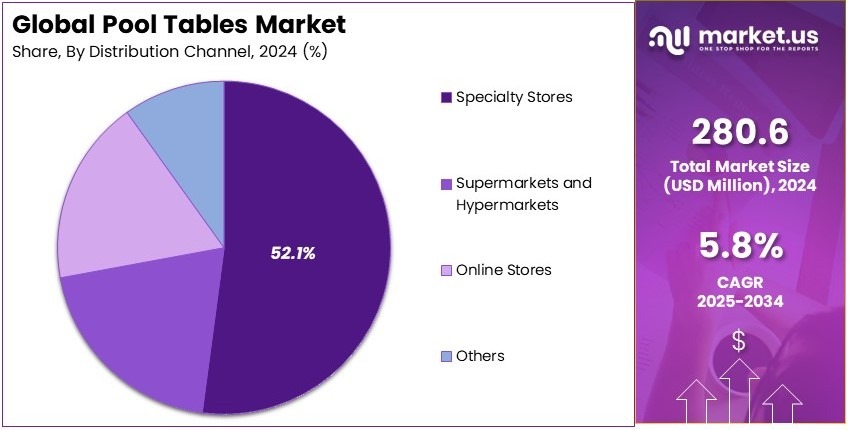
- In 2024, Specialty Stores lead the distribution channel segment with 52.1%, offering a wide range of high-quality pool tables.
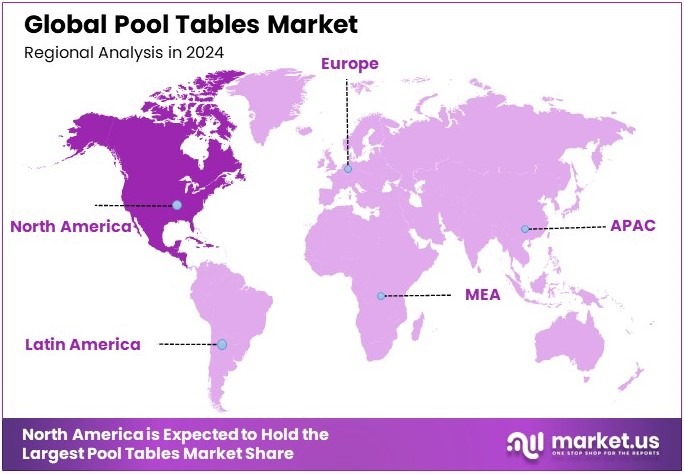
- In 2024, North America dominates the regional market with 47.5%, reflecting high demand due to strong recreational sports culture.
Type Analysis
American Pool Tables dominate with 50.2% due to their popularity in recreational settings.
The “American Pool Tables” segment dominates the pool table market, accounting for 50.2% of the market share. This segment is particularly popular in the United States and other countries where pool and billiards are widely played in both professional and recreational settings.
American pool tables are known for their larger size and the use of a pocket system that is well-suited to popular games like 8-ball and 9-ball. Their design, which includes deep pockets and a variety of finishes, appeals to both casual players and serious enthusiasts. This popularity can be traced back to the widespread presence of pool halls, home game rooms, and the cultural association of pool tables with entertainment and socialization.
In contrast, “British Pool Tables” hold a smaller share of the market. These tables are primarily used in the United Kingdom and feature a smaller playing surface, along with different pocket and ball sizes. While they are widely used in pubs and smaller-scale competitions, they do not have the same broad international appeal as American pool tables.
The “Others” category, which includes various regional styles and niche products, represents a small portion of the market. This sub-segment includes custom and specialized pool tables for unique or high-end applications, such as those used in luxury hotel or private collections. While it is a growing area, it still represents a minor part of the overall pool table market.
Size Analysis
8 ft pool tables dominate with 45.5% due to their balance of size and functionality.
In the pool table market, the 8 ft pool table is the dominant size, holding a 45.5% market share. This size is considered the ideal balance between usability and space requirements. It is widely used in home game rooms, pool halls, and recreational settings because it offers enough room for playing a variety of pool games while still fitting comfortably in most spaces.
The 8 ft table is versatile, offering an appropriate playing surface for both casual players and serious enthusiasts. Its size makes it suitable for standard pool games like 8-ball and 9-ball, while still being manageable for those who have limited space. As a result, it has become the go-to choice for the majority of consumers in both residential and commercial markets.
The 7 ft pool table is also popular, particularly in homes or spaces with limited room. It is a smaller alternative, suitable for casual or recreational players who may not have the space for an 8 ft table. While it offers a more compact playing area, the 7 ft table is still functional and widely used in home settings.
The 9 ft pool table, on the other hand, is favored more by professional players and pool halls, where the larger playing surface is necessary for competitive play. Despite its popularity in professional settings, the 9 ft table only holds a smaller share of the overall market compared to the 8 ft and 7 ft options.
Material Analysis
Slate Pool Tables dominate with 60.3% due to their durability and premium quality.
Slate pool tables dominate the market, representing 60.3% of the total share. Slate is known for its durability, smoothness, and the high-quality playing surface it offers. This material is considered the gold standard in pool tables because it provides the most level playing surface, which is critical for serious gameplay.
The stability of slate ensures that the balls roll smoothly and predictably, making it the material of choice for professional and recreational players alike. While slate pool tables are typically more expensive than those made from other materials, their superior quality justifies the price. This dominance is especially visible in commercial environments like pool halls and sports clubs, where long-lasting, high-quality equipment is required.
Wooden pool tables come next, making up a significant portion of the market, but still far behind slate tables in terms of market share. Wooden tables are more affordable and often used for home entertainment purposes.
While they do not offer the same level of durability and smoothness as slate tables, they are still suitable for casual play. Metal pool tables are even more niche, typically found in outdoor or specialized settings. They are valued for their resistance to weather and their unique aesthetic appeal but are not as commonly used for traditional pool gameplay. The “Others” category includes non-traditional pool tables made from a mix of materials, such as glass or synthetic surfaces, which are rare and cater to specific consumer tastes.
Distribution Channel Analysis
Specialty Stores dominate with 52.1% due to their specialized offerings and expertise.
Specialty stores are the dominant distribution channel in the pool table market, accounting for 52.1% of the market share. These stores focus on providing a curated selection of pool tables and accessories, along with expert advice and customer service. Many consumers prefer shopping at specialty stores because they offer a wider range of models, from high-end slate tables to affordable wooden ones.
Additionally, these stores often provide customization options, where customers can choose from various finishes, sizes, and styles. The knowledge and expertise offered by specialty store staff also help consumers make informed decisions about their purchases, ensuring they get the best table for their needs. As a result, specialty stores remain a key channel for pool table sales.
Online stores, while growing rapidly, still account for a smaller portion of the market, at around 30%. E-commerce platforms offer the convenience of shopping from home and often provide competitive pricing, but they lack the ability for customers to see and feel the products before purchase. This makes online sales more popular for accessories and smaller items, but less dominant for large purchases like pool tables.
Supermarkets and hypermarkets make up a small share of the market, as they typically only carry low-end, budget-friendly models. While these stores may appeal to consumers looking for a simple pool table for home use, they do not offer the specialized selection or expertise provided by specialty stores. The “Others” category includes non-traditional sales channels like warehouse clubs or auction sites, which represent a very small portion of the market.
Key Market Segments
By Type
- American Pool Tables
- British Pool Tables
- Others
By Size
- 7 ft
- 8 ft
- 9 ft
- Others
By Material
- Slate Pool Tables
- Wooden Pool Tables
- Metallic Pool Tables
- Others
By Distribution Channel
- Supermarkets and Hypermarkets
- Specialty Stores
- Online Stores
- Others
Driving Factors
Rising Demand for Cue Sports and High-End Entertainment Drives Market Growth
The increasing popularity of cue sports as both a recreational and competitive activity is significantly boosting the pool tables market. As more people enjoy games like pool and billiards, the demand for quality tables continues to rise.
Additionally, the growing trend of high-end home entertainment and game room equipment is driving the sales of premium pool tables. Many homeowners are opting to build dedicated game rooms, leading to a steady rise in the demand for full-sized and luxury pool tables.
Moreover, the increasing prevalence of pool in bars, clubs, and entertainment venues has expanded the need for commercial-grade tables. This shift is evident in cities where pool is seen as a social and entertainment staple, increasing demand in hospitality sectors.
Lastly, the growing number of pool tournaments and leagues is pushing the sales of professional-grade tables. These developments are creating a dynamic market where both leisure and professional use of pool tables contribute to overall market growth.
Restraining Factors
Space Limitations and Alternative Games Restrain Market Growth
Despite the increasing demand, several factors are limiting the pool table market’s accessibility. The high initial investment cost of quality pool tables is a major barrier for many potential buyers. For many consumers, the price of a high-end table can be prohibitive.
Additionally, space constraints in urban apartments and homes reduce the feasibility of owning full-sized tables. As living spaces become smaller, fewer people have room for such large items. This is particularly relevant in densely populated areas where apartment sizes are shrinking.
The popularity of alternative indoor games like foosball and air hockey also affects sales, as consumers may opt for more compact and less expensive entertainment options. These games take up less space and are often more affordable, making them attractive alternatives.
Lastly, the rise of online and digital gaming alternatives has reduced footfall in traditional pool halls, limiting the demand for physical tables. With many people now choosing virtual games, the number of people visiting physical pool halls has decreased, affecting the traditional pool hall market.
Growth Opportunities
Opportunities in Multi-Functional, Custom, and Eco-Friendly Pool Tables
The pool tables market is presented with several opportunities for growth. One major opportunity lies in the rising demand for multi-functional and convertible pool tables, which cater to compact living spaces. These innovative designs allow consumers to enjoy the game without sacrificing valuable space.
Moreover, custom and handcrafted pool tables are increasingly popular among luxury buyers who seek unique, high-end items for their game rooms. These bespoke tables offer a personalized experience, making them attractive to consumers with higher disposable incomes.
Another growing opportunity is the rising demand for eco-friendly and sustainable materials in pool table production. Consumers are becoming more environmentally conscious, seeking products that are not only durable but also sustainably produced.
Companies that incorporate these trends into their designs can tap into a niche market, meeting the preferences of environmentally conscious buyers. These opportunities offer growth potential for companies that innovate in terms of design, functionality, and sustainability.
Emerging Trends
LED-Integrated and Smart Features Are the Latest Trends in Pool Tables
Several exciting trends are shaping the pool tables market. One of the most notable trends is the integration of LED lighting and interactive features, which appeal to modern entertainment spaces. These innovative tables add an element of excitement and sophistication, attracting both casual players and enthusiasts.
Furthermore, the growth of online pool gaming has sparked renewed interest in physical pool tables, as digital gaming players look to experience the game in real life. This has created a synergy between online gaming and traditional pool, driving interest in high-quality, physical tables.
Additionally, there is a growing demand for minimalist and contemporary designs in pool table aesthetics, reflecting a broader shift towards clean, sleek home decor. These designs appeal to modern homeowners who value simplicity and elegance.
Companies are also offering custom felt and personalized graphics, particularly for corporate events and home use. These customized options allow consumers to create a unique experience, contributing to the growing trend of personalization in recreational products.
Regional Analysis
North America Dominates with Major Market Share
North America leads the Pool Tables Market with a dominant market share. The region benefits from a well-established culture of recreational and competitive pool, supported by a large number of sports bars, entertainment centers, and home users. North America also has numerous key brands like Brunswick and American Heritage, contributing to the high demand for quality pool tables.
Key factors driving North America’s market dominance include the popularity of billiards in the U.S. and Canada, where pool is a common pastime. The region’s strong economy and the prevalence of large recreational spaces in both homes and commercial venues boost the demand for premium pool tables. Furthermore, North America enjoys a well-developed distribution network for pool tables and accessories, making it easy for consumers to access a variety of products.
Market dynamics in North America are influenced by trends in leisure and entertainment. The growing trend of home entertainment and gamification, especially among younger generations, has increased the demand for pool tables in home settings. Additionally, commercial establishments like bars and pool halls continue to generate substantial revenue, further driving the market. High-end pool tables with advanced features like durable slate beds and custom finishes remain popular in the region.
Regional Mentions:
- Europe: Europe is a strong player in the Pool Tables Market, driven by countries like Germany, the UK, and France. The demand for pool tables in sports clubs and homes continues to grow, with increasing interest in premium and customized options.
- Asia Pacific: The Asia Pacific region shows a growing demand for pool tables, particularly in countries like China and Japan, where billiards is becoming more popular. The market is also benefiting from an increase in leisure activities and sports facilities.
- Middle East & Africa: The Middle East & Africa are expanding in the Pool Tables Market, with high growth seen in countries like the UAE. As leisure activities grow in urban areas and luxury homes, pool tables are becoming a sought-after item.
- Latin America: Latin America has a developing market for pool tables, particularly in countries like Brazil and Mexico. As urbanization increases and recreational sports gain popularity, demand for pool tables is expected to rise, especially in commercial venues.
Key Regions and Countries Covered in the Report
- North America
- US
- Canada
- Europe
- Germany
- France
- The UK
- Spain
- Italy
- Rest of Europe
- Asia Pacific
- China
- Japan
- South Korea
- India
- Australia
- Rest of APAC
- Latin America
- Brazil
- Mexico
- Rest of Latin America
- Middle East & Africa
- South Africa
- Saudi Arabia
- UAE
- Rest of MEA
Competitive Landscape
The Pool Tables Market is highly competitive, with several top companies driving innovation and market growth. Brunswick Billiards, Diamond Billiard Products, Inc., Valley-Dynamo, Inc., and Olhausen Billiards are the dominant players in this market.
Brunswick Billiards is one of the oldest and most recognized names in the pool table industry. Known for its high-quality craftsmanship and innovation, Brunswick offers a wide range of pool tables, from recreational models to professional-grade options. The brand is highly regarded for its durability and design, catering to both home users and commercial establishments.
Diamond Billiard Products, Inc. is another leading player known for producing professional-grade pool tables. Diamond tables are widely used in tournaments and competitive settings, valued for their precision and quality. The company has a reputation for creating tables that meet the rigorous demands of professional players while maintaining a high level of craftsmanship for residential customers.
Valley-Dynamo, Inc. focuses on high-performance pool tables for commercial use. They are particularly known for their durable, coin-operated tables, which are commonly found in bars and arcades. Valley-Dynamo’s products are recognized for their reliability, ensuring consistent play even in high-traffic environments.
Olhausen Billiards is renowned for its custom pool tables and exceptional craftsmanship. With a focus on luxury and high-end finishes, Olhausen offers customizable options that appeal to homeowners looking for a premium experience. The brand is committed to quality materials and precision engineering, helping it maintain a strong position in both the residential and commercial sectors.
These companies lead the pool table market by delivering products that combine durability, quality, and performance. Their diverse product offerings and focus on innovation ensure they continue to meet the needs of a wide range of customers, from casual players to professional athletes.
Major Companies in the Market
- Brunswick Billiards
- Diamond Billiard Products, Inc.
- Valley-Dynamo, Inc.
- Olhausen Billiards
- Riley England
- Imperial International
- Barrington Billiards
- Hathaway Games & Sports
- Fat Cat by GLD Products
- EastPoint Sports
- Shelti, Inc.
- Legacy Billiards
- Plank & Hide Co.
- Golden West Billiards
- Mizerak
Recent Developments
- Gucci: On November 2024, Gucci revealed a luxurious, Italian-crafted pool table as part of its high-end home décor line. Priced around €91,500 (USD 110,000), the pool table features walnut and brass construction with the iconic GG monogram on the felt surface, available exclusively through select Gucci boutiques.
- Tim Vranken: On March 2024, Belgian designer Tim Vranken introduced the ARA Pool Table at COLLECTIBLE 2024 in Brussels, offering an innovative take on traditional pool table design. The minimalist design reduces the tabletop’s thickness, with a 460 kg pool table featuring interlocking wooden tubes and a cruciform wood joint, creating a sophisticated, lightweight aesthetic through geometric shapes and intricate craftsmanship.









