


Report Overview
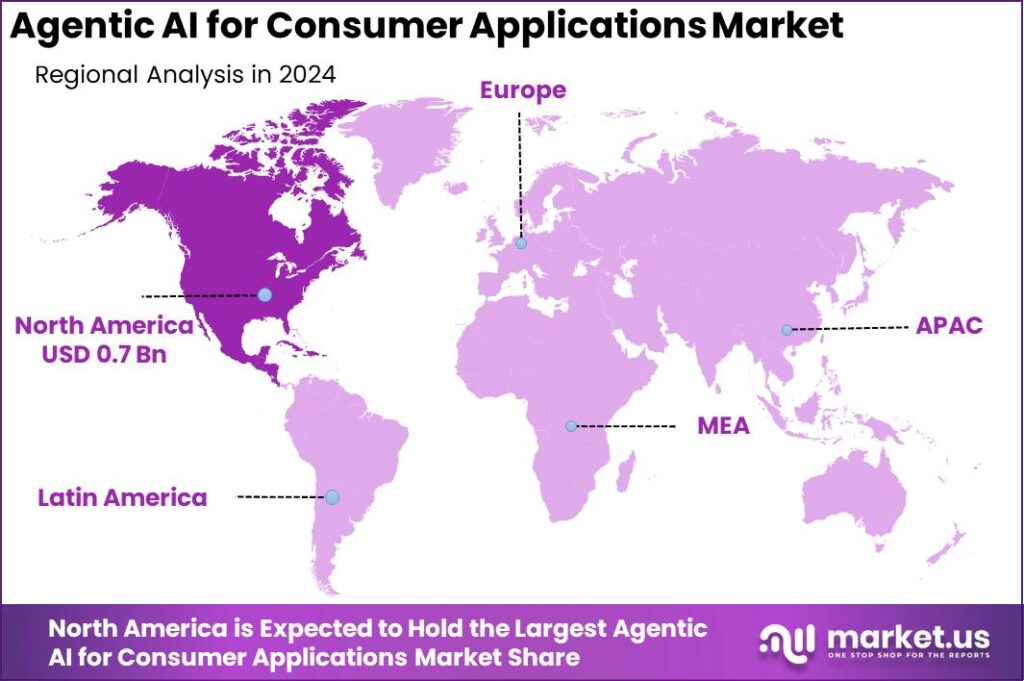
The Global Agentic AI for Consumer Applications Market size is expected to be worth around USD 44.3 Billion By 2034, from USD 1.7 billion in 2024, growing at a CAGR of 38.8% during the forecast period from 2025 to 2034. In 2024, North America held a dominant market position, capturing more than a 42.3% share, holding USD 0.7 Billion revenue.
Agentic AI for consumer applications refers to the integration of autonomous, self-directed AI systems that enable users to interact with, control, and benefit from advanced AI technologies in everyday life. These systems are designed to perform tasks that typically require human-like decision-making, such as personalized recommendations, automated assistance, and intelligent process management.
The Agentic AI market for consumer applications has been experiencing significant growth due to increased demand for personalized, intuitive, and efficient user experiences. As consumers seek more seamless and automated interactions with technology, businesses are incorporating advanced AI systems into their products and services.
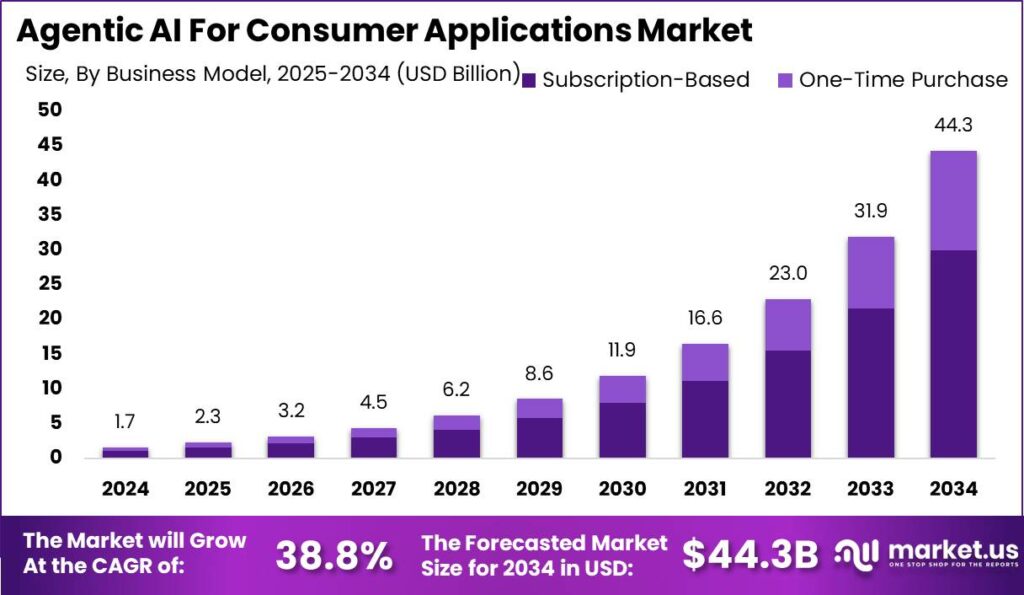
The market is expanding rapidly, driven by rising consumer expectations, technological advancements, and an increasing shift toward digital and automated solutions in everyday life. The growth of the Agentic AI market for consumer applications can be attributed to several key drivers. First, the widespread adoption of smart devices and the Internet of Things (IoT) has accelerated the demand for AI-enabled solutions that can learn and adapt to user preferences.
Additionally, consumers are increasingly seeking personalized experiences, which Agentic AI can deliver through advanced data analytics and machine learning algorithms. Moreover, the desire for convenience and efficiency in daily life further propels the market, as consumers turn to AI to streamline tasks and provide actionable insights.
There is a growing demand for Agentic AI applications across multiple sectors, particularly in e-commerce, healthcare, home automation, and entertainment. Consumers are increasingly adopting AI-powered devices, such as virtual assistants and smart home products, which can predict their needs and provide tailored services.
According to DigitalDefynd, 60% of companies are already using agentic AI to improve customer engagement, highlighting its increasing role in personalizing interactions. By 2028, 33% of enterprise software applications are expected to integrate agentic AI, a significant rise from under 1% in 2024. This shift aligns with consumer demand, as 65% of shoppers are interested in AI-driven personalized recommendations and customer service, contributing to a 10% boost in satisfaction when implemented well.
Businesses utilizing agentic AI in personalization have seen sales jump by up to 15%, particularly in retail and e-commerce. Additionally, agentic AI is helping companies streamline operations, with anticipated improvements of 30% in efficiency, especially in sectors like logistics and manufacturing. Those adopting AI in customer service expect a 25% reduction in costs, primarily from automating routine tasks
The Agentic AI market presents significant opportunities for innovation and growth. As technology continues to evolve, new use cases for AI in consumer applications are emerging, such as personalized health tracking, intelligent home management, and automated financial planning. Companies can capitalize on these opportunities by developing AI-powered solutions that cater to the growing consumer interest in convenience, personalization, and efficiency.
Technological advancements in machine learning, natural language processing (NLP), and edge computing are significantly enhancing the capabilities of Agentic AI for consumer applications. These advancements enable AI systems to process vast amounts of data more efficiently, understand and respond to human interactions more naturally, and perform tasks autonomously without requiring continuous human input.
Key Takeaways
- The Global Agentic AI for Consumer Applications Market is projected to reach a value of USD 44.3 billion by 2034, reflecting a compound annual growth rate (CAGR) of 38.8% during the forecast period from 2025 to 2034.
- In 2024, North America commanded the largest share of the market, accounting for over 42.3% and generating approximately USD 0.7 billion in revenue.
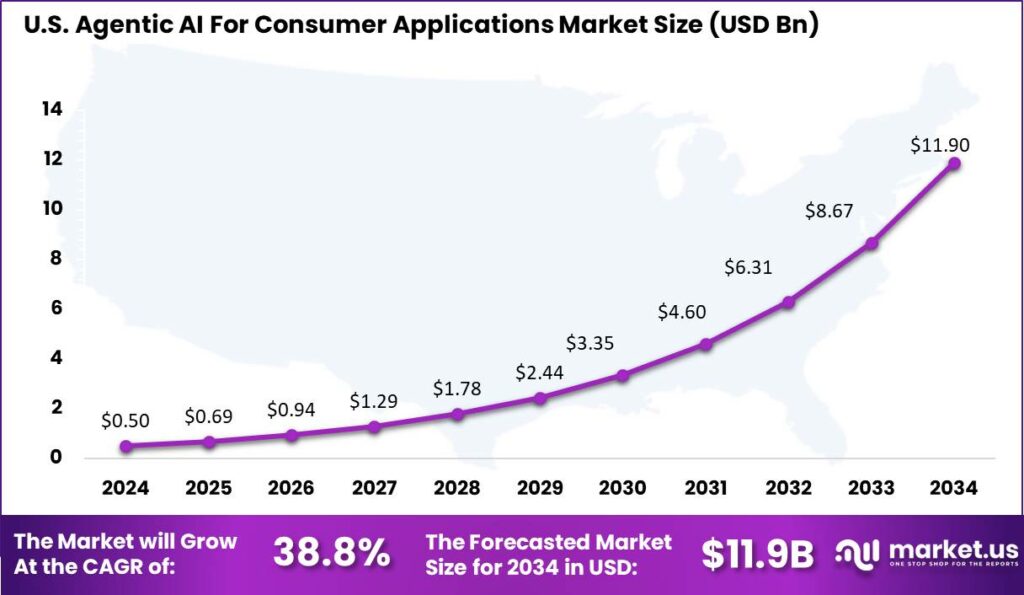
- The U.S. market, in particular, is poised for substantial expansion, with a market size of USD 0.5 billion in 2024 and a CAGR of 37.3%.
- Among the key market segments in 2024, Virtual Assistants & AI Companions held a leading position, contributing to 28.2% of the market share.
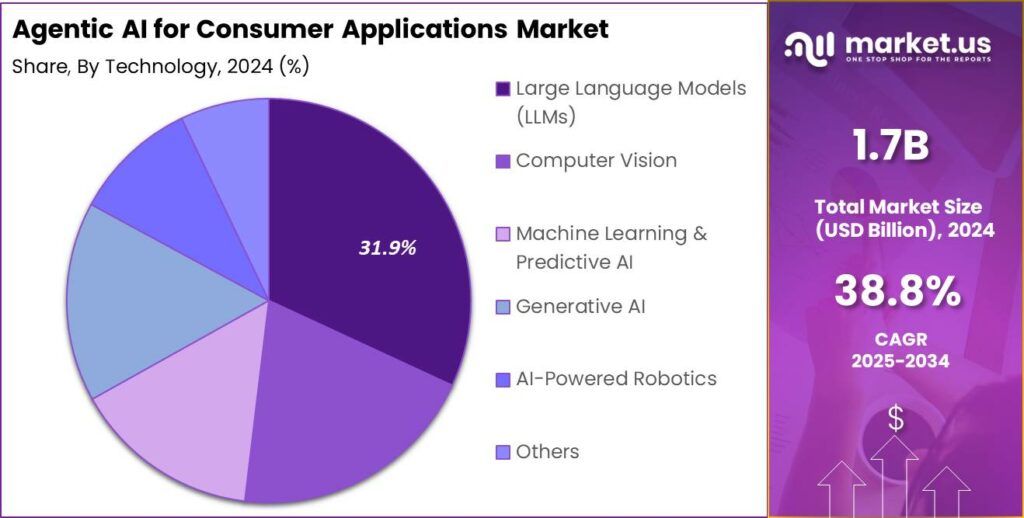
- Additionally, the Large Language Models (LLMs) segment was a dominant force, holding a significant 31.9% market share in 2024.
- Lastly, the Subscription-Based business model was the most prevalent in the market, capturing over 67.8% of the share in 2024.
U.S. Market Size and Growth
The US Agentic AI for Consumer Applications Market is poised for substantial growth, with an estimated market size of USD 0.5 billion in 2024 and a robust compound annual growth rate (CAGR) of 37.3%. This impressive growth can be attributed to several factors, including the increasing consumer demand for personalized, efficient, and automated experiences.
As consumers continue to seek out smarter technologies in everyday devices, businesses are turning to advanced AI systems that can offer tailored services, enhance convenience, and deliver seamless user interactions. The dominance of the United States in this market can be attributed to its technological leadership and high digital adoption rates.
The country has a strong ecosystem of technology companies that are driving innovation in AI, with significant investments in AI research and development. This enables rapid product launches and adoption of new AI-powered solutions. Additionally, a tech-savvy consumer base in the US is highly receptive to AI-enabled products, from virtual assistants and smart home devices to personalized retail experiences.
Furthermore, the US market benefits from a mature infrastructure that supports the deployment and scaling of Agentic AI applications. High internet penetration, widespread usage of smart devices, and increasing consumer trust in AI-driven solutions are contributing to the adoption of these technologies.
As of 2023, over 85% of US households had access to smart home technologies, and a large portion of consumers already use AI-powered applications for shopping, entertainment, and daily tasks. This growing consumer familiarity with AI is fueling the expansion of Agentic AI in consumer-facing applications.
In 2024, North America held a dominant market position, capturing more than a 42.3% share, translating to approximately USD 0.7 billion in revenue within the agentic AI for consumer applications market. This dominance can largely be attributed to the region’s advanced technological infrastructure, the presence of leading tech companies, and a high adoption rate of AI technologies.
The U.S., in particular, is a key driver, with its robust investment in AI research and development and the proliferation of AI-driven consumer applications across sectors such as retail, healthcare, and entertainment. The region’s favorable regulatory environment and the early-stage implementation of AI solutions also play crucial roles in fostering growth.
North America’s leadership is further supported by its well-established consumer base, which is increasingly open to adopting advanced technological solutions. The region’s high disposable income levels allow consumers to easily integrate AI-powered products into their daily lives, thus driving demand. Moreover, partnerships between technology firms and startups have resulted in the rapid development of innovative AI applications, contributing to the overall market expansion.
Application Analysis
In 2024, the segment of Virtual Assistants & AI Companions notably dominated the Agentic AI for Consumer Applications Market, holding a significant market share of 28.2%. This prominence is largely attributed to their widespread integration across various consumer platforms – virtually becoming a standard feature in smartphones, home automation systems, and online customer service solutions.
Virtual assistants such as Siri, Alexa, and Google Assistant have transformed how consumers interact with devices, making technology more accessible and enhancing user experiences by enabling efficient handling of tasks through simple voice commands.
The surge in this segment’s market dominance is underpinned by several factors. Firstly, the continuous enhancements in natural language processing and machine learning algorithms have significantly improved the responsiveness and accuracy of virtual assistants, making them more reliable for everyday use.
Secondly, there is a growing consumer preference for personalized and seamless technology interactions. Virtual assistants are increasingly capable of providing tailored recommendations, reminders, and automation of routine tasks based on individual user habits and preferences, which boosts user engagement and satisfaction.
Furthermore, the integration of virtual assistants into a wider array of devices and platforms has expanded their utility and appeal. They are no longer confined to smartphones but are now integral components of smart home systems, wearables, and even automotive technology, providing a cohesive and interconnected user experience across all touchpoints. This expansion is strategically aligned with the broader consumer electronics market’s shift towards creating more integrated and user-centric solutions.
These advancements and integrations highlight a significant market opportunity for further innovation and development in the Agentic AI sector, particularly in enhancing the interconnectivity and intelligence of virtual assistants. As these technologies continue to evolve, they are expected to play a crucial role in driving the future direction of consumer interactions with smart technologies, marking a key area for continued investment and research within the Agentic AI market.
Technology Type Analysis
In 2024, the Large Language Models (LLMs) segment held a commanding position in the Agentic AI for Consumer Applications Market, capturing more than a 31.9% share. This dominance is primarily attributed to the versatile capabilities of LLMs to process and understand human language, making them indispensable across various consumer applications, from chatbots to sophisticated personal assistants.
Large Language Models like GPT-4 are at the forefront of this trend, offering deep contextual understanding that enhances user interactions with technology by providing more accurate and relevant responses to user queries. The leadership of LLMs in the market is further bolstered by their integration into a wide range of applications beyond simple text processing.
These models are increasingly used in generating personalized content, automating customer support, and even in applications requiring nuanced understanding of user intents, such as in gaming and personalized learning environments. The ability of LLMs to continuously learn from interactions to improve their accuracy and effectiveness makes them particularly valuable in dynamic market environments where consumer preferences are constantly evolving.
Moreover, advancements in training techniques and the growing availability of computational power allow LLMs to scale new heights in performance and sophistication, driving their adoption in more complex and diverse applications. This trend is supported by significant investments from major tech companies in enhancing the capabilities of these models, which not only enhances user experience but also creates new pathways for revenue through innovative applications of LLM technology.
Business Model Analysis
In 2024, the Subscription-Based business model held a dominant market position in the Agentic AI for Consumer Applications Market, capturing more than a 67.8% share. This model’s prominence can be attributed to its recurring revenue structure, which provides businesses with a steady stream of income and promotes long-term customer relationships.
Subscription models also allow for regular updates and improvements to AI-driven products, ensuring consumers have access to the latest features and enhancements without the need for additional upfront costs, which is particularly appealing in the rapidly evolving AI landscape.
The subscription model’s success is also driven by its affordability and flexibility. With consumers increasingly seeking continuous value, rather than a one-time purchase, the subscription model enables them to access powerful AI tools and services for a predictable monthly or annual fee.
This is especially attractive for AI-powered applications like virtual assistants, personalized health or finance apps, and smart home systems, where ongoing updates and improvements are integral to maintaining user satisfaction and adapting to emerging technologies.
Additionally, the subscription model fosters a deeper customer engagement by incentivizing regular interactions with the service. This ensures businesses can continually gather data to refine and improve AI offerings based on real user feedback, ultimately leading to better customer experiences and higher retention rates. For companies, this model reduces customer churn by keeping users tied to the service through long-term, value-driven relationships.
Key Market Segments
By Application
- Virtual Assistants & AI Companions
- Smart Home & IoT Integration
- AI-Powered Personal Finance & Investments
- AI in Retail & Shopping
- AI for Content Generation & Entertainment
- AI for Travel & Transportation
- AI in Health & Wellness
- Others (AI for Education & Learning, etc.)
By Technology Type
- Large Language Models (LLMs)
- Computer Vision
- Machine Learning & Predictive AI
- Generative AI
- AI-Powered Robotics
- Others
By Business Model
- Subscription-Based
- One-Time Purchase
Driver
Growing Demand for Personalization and Enhanced User Experience
A key driver behind the growth of agentic AI in consumer applications is the rising demand for personalized experiences across industries like retail, entertainment, and healthcare. Consumers are increasingly seeking products and services that cater to their unique preferences, needs, and behaviors.
Agentic AI, with its ability to process vast amounts of data, enables businesses to tailor their offerings more precisely, thus improving customer satisfaction. In retail, for instance, AI-driven systems can track individual browsing habits and recommend products accordingly, creating a personalized shopping experience that can significantly boost sales.
In the entertainment sector, streaming platforms like Netflix and Spotify leverage AI algorithms to suggest content based on a user’s viewing or listening history. Similarly, in healthcare, AI-powered apps can provide personalized health advice by analyzing a user’s activity levels, diet, and medical history.
Restraint
Data Privacy and Ethical Concerns
Despite the growing adoption of agentic AI, one of the significant restraints is the rising concern over data privacy and ethical implications surrounding AI usage. Agentic AI relies on large datasets to train algorithms and improve predictive accuracy, but these datasets often include sensitive consumer information, such as personal preferences, browsing habits, and even health data.
In recent years, data privacy has become a central issue, with high-profile incidents like the Cambridge Analytica scandal and various data breaches making consumers wary of how their personal information is being collected and utilized. As AI continues to evolve and integrate into consumer applications, there is an increasing demand for stricter regulations and transparency around data handling.
Opportunity
AI-Enhanced Customer Support and Virtual Assistants
A significant opportunity for agentic AI in consumer applications lies in its ability to transform customer support and enhance user interactions through virtual assistants. As customer expectations evolve, consumers increasingly prefer instant, round-the-clock support.
Traditional customer service methods often fall short, with long wait times and inconsistent responses. AI-powered virtual assistants, however, can offer immediate, personalized assistance, making them an attractive option for businesses looking to enhance customer engagement.
In industries like e-commerce, telecommunications, and banking, virtual assistants can provide answers to customer queries, handle transactions, and resolve issues with minimal human intervention. This reduces operational costs for businesses while improving customer satisfaction through faster, more efficient service. With advancements in natural language processing (NLP), virtual assistants are becoming more conversational, able to understand context and intent, and offer responses that feel more human-like.
Challenge
Integration and Scalability of AI Solutions
One of the primary challenges faced by businesses looking to integrate agentic AI into their consumer applications is the complexity and cost of implementation. Developing and scaling AI-driven solutions require significant resources, both in terms of technology and expertise.
Many companies, particularly small and mid-sized businesses, may find it difficult to navigate the complexities of integrating AI into their existing systems without substantial investments in infrastructure, training, and personnel. AI integration also requires a high level of technical expertise to ensure that the algorithms are properly tailored to a company’s specific needs.
This can often lead to additional challenges such as talent shortages, as AI specialists remain in high demand across many sectors. For businesses without the required expertise, there is a risk of unsuccessful implementation or underperformance, which can undermine the potential benefits of AI technology.
Moreover, scalability is another significant concern. While AI can improve efficiency in the short term, ensuring that these systems can scale effectively to meet growing demands is a complex challenge. Many AI solutions may work well on a small scale but encounter issues such as latency, errors, or system overloads when handling larger volumes of data or customers.
Growth Factors
- Demand for Real-Time Decision-Making: The increasing complexity of consumer markets necessitates faster and more accurate decision-making. Agentic AI enables businesses to analyze vast datasets in real time and make proactive decisions. For instance, in e-commerce, it predicts demand spikes and adjusts inventory or pricing strategies dynamically.
- Shift Toward Personalization: Consumers today expect tailored experiences. Agentic AI leverages behavioral data to offer hyper-personalized recommendations, marketing campaigns, and customer support. This trend is especially evident in industries like retail and healthcare, where individualized services directly impact customer satisfaction and retention.
- Operational Efficiency: Businesses are under pressure to optimize resources while reducing costs. Agentic AI automates complex workflows – such as supply chain management and fraud detection – minimizing human intervention and errors while enhancing scalability.
- Technological Advancements: The integration of cloud platforms, APIs, and large language models (LLMs) has accelerated the deployment of agentic AI systems. These technologies enable seamless scaling across regions and platforms, making agentic AI accessible to businesses of all sizes.
Emerging Trends
- Autonomous Ecosystems: Agentic AI is evolving from isolated tools to interconnected ecosystems that manage multiple processes autonomously. For example, in customer service, it acts as a “superagent” by coordinating issue resolution, predictive support, and personalized recommendations across channels.
- Dynamic Pricing Models: In e-commerce and hyperlocal services, agentic AI analyzes competitor pricing, demand elasticity, and market conditions to implement dynamic pricing strategies that maximize profitability while maintaining competitiveness.
- Healthcare Transformation: Agentic AI is revolutionizing healthcare by automating administrative tasks like appointment scheduling while providing personalized treatment recommendations based on patient data. It also accelerates drug discovery by analyzing massive datasets for potential drug targets.
- Enhanced Risk Management: Financial institutions are leveraging agentic AI for real-time fraud detection and investment optimization. By autonomously analyzing patterns in transactions or market trends, it mitigates risks proactively.
Key Benefits For Stakeholders
- For Businesses
- Increased Efficiency: Automating end-to-end workflows reduces manual effort and operational costs while improving accuracy.
- Scalability: Agentic AI adapts to growing workloads without compromising performance by leveraging self-learning algorithms.
- Better ROI: Intelligent resource allocation – such as reallocating ad budgets or optimizing inventory – ensures superior returns on investment.
- For Consumers
- Personalized Experiences: From tailored shopping recommendations to proactive healthcare solutions, agentic AI enhances user satisfaction by addressing individual needs effectively.
- Faster Service Delivery: Real-time optimization of delivery routes or customer support ensures quicker resolutions and improved convenience.
- For Industry Professionals
- Enhanced Decision-Making: By automating data analysis and providing actionable insights, agentic AI empowers professionals to focus on strategic planning rather than routine tasks.
- Risk Mitigation: Proactive identification of threats or inefficiencies safeguards operations across sectors like finance and logistics.
Key Regions and Countries
- North America
- US
- Canada
- Europe
- Germany
- France
- The UK
- Spain
- Italy
- Rest of Europe
- Asia Pacific
- China
- Japan
- South Korea
- India
- Australia
- Singapore
- Rest of Asia Pacific
- Latin America
- Brazil
- Mexico
- Rest of Latin America
- Middle East & Africa
- South Africa
- Saudi Arabia
- UAE
- Rest of MEA
Key Players Analysis
The Agentic AI market is rapidly growing, with key players leveraging advanced technologies to create autonomous systems that analyze data, make decisions, and execute tasks with minimal human intervention. Major companies in this space include Microsoft, NVIDIA, IBM, Google, Amazon Web Services (AWS), Salesforce, and Alibaba. These firms are driving innovation through diverse applications such as customer service, healthcare, financial services, and more.
For instance, Microsoft Azure AI provides tools for predictive modeling and cognitive services, while NVIDIA focuses on AI computing with products like the A100 Tensor Core GPU. Similarly, Salesforce’s Agentforce offers low-code solutions for personalized AI agents in sales and customer service. Companies like IBM Watson and Google DeepMind are also advancing the market with AI-driven decision-making tools.
Top Key Players in the Market
- Aisera
- TELUS Digital
- UiPath
- Automation Anywhere Inc.
- Akira AI
- International Business Machines Corporation (IBM)
- Acuvate
- NVIDIA Corporation
- Cognizant
- Verint Systems Inc.
- Others
Recent Developments
- In January 2025, NVIDIA partnered with Accenture to power the AI Refinery platform using its enterprise-grade AI stack. This collaboration aims to democratize access to advanced agentic AI capabilities for businesses worldwide.
- In January 2025, Accenture unveiled the “AI Refinery for Industry,” a platform featuring 12 agentic AI solutions tailored to industry-specific challenges. Built on NVIDIA’s AI Enterprise software, it accelerates multi-agent network deployments and enhances workforce productivity.
- In December 2024, Aisera introduced its “Agentic AI Copilot,” designed to enhance enterprise productivity by automating workflows, improving customer service, and reducing operational costs. The platform supports IT service management (ITSM) and HR functions, leveraging generative AI for conversational and autonomous solutions.
- In December 2024, Acuvate highlighted advancements in agentic AI for customer service, emphasizing real-time decision-making, personalized customer interactions, and scalability. These innovations aim to reduce human intervention in routine tasks while improving customer satisfaction and operational efficiency.









