


Report Overview
The Global Smart Pills Market Size is expected to be worth around US$ 3.5 Billion by 2034, from US$ 1.2 Billion in 2024, growing at a CAGR of 11.2% during the forecast period from 2025 to 2034.
The global smart pills market is experiencing significant growth driven by increasing demand for non-invasive diagnostic and therapeutic solutions. Advancements in wireless technology and miniaturization of sensors have enabled the development of smart pills capable of monitoring health conditions in real-time, offering patients and healthcare provider’s valuable insights.
Rising chronic diseases, such as gastrointestinal disorders and cancer, are pushing the need for effective and less invasive treatments, further fueling market expansion. Additionally, the growing adoption of telemedicine and remote patient monitoring is creating opportunities for smart pills to play a key role in personalized healthcare.
However, challenges such as high costs, regulatory hurdles, and concerns about data security and patient privacy may limit market growth. On the other hand, the growing acceptance of digital health devices and the potential for smart pills to revolutionize drug delivery systems and diagnostics present a promising future for the market.

Key Takeaways
- The global smart pills market was valued at USD 1.2 billion in 2024 and is anticipated to register substantial growth of USD 3.5 billion by 2034, with 11.2% CAGR.
- In 2024, the celiac disease segment took the lead in the global market, securing 26.7% of the total revenue share.
- The small intestine segment took the lead in the global market, securing 28.6% of the total revenue share.
- The capsule endoscopy segment took the lead in the global market, securing 53.3% of the total revenue share.
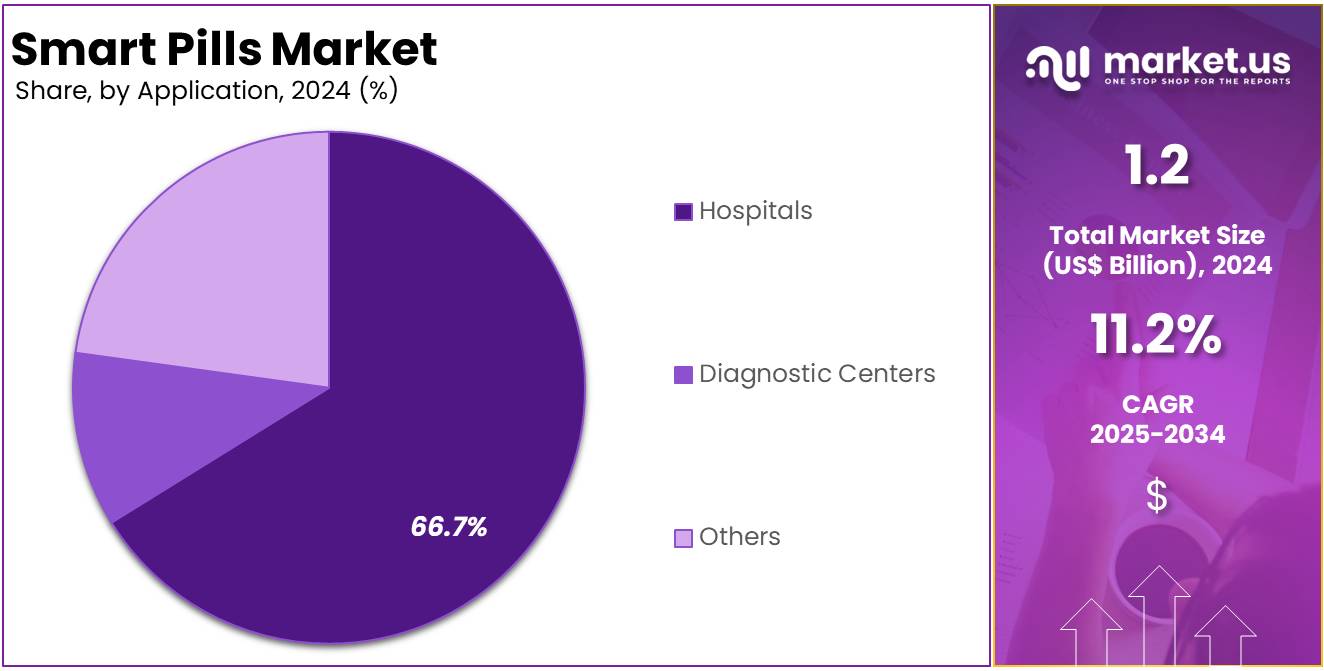
- The hospitals segment took the lead in the global market, securing 66.7% of the total revenue share.
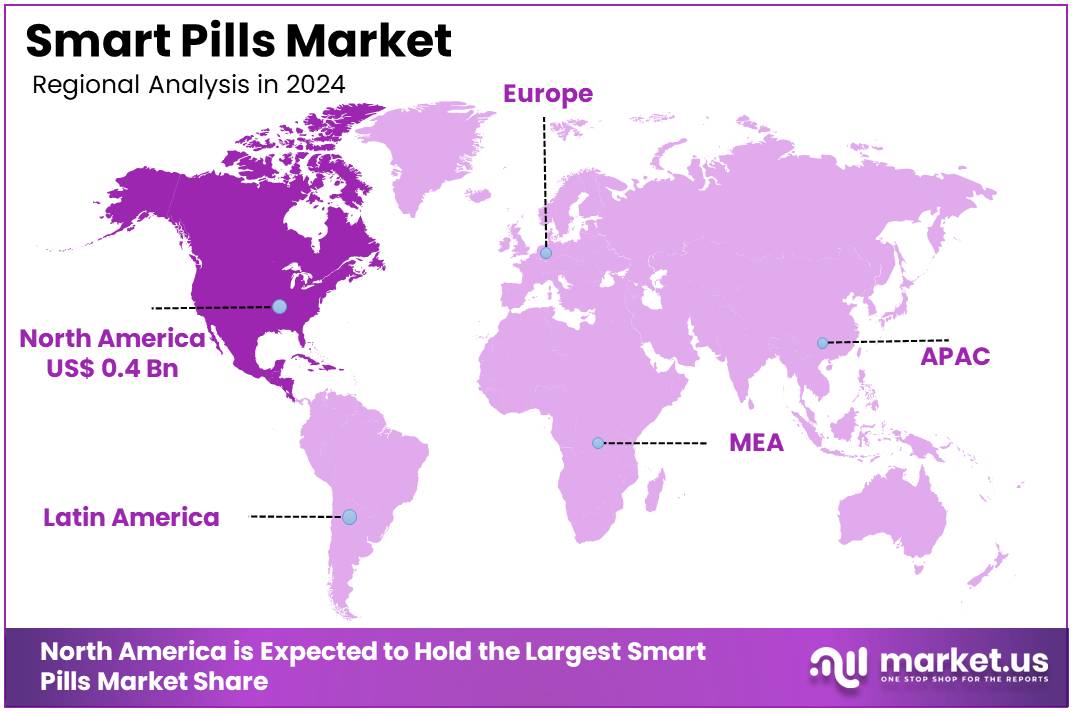
- North America maintained its leading position in the global market with a share of over 37.8% of the total revenue.
Disease Indication Analysis
Based on disease indication the market is fragmented into celiac disease, occult GI bleeding, crohn’s disease, small bowel tumors, inherited polyposis syndromes, neurological disorders, and other disease indications. Amongst these, celiac disease dominated the global smart pills market capturing a significant market share of 26.7% in 2024.
The increasing prevalence of celiac disease, a chronic autoimmune disorder triggered by gluten, has heightened the demand for non-invasive diagnostic and monitoring solutions. Smart pills equipped with sensors can provide real-time data on the gastrointestinal tract, enabling healthcare providers to monitor the disease progression and the patient’s response to treatment more effectively.
Traditional diagnostic methods for celiac disease, such as endoscopies and biopsies, can be invasive and uncomfortable for patients, making smart pills a preferred alternative. Furthermore, the ability of smart pills to offer continuous monitoring and provide detailed insights into the gut’s health aligns with the growing trend of personalized medicine. As a result, the celiac disease segment is expected to remain a dominant force in the smart pills market, driving technological innovation and expanding market adoption in the coming years.
Target Area Analysis
Based on target area the market is fragmented into small intestine, esophagus, large intestine, and stomach. Amongst these, small intestine dominated the global smart pills market capturing a significant market share of 28.6% in 2024 due to its critical role in the digestive process and the increasing need for non-invasive diagnostic solutions for gastrointestinal conditions.
Smart pills designed for small intestine monitoring can capture real-time data on factors such as motility, pH levels, and the presence of specific biomarkers, providing valuable insights into a range of disorders, including Crohn’s disease, celiac disease, and irritable bowel syndrome (IBS). These pills are particularly advantageous for patients with conditions affecting the small intestine, as they offer a non-invasive alternative to traditional diagnostic methods like endoscopies or colonoscopies, which can be uncomfortable and expensive.
With the growing adoption of smart technology in healthcare, patients and providers are increasingly relying on these innovative pills to monitor the small intestine’s health. As a result, the small intestine-focused segment continues to drive the growth and technological advancements in the global smart pills market.
Application Analysis
Based on application the market is fragmented into capsule endoscopy, drug delivery, and vital sign monitoring. Amongst these, capsule endoscopy dominated the global smart pills market capturing a significant market share of 53.3% in 2024 due to its ability to provide a non-invasive, efficient method for diagnosing and monitoring gastrointestinal conditions.
This technology involves swallowing a small, camera-equipped pill that captures high-resolution images as it travels through the digestive tract, offering real-time insights into areas that are difficult to reach with traditional endoscopes. Capsule endoscopy is particularly beneficial for diagnosing disorders of the small intestine, such as Crohn’s disease, celiac disease, and unexplained gastrointestinal bleeding. Its non-invasive nature and ease of use have made it increasingly popular among both patients and healthcare providers, as it reduces discomfort, eliminates the need for sedation, and allows for outpatient use.
As the technology continues to improve in terms of image quality, data processing, and patient comfort, capsule endoscopy is expected to remain the leading segment in the smart pills market, driving growth and innovation in gastrointestinal diagnostics.
End-User Analysis
The market is fragmented by end-user into hospitals, diagnostic centers, and others. Hospitals dominated the global smart pills market capturing a significant market share of 66.7% in 2024. As primary healthcare institutions, hospitals are increasingly adopting smart pill technologies for more accurate, efficient, and less invasive patient monitoring.
Smart pills, such as those used for capsule endoscopy, offer hospitals a valuable tool to diagnose and manage a wide range of gastrointestinal and chronic diseases, including Crohn’s disease, celiac disease, and cancers of the digestive system. Their non-invasive nature is particularly appealing in hospital settings, where minimizing patient discomfort and recovery time is crucial. Moreover, hospitals benefit from smart pills’ ability to streamline workflows and reduce the need for traditional, more invasive procedures like endoscopies or biopsies.
Key Segments Analysis
By Disease Indication
- Celiac Disease
- Occult GI Bleeding
- Crohn’s Disease
- Small Bowel Tumors
- Inherited Polyposis Syndromes
- Neurological Disorders
- Other Disease Indications
By Target Area
- Small Intestine
- Esophagus
- Large Intestine
- Stomach
By Application
- Capsule Endoscopy
- Drug Delivery
- Vital Sign Monitoring
By End-use
- Hospitals
- Diagnostic Centers
- Others
Drivers
Growing Demand for Non-Invasive and Personalized Healthcare Solutions
The growing demand for non-invasive and personalized healthcare solutions is a key driver of the smart pills market. As chronic diseases, such as gastrointestinal disorders, cancer, and neurological conditions, become more prevalent, there is an increasing need for efficient diagnostic and monitoring tools. Smart pills, especially those designed for capsule endoscopy, offer a minimally invasive alternative to traditional diagnostic methods like endoscopies and colonoscopies.
These pills can capture real-time data on a patient’s condition, enabling quicker, more accurate diagnoses, and reducing the need for surgical interventions. Additionally, the integration of wireless technology in smart pills allows for remote monitoring, which is becoming more attractive in an era of telemedicine. As healthcare providers seek ways to enhance patient care while reducing costs, the convenience, accuracy, and comfort offered by smart pills make them an attractive solution, driving significant growth in the market.
Restraints
High Cost of Development and Implementation
The high cost of development and implementation, which limits widespread adoption, particularly in emerging markets. Smart pills require sophisticated technology, such as miniaturized sensors and wireless communication systems, which leads to higher production costs compared to traditional diagnostic tools. Additionally, healthcare systems may face challenges in integrating these advanced technologies into existing infrastructure, increasing the overall cost burden.
For patients, out-of-pocket costs for procedures involving smart pills, such as capsule endoscopy, can be prohibitive, limiting access to those who most need it. Furthermore, reimbursement policies in some regions are still evolving, which creates uncertainty about the long-term affordability and accessibility of smart pills. These factors hinder the market’s expansion, particularly in lower-income countries and for underserved patient populations, where cost-effective healthcare solutions are more critical.
Opportunities
Digital Marketing and E-commerce Growth
The smart pills market is experiencing a notable surge in growth, primarily driven by the increasing utilization of digital marketing and e-commerce strategies. As consumers increasingly seek convenient and accessible dental care solutions, online platforms have emerged as critical channels for promoting and purchasing orthodontic products. Digital marketing facilitates targeted advertising via social media, search engines, and influencers, significantly expanding the reach to a broader audience interested in dental hygiene and orthodontic care.
Furthermore, e-commerce enhances customer convenience by enabling the purchase of orthodontic wax and related products from home. The rise of direct-to-consumer sales models allows businesses to engage with customers more effectively through personalized recommendations and promotions. This growing consumer awareness about oral health, coupled with the ease of online shopping, is propelling the demand for orthodontic wax. These trends are forging new growth opportunities in the market, reshaping its future landscape in response to digital advancements.
Impact of macroeconomic factors / Geopolitical factors
Macroeconomic and geopolitical factors significantly impact the global smart pills market by influencing both supply and demand dynamics. Economic downturns or recessions can lead to reduced healthcare budgets, affecting the affordability and adoption of advanced technologies like smart pills, especially in public health systems.
On the other hand, economic growth in emerging markets can boost demand for innovative healthcare solutions as disposable incomes rise and more people seek access to better diagnostic tools. Geopolitical factors, such as trade tensions or regulatory changes, can disrupt the supply chains for the raw materials needed to produce smart pills, potentially leading to price volatility or delays in product availability.
Additionally, differences in healthcare regulations across regions may limit the speed at which smart pill technologies are adopted in some countries. Political stability and government policies promoting digital health, however, can create a favorable environment for market growth by encouraging investment and ensuring smoother integration of smart pills into healthcare systems worldwide.
Trends
The global smart pills market is undergoing transformative changes, primarily driven by the integration of artificial intelligence (AI) and machine learning (ML). These technologies enhance smart pill capabilities, enabling sophisticated data analysis, real-time monitoring, and tailored treatment plans. Additionally, the trend towards multifunctional smart pills is notable. These pills are not only used for diagnostic purposes like capsule endoscopy but also for drug delivery, providing dual benefits to patients.
Another significant trend is the expansion of telemedicine and remote patient monitoring, which promotes the adoption of smart pills. These innovations allow for ongoing health tracking from home. Moreover, advancements in miniaturization and sensor technology are increasing the efficiency and affordability of smart pills. Coupled with the rise in healthcare digitization and a shift towards preventive care, these developments are paving the way for smart pills to become integral to future healthcare solutions.
Regional Analysis
North America plays a pivotal role in the global smart pills market, primarily due to its advanced healthcare infrastructure. This region, especially the United States, leads in adopting innovative medical technologies. The integration of smart pills into hospitals and clinics for non-invasive diagnostics showcases this trend. The technology’s appeal is its ability to provide real-time, minimally invasive monitoring solutions.
Significant investment in research and development supports the widespread adoption of smart pills in North America. These investments help in advancing the technology behind smart pills, enhancing their diagnostic capabilities. As a result, smart pills are becoming more reliable for medical practitioners and patients seeking precise health monitoring tools.
The demand for smart pills is also driven by the rising prevalence of chronic diseases such as gastrointestinal disorders and cancers. These conditions necessitate the need for accurate, non-intrusive diagnostic methods. Capsule endoscopy, a prominent application of smart pills, is particularly beneficial in diagnosing and monitoring these diseases, making it a sought-after solution in the healthcare sector.
Key Regions and Countries
- North America
- US
- Canada
- Europe
- Germany
- France
- The UK
- Spain
- Italy
- Russia
- Netherland
- Rest of Europe
- Asia Pacific
- China
- Japan
- South Korea
- India
- New Zealand
- Singapore
- Thailand
- Vietnam
- Rest of APAC
- Latin America
- Brazil
- Mexico
- Rest of Latin America
- Middle East & Africa
- South Africa
- Saudi Arabia
- UAE
- Rest of MEA
Key Players Analysis
The competitive landscape of the global smart pills market is characterized by the presence of key players focused on innovation, product development, and strategic partnerships. Major companies, such as Medtronic, Capsovision, and Given Imaging, lead the market with their advanced capsule endoscopy and smart pill technologies, offering non-invasive solutions for gastrointestinal diagnostics.
These players are investing heavily in R&D to enhance the capabilities of smart pills, incorporating features like drug delivery, real-time data transmission, and AI-driven diagnostics. Additionally, several smaller companies and startups are entering the market, bringing fresh innovations and targeting specific niches like neurological and gastrointestinal monitoring. To gain a competitive edge, companies are forming strategic alliances with healthcare providers, technology firms, and academic institutions to expand their market reach and improve the functionality of their products.
Medtronic is a global leader in medical technology, offering a wide range of products and services across various healthcare segments, including cardiovascular, diabetes, neurological, and gastrointestinal care. The company is known for its innovations in surgical tools, implantable devices, and diagnostic solutions.
In addition, Otsuka Holdings Co., Ltd. is a Japanese multinational company primarily focused on pharmaceuticals and nutraceuticals. It operates in diverse sectors, including the development of innovative drugs, medical devices, and consumer health products. Otsuka is particularly recognized for its work in the central nervous system and cardiovascular disease areas.
Top Key Players in the Smart Pills Market
- Medtronic
- Otsuka Holdings Co. Ltd.
- Olympus Corporation
- CapsoCam Plus
- Pentax Medical
- JINSHAN Science & Technology (Group) Co. Ltd.
- Check-Cap Ltd.
- etectRx
- INTROMEDIC
- Shenzen Jifu Medical Technology Co. Ltd
- BodyCapUSA
Recent Developments
- In April 2024, PENTAX Medical EMEA unveiled the Digital Capture Module 9380, a pioneering device aimed at transforming medical recording in ENT and speech-language pathology settings. This portable, compact unit enhances recording capabilities with customizable features, adapting to the diverse needs of healthcare professionals. It sets a new benchmark in medical imaging with its ability to record from multiple camera sources, along with seamless recording and playback features, coupled with an intuitive software interface that simplifies its use in clinical environments.
- In December 2024, Medtronic plc, renowned for its healthcare technology solutions, disclosed that the University of Miami Health System (UHealth) had performed the first patient procedure using its innovative PillCam™ Genius SB capsule endoscopy kit. This next-generation kit enhances procedural flexibility by simplifying equipment management, which permits the procedure to be carried out in various settings including hospitals, clinics, or remotely via telehealth, thus broadening access and convenience for patients.









