


Report Overview
The Global Predictive analytics in EdTech Market size is expected to be worth around USD 5,892 Million By 2034, from USD 680.1 Million in 2024, growing at a CAGR of 24.10% during the forecast period from 2025 to 2034. North America dominated the market in 2024, holding more than 34.85% of the market share, with revenues amounting to USD 237 Million.
Predictive analytics in EdTech refers to the use of data, statistical algorithms, and machine learning techniques to identify the likelihood of future outcomes based on historical data. This approach can help educational institutions and technology providers enhance learning experiences, improve educational outcomes and optimize operational efficiencies.
In education technology, predictive analytics is often applied to personalize learning paths, forecast student performance, and identify at-risk students before they fall behind. It can also be used for more effective management of resources, like optimizing class schedules and predicting the demand for courses.
The growth of predictive analytics in EdTech is fueled by the increasing volume of data from digital learning platforms and the shift toward personalized learning. As more schools and universities adopt online tools, this data becomes key for tailoring educational content to individual student needs and enhancing learning outcomes.

Additionally, educational institutions are under increasing pressure to improve student outcomes and retention rates, which predictive analytics can help achieve by enabling early intervention for students at risk of underperforming or dropping out. Advancements in AI and machine learning technologies have made it more accessible and cost-effective for educational organizations to implement predictive analytics solutions.
A key emerging trend in EdTech predictive analytics is the shift toward agile, responsive education systems. Platforms are now using real-time data to offer immediate feedback and personalized learning paths. Additionally, the democratization of analytics is making these tools more user-friendly, allowing non-technical educators to make data-driven decisions independently, enhancing overall educational outcomes.
Technological innovations in EdTech are driven by machine learning models that predict student performance and identify at-risk students. AI is also streamlining administrative tasks and personalizing learning experiences, while natural language processing (NLP) enhances feedback on text-based assignments, improving language learning and writing skills.
Key Takeaways
- The Global Predictive Analytics in EdTech Market is projected to reach USD 5,892 Million by 2034, up from USD 680.1 Million in 2024, reflecting a CAGR of 24.10% during the forecast period from 2025 to 2034.
- The U.S. education technology sector for predictive analytics was valued at USD 237 Million in 2024, with expectations to grow at a CAGR of 24.10%.
- North America dominated the market in 2024, holding more than 34.85% of the market share, with revenues amounting to USD 237 Million.
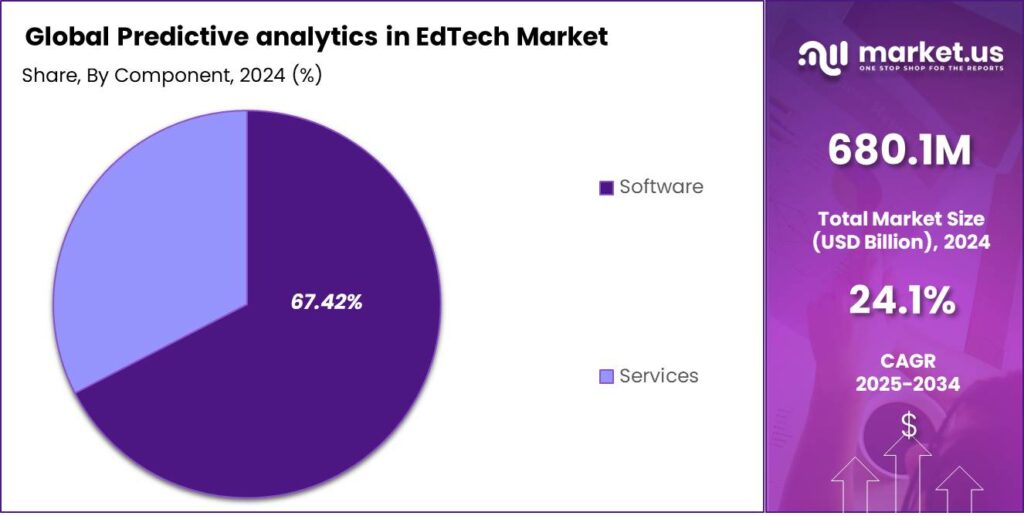
- In 2024, the Software segment led the predictive analytics in EdTech market, commanding over 67.42% of the market share.
- The Cloud-Based segment captured a dominant position in 2024, holding more than 58.23% of the market share.
- The Student Performance Management segment was the leader in 2024, capturing more than 47.3% of the market share.
- The Higher Education segment was also a dominant player in the market in 2024, with a share of over 26.2%.
U.S. Predictive analytics in EdTech Market
The market for predictive analytics in the U.S. education technology sector was estimated at $237 million in 2024. It is projected to expand at a compound annual growth rate (CAGR) of 24.10%. This significant growth underscores the increasing adoption of data-driven technologies in educational settings.
The use of predictive analytics in EdTech allows institutions to tailor educational experiences to individual student needs by analyzing data points like engagement rates, learning speeds, and quiz outcomes. This not only helps in identifying students who might need extra attention but also aids in optimizing course offerings and content delivery.
The growth of predictive analytics in EdTech is driven by the demand for scalable solutions to meet diverse learning needs. It helps institutions enhance efficiency, improve student outcomes, and support resource allocation, policy-making, and strategic planning, playing a key role in shaping the future of education.

In 2024, North America held a dominant market position in the predictive analytics in EdTech market, capturing more than a 34.85% share with revenues reaching USD 237 million. This leadership can be attributed to several factors that are characteristic of the region’s advanced educational and technological infrastructure.
The region’s educational institutions are increasingly recognizing the value of data-driven decision-making, which has spurred the integration of predictive analytics in both K-12 and higher education systems. North America’s robust IT infrastructure and widespread availability of digital devices provide an ideal environment for deploying advanced analytics solutions.
Europe is following North America in adopting predictive analytics in education, spurred by digitalization and government efforts to improve outcomes. In the Asia-Pacific region, rapid growth is driven by rising educational demands and greater internet access, enabling the widespread use of online learning and analytics tools.
Latin America and the Middle East & Africa are emerging markets for predictive analytics in EdTech, driven by improving tech infrastructure and rising awareness of personalized learning. As these regions develop economically, the adoption of advanced education technologies is expected to grow, creating significant opportunities for market expansion.

Component Analysis
In 2024, the Software segment held a dominant position in the Predictive Analytics in EdTech market, capturing more than a 67.42% share. This segment’s leadership is primarily attributed to the critical role that software solutions play in the implementation of predictive analytics.
These software platforms are the backbone of predictive analytics, providing the necessary tools and algorithms that allow educational institutions to analyze large datasets. The software enables the extraction of actionable insights that can significantly enhance decision-making processes regarding student outcomes and educational strategies.
The predominance of the Software segment is further bolstered by the increasing integration of artificial intelligence (AI) and machine learning (ML) in educational tools. These technologies are integral to predictive analytics software, enabling more accurate forecasts and personalized learning experiences.
Another factor contributing to the Software segment’s success is the scalability of these solutions. Predictive analytics software can be scaled to accommodate the growing amount of data generated by online educational platforms and student information systems.
Deployment Mode Analysis
In 2024, the Cloud-Based segment held a dominant position in the predictive analytics in EdTech market, capturing more than a 58.23% share. This substantial market share can be attributed to the flexibility and scalability that cloud-based solutions offer.
Educational institutions and EdTech providers are increasingly adopting cloud-based platforms as they enable easy access to analytics tools and data without the need for significant hardware investments. This accessibility is particularly crucial for institutions aiming to scale up or down based on enrollment numbers and demand.
Cloud-based deployment of predictive analytics is favored for its cost-effectiveness, reducing the need for heavy IT infrastructure. This makes it more accessible for smaller institutions and startups, promoting broader adoption and enabling more personalized, data-driven educational practices across different educational levels.
The cloud-based segment is growing due to its enhanced collaboration features, allowing seamless interaction between students and teachers. This integration of various educational tools into one platform creates a more cohesive learning experience and supports effective teaching strategies.
Application Analysis
In 2024, the Student Performance Management segment held a dominant market position in the predictive analytics in EdTech market, capturing more than a 47.3% share. This segment’s prominence is largely due to the growing emphasis on individual student outcomes and the customization of learning experiences.
Educational institutions are increasingly adopting predictive analytics tools to analyze student data in real-time, allowing for immediate interventions and support where necessary. This proactive approach helps in significantly enhancing student engagement and academic performance.
Predictive analytics help educators identify at-risk students early by analyzing patterns like attendance, grades, and assignments. This enables targeted interventions and personalized teaching to improve student outcomes.
Predictive analytics helps optimize resource allocation in EdTech by analyzing data on resource use and student performance. This ensures efficient use of physical and digital resources, aids in budgeting, and supports financial planning, contributing to the sustainability of educational institutions.
End-User Analysis
In 2024, the Higher Education segment held a dominant market position in the predictive analytics in EdTech market, capturing more than a 26.2% share. This leadership is primarily driven by the complex needs of higher education institutions that seek to enhance operational efficiency and academic effectiveness through data-driven strategies.
Moreover, the growing competition among higher education institutions to attract and retain top talent has led them to adopt advanced technologies like predictive analytics. These tools help institutions understand student behaviors and preferences, enabling them to tailor their courses and services to better meet student needs.
Corporate Training is another key area where predictive analytics is making a significant impact. Companies are using these tools to assess training outcomes and improve employee performance alignment with business goals. This not only helps in optimizing training programs but also enhances ROI on training investments by linking learning paths with strategic objectives.
K-12 and online learning platforms are leveraging predictive analytics to personalize learning, track progress, and offer early interventions. These tools help create adaptive learning paths and optimize content delivery to improve student outcomes and engagement.
Key Market Segments
By Component
- Software
- Services
By Deployment Mode
- Cloud-Based
- On-Premises
By Application
- Student Performance Management
- Curriculum Development
- Resource Allocation
- Others
By End-User
- K-12 Education
- Higher Education
- Corporate Training
- Online Learning Platforms
Key Regions and Countries
- North America
- US
- Canada
- Europe
- Germany
- France
- The UK
- Spain
- Italy
- Rest of Europe
- Asia Pacific
- China
- Japan
- South Korea
- India
- Australia
- Singapore
- Rest of Asia Pacific
- Latin America
- Brazil
- Mexico
- Rest of Latin America
- Middle East & Africa
- South Africa
- Saudi Arabia
- UAE
- Rest of MEA
Driver
Enhanced Personalization in Learning
Predictive analytics is transforming education by enabling personalized learning experiences. By analyzing data on student performance, learning styles, and engagement, educators can tailor instruction to meet individual needs.
For instance, platforms like DreamBox Learning use adaptive learning technologies to adjust lessons in real-time, ensuring that each student receives content suited to their current understanding and pace. This approach not only boosts academic performance but also keeps students engaged by addressing their unique challenges and strengths.
Restraint
Data Privacy and Security Concerns
While predictive analytics offers significant benefits, it also raises concerns about data privacy and security. Educational institutions collect vast amounts of sensitive information, including personal details and academic records. Without robust security measures, this data can be vulnerable to breaches, leading to unauthorized access and potential misuse.
A report highlighted that 89% of assessed educational technology products could collect children’s data, sometimes without proper consent. This situation underscores the need for stringent data protection protocols and clear policies to ensure that student information is handled responsibly. Addressing these concerns is crucial for maintaining trust among students, parents, and educators, and for complying with legal regulations.
Opportunity
Early Identification of At-Risk Students
Predictive analytics provides an opportunity to identify students who may be at risk of falling behind or dropping out. By analyzing factors such as attendance, participation, and assessment scores, educators can detect early warning signs of disengagement or academic struggles.
For example, Georgia State University implemented a predictive analytics system that monitors various student metrics to flag those needing additional support. This proactive approach allows institutions to intervene promptly, offering resources like tutoring or counseling to help students overcome challenges, thereby improving retention rates and overall success.
Challenge
Integrating Data from Multiple Sources
A significant challenge in implementing predictive analytics in education is the integration of data from various platforms and systems. Educational institutions often use multiple tools for learning management, student information, and assessment, leading to fragmented data silos.
This fragmentation makes it difficult to obtain a comprehensive view of student performance and hampers the effectiveness of predictive models. To address this challenge, institutions must develop strategies for seamless data integration. This includes adopting interoperable systems and standardizing data protocols to ensure smooth data flow and enable holistic analysis across different platforms.
Emerging Trends
Predictive analytics is transforming education by using data to enhance learning experiences. One significant trend is personalized learning. By analyzing individual student data, educators can identify learning gaps and tailor lessons to meet each student’s needs, making learning more effective.
Another emerging trend is the use of predictive models to identify students who might be at risk of falling behind. By examining patterns in student behavior and performance, these models help educators intervene early, providing support to keep students on track.
Additionally, predictive analytics aids in resource optimization. By understanding trends in student engagement and performance, institutions can allocate resources more effectively, ensuring that support is available where it’s needed most.
Business Benefits
- Increased Revenue Opportunities: Analytics help identify unmet needs and potential growth areas, enabling institutions to offer targeted courses and programs that align with student demands and market trends.
- Enhanced Student Retention: By predicting which students may struggle or disengage, predictive analytics allows institutions to intervene proactively with support measures, significantly improving retention rates.
- Optimized Educational Content: Data insights can guide the development and refinement of curriculum and teaching methods, ensuring that educational materials are both effective and relevant.
- Efficient Resource Allocation: Analytics provide insights that help institutions make informed decisions about where to allocate resources, thus reducing costs and improving service delivery.
- Better Academic Results: By facilitating real-time adjustments in teaching strategies and personalized student support, predictive analytics lead to better academic performances and satisfaction.
Key Player Analysis
Key players in Predictive analytics in EdTech Market are leveraging their technology and expertise making education more efficient and tailored to individual needs.
- IBM is a major force in the predictive analytics space, particularly with its Watson platform. Watson leverages artificial intelligence (AI) and machine learning to analyze vast amounts of data and predict student outcomes. In the EdTech space, IBM uses its technology to help institutions identify at-risk students, personalize learning paths, and enhance teacher effectiveness.
- Microsoft has made significant strides in the EdTech industry, particularly with its Azure cloud services and AI-powered tools like Microsoft Power BI. By harnessing the power of predictive analytics, Microsoft helps schools and universities optimize their teaching methods, track student progress, and predict academic outcomes.
- Google has solidified its position in the EdTech market with its suite of tools designed to enhance learning and collaboration. Through Google Cloud and its AI-powered services, Google offers predictive analytics tools that help educators forecast student performance, improve learning experiences, and reduce dropout rates.
Top Key Players in the Market
- IBM Corporation
- Microsoft Corporation
- Google LLC
- Oracle Corporation
- SAS Institute Inc.
- Salesforce
- Blackboard Inc.
- D2L Corporation
- Civitas Learning
- Instructure, Inc.
- Other Major Players
Top Opportunities Awaiting for Players
- Personalized Learning Pathways: Predictive analytics allows EdTech companies to create customized learning experiences based on individual student needs.EdTech platforms that integrate predictive analytics can offer highly personalized, engaging content that not only keeps students motivated but also ensures they are mastering key concepts at their own pace. As a result, student outcomes improve, and institutions can provide more targeted interventions.
- Early Identification of At-Risk Students: One of the most impactful applications of predictive analytics is the ability to identify students who may be at risk of falling behind or dropping out. EdTech companies can develop solutions for early intervention, allowing educators to take proactive steps to support struggling students, such as offering tutoring, mentorship, or tailored resources. This helps improve retention rates and overall academic performance.
- Optimized Resource Allocation: Institutions and EdTech providers that use data-driven insights to optimize their resources can reduce waste, lower costs, and better meet the needs of students and faculty. This also allows schools to operate more efficiently, improving the quality of education without overburdening budgets.
- Curriculum Improvement and Content Creation: Another significant opportunity is using predictive analytics to improve the design and effectiveness of curricula. EdTech companies and educational institutions can collaborate on curriculum development, using predictive analytics to refine teaching materials, adjust pacing, and enhance engagement strategies.
- Enhanced Teacher Support and Professional Development: EdTech platforms can develop tools for teacher growth and development, offering insights that help educators improve their effectiveness in the classroom. By providing data-driven support, schools can ensure that their teachers remain equipped to address diverse student needs and stay up-to-date with the latest educational trends.
Recent Developments
- In June 2024, Salesforce introduced new AI-powered tools for its Education Cloud, including features like Intelligent Degree Planning and a Skills Generator, aimed at improving student outcomes and personalizing educational experiences.
- In July 2024, Anthology revealed updates to its Blackboard LMS that focus on enhancing AI literacy and improving instructor workflows. This iteration aims to support student achievement through advanced technological integrations.
- In July 2024, D2L launched an AI-powered product called D2L Lumi, designed to assist educators in creating course content efficiently. This tool aims to streamline content creation processes within educational environments.









