Report Overview
The Global Portable Home Ventilator Market Size is expected to be worth around US$ 1393.7 Million by 2034, from US$ 785.6 Million in 2024, growing at a CAGR of 5.9% during the forecast period from 2025 to 2034.
The portable home ventilator market is experiencing rapid growth, driven by the increasing prevalence of respiratory conditions such as COPD, asthma, and sleep apnea. The demand for home-based healthcare solutions is rising, promoting the development of these devices. Portable ventilators provide crucial mechanical ventilation, offering flexibility and convenience for patients managing their conditions from home. This shift is supported by technological advances that make ventilators more compact, user-friendly, and efficient.
Innovations in ventilator technology include features like battery operation, remote monitoring, and integration with smart health systems. These enhancements improve patient care by enabling continuous, real-time health management outside traditional medical settings. The market benefits from a growing preference for at-home treatment, reflecting broader trends towards personalized and accessible healthcare solutions.
Market dynamics are influenced by strong competition among leading companies, focusing on product innovation, strategic partnerships, and expanded distribution networks. These efforts aim to capture a larger market share and address diverse consumer needs. Additionally, favorable government initiatives and comprehensive insurance coverage support the market’s expansion, ensuring more patients have access to advanced respiratory care technologies.
Geographically, North America leads the portable home ventilator market due to its well-established healthcare infrastructure. However, Asia-Pacific is anticipated to show the fastest growth, driven by improving healthcare access and an increasing burden of chronic diseases. Despite the decline in COVID-19 cases, ongoing pandemic effects necessitate sustained high production of ventilators to meet the needs of patients with severe respiratory challenges.

Key Takeaways
- In 2024, the market for Portable Home Ventilator generated a revenue of US$ 785.6 million, with a CAGR of 5.9%, and is expected to reach US$ 1,393.7 million by the year 2034.
- The Product Type segment is divided into Invasive Ventilators and Non-Invasive Ventilators, with Non-Invasive Ventilators taking the lead in 2024 with a market share of 61.4%.
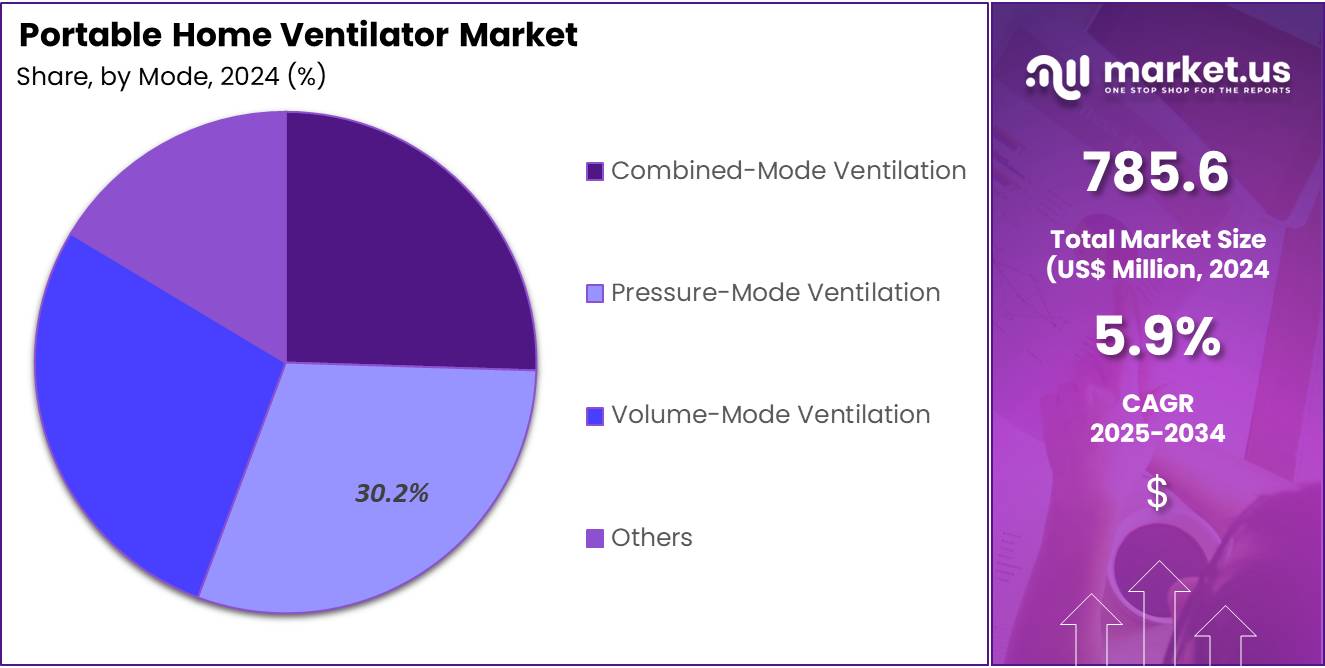
- Considering Mode, the market is divided into Combined-Mode Ventilation, Pressure-Mode Ventilation, Volume-Mode Ventilation and Others. Among these, Pressure-mode ventilation held a significant share of 30.2%.
- Concerning the Application, the Chronic Obstructive Pulmonary Disease (COPD) stands out as the dominant segment, holding the largest revenue share of 50.9% in the Portable Home Ventilator market.
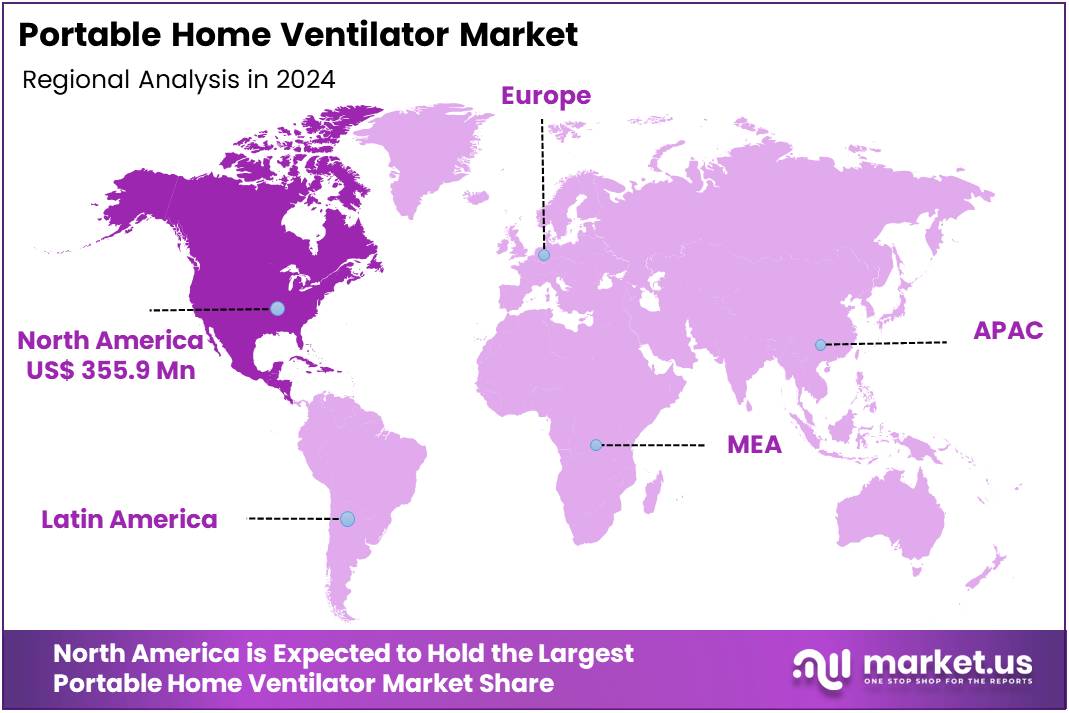
- North America led the market by securing a market share of 45.3% in 2024.
Product Type Analysis
The portable home ventilator market is segmented by product type into invasive and non-invasive ventilators. Non-invasive ventilators hold a dominant 61.4% market share. These ventilators are preferred for their ease of use, comfort, and lower infection risk. Devices like CPAP and BiPAP machines are included in this category. They are primarily used for conditions such as sleep apnea and mild to moderate respiratory diseases.
Non-invasive ventilators are favored for home care due to their portability, quiet operation, and user-friendly design. These features make them ideal for continuous, everyday use without significant disruption to normal life. The convenience and efficiency of non-invasive ventilators continue to drive their popularity in the market.
In May 2022, Max Ventilator launched new multifunctional non-invasive ventilators. These devices come equipped with built-in oxygen therapy and a humidifier, enhancing patient care. According to the company’s press release, these ventilators are designed to be lightweight and easy to use. They offer unique multifunctional capabilities that set them apart in the home healthcare equipment sector.
Mode Analysis
By Mode, Pressure-mode ventilation holds the largest market share of 30.2% due to its suitability for patients with chronic respiratory conditions like COPD. This mode delivers a set pressure to help patients breathe comfortably and is widely preferred for non-invasive ventilation, especially in homecare settings.
Volume-mode ventilation, though less commonly used in home care, is crucial for patients who require precise control over the volume of air delivered, such as those with severe respiratory failure. It’s typically used in more critical care settings but is expanding in home healthcare for patients with long-term needs.
Application Analysis
The portable home ventilator market is segmented by application into Chronic Obstructive Pulmonary Disease (COPD), sleep apnea, asthma, neuromuscular disorders, and others. Chronic Obstructive Pulmonary Disease (COPD) dominates the market with 50.9% due to the high prevalence of COPD worldwide, especially among the aging population and smokers. Portable ventilators are commonly used to manage COPD symptoms and improve quality of life for patients with severe airflow limitations.
According to WHO report published i9n November 2024, Chronic obstructive pulmonary disease (COPD) ranks as the fourth leading cause of death globally, responsible for 3.5 million deaths in 2021, which accounts for about 5% of all global fatalities. Nearly 90% of COPD-related deaths in individuals under 70 occur in low- and middle-income countries (LMICs). In high-income countries, tobacco smoking is the primary contributor, accounting for over 70% of COPD cases. In contrast, in LMICs, tobacco smoking contributes to 30–40% of COPD cases, while household air pollution emerges as a significant risk factor.
Key Market Segments
By Product Type
- Invasive Ventilators
- Non-Invasive Ventilators
By Mode
- Combined-Mode Ventilation
- Pressure-Mode Ventilation
- Volume-Mode Ventilation
- Others
By Application
- Chronic Obstructive Pulmonary Disease (COPD)
- Sleep Apnea
- Asthma
- Neuromuscular Disorders
- Others
Drivers
Rising Prevalence of Respiratory Diseases
The increasing prevalence of chronic respiratory conditions such as COPD, sleep apnea, and asthma is a major driver for the portable home ventilator market. Aging populations, pollution, and lifestyle factors like smoking contribute to the growing burden of these diseases. Portable ventilators offer a convenient and effective solution for managing these conditions at home, reducing hospital visits and improving patient quality of life.
As per the data by NCBI, as of 2019, approximately 454.6 million individuals globally were affected by CRDs, which include chronic obstructive pulmonary disease (COPD), asthma, interstitial lung diseases, and others. This figure reflects a 39.8% increase since 1990. COPD is the most prevalent CRD, with around 212 million cases, while asthma affects approximately 262 million individuals. Projections indicate that by 2050, the global prevalence of COPD could reach around 600 million cases, driven particularly by increases in low- and middle-income countries
Restraints
High Cost of Devices and Limited Reimbursement
The high cost of portable home ventilators and associated accessories can limit market growth, particularly in low- and middle-income countries. Additionally, limited insurance coverage or reimbursement policies for home-based respiratory care devices in some regions acts as a barrier to adoption, making it difficult for patients to afford these life-saving devices.
While some health insurance plans provide coverage for certain types of ventilation therapy, reimbursement policies are often restrictive and may not cover the full cost of the device or associated services. This limits access for patients who need continuous ventilatory support, especially in home care settings. These financial barriers are a key challenge in expanding the market, as they reduce affordability and accessibility for a broader patient base, particularly in lower-income and developing regions.
Opportunities
Technological Advancements and Miniaturization
Innovations in portable ventilator technology, such as miniaturization and battery-powered devices, significantly enhance their portability and ease of use. These advancements also improve patient compliance, making the devices more suitable for home use. Additionally, the incorporation of smart connectivity features facilitates integration with IoT and telehealth platforms, expanding opportunities for remote patient monitoring and management.
In September 2023, VSSC/ISRO launched ‘PRANA’, a low-cost, portable critical care ventilator. PRANA stands for “Programmable Respiratory Assistance for the Needy Aid.” It features automated compression of an AMBU bag and is equipped with an advanced control system. This innovation targets emergency and resource-limited settings, making critical care more accessible.
PRANA is designed with several high-tech components to ensure efficient operation. It includes an airway pressure sensor, flow sensor, oxygen sensor, servo actuator, and valves that control expiration and Positive End-Expiratory Pressure (PEEP). These features collectively enhance the functionality and reliability of the ventilator, providing affordable and effective respiratory support in various clinical environments.
Impact of Macroeconomic / Geopolitical Factors
Macroeconomic and geopolitical factors significantly influence the Portable Home Ventilator Market. Economic stability and healthcare spending directly impact market growth, as higher disposable incomes and government healthcare budgets enable greater access to advanced medical devices. Conversely, economic downturns or inflation can reduce affordability, limiting market expansion.
Geopolitical tensions, trade restrictions, and supply chain disruptions can affect the production and distribution of portable ventilators, leading to shortages or price fluctuations. For instance, the COVID-19 pandemic highlighted vulnerabilities in global supply chains, causing delays in ventilator availability. Additionally, regulatory changes, such as stricter approval processes or intellectual property laws, can shape market dynamics.
Emerging markets, driven by improving healthcare infrastructure and rising awareness, present growth opportunities but are vulnerable to political instability and currency volatility. Government initiatives and funding for home-based healthcare, particularly in developed regions, further boost market growth. Overall, the portable home ventilator market is closely tied to global economic and geopolitical conditions, which can either foster growth or pose challenges for manufacturers and consumers alike.
Trends
Shift Toward Home-Based Healthcare
The shift towards home-based healthcare significantly drives the growth of the portable home ventilator market. With an emphasis on reducing hospital admissions and managing chronic conditions at home, there is a rising demand for medical devices that support home care. Portable home ventilators are crucial in this transition, providing convenience and cost-effectiveness. They enhance patients’ quality of life, particularly those with respiratory disorders.
Technological advancements have made portable ventilators more compact and user-friendly, with capabilities for remote monitoring. This progress supports the trend towards home care, aligning with healthcare systems’ goals to minimize hospital stays. As these devices evolve, they become integral to modern home healthcare solutions, appealing to a broader range of patients and healthcare providers.
Opting for home-based ventilation solutions offers significant benefits, such as reduced healthcare costs and hospital stays. These solutions provide a comfortable and less stressful environment for patients, promoting independence and a better overall patient experience. The trend towards home care continues to grow, with portable home ventilators playing a pivotal role in facilitating effective and efficient care in home settings.
Regional Analysis
North America is leading the Portable Home Ventilator Market
In 2024, North America held a dominant market position, capturing more than a 45.3% share and holds US$ 355.9 Million market value for the year. The Portable Home Ventilator Market exhibits distinct regional dynamics, with North America leading the market due to its advanced healthcare infrastructure, high prevalence of respiratory diseases, and strong adoption of home-based healthcare solutions.
The region benefits from significant healthcare spending, favorable reimbursement policies, and the presence of key market players like Philips Respironics and ResMed. The aging population and rising cases of COPD and sleep apnea further drive demand. Europe follows closely, supported by government initiatives promoting home healthcare and a growing geriatric population.
Asia-Pacific is the fastest-growing region, fueled by increasing healthcare awareness, rising pollution levels, and improving access to medical devices. However, affordability remains a challenge in developing economies. Latin America and the Middle East & Africa show slower growth due to limited healthcare access but present untapped potential.
Key Regions and Countries
- North America
- US
- Canada
- Europe
- Germany
- France
- The UK
- Spain
- Italy
- Russia
- Netherland
- Rest of Europe
- Asia Pacific
- China
- Japan
- South Korea
- India
- Australia
- New Zealand
- Singapore
- Thailand
- Vietnam
- Rest of APAC
- Latin America
- Brazil
- Mexico
- Rest of Latin America
- Middle East & Africa
- South Africa
- Saudi Arabia
- UAE
- Rest of MEA
Key Players Analysis
The portable home ventilator market is dominated by several key players, including Hamilton Medical, Medtronic, and Vyaire. Hamilton Medical leads with its advanced ventilator systems like the Hamilton-T1, which are highly regarded for their quality and versatility. These systems cater to both invasive and non-invasive ventilation needs, making them ideal for home care, especially for patients with chronic respiratory conditions.
Medtronic is another significant player, known for its innovative respiratory solutions such as the PB980 and Puritan Bennett series. These devices are designed to improve patient outcomes by providing both invasive and non-invasive ventilation options. Their focus on ease of use makes them suitable for home-based care, aligning with the needs of patients requiring continuous respiratory support.
Additional prominent companies in the market include Airon Corporation, WEINMANN Emergency, Smiths Medical (now part of ICU Medical, Inc.), and Air Liquide Medical Systems. Together with Dragerwerk AG & Co. KGaA, GE Healthcare, ZOLL Medical Corporation, Koninklijke Philips N.V., and ResMed, these firms contribute to the diverse range of products available. Each company brings unique innovations that enhance the quality of life for patients needing home ventilation.
Recent Developments
- In April 2021, Hamilton Medical launched upgraded version of their most popular ventilators HAMILTON-C1/T1/MR1 withy many improvements and some exciting new features.
- In May 2020, Royal Philips, a global leader in health technology, has announced an increase in the production of key critical care products and solutions to support the diagnosis and treatment of patients affected by the novel coronavirus disease (COVID-19). This move is aimed at meeting the growing demand for healthcare equipment in response to the pandemic. Philips is ramping up the production of hospital ventilators and plans to double production within the next eight weeks and achieve a four-fold increase by the third quarter of 2020.
- In April 2020, Sree Chitra Tirunal Institute for Medical Sciences and Technology (SCTIMST), an institute of National Importance under the Department of Science and Technology, has partnered with Wipro 3D, Bengaluru, to jointly develop a prototype of an emergency ventilator system. This system is based on the Artificial Manual Breathing Unit (AMBU), originally developed by SCTIMST. The collaboration will focus on advancing the prototype through clinical trials and subsequent manufacturing, aiming to enhance the availability of critical care ventilators.
Top Key Players in the Portable Home Ventilator Market
- Hamilton Medical
- Medtronic
- Vyaire
- Airon Corporation
- WEINMANN Emergency Medical Technology GmbH + Co. KG
- Smiths Medical (ICU Medical, Inc.)
- Air Liquide Medical Systems
- Dragerwerk AG & Co. KGaA
- GE HealthCare
- ZOLL Medical Corporation
- Koninklijke Philips N.V.
- ResMed
- Other Key Players