


Report Overview
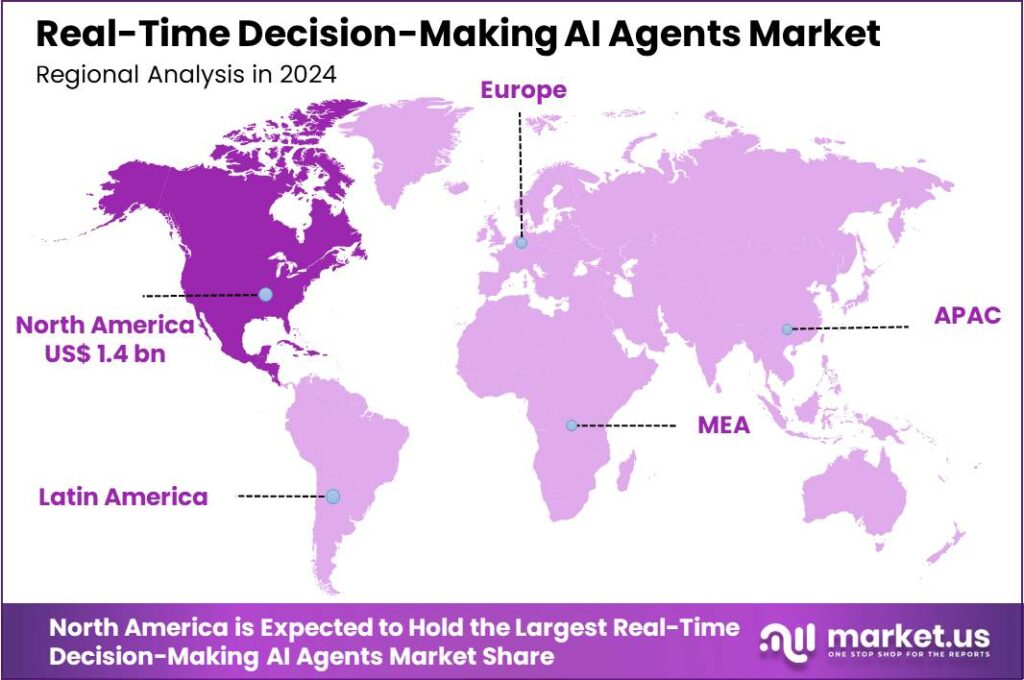
The Global Real-time Decision-Making AI Agents Market size is expected to be worth around USD 144.9 Billion By 2034, from USD 3.6 billion in 2024, growing at a CAGR of 44.7% during the forecast period from 2025 to 2034. In 2024, North America held a dominant market position, capturing more than a 40.2% share, holding USD 1.4 billion revenue.
Real-time decision-making AI agents are advanced systems equipped to process and analyze large volumes of data instantly, enabling immediate and informed decisions without human delay. These agents are embedded in various sectors including customer service, financial trading, and smart manufacturing, where decision speed is critical.
The market for real-time decision-making AI agents is expanding as businesses seek to improve operational efficiencies and response times. The incorporation of AI agents in industries such as e-commerce, telecommunications, and emergency services is driving market growth. This growth can be attributed to the increasing volume of data generated by digital interactions and the need for instant data processing and analysis.
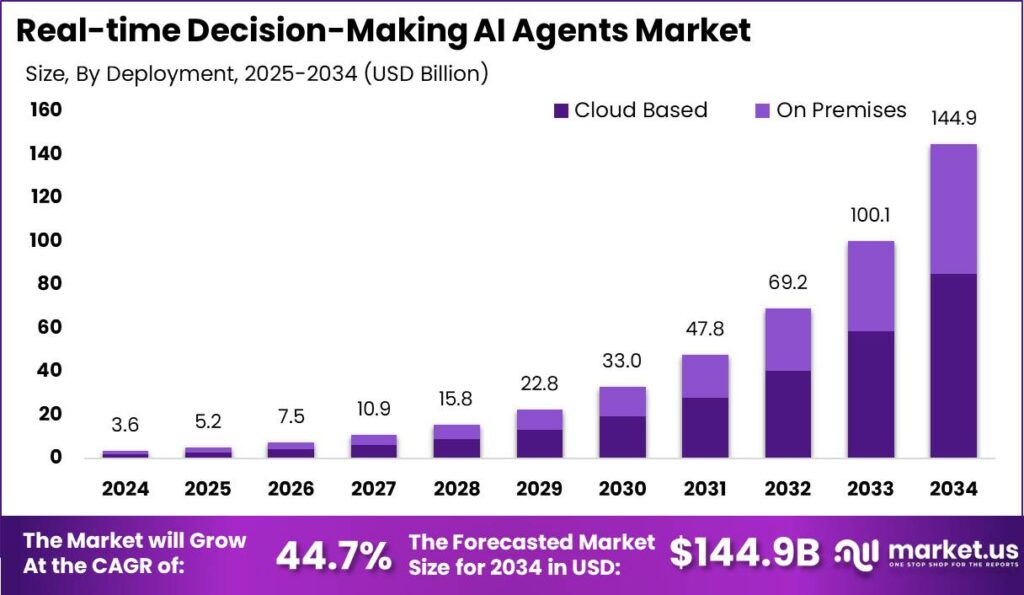
Several factors are propelling the growth of the real-time decision-making AI agents market. The need for operational efficiency and cost reduction, particularly in high-stakes environments like financial services and healthcare, drives businesses towards these technologies. Additionally, the ability of AI agents to scale operations and manage large data sets efficiently without compromising on speed or accuracy is crucial for industries facing voluminous customer interactions or transactions.
Market demand for real-time decision-making AI agents is particularly high in customer service, finance, and healthcare sectors. In customer service, AI agents improve interaction quality and response times, enhancing overall customer satisfaction. In finance, they provide rapid trading decisions and risk assessments, while in healthcare, they assist in patient management and diagnostic processes.
The integration of AI agents in emerging technologies and platforms presents significant opportunities. For instance, their application in IoT and smart devices for home and industrial use is expanding. Additionally, the development of more sophisticated multi-agent systems that can collaborate and learn from each other offers potential for even greater efficiencies and capabilities in handling complex organizational tasks.
Technological advancements are continuously shaping the real-time decision-making AI agents market. The incorporation of Large Language Models (LLMs) like GPT-4 enhances agents’ natural language processing capabilities, making them more intuitive and effective in human-like interactions.
Key Takeaways
- The Global Real-time Decision-Making AI Agents Market is projected to skyrocket from USD 3.6 billion in 2024 to an impressive USD 144.9 billion by 2034. This growth represents a stunning CAGR of 44.7% over the next decade, spanning from 2025 to 2034.
- In the year 2024, North America stood out in the global market, securing a substantial 40.2% share, which translates to revenue of USD 1.4 billion.
- Zooming in on the United States, the market for real-time decision-making AI agents was valued at USD 1.15 billion in 2024. It’s on track for vigorous growth, with a forecasted CAGR of 43.2%.
- Turning our attention to market segments in 2024, the Software segment emerged as a major player, holding a dominant 67.7% share of the market.
- Similarly, the Cloud Based deployment option also claimed a significant portion of the market, capturing 58.8%.
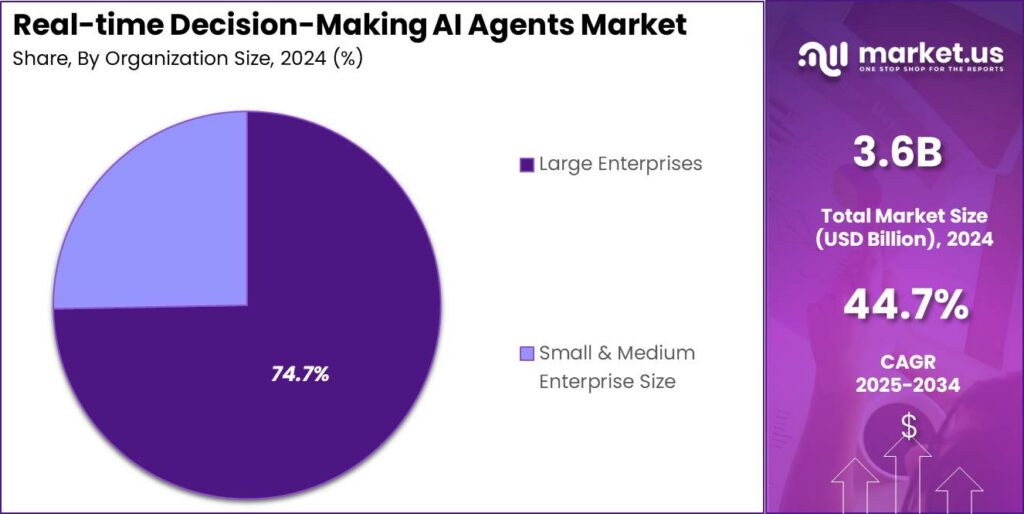
- Looking at enterprise size, Large Enterprises were the main adopters, dominating the market with a 74.7% share.
- Lastly, the Banking, Financial Services, and Insurance (BFSI) sector was a major contributor in the realm of real-time decision-making AI agents, grabbing a 32.6% share of the market.
U.S. Market Size and Growth
The U.S. market for real-time decision-making AI agents was valued at USD 1.15 billion in 2024 and is expected to experience a robust growth, with a compound annual growth rate (CAGR) of 43.2%. This growth trajectory places the U.S. at the forefront of the AI agents market, primarily due to the significant technological advancements and substantial investments in AI technologies by major U.S. firms.
The dominance of the U.S. in this market segment can be attributed to several key factors. Firstly, the presence of major technology leaders like Google, Microsoft, and IBM, which continuously innovate and expand their AI capabilities, significantly contributes to the market’s expansion.
Furthermore, the U.S. benefits from a highly developed technological infrastructure, which facilitates the rapid adoption and implementation of AI solutions across various sectors including healthcare, finance, and customer service. Additionally, the U.S. market is bolstered by the enterprise sector’s strong adoption of AI for improving operational efficiencies and decision-making processes.
The demand for AI agents in customer service to handle vast volumes of interactions and enhance the customer experience is notably high, which in turn drives market growth. Advanced AI algorithms are being increasingly utilized to personalize customer interactions and improve service delivery, underscoring their value in the competitive U.S. market.
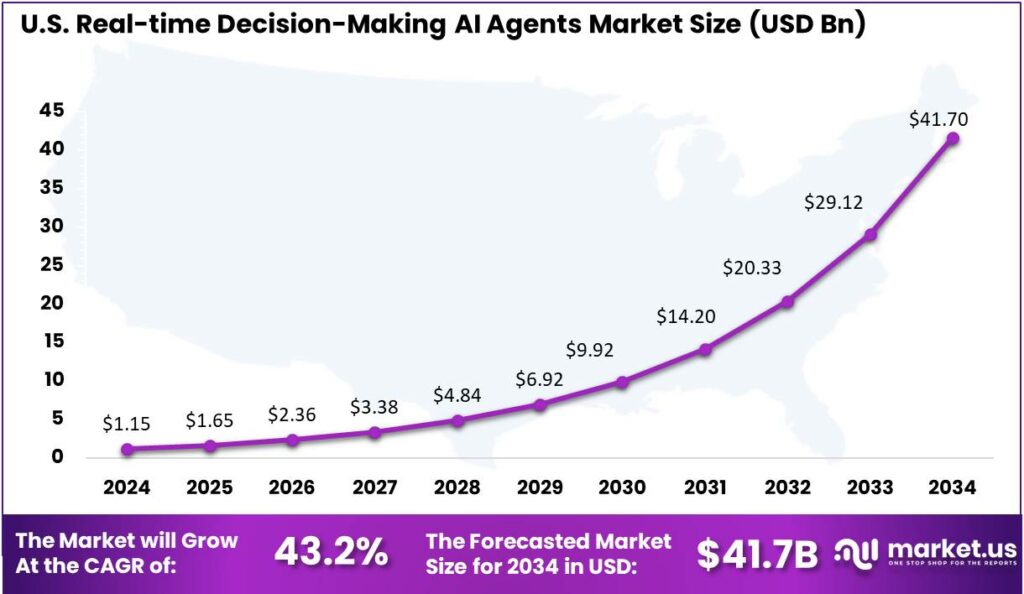
In 2024, North America held a dominant market position in the real-time decision-making AI agents sector, capturing more than a 40.2% share with USD 1.4 billion in revenue. This leadership can be attributed to several strategic and technological factors.
North America, particularly the United States, houses a concentration of major technology companies, such as Google, IBM, and Microsoft, which are at the forefront of AI research and development. These companies not only contribute to the innovation within the region but also drive the implementation of AI solutions across various industries including finance, healthcare, and customer service.
The region’s advanced technological infrastructure supports the widespread deployment and integration of AI technologies. This is further enhanced by a robust investment in AI from both public and private sectors, aiming to maintain a competitive edge in global markets. Additionally, the regulatory environment in North America generally supports technological innovation, with policies that encourage research and development in AI.
Solution Analysis
In 2024, the Software segment held a dominant market position in the real-time decision-making AI agents landscape, capturing more than a 67.7% share. This leading stance can be attributed to the essential role that software plays in the functionality and deployment of AI agents across various industries.
Software solutions provide the core intelligence and operational capabilities that enable AI agents to automate tasks, process data in real-time, and deliver personalized services efficiently. Software’s prominence in the market is reinforced by its ability to integrate seamlessly with existing IT infrastructure, allowing businesses to enhance their operations without substantial initial investments in new hardware.
The adaptability and scalability offered by software-based AI agents are crucial for organizations looking to leverage real-time data analytics and decision-making capabilities. Moreover, the software enables continuous updates and improvements, which are vital in keeping pace with evolving business needs and technological advancements.
Furthermore, the demand for hyper-personalized digital experiences and the integration of AI into enterprise business process automation are significant drivers boosting the adoption of software solutions. Enterprises are increasingly relying on AI agent software to improve operational efficiency, reduce costs, and enhance customer engagement by automating and optimizing a wide range of processes.
Deployment Analysis
In 2024, the Cloud Based segment held a dominant market position in the real-time decision-making AI agents market, capturing more than a 58.8% share. This dominance is largely due to the cloud’s ability to provide scalable, flexible, and cost-effective solutions for deploying AI technologies.
Cloud-based platforms allow businesses of all sizes to leverage advanced AI capabilities without the substantial upfront investment typically associated with on-premises installations. This accessibility has made it particularly attractive to small and medium-sized enterprises looking to adopt AI without significant capital expenditure.
The superiority of the cloud-based deployment model is further underscored by its inherent advantages in speed and innovation. Companies using cloud services can deploy and iterate their AI solutions more quickly than those reliant on on-premises infrastructure, facilitating faster adaptation to market changes and technological advancements.
Additionally, the cloud offers a robust environment for handling the extensive data processing required by AI agents, providing the necessary computing power to analyze large datasets in real time. Moreover, the global shift towards digital transformation initiatives across industries has propelled the adoption of cloud-based solutions.
Businesses are increasingly relying on cloud platforms to enhance their operational efficiencies and to integrate AI into their processes seamlessly. The trend towards remote working models has also played a significant role, with cloud-based AI agents enabling better collaboration and data accessibility regardless of geographical locations.
Enterprise Size Analysis
In 2024, the Large Enterprises segment held a dominant market position in the real-time decision-making AI agents market, capturing more than a 74.7% share. This dominance is largely attributable to the substantial resources large enterprises possess, which allow them to invest in advanced AI technologies and infrastructure that small and medium-sized enterprises (SMEs) may find cost-prohibitive.
Large enterprises typically have the capacity to implement comprehensive AI systems that integrate with various aspects of their operations, from customer service and human resources to supply chain management and data analytics. Furthermore, large enterprises often operate in highly competitive and regulated industries where the ability to make quick, data-driven decisions is a critical advantage.
The use of real-time decision-making AI agents enables these companies to process and analyze large datasets swiftly, leading to faster and more informed decision-making processes. This capability is crucial for maintaining a competitive edge and adapting to rapidly changing market conditions.
The scale of operations in large enterprises also necessitates robust systems that can handle complex, voluminous tasks simultaneously, which AI agents are well-equipped to manage. The adoption of AI technologies in these organizations not only drives efficiency and cost savings but also enhances the accuracy and reliability of the operations, minimizing human error in critical processes.
Industry Analysis
In 2024, the Banking, Financial Services and Insurance (BFSI) segment held a dominant market position in the real-time decision-making AI agents market, capturing more than a 32.6% share. This leadership is primarily driven by the sector’s high demand for precision, security, and real-time processing capabilities in financial transactions and risk management.
BFSI organizations leverage AI agents to enhance their fraud detection systems, personalize customer service, and automate routine tasks such as claims processing and customer onboarding, significantly improving efficiency and customer satisfaction. The robust adoption of AI agents in BFSI is also motivated by the need to comply with stringent regulatory requirements.
AI agents assist in ensuring compliance by continuously monitoring transactions and customer interactions to detect and report anomalies that may indicate compliance failures or fraudulent activities. This capability is vital in an industry where failure to adhere to legal standards can result in hefty penalties and reputational damage.
Additionally, the integration of AI technologies helps financial institutions gain a competitive edge by providing them with capabilities to analyze large volumes of data to uncover insights into customer behavior, market trends, and potential risks. This data-driven approach enables more informed decision-making, better risk management, and tailored financial products that meet the evolving needs of customers.
Overall, the BFSI sector’s focus on innovation, security, and customer-centric services, combined with the advanced capabilities of AI agents, underscores its leading position in the market. This trend is expected to continue as more financial institutions recognize the benefits of real-time decision-making AI technologies in enhancing operational efficiencies and boosting customer engagement.
Key Market Segments
By Solution
- Software
- Services
- Implementation & Integration
- Consulting & Training Services
- Support & Maintenance Services
By Deployment
- Cloud Based
- On Premises
By Enterprise Size
- Small & Medium Enterprise Size (SMEs)
- Large Enterprises
By Industry
- Banking, Financial Services and Insurance (BFSI)
- Automotive
- Healthcare
- Retail & E-commerce
- IT & Telecom
- Aerospace & Defence
- Others (Utilities, Media & Entertainment))
Driver
Accelerated Deployment of AI in Strategic Decision-Making
The integration of AI in real-time decision-making is increasingly driven by its ability to process vast amounts of data rapidly, offering actionable insights that are crucial in strategic contexts. This capability is essential for industries like finance, defense, and healthcare, where decisions need to be both quick and informed.
The acceleration of AI deployment in decision-making processes is transforming these sectors by enabling them to respond more effectively to dynamic market conditions and complex challenges. As AI continues to evolve, its role in strategic decision-making is expanding, providing significant competitive advantages and operational efficiencies to organizations that adopt it.
Restraint
Complexity and Opacity of AI Systems
One of the primary restraints in the adoption of real-time decision-making AI agents is their complexity and the opaque nature of their operational mechanisms. Often referred to as “black box” systems, AI agents can be difficult to interpret and trust, especially in sectors where transparency and accountability are critical, such as healthcare and finance.
The inability to easily understand or predict the decision-making process of AI systems can hinder their acceptance and raise ethical concerns. Ensuring that AI systems are interpretable and their actions justifiable remains a significant challenge, impacting the broader deployment and trust in AI technologies.
Opportunity
AI in Enhancing Customer Interaction and Business Processes
AI presents vast opportunities for enhancing customer interaction and optimizing business processes. By automating routine tasks, AI agents free up human resources to focus on more complex and creative tasks, thereby improving efficiency and productivity. In customer-facing roles, AI can deliver personalized experiences and respond to customer needs in real-time, significantly enhancing customer satisfaction.
For businesses, the use of AI in areas like marketing, supply chain management, and cybersecurity can drive substantial ROI, making operations more agile and responsive to market demands. The potential for AI to transform a wide range of business functions suggests continued growth and innovation in this technology.
Challenge
Ethical Concerns and Security Risks
The widespread use of AI in real-time decision-making also presents several challenges, particularly in terms of ethics and security. AI systems, if not properly managed, can perpetuate biases and make decisions that may inadvertently harm individuals or groups. Moreover, as AI agents become more embedded in critical infrastructure, the potential for security vulnerabilities increases.
Ensuring that AI systems are both ethical and secure requires continuous effort in terms of developing robust security measures, conducting fairness audits, and implementing transparent operational procedures. Addressing these challenges is crucial for maintaining trust in AI technologies and for the responsible scaling of AI applications across industries.
Growth Factors
The proliferation of real-time decision-making AI agents is primarily fueled by the increasing need for efficiency and speed in data processing across various industries. As businesses face more complex and dynamic operational challenges, the demand for AI agents capable of real-time analytics and decision-making has surged.
These agents provide crucial advantages by enabling organizations to handle large volumes of data more effectively, making instantaneous decisions that are critical in sectors such as finance, healthcare, and customer service. The integration of AI with emerging technologies like IoT enhances their capability to perform at scale, further driving their adoption.
Emerging Trends
Emerging trends in real-time decision-making AI agents include the increased integration with IoT devices, enhancing the automation and data analysis capabilities across smart homes, offices, and cities. Furthermore, the development of AI agent frameworks and tools has democratized the use of AI, enabling even those without a technical background to deploy AI solutions.
Ethical AI and transparency in decision-making are becoming focal points, with businesses increasingly prioritizing frameworks that ensure fairness and accountability. This shift is crucial as AI agents take on more integral roles in decision-making processes, particularly in sensitive areas like finance and healthcare.
Key Benefits for Stakeholders
The deployment of real-time decision-making AI agents offers manifold benefits to stakeholders across all levels of operation. These benefits include enhanced operational efficiency, as AI agents automate routine tasks and optimize decision-making processes, allowing human employees to focus on more strategic activities.
In customer-facing roles, AI agents provide personalized experiences and respond swiftly to customer inquiries, significantly enhancing satisfaction and loyalty. For businesses, the real-time insights offered by AI agents facilitate more informed decision-making, leading to improved business outcomes and competitive advantages.
Key Regions and Countries
- North America
- US
- Canada
- Europe
- Germany
- France
- The UK
- Spain
- Italy
- Rest of Europe
- Asia Pacific
- China
- Japan
- South Korea
- India
- Australia
- Singapore
- Rest of Asia Pacific
- Latin America
- Brazil
- Mexico
- Rest of Latin America
- Middle East & Africa
- South Africa
- Saudi Arabia
- UAE
- Rest of MEA
Key Player Analysis
Key Players Analysis in the context of Real-Time Decision-Making AI Agents involves evaluating the major companies that are influencing and shaping the market for AI technologies focused on making immediate decisions. These companies develop, innovate, and distribute solutions that leverage artificial intelligence to analyze data in real time and facilitate rapid, informed decision-making processes in various industries such as customer service, sales, tech support, and more.
Sparkout Tech has solidified its position as a top player in AI agent development by focusing on multi-agent systems and customized AI solutions across industries like healthcare, e-commerce, and defense. In 2024, the company launched a groundbreaking AI agent framework that integrates predictive analytics and reinforcement learning with human feedback.
Abacus.ai has emerged as a leader with its cutting-edge real-time AI/ML solutions. In 2024, the company introduced a new platform that allows seamless deployment of AI agents for business intelligence and operational efficiency. This product was designed to cater to industries requiring instant data-driven decision-making.
Moogle Labs has gained recognition for its affordable yet high-quality AI agent development services. In 2024, the company launched an advanced chatbot platform powered by generative AI and multi-agent systems, aimed at improving decision-making capabilities for small and medium-sized businesses.
Top Key Players in the Market
- Observe.AI
- Cresta
- Salesforce, Inc.
- NVIDIA Corporation
- Microsoft Corporation
- SAP SE
- Cisco Technology Inc.
- DIALPAD, INC.
- Creovai
- Convin AI
- Others
Recent Developments
- In January 2025, NVIDIA enhanced its Omniverse platform to improve real-time decision-making capabilities in industries like healthcare, gaming, and autonomous vehicles. The updates integrate advanced AI frameworks like TensorRT and CUDA to support complex decision-making tasks.
- In January 2025, Cisco acquired Creovai to strengthen its AI agent capabilities for network automation and real-time data processing. This acquisition aims to enhance Cisco’s ability to deliver intelligent systems for enterprise IT operations
- In December 2024, Microsoft introduced new features in Azure AI to bolster real-time analytics and decision-making for enterprises. These updates include improved large language model (LLM) integration and predictive analytics tools for supply chain management and customer service.
- In November 2024, SAP announced the integration of generative AI into its business suite, enabling automated decision-making for HR, finance, and logistics. This includes predictive analytics tools that optimize workflows and reduce operational costs.

- 蓝茶市场(2026—2031)
0评论2026-09-15

- 泡沫材料市场(2026—2031)
0评论2026-09-15

- 重铬酸钠市场(2026—2031)
0评论2026-09-15

- 家族性淀粉样多发性神经病(FAP)市场(2026—2031)
0评论2026-09-15

- 次氯酸钙市场(2026—2031)
0评论2026-09-15

- 海上储能市场(2026—2031)
0评论2026-09-12

- 混凝土市场(2026—2031)
0评论2026-09-12

- 矫形器械市场(2026—2031)
0评论2026-09-12

- 木质素基树脂市场(2026—2031)
0评论2026-09-12

- 聚碳酸酯二元醇市场(2026—2031)
0评论2026-09-12