


Report Overview
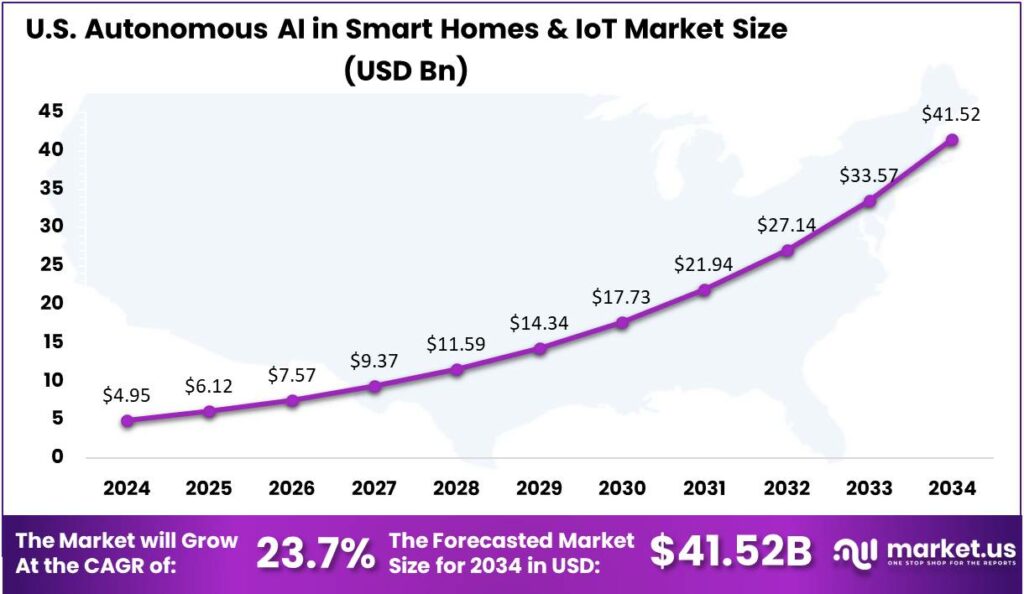
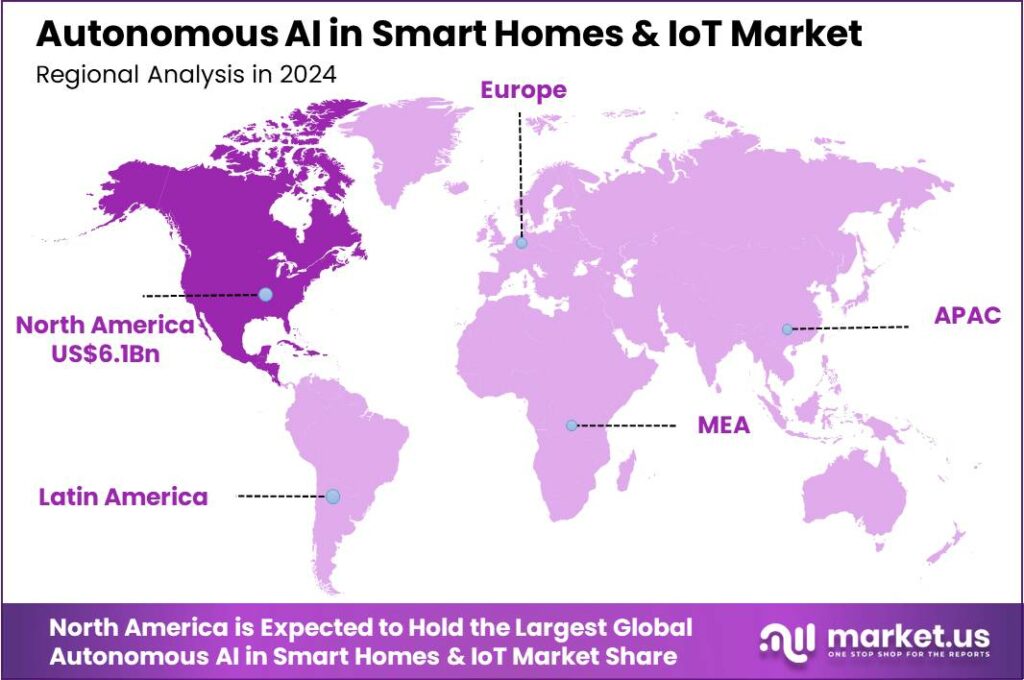
The Global Autonomous AI in Smart Homes & IoT Market is expected to be worth around USD 138.7Billion By 2034, from USD 14.2 Billion in 2024, growing at a CAGR of 25.60% during the forecast period from 2025 to 2034. In 2024, North America led the Autonomous AI in Smart Homes and IoT market, holding over 43.6% of the global share with a revenue of around USD 6.1 billion. The U.S. market was valued at $4.95 billion in 2024, is projected to grow at a 23.7% CAGR.
Autonomous AI in smart homes and IoT refers to the integration of advanced artificial intelligence systems within connected devices, enabling them to operate independently, adapt to users preferences and make real-time decisions without human intervention. By blending advanced AI capabilities with IoT devices, smart homes are becoming increasingly intuitive, efficient, and responsive to the needs of their occupants.
The market for autonomous AI in smart homes and IoT is expanding rapidly as consumers seek more convenience, energy efficiency, and enhanced security in their living environments. It is driven by the increasing availability of smart devices that can connect seamlessly, creating a network of interactive and self-managing appliances and systems.
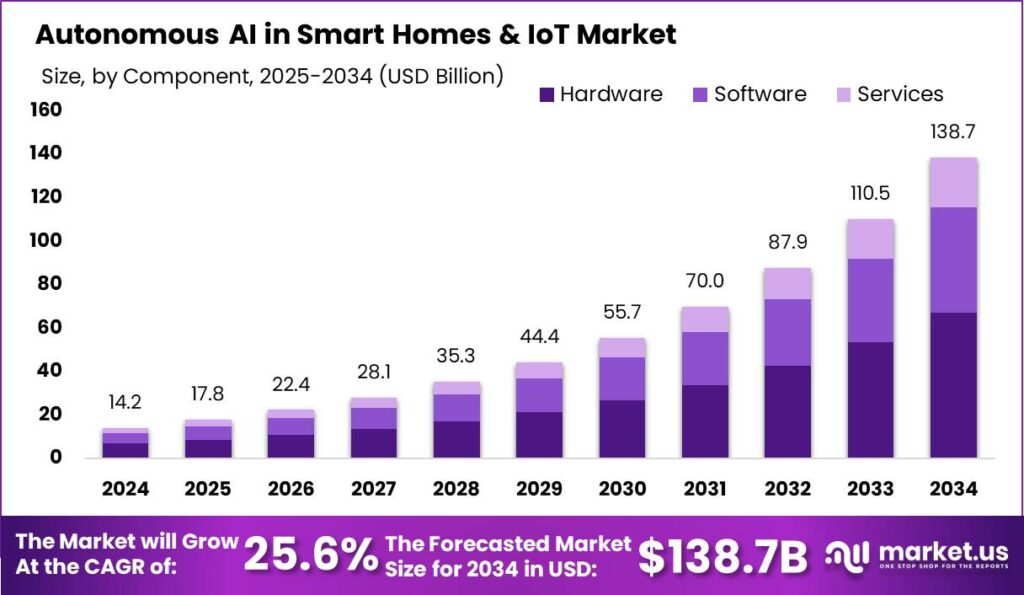
The growth of autonomous AI in smart homes and IoT is driven by advancements in AI algorithms and machine learning, making devices more intuitive and personalized. The widespread use of smartphones and voice assistants like Alexa and Google Assistant has increased demand for interconnected devices, as consumers embrace using technology to control home environments and security systems.
Rising concerns about energy efficiency and sustainability are driving the adoption of AI-powered solutions for optimizing energy use in smart homes and commercial IoT applications. The rollout of 5G networks enables faster, more reliable connections, supporting real-time data processing and enhancing AI integration, which accelerates IoT capabilities and adoption.
A notable trend is the rise of AI-powered voice interfaces, which are becoming central to smart home ecosystems. These voice-activated systems manage devices, while AI-driven analytics adjust settings based on preferences. IoT-integrated health-monitoring features track vital metrics and alert users or caregivers to potential health concerns.
Technological advancements are driving the smart home and IoT revolution, with AI-powered home hubs taking center stage as command centers. These hubs integrate data from devices like security systems and thermostats, using AI for optimization. Edge computing allows local decision-making, reducing cloud reliance and minimizing latency for faster responses, like adjusting security or turning off lights when not in use.
Key Takeaways
- The Global Autonomous AI in Smart Homes & IoT Market is projected to grow from USD 14.2 Billion in 2024 to USD 138.7 Billion by 2034, reflecting a CAGR of 25.60% during the forecast period from 2025 to 2034.
- In 2024, the Hardware segment dominated the market, holding more than 48.5% of the market share in the Autonomous AI in Smart Homes & IoT sector.
- The Machine Learning (ML) segment also held a dominant position in 2024, capturing more than 28.9% of the overall market share within the autonomous AI-driven smart homes and IoT industry.
- The Voice Assistance & Command Recognition segment led the market in 2024, with a dominant share of more than 24.7% in the Autonomous AI in Smart Homes & IoT market.
- In 2024, the Wireless Protocols segment held a leading position, capturing over 60.6% of the total market share in the Autonomous AI in Smart Homes and IoT market.
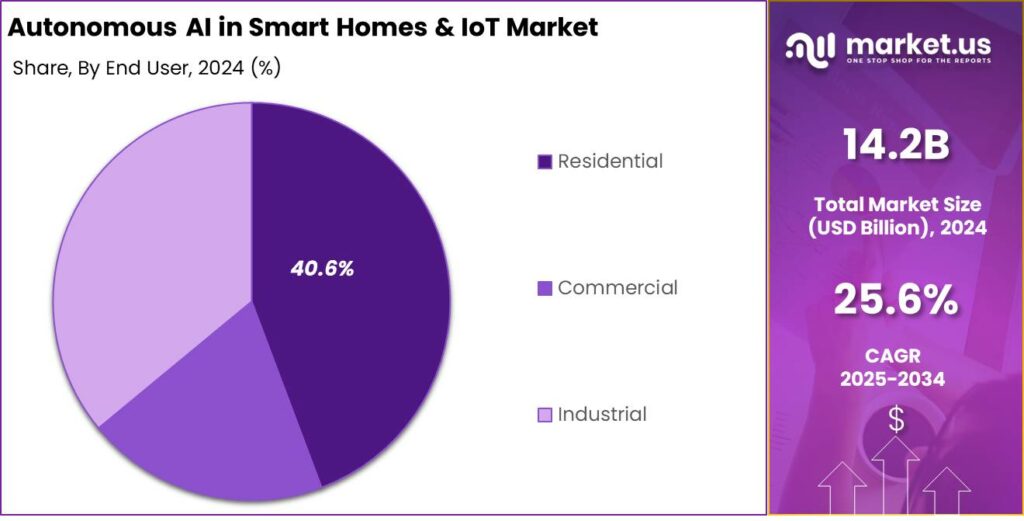
- The Residential segment maintained a dominant position in 2024, accounting for more than 40.6% of the total market share within the Autonomous AI in Smart Homes and IoT sector.
- In 2024, North America dominated the Autonomous AI in Smart Homes and IoT market, capturing more than 43.6% of the global share, equating to a revenue of approximately USD 6.1 billion.
- The U.S. Autonomous AI in Smart Homes & IoT market was valued at USD 4.95 billion in 2024, with a projected CAGR of 23.7%.
U.S. Market Size and Growth
The U.S. market for Autonomous AI in Smart Homes and the Internet of Things (IoT) is expected to reach a valuation of $4.95 billion by 2024, marking a significant milestone in its growth trajectory. This market is poised for rapid expansion, with projections indicating a compound annual growth rate (CAGR) of 23.7%.
As autonomous AI continues to evolve, its integration into smart homes and IoT ecosystems is expected to unlock new levels of functionality. Devices like voice assistants, smart thermostats, lighting systems, and security solutions are becoming increasingly intelligent, with the ability to learn user preferences, adapt to environmental changes, and make real-time decisions.
Moreover, the market growth is fueled by rising consumer interest in energy-efficient solutions, the growing need for home security, and a shift towards more personalized, data-driven home experiences. As more households adopt these technologies, the U.S. market for autonomous AI-driven smart homes and IoT will likely continue its rapid expansion, benefiting from innovation across hardware, software, and connectivity solutions.
In 2024, North America held a dominant market position in the Autonomous AI in Smart Homes and IoT market, capturing more than 43.6% of the global share, which equates to a revenue of approximately USD6.1 billion. This market leadership is driven by high technological adoption, a large consumer base, and the presence of leading tech companies.
North America, especially the U.S., leads in AI innovation and smart home integration, with major companies advancing AI development, IoT connectivity, and smart devices. This has fueled growing demand for autonomous AI solutions in both residential and commercial sectors.
The rapid adoption of smart home technologies in North America is driven by consumer preferences for convenience, energy efficiency, and security. With widespread availability of high-speed internet and a high penetration of smartphones and connected devices, the region is highly conducive to the growth of autonomous AI-powered ecosystems.
Increasing concerns about home security, a demand for personalized, data-driven experiences, and a growing focus on sustainability are driving IoT device adoption in North American households. Consumers and businesses are seeking energy-efficient solutions to reduce utility costs and carbon footprints, fueling the market for AI-enabled smart technologies.
Component Analysis
In 2024, the Hardware segment held a dominant market position, capturing more than a 48.5% share in the Autonomous AI in Smart Homes & IoT Market.This growth is driven by rising consumer demand for physical smart devices, such as smart speakers, thermostats, lighting systems, and security cameras, which form the foundation of AI-powered smart homes.
As these hardware devices become more affordable, accessible, and user-friendly, their adoption has surged across various demographic groups. Smart speakers, such as Amazon Echo and Google Home, remain key players in driving this segment, offering voice-controlled convenience while integrating seamlessly with other home automation devices.
The hardware segment leads due to growing consumer demand for smart, energy-efficient, interconnected devices. Innovations in sensors, processors, and wireless tech enable advanced features, enhancing daily life and providing valuable data for AI optimization, driving further demand for smart hardware.
The growth of the IoT ecosystem, coupled with advancements like 5G, is driving more hardware devices into the market. These technologies make IoT-connected devices faster and more reliable, solidifying hardware’s role in the autonomous AI ecosystem. Companies are investing in smarter, more integrated devices, boosting their market position in 2024 and beyond.
Technology Analysis
In 2024, the Machine Learning (ML) segment held a dominant market position, capturing more than 28.9% of the overall market share in the autonomous AI-driven smart homes and IoT industry. The primary reason for ML’s leading position is its ability to continuously learn and adapt based on data, allowing it to optimize various functions within smart homes.
Machine Learning enables devices to predict user preferences, automate daily tasks, and adjust settings dynamically. This level of adaptability is crucial for enhancing convenience, reducing energy consumption, and providing personalized experiences, which are key selling points for consumers in the smart home market.
Furthermore, the versatility of ML in smart home devices contributes significantly to its dominance. From energy management systems that learn optimal heating or cooling patterns to security systems that identify and respond to potential threats, ML can be applied across a wide range of applications.
The advancement of ML algorithms, particularly deep learning and neural networks, is driving growth in this segment. These technologies enable processing complex data patterns, unlocking advanced features like facial recognition, predictive maintenance, and accurate energy forecasts.
Application Analysis
In 2024, the Voice Assistance & Command Recognition segment held a dominant market position in the Autonomous AI in Smart Homes & IoT market, capturing more than 24.7% of the overall share.
This leadership can be attributed to the widespread adoption of voice-controlled AI assistants such as Amazon Alexa, Google Assistant, and Apple’s Siri. These voice-powered devices have become integral to everyday life, allowing users to control their smart home systems, manage daily tasks, and access information hands-free.
One of the primary reasons for the dominance of this segment is the increasing reliance on voice assistants as a central hub for managing other IoT devices within the home. Voice recognition has become the simplest and most efficient method for controlling smart devices, including thermostats, lighting systems, security cameras, and home appliances.
The segment’s growth is fueled by advancements in AI-powered voice recognition, making it more accurate and adaptable to various accents and environments. As voice assistants improve, they can handle complex tasks like scheduling, offering personalized recommendations, and controlling more smart home devices.
Connectivity Analysis
In 2024, the Wireless Protocols segment held a dominant market position in the Autonomous AI in Smart Homes and IoT market, capturing more than 60.6% of the total market share. This leadership can be attributed to the widespread adoption of wireless technologies that offer significant advantages in terms of flexibility, scalability, and ease of installation.
The convenience of wireless communication also enables seamless integration of a wide variety of smart devices in homes and businesses, facilitating the smooth operation of IoT ecosystems. Wireless protocols such as Wi-Fi provide high-speed internet connectivity, making them ideal for applications like smart home assistants, security cameras, and connected appliances.
Moreover, the growing trend towards connected homes and the increasing adoption of Internet of Things (IoT) devices have fueled the expansion of wireless protocols in this space. Cellular networks, particularly with the rollout of 5G, have further boosted the segment, enabling even greater speeds and connectivity range for smart home solutions.
Compared to wired protocols, wireless technologies offer far more flexibility in device placement, without the need for physical cables, which is a major advantage in modern smart home designs. This ease of deployment and the broad ecosystem of devices supported by wireless protocols are central factors in why this segment dominates the market.
End User Analysis
In 2024, the Residential segment held a dominant market position in the Autonomous AI in Smart Homes and IoT market, capturing more than 40.6% of the total market share. This dominance can largely be attributed to the rapid rise in consumer demand for smart home technologies that enhance comfort, convenience, and energy efficiency.
One of the key factors propelling the growth of the residential segment is the growing interest in home automation, supported by the increasing availability and affordability of smart devices. Consumers are increasingly looking for solutions that allow them to control their homes remotely, whether it’s adjusting the thermostat, locking doors, or monitoring security cameras.
Additionally, the residential sector is benefiting from the ongoing trend of home improvement and renovation projects, where smart home solutions are becoming a central part of modern living. The COVID-19 pandemic has also played a role in accelerating interest in smart homes, as people spend more time at home and seek ways to improve their living environments.
The residential market, with its larger consumer base, offers greater scalability and faster adoption of AI-driven smart home technologies compared to the commercial and industrial sectors. Advancements in AI and IoT have also made these solutions more accessible, with user-friendly and intuitive products and platforms.
Key Market Segments
By Component
- Hardware
- Smart Speakers
- Thermostats
- Lighting Systems
- Cameras
- Others
- Software
- Services
- Implementation & Integration Services
- Consulting & Training
- Support & Maintenance
By Technology
- Machine Learning (ML)
- Natural Language Processing (NLP)
- Computer Vision
- Predictive Analytics
- Others
By Application
- Voice Assistance & Command Recognition
- Security & Surveillance
- Energy Management
- Healthcare & Assisted Living
- Entertainment & Ambient Intelligence
- Others
By Connectivity
- Wireless Protocols
Wi-Fi
Bluetooth/Zigbee
Cellular - Wired Protocols
By End User
- Residential
- Commercial
- Industrial
Key Regions and Countries
- North America
- US
- Canada
- Europe
- Germany
- France
- The UK
- Spain
- Italy
- Rest of Europe
- Asia Pacific
- China
- Japan
- South Korea
- India
- Australia
- Singapore
- Rest of Asia Pacific
- Latin America
- Brazil
- Mexico
- Rest of Latin America
- Middle East & Africa
- South Africa
- Saudi Arabia
- UAE
- Rest of MEA
Driver
Increased Consumer Demand for Convenience and Efficiency
One of the key drivers for the adoption of Autonomous AI in smart homes and IoT is the growing consumer demand for convenience and efficiency. People are increasingly looking for ways to streamline their daily routines, save time, and reduce energy consumption. Autonomous AI systems in smart homes can automate tasks like adjusting lighting, temperature, and security settings without the need for manual input.
AI-enabled devices can learn individual preferences and make automatic adjustments based on patterns of behavior. This boosts convenience and energy efficiency by optimizing heating and cooling, potentially lowering utility costs. As people become more tech-savvy, the demand for AI-powered smart homes grows.
Restraint
Privacy and Security Concerns
A significant restraint holding back the widespread adoption of Autonomous AI in smart homes and IoT is the concern over privacy and security. As smart home devices become more prevalent, they collect extensive personal data, including activity patterns, location, and voice recordings. This raises concerns among consumers about the potential misuse or hacking of such sensitive information, which could lead to identity theft or unauthorized surveillance.
With the increasing use of AI to control devices like security cameras, smart locks, and home assistants, the risk of cyberattacks and data breaches becomes more prominent. Despite advancements in cybersecurity, many individuals remain apprehensive about allowing AI to manage their homes, fearing that hackers could exploit vulnerabilities.
Opportunity
Integration with Renewable Energy Sources
One of the most promising opportunities for Autonomous AI in smart homes is its potential integration with renewable energy sources. As the world transitions towards more sustainable energy solutions, there is a growing demand for technologies that can help optimize energy usage and reduce reliance on non-renewable resources.
Autonomous AI systems can enhance the efficiency of homes powered by renewable energy sources like solar panels and wind turbines. AI analyzes real-time data, such as sunlight and wind conditions, to optimize energy consumption, maximizing renewable energy use while reducing grid reliance. It can also manage energy storage, storing excess power in batteries or selling it back to the grid when needed. This integration promotes a more sustainable and eco-friendly home environment.
Challenge
High Initial Setup Costs
One of the major challenges for adopting Autonomous AI in smart homes is the high initial setup cost. While the technology offers long-term savings and enhanced convenience, the upfront expense of purchasing AI-powered smart devices and installing them can be significant. Many households are discouraged from upgrading to a fully integrated AI system due to the high costs of smart appliances, sensors, and installation.
Furthermore, the complexity of setting up and configuring these devices may require professional assistance, adding to the overall expense. While the costs of individual smart devices have been decreasing over time, the need for a wide array of interconnected devices, along with the technology infrastructure to support them, still makes the transition to a fully autonomous home expensive.
Emerging Trends
Autonomous AI enables devices to not only respond to commands but also to learn from user behavior, anticipate needs, and perform tasks without explicit instructions. For example, AI can optimize energy consumption by learning the user’s daily routines and adjusting heating, lighting, and appliances accordingly.
Smart thermostats, lights, security cameras, and voice assistants are increasingly interconnected, allowing them to function as part of a cohesive, automated system. AI systems can identify patterns in data collected from these devices, making real-time adjustments based on user preferences or even external factors like weather or time of day.
AI-powered virtual assistants are getting more advanced, understanding natural language and offering contextual suggestions, like adjusting the thermostat, locking doors, or recommending recipes based on available ingredients.
Business Benefits
- Cost Savings: Autonomous AI helps businesses reduce costs by optimizing energy consumption. Smart thermostats, lights, and appliances learn patterns of usage and adjust automatically to save energy. Over time, this leads to lower electricity bills and reduced operational costs.
- Increased Property Value: Homes and businesses equipped with smart technology powered by AI tend to have higher resale values. Potential buyers are attracted to the convenience, security, and energy efficiency of smart systems, making these properties more desirable in the market.
- Better Customer Experience: AI in smart homes creates a more personalized experience by learning individual preferences. Whether it’s adjusting lighting, music, or the temperature, AI ensures the environment feels just right for each user, increasing satisfaction and loyalty.
- Remote Control & Monitoring: With AI-powered IoT devices, business owners and homeowners can control and monitor their homes remotely. This is especially useful for property management businesses that need to keep an eye on multiple locations without physically being there.
- Streamlined Operations: Businesses using autonomous AI for smart homes and IoT devices can create a more streamlined, automated environment. For example, inventory management systems, HVAC controls, and lighting can all be optimized without constant human intervention.
Key Player Analysis
The market for Autonomous AI in smart homes and IoT is increasingly competitive, with several major players taking the lead in innovation and adoption.
Samsung is a prominent player in the smart home and IoT sectors, driving the development of advanced autonomous AI solutions. Their AI-powered platform, SmartThings, integrates a wide variety of devices, from appliances to security systems.
Amazon Web Services (AWS) plays a crucial role in the smart home and IoT market by offering cloud-based solutions that power the backend infrastructure for many autonomous systems. AWS provides the necessary computing power and machine learning tools that enable IoT devices to operate efficiently and make real-time decisions.
Google LLC, with its powerful AI capabilities, is another key player revolutionizing the smart home space. Google Assistant, the company’s voice-activated AI platform, is at the heart of its smart home offerings. Google has also expanded into hardware with devices like Google Nest, integrating AI to optimize energy usage, security, and user convenience.
Top Key Players in the Market
- Samsung Electronics
- Amazon Web Services, Inc. (AWS)
- Google LLC
- Honeywell International, Inc.
- ADT Inc.
- Arlo Technologies, Inc.
- Ecobee
- Schneider Electric SE
- Lumi United Technology Co., Ltd.
- SwitchBot
- Terminus Group
- Others
Top Opportunities Awaiting for Players
- Enhanced Home Automation & Personalization: Consumers are looking for smarter, more intuitive ways to manage their homes.Companies can develop AI-powered smart home systems that learn and adapt to users’ needs, offering seamless home automation that feels more natural and user-friendly. By enhancing personalization, brands can increase customer satisfaction and retention.
- Predictive Maintenance & Proactive Problem-Solving: Manufacturers and service providers can integrate predictive maintenance algorithms into their products, offering subscription-based models that provide regular updates, maintenance, and even parts replacement before something breaks. This proactive service model could lead to new revenue streams and improved customer loyalty.
- Security & Surveillance Enhancements: With the rise of smart home security systems, consumers expect more than just basic monitoring. AI-driven security products that offer enhanced safety features such as facial recognition, motion detection, and smart threat identification can command premium prices. This is an area where AI can directly contribute to peace of mind, a critical aspect for many homeowners.
- Energy Efficiency and Cost Savings: IoT companies can focus on creating AI-powered energy management systems that are not only smart but also cost-effective. Collaboration with energy providers could enable dynamic pricing models based on real-time usage patterns, helping consumers save money while promoting sustainability.
- Integration with Broader Ecosystems (Cross-Device Compatibility): Developing AI solutions that allow different smart home devices to work together smoothly could become a game-changer. By providing cross-platform compatibility, companies can position themselves as leaders in the next generation of smart home technology, tapping into a broader consumer base.
Recent Developments
- In September 2024, Schneider Electric launched an AI-powered feature for its Wiser Home app that optimizes energy management for water heaters and electric vehicles. This innovative solution aims to help homeowners manage their energy consumption more efficiently.
- In October 2024, At the 2024 Samsung Developer Conference (SDC24), Samsung unveiled plans to expand Knox Matrix, extending its security reach from mobile devices and TVs to home appliances. This enhanced Knox Matrix will enable interconnected devices to work together, monitoring for security threats and alerting users to take protective action.









