


Report Overview
The Global Wireless Motor Monitoring System Market size is expected to be worth around USD 385.8Million By 2034, from USD 241.4 Million in 2024, growing at a CAGR of 4.80% during the forecast period from 2025 to 2034. In 2024, North America dominated the Wireless Motor Monitoring System market, holding over 35% share with revenues of USD 84.4 million.
The market for Wireless Motor Monitoring Systems is experiencing substantial growth driven by several factors. Key among these is the increasing focus on predictive maintenance, which helps industries minimize downtime and reduce maintenance costs.
The demand for these systems is also bolstered by their ability to improve energy efficiency and optimize machine performance. Technological advancements in IoT and machine learning are further expanding the capabilities of these monitoring systems, making them more accurate and efficient.

Several key factors are driving the growth of the Wireless Motor Monitoring System market. First, the increasing focus on predictive maintenance, which helps companies avoid costly downtime and repairs, is a significant driver. Secondly, the ongoing industrial automation and digital transformation initiatives across industries necessitate robust monitoring solutions to ensure the smooth operation of machinery.
Lastly, energy efficiency mandates and sustainability goals are pushing businesses to adopt these systems to optimize energy use and reduce environmental impact. The demand for Wireless Motor Monitoring Systems is bolstered by the growing emphasis on asset management and operational reliability in heavy industries.
There is a notable opportunity in retrofitting older equipment with advanced monitoring systems, offering a cost-effective way to enhance monitoring capabilities without needing full-scale replacements. Additionally, emerging markets are presenting new opportunities as industrialization progresses, and local enterprises begin to adopt modern maintenance strategies.
Technological advancements are continuously shaping the Wireless Motor Monitoring System market. Improvements in sensor technology, battery life, and data analytics are making these systems more reliable and insightful. The integration of AI and machine learning is further enhancing the predictive capabilities of these systems, enabling more accurate forecasts and smarter decision-making.
Key Takeaways
- The Global Wireless Motor Monitoring System Market size is expected to be worth around USD 385.8 Million by 2034, growing from USD 241.4 Million in 2024, at a compound annual growth rate (CAGR) of 4.80% during the forecast period from 2025 to 2034.
- In 2024, the Vibration Sensors segment held a dominant market position within the Wireless Motor Monitoring System market, capturing more than 45% share.
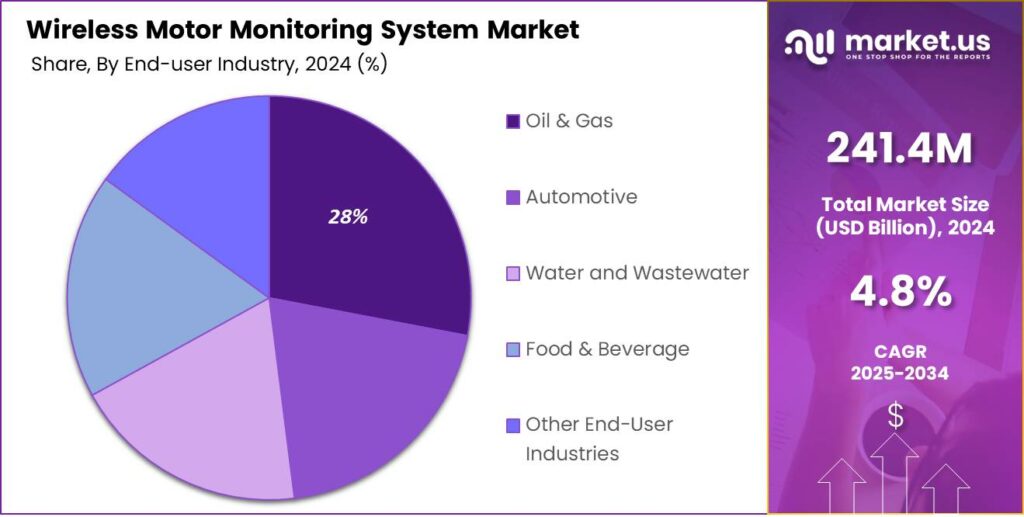
- The Oil & Gas segment held a dominant position in the wireless motor monitoring system market in 2024, capturing more than 28% share.
- North America held a dominant market position in the Wireless Motor Monitoring System sector in 2024, capturing more than 35% share with revenues amounting to USD 84.4 million.
- The U.S. Wireless Motor Monitoring System Market was valued at USD 78.4 million in 2024 and is expected to grow at a CAGR of 3.9%.
U.S. Market Size and Growth
In 2024, the market for Wireless Motor Monitoring Systems in the U.S. was estimated to be worth $78.4million. It is projected to expand at a compound annual growth rate (CAGR) of 3.9%. This growth is indicative of increasing demand within industries that require real-time monitoring of motor conditions to enhance operational efficiency and reduce downtime.
The trend towards automation and data-driven maintenance is further driving the market’s growth. Companies are increasingly relying on wireless motor monitoring systems to obtain critical data on motor performance that can preempt failures and optimize energy usage.
Furthermore, environmental regulations and the push for sustainability are compelling companies to invest in technologies that contribute to energy efficiency. Wireless motor monitoring systems play a pivotal role in this regard by ensuring equipment operates within optimal parameters, thus minimizing energy waste and extending the lifespan of motors.

In 2024, North America held a dominant market position in the Wireless Motor Monitoring System sector, capturing more than a 35% share with revenues amounting to USD 84.4 million. This substantial market share can be attributed to several key factors that distinguish North America as a leader in this technology.
The prevalence of stringent regulatory standards in North America regarding equipment safety and energy efficiency further bolsters the adoption of wireless motor monitoring systems. These regulations compel industries to maintain high standards of machinery health, which in turn fuels the market for these advanced monitoring systems.
North America’s commitment to innovation is demonstrated through its investment in IoT and machine learning research, which are key to advancing wireless motor monitoring systems. These efforts have greatly improved system accuracy, reliability, and usability, increasing their appeal to industrial users.
The rise of smart factories and Industry 4.0 in North America further drives the adoption of wireless motor monitoring systems. As factories become more connected, the ability to monitor equipment remotely and predict potential failures is crucial. This integration helps prevent operational issues, reducing costs and boosting production efficiency.

Product Type Analysis
In 2024, the Vibration Sensors segment held a dominant market position within the Wireless Motor Monitoring System market, capturing more than a 45% share. This segment leads due to its critical role in the early detection of potential failures in motors by monitoring anomalies in vibration patterns.
Vibration sensors are particularly valuable in predictive maintenance strategies, allowing industries to take preventative actions before costly breakdowns occur. Their ability to provide real-time insights into the operational integrity of motors enhances their adoption across various sectors, including manufacturing, automotive, and energy.
Vibration sensors’ popularity is further bolstered by advancements in sensor technology, which have improved their accuracy, durability, and sensitivity. These enhancements make them suitable for use in harsh industrial environments where reliable performance is crucial.
Additionally, the regulatory push towards safer working environments and the increasing emphasis on asset management in industries have contributed to the growth of the vibration sensors market. Regulations often require regular monitoring and maintenance of industrial equipment to ensure operational safety, which supports the continued adoption of vibration sensors.
End-User Industry Analysis
In 2024, the Oil & Gas segment held a dominant position in the wireless motor monitoring system market, capturing more than a 28% share. This leading role is primarily due to the critical need for uninterrupted operation and maintenance within the oil and gas industry.
Wireless motor monitoring systems are crucial for maintaining equipment integrity in exploration, extraction, and processing industries, which often operate in harsh environments and remote locations. Unlike traditional methods, wireless systems offer real-time data and diagnostics, minimizing downtime and improving safety by predicting failures before they happen.
The automotive industry, while trailing behind oil and gas, extensively uses wireless motor monitoring systems to track the performance of motors in machinery and robotic assemblies. These systems reduce production halts and support the precision needed in assembly, driven by the demand for lean manufacturing and automation.
The Water and Wastewater industry also uses wireless motor monitoring systems to ensure the reliability and efficiency of pumps and critical equipment, especially in remote areas with limited maintenance access. These systems help prevent unexpected failures, avoiding service disruptions and ensuring continuous water treatment and supply.
Key Market Segments
By Product Type
- Vibration Sensors
- Power Sensors
- Dual Analog Sensors
By End-User Industry
- Oil & Gas
- Automotive
- Water and Wastewater
- Food & Beverage
- Other End-User Industries
Key Regions and Countries
- North America
- US
- Canada
- Europe
- Germany
- France
- The UK
- Spain
- Italy
- Rest of Europe
- Asia Pacific
- China
- Japan
- South Korea
- India
- Australia
- Singapore
- Rest of Asia Pacific
- Latin America
- Brazil
- Mexico
- Rest of Latin America
- Middle East & Africa
- South Africa
- Saudi Arabia
- UAE
- Rest of MEA
Driver
Increasing Adoption of Industry 4.0 in Manufacturing
The manufacturing sector is increasingly embracing Industry 4.0 principles, which integrate advanced technologies like the Internet of Things (IoT) and automation into production processes. This shift aims to create “smart” factories where machines communicate and operate autonomously to enhance efficiency.
Wireless motor monitoring systems play a crucial role in this transformation by enabling real-time data collection and analysis of motor performance. By continuously monitoring parameters such as temperature, vibration, and energy consumption, these systems help predict potential failures and schedule maintenance proactively, thereby reducing downtime and operational costs.
Restraint
High Initial Implementation Costs
Despite the advantages, the adoption of wireless motor monitoring systems is often hindered by the high upfront costs associated with their implementation. These expenses include the purchase of advanced sensors, communication devices, and the necessary software platforms for data analysis.
Additionally, integrating these systems into existing manufacturing setups may require modifications to current infrastructure, further escalating costs. For small and medium-sized enterprises (SMEs), these financial barriers can be particularly challenging, making it difficult to justify the investment despite potential long-term savings. Consequently, the substantial initial expenditure remains a significant restraint in the widespread adoption of wireless motor monitoring systems across various industries.
Opportunity
Focusing on regulatory compliance while prioritizing energy efficiency.
There is a growing global focus on energy efficiency and adherence to environmental regulations. Industries are under increasing pressure to optimize energy consumption and reduce their carbon footprint. Wireless motor monitoring systems offer a valuable opportunity in this context by providing detailed insights into motor energy usage.
By analyzing this data, companies can identify inefficiencies, implement corrective measures, and ensure compliance with energy standards. Moreover, many governments offer incentives for adopting energy-efficient technologies, making the implementation of these monitoring systems not only environmentally responsible but also economically beneficial. This emphasis on sustainability and regulatory compliance presents a significant opportunity for the expansion of wireless motor monitoring solutions.
Challenge
Integration with Existing Systems
Integrating wireless motor monitoring systems into existing industrial setups poses a considerable challenge. Many facilities operate with legacy equipment that may not be compatible with modern monitoring technologies. Ensuring seamless communication between old and new systems often requires customized solutions, which can be complex and costly.
Additionally, the workforce may need training to effectively use and maintain these new systems, adding to the implementation burden. Overcoming these integration challenges is crucial for the successful deployment of wireless motor monitoring systems and requires careful planning and resource allocation.
Emerging Trends
Wireless motor monitoring systems are rapidly evolving, bringing several notable trends to the forefront. A significant development is the integration of the Internet of Things (IoT), which allows for real-time data collection and analysis from motors across various industries.
Additionally, advancements in wireless sensor technology have led to the creation of compact, energy-efficient sensors capable of monitoring critical parameters like temperature, vibration, and power consumption. These sensors are not only easier to install but also more cost-effective, making them accessible to a broader range of businesses.
Moreover, the shift towards cloud-based monitoring solutions offers enhanced scalability and data accessibility, allowing businesses to monitor motor performance remotely and make informed decisions promptly. Collectively, these trends are paving the way for more efficient and reliable motor management practices across sectors.
Business Benefits
Implementing wireless motor monitoring systems offers numerous business advantages.They significantly reduce installation and maintenance costs by eliminating the need for extensive wiring and physical inspections.
Wireless systems can be deployed in challenging terrains and hard-to-reach areas without the logistical hurdles associated with wired setups. This flexibility ensures continuous monitoring in diverse environments, leading to improved operational efficiency.
Wireless motor monitoring systems offer real-time data for predictive maintenance, reducing unplanned downtimes. Their scalability allows seamless integration of additional sensors as businesses grow, resulting in increased productivity, cost savings, and streamlined equipment maintenance.
Key Player Analysis
The key players in Wireless Motor Monitoring System Market play a crucial role in providing innovative solutions that enhance operational efficiency and ensure sustainability.
ABB Ltd. stands as one of the leading players in the wireless motor monitoring space. The company is known for its strong portfolio of automation and electrical equipment, including advanced motor control systems. ABB’s wireless solutions allow for seamless data collection, which helps in detecting potential issues before they lead to system failures.
Beckhoff Automation GmbH and Co. KG is another significant player, specializing in industrial automation, including wireless monitoring solutions for motors. Their systems integrate PC-based control technology, offering flexibility and scalability in motor monitoring applications.
Eaton Corp. Plc is a global player in the power management sector and has a notable presence in the wireless motor monitoring market. Their motor monitoring systems are designed to optimize energy usage and improve operational efficiency. Eaton’s solutions focus on predictive analytics and real-time monitoring, which can prevent costly breakdowns and minimize downtime.
Top Key Players in the Market
- ABB Ltd.
- Beckhoff Automation GmbH and Co. KG
- Eaton Corp. Plc
- Emerson Electric Co.
- Fluke Corp.
- General Electric Co.
- Honeywell International Inc.
- Infineon Technologies AG
- K. A. Schmersal Holding GmbH and Co. KG
- Mitsubishi Electric Corp.
- Moxa Inc.
- OleumTech Corp.
- OMRON Corp.
- Pepperl and Fuchs SE
- Phoenix Contact GmbH and Co. KG
- Robert Bosch GmbH
- Rockwell Automation Inc.
- Schneider Electric SE
- Siemens AG
- Yokogawa Electric Corp.
- Other Key Players
Top Opportunities Awaiting for Players
The wireless motor monitoring system market is poised for significant growth, offering numerous opportunities for industry players.
- Expansion in Emerging Markets: As economies in regions like Asia-Pacific, the Middle East, and Africa continue to develop, there is a rising demand for industrial automation and monitoring solutions. Companies can capitalize on this by introducing wireless motor monitoring systems tailored to these emerging markets, where there is a growing focus on efficiency and preventive maintenance.
- Technological Advancements: The integration of IoT and AI technologies into wireless motor monitoring systems is becoming a key driver. These technologies enable predictive maintenance capabilities, which can significantly reduce downtime and maintenance costs for industries. The adoption of cloud-based systems and big data analytics also presents opportunities for more sophisticated monitoring solutions.
- Diversification into Various Industries: There is a broad range of applications for wireless motor monitoring systems across different industries such as oil and gas, automotive, food and beverage, and water and wastewater management. Each of these sectors has unique needs that can be met with specialized monitoring solutions, potentially increasing the market reach and relevance of these systems.
- Regulatory Compliance and Safety Standards: Increasingly stringent safety and environmental regulations across the globe are compelling industries to adopt advanced monitoring and maintenance systems. Wireless motor monitoring systems can help meet these regulations by ensuring equipment operates within required parameters, thereby avoiding penalties and reducing risk.
- Strategic Collaborations and Partnerships: Developing partnerships and strategic alliances with other technology providers and industry specialists can provide market players access to new technologies, markets, and product development resources. This can enhance their product offerings and competitive edge in the market.
Recent Developments
- In March 2024, Siemens announced plans to acquire the industrial drive technology business of ebm-papst. This acquisition aims to strengthen Siemens’ position in factory automation and digitalization by adding intelligent, integrated mechatronic systems to its portfolio.
- In September 2024, Schaeffler partnered with ZF to develop a wireless axlebox-bearing condition monitoring solution. This system uses ZF’s battery-powered sensors to transmit vibration and temperature data, analyzed via cloud-based software provided by Schaeffler.









