


Report Overview
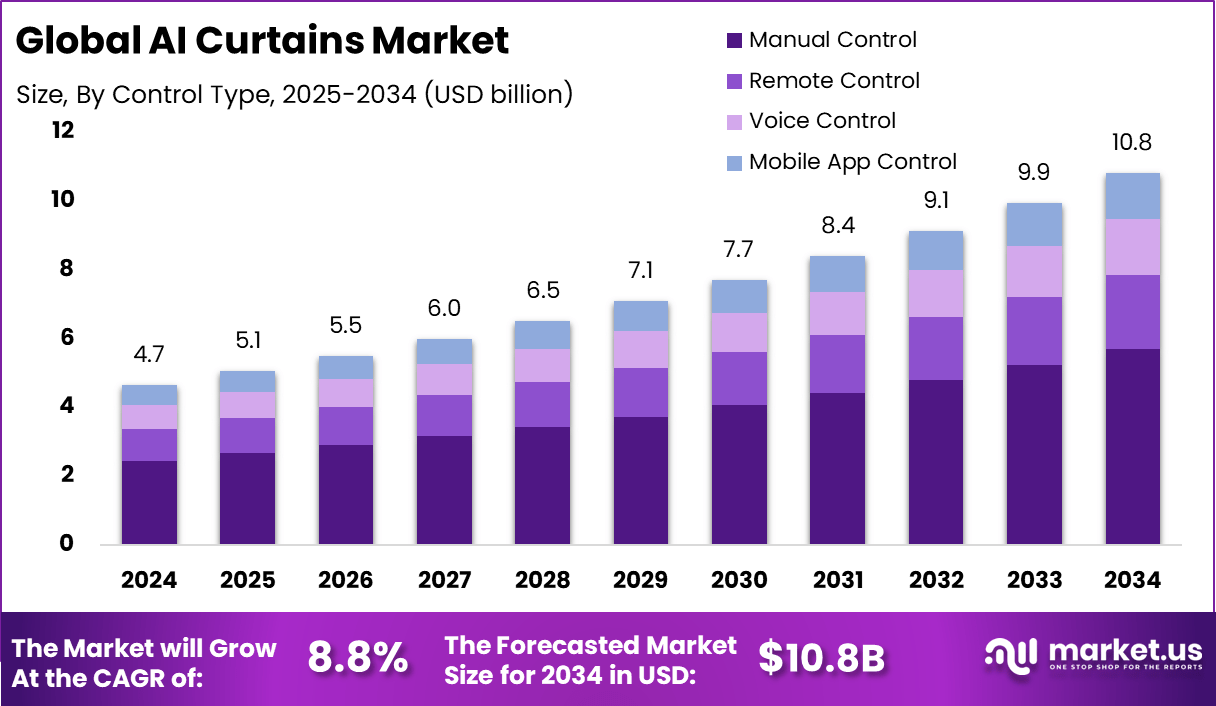
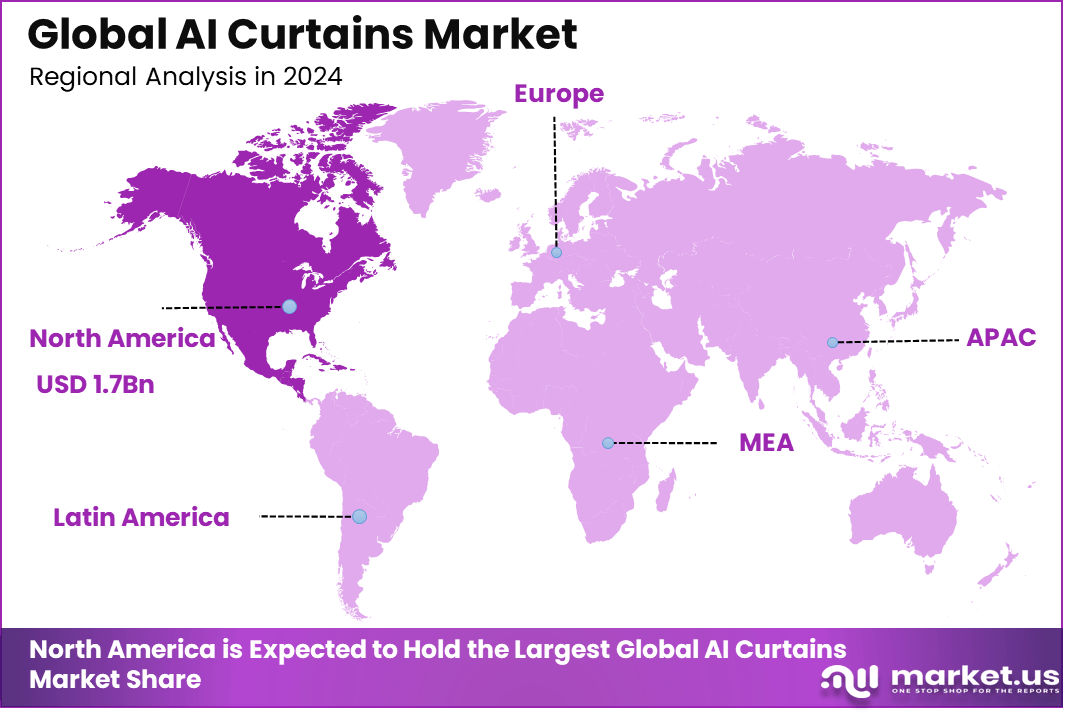
The Global AI Curtains Market generated USD 4.7 billion in 2024 and is predicted to register growth from USD 5.1 billion in 2025 to about USD 10.8 billion by 2034, recording a CAGR of 8.8% throughout the forecast span. In 2024, North America held a dominan market position, capturing more than a 38.2% share, holding USD 1.7 Billion revenue.
The AI Curtains Market refers to the segment of window and door coverings that integrates artificial intelligence technology to offer smart, automated control of curtains. These systems move beyond traditional manual or remote-controlled curtains by utilizing AI algorithms to adjust curtain operations based on factors like sunlight intensity, room occupancy, and user preferences.
This market is part of the broader smart home and building automation landscape, with applications in residential, commercial, and hospitality sectors. AI curtains enhance convenience, energy efficiency, and user comfort by allowing seamless interaction through voice commands, smartphone apps, or automated schedules.
Top driving factors for the AI Curtains Market include the growing consumer demand for smart home automation, energy-efficient solutions, and seamless integration with other IoT devices. Advances in AI and machine learning enable curtains to learn user behaviors and environmental conditions to optimize natural light and temperature control. The trend towards urbanization and increasing construction of smart buildings further propels the adoption of AI curtains.
According to Market.us, The global AI market was valued at USD 391.70 billion in 2024 and is expected to grow from USD 542.50 billion in 2025 to around USD 10,173.05 billion by 2034. This represents a compound annual growth rate (CAGR) of 38.5% during the forecast period. In 2024, North America held a leading market position, generating approximately USD 143.75 billion in revenue.
Top Market Takeaways
- By control type, manual control leads with 52.6%, reflecting continued reliance on hybrid and semi-automated curtain systems.
- By material, fabric-based curtains dominate with 45.5%, driven by their adaptability and widespread commercial use.
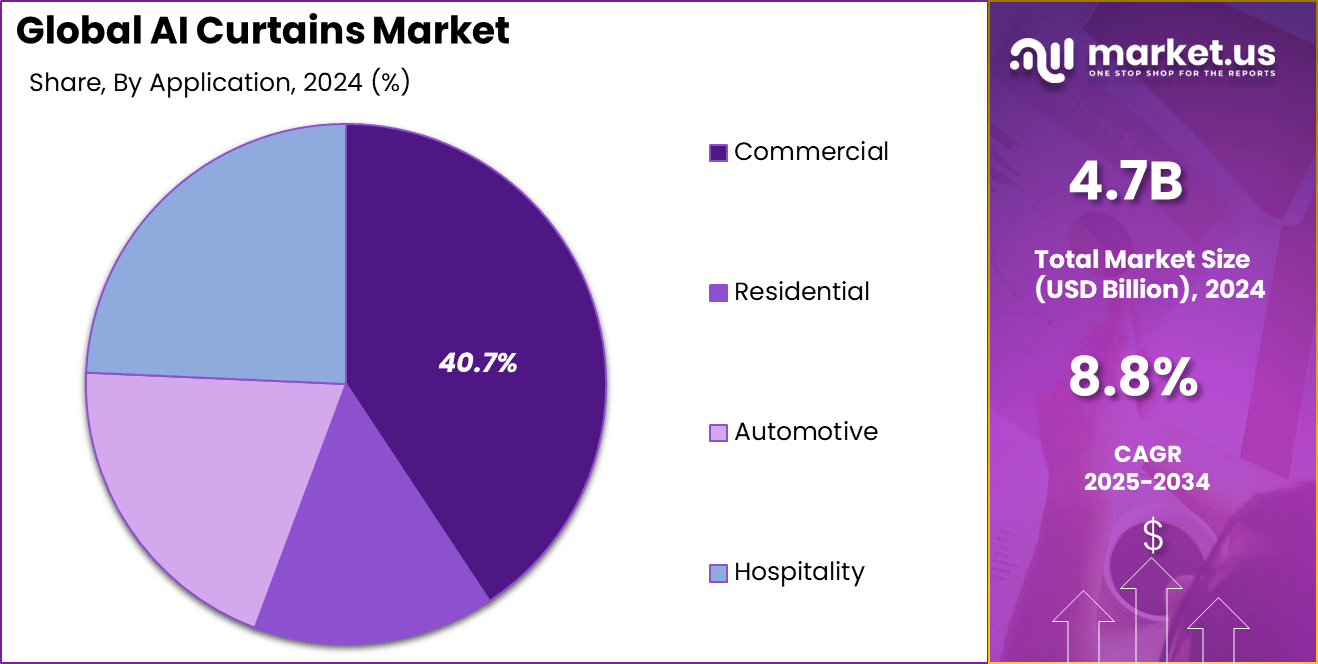
- By application, the commercial segment holds 40.7%, supported by adoption in offices, hotels, and retail spaces.
- By end use, industrial use accounts for 54.8%, as factories and warehouses integrate AI-driven automation for efficiency.
- North America contributes 38.2%, supported by early adoption of smart infrastructure and energy-efficient building technologies.
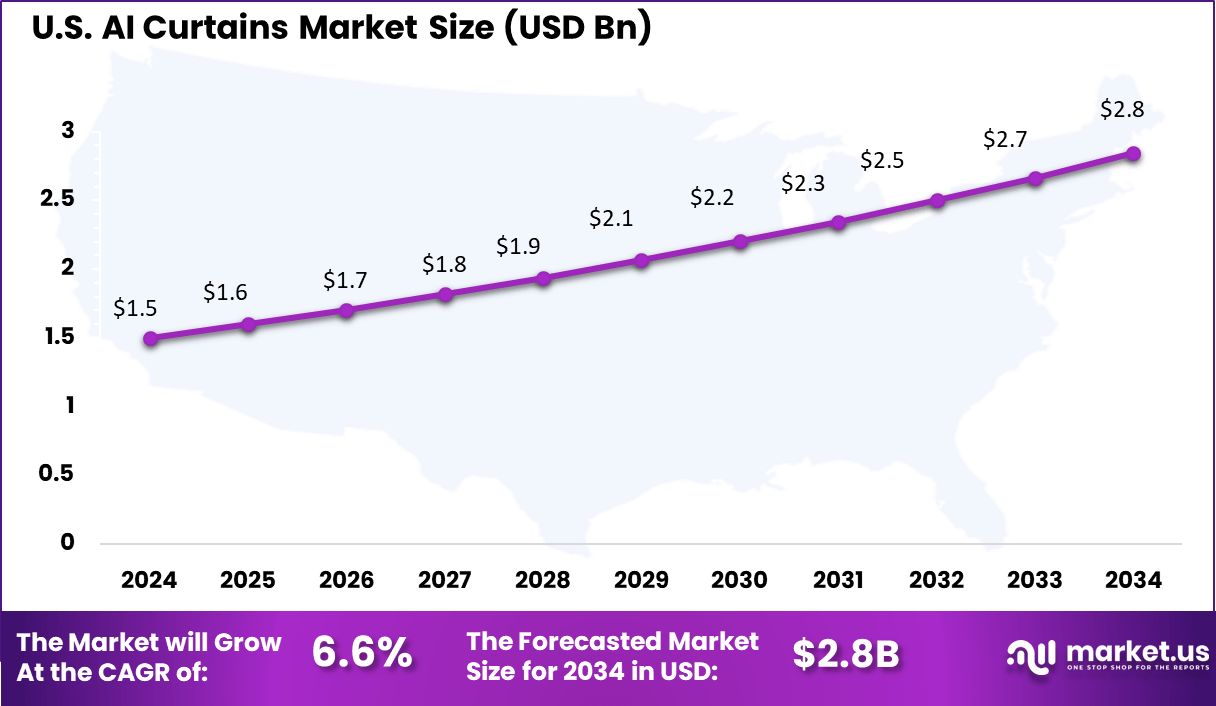
- The US market reached USD 1.50 billion and is expanding at a steady CAGR of 6.6%, highlighting its role in driving global adoption of AI-enabled curtain systems.
Role of Generative AI
AI Curtains market is rapidly evolving with the integration of generative AI, raising the bar for smart and automated window treatments. Generative AI plays a crucial role by enabling curtains to learn user preferences, adapt to environmental changes, and offer voice or app controls. Around 92% of Fortune 500 companies have adopted generative AI for various applications, demonstrating its broad acceptance and influence.
This technology helps AI curtains provide personalized, convenient experiences, saving users time by automating daily adjustments. Generative AI’s impact on productivity is significant, with many users reporting saving more than 2-4 hours weekly by automating tasks such as adjusting room lighting and temperature via smart curtains.
This automation reduces energy consumption and improves comfort, aligning with the growing demand for energy-efficient home solutions. Integration with smart home systems also means up to 95% of customer interactions could involve AI technologies by the year 2025, underscoring the deepening role of AI in everyday living environments.
Analysts’ Viewpoint
Demand analysis shows high interest from urban residential buyers, commercial office spaces, hotels, and healthcare facilities, all seeking smart solutions to improve operational efficiency and user experience. Consumer preferences increasingly favor voice-activated and sensor-enabled curtains that provide hands-free, personalized control.
The incorporation of augmented reality for visualizing curtain styles and fabrics before purchase is also enhancing demand by improving customer confidence and reducing returns. Additionally, the hospitality industry values these systems for their ability to create customized ambiance settings, improving guest satisfaction.
Increasing adoption technologies in AI curtains include machine learning algorithms for predictive behaviors, sensors for light and temperature detection, and voice control integration with assistants such as Alexa and Google Home. Cloud-based management platforms allow remote monitoring and scheduling, supporting convenience and energy management.
Modular designs and retrofittable battery-powered curtain motors enable easier installation in existing buildings, accelerating adoption in retrofit markets. The focus on minimized energy consumption and silent motor operation also supports broader acceptance.
Investment and Business Benefits
Investment opportunities in the AI Curtains Market stem from advances in AI integration, IoT ecosystem expansions, and smart building developments. Startups and mid-cap companies focused on machine learning software, sensor technology, and motor innovation offer growth potential.
Additionally, companies enabling retrofit solutions and smart home system compatibility present appealing avenues for investors. The increasing number of smart housing projects in metropolitan areas and growing awareness of energy conservation create long-term prospects. Furthermore, linkage with related smart home devices opens cross-industry investment possibilities.
Business benefits of AI curtains include operational efficiency, energy cost reductions, enhanced user experience, and brand differentiation. Businesses such as hotels and offices can automate environment controls to reduce manual labor and maintenance.
The intelligent management of daylight and temperature helps lower energy expenses and supports sustainability goals. Offering AI-integrated curtains elevates product portfolios, attracting tech-savvy consumers and reinforcing positions in competitive markets. Improved product quality driven by automation and AI-enabled customization also boosts customer satisfaction and retention.
US Market Size
The United States stands out as a key market within North America, with a market size close to USD 1.50 billion. The country experiences steady growth due to widespread home automation adoption and smart building projects. The CAGR of 6.6% reflects continued investment in AI-powered solutions that offer comfort and control.
The US market’s growth is reinforced by consumer demand for integration with voice assistants and smart devices, as well as commercial infrastructure upgrades. This combination of residential and commercial drivers supports a robust and progressive AI curtains market landscape.
In 2024, North America leads the AI curtains market with a 38.2% share. The region benefits from high adoption rates of smart home and building automation technologies. Consumers and businesses invest heavily in convenience, energy efficiency, and security, making AI curtains a natural fit in this ecosystem.
The development of smart infrastructure and the presence of a tech-savvy customer base push demand further. Increasing awareness of energy conservation and sustainability also contributes to North America’s leading role in this market.
By Control Type
In 2024, Manual control holds a significant share of 52.6% in the AI curtains market. This segment remains popular due to its affordability and simplicity. Manual curtains are easy to install, require no electrical components, and allow users direct handling, making them a preferred choice in regions or settings where advanced automation is either not feasible or unnecessary.
In addition, manual control curtains offer low maintenance and repair costs since they do not rely on motors or smart systems. This makes them practical for budget-conscious buyers and spaces where basic functionality is sufficient. Their continued demand also reflects a consumer preference for straightforward technologies that do not depend on power sources or connectivity.
By Material
In 2024, Fabric is the leading material in AI curtains, accounting for 45.5% of the market. The use of fabric offers versatility in design, texture, and color options, suiting a wide range of aesthetic preferences and interior styles. Natural fibers like cotton and linen are favored for their durability and classic look, while synthetic fabrics add benefits like light weight and easy maintenance.
Fabric curtains also lend themselves well to automation technologies as they are flexible and easy to move with motorized systems. The combination of comfort, style, and functionality keeps fabric curtains at the forefront, especially in residential and commercial spaces that demand both elegance and performance.
By Application
In 2024, The commercial application segment makes up 40.7% of the AI curtains market. Commercial spaces such as offices, hotels, and conference rooms appreciate the convenience and efficiency that AI curtains provide. These curtains enhance workplace aesthetics while also contributing to energy management through automated light and heat control.
They support operational ease in environments where frequent adjustment is needed, like meeting rooms or event spaces. The smart automation of curtains helps maintain privacy and lighting balance seamlessly, making them a preferred solution in professional and public settings.
By End Use
In 2024, Industrial use dominates the end-user category with 54.8% market share. In industries, curtains are used for space partitioning, temperature control, and contamination prevention. AI-enabled curtains offer faster and more precise operation, helping improve efficiency in manufacturing floors, warehouses, and cleanrooms.
Automation mitigates the need for manual adjustment in busy industrial environments, where quick responses to environmental changes are essential. Moreover, AI curtains help optimize energy use, safeguarding product quality and worker comfort, which makes them an indispensable asset in industrial applications.
Emerging Trends
Emerging trends in AI curtains include stronger focus on sustainability and smart integration. Google Trends data from 2025 shows blackout curtains and motorized curtain systems receiving growing attention, with seasonal spikes linked to home renovation cycles. Electric blinds and motorized curtains lead search interest for smart window treatments, as consumers prioritize ease of use and energy savings.
Smart curtains now commonly incorporate sensors for light and temperature, responding automatically to environmental conditions, which reflects in the market’s steady growth of around 13.5% CAGR in similar smart curtain segments. Additionally, the trend towards cordless and battery-efficient designs is gaining momentum, driven by consumers’ desire for hassle-free installation and long-lasting products.
Advanced technologies like augmented reality (AR) are being introduced for improved customer experience, allowing users to visualize curtain styles and colors in their homes before purchase. This trend toward experiential retail and technology-driven customization supports market innovation and consumer engagement.
Growth Factors
The growth of the AI curtains market is propelled by increasing urbanization and rising income levels, which encourage investments in smart home technology. The desire for convenient, secure, and energy-efficient solutions inspires consumers to adopt automated curtains that integrate with voice assistants like Alexa and Google Assistant.
Around 73% of marketing departments use generative AI tools, which also include targeting consumer preferences for smart home products such as AI curtains, further promoting product awareness and demand. Technological advancements are expanding the market by improving device features such as ultra-long battery life and multiple control options including voice commands and smartphone apps.
With rising disposable incomes, households are investing in home automation, seeing smart curtains as elements of comfort and modern living. The trend towards home improvement and energy efficiency continues to push demand forward across regions like North America, Europe, and Asia-Pacific, where smart home adoption rates continue to climb.
Key Market Segments
By Control Type
- Manual Control
- Remote Control
- Voice Control
- Mobile App Control
By Material
- Fabric
- Vinyl
- Wood
- Plastic
By Application
- Commercial
- Residential
- Automotive
- Hospitality
By End use
- Home Use
- Office Use
- Industrial Use
Regional Analysis and Coverage
- North America
- US
- Canada
- Europe
- Germany
- France
- The UK
- Spain
- Italy
- Russia
- Netherlands
- Rest of Europe
- Asia Pacific
- China
- Japan
- South Korea
- India
- Australia
- Singapore
- Thailand
- Vietnam
- Rest of Latin America
- Latin America
- Brazil
- Mexico
- Rest of Latin America
- Middle East & Africa
- South Africa
- Saudi Arabia
- UAE
- Rest of MEA
Driver
Growing Demand for Smart Home Integration
The AI curtains market is primarily driven by the increasing adoption of smart home systems. Consumers appreciate the convenience of operating curtains remotely through voice assistants or smartphone apps, which adds ease to daily life. These curtains can be programmed to open or close based on time schedules, ambient light, and occupancy, enhancing comfort and energy efficiency.
Integration with widely used smart home ecosystems such as Alexa, Google Home, and Apple HomeKit makes AI curtains appealing to tech-savvy homeowners and businesses. This seamless connectivity is helping to fuel ongoing market growth as more consumers seek intelligent automation for their living and working spaces.
Restraint
High Upfront Cost and Complex Installation
Despite their benefits, AI curtains face a restraint in the form of significant initial investment and installation complexity. These motorized systems often require professional setup to ensure proper integration with smart home controls and smooth operation. The high price compared to traditional manual curtains discourages price-sensitive buyers, limiting mass market penetration.
Additionally, installation can involve wiring and technical adjustments that add to the cost and inconvenience. For consumers prioritizing simplicity and affordability, these factors can slow adoption and restrict the market’s reach, especially in emerging regions.
Opportunity
Expansion in Emerging Markets and Customization
AI curtains have strong growth potential in emerging markets where rising incomes and urbanization increase demand for smart home products. As more consumers in Asia-Pacific and Latin America invest in home automation, AI curtain manufacturers can tap into these new customer bases. There is also increasing opportunity in providing customizable options for fabrics, designs, and control features.
Tailoring products to meet local tastes and varying commercial and hospitality needs can broaden appeal. Collaborations with interior designers and smart home companies further open doors for innovation and increased market share, making customization and emerging markets key growth areas.
Challenge
Ensuring Reliability and User Experience
A notable challenge for the AI curtain market is maintaining system reliability and ensuring a smooth user experience. Motorized curtain systems must operate quietly and without frequent malfunctions to satisfy users. Poor installation or low-quality components can lead to problems such as noise, delayed responses, or connectivity failures, undermining consumer trust.
Furthermore, ongoing maintenance and software updates are necessary to keep devices functioning well, which can be a hassle for users. Addressing these issues is critical for manufacturers to build strong customer loyalty and avoid negative perceptions that could hamper long-term growth.
Competitive Analysis
The AI Curtains Market is led by global home automation and window treatment providers such as Somfy, Lutron, Silent Gliss, and Hunter Douglas. These companies offer smart curtain systems integrated with automated controls, voice assistants, and IoT platforms. Their solutions enhance energy efficiency, convenience, and home security, driving adoption in residential and commercial settings.
Regional and specialized manufacturers including Huang Jia, Draper, Belinda, and The Great Curtain Company contribute with customized designs, motorized curtain tracks, and AI-driven scheduling features. Their offerings focus on comfort, aesthetic appeal, and seamless integration with smart home ecosystems, catering to both luxury and mid-market segments.
Emerging and tech-savvy players such as Autorail, Xiaomi, and a range of other major participants provide cost-effective, app-controlled, and automated curtain solutions. These companies continue to expand market penetration by leveraging AI-based automation, remote control, and energy-saving functionalities for modern homes and offices.
Top Key Players in the Market
- Somfy
- Lutron
- Silent Gliss
- Hunter Douglas
- Huang Jia
- Draper
- Belinda
- The Great Curtain Company
- Autorail
- Xiaomi
- Other Major Players
Recent Developments
- February 2025: Lutron debuted its Caséta Smart Shades, compatible with Apple HomeKit and other platforms, priced affordably at $399 for standard sizes. The shades offer quiet operation, easy installation, and up to 10+ years of tested performance. They enable integrated control of natural and artificial light, aiming to bring smart shading technology to a broader market with mass appeal
- November 2024: Silent Gliss announced the launch of a smart home integration platform partnership to improve connectivity in its automated curtain systems. This move aims to enhance seamless integration and smart control functionalities within connected home environments.









