


Report Overview
The Global Customized Furniture Market size is expected to be worth around USD 104.7 Billion by 2034, from USD 36.2 Billion in 2024, growing at a CAGR of 11.2% during the forecast period from 2025 to 2034.
Customized furniture refers to furniture that is tailored to meet specific needs, preferences, or spaces. This can include bespoke designs for residential or commercial use. Custom furniture offers unique dimensions, materials, and styles that suit the individual requirements of the customer or space.
The Customized Furniture Market encompasses the industry focused on designing and producing personalized furniture. This market includes furniture that is created based on customer specifications in terms of size, style, and material. It caters to individuals or businesses seeking unique and specific furniture solutions.
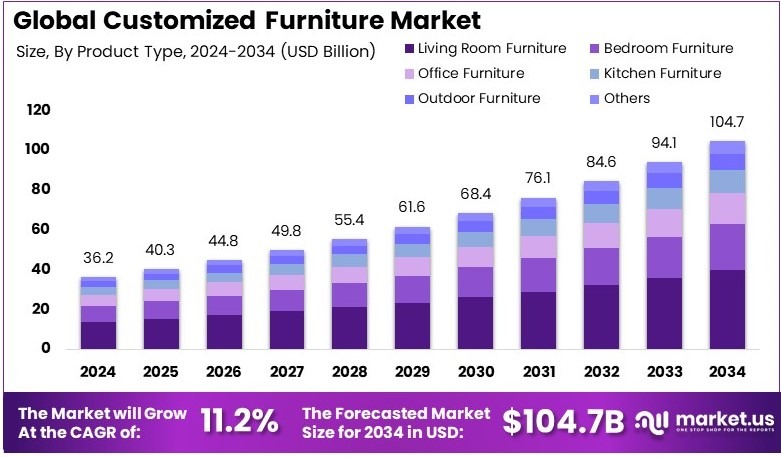
The customized furniture market is expanding as homeowners seek personalized and unique designs. According to a survey by Opendoor, 66% of homeowners are opting for cost-effective decor solutions, including custom furniture. As disposable income increases, with $34.2 billion in disposable personal income growth, the demand for customized furniture continues to rise.
As demand grows, so does the opportunity for customized furniture. Increased interest in interior design, driven by home improvement TV shows and social media, fuels the market. For example, new homeowners spend an average of $5,000 on furnishings. Moreover, the employment of interior designers is projected to grow by 4% from 2022 to 2032.
The market is competitive, with a variety of companies offering customized furniture solutions. Local businesses face pressure from large brands that dominate the market. However, the increased demand for personalized products provides a significant opportunity for smaller, niche players to differentiate themselves by offering unique designs and customized solutions to meet specific consumer needs.
On a broader scale, the increased focus on luxury interior design and home décor boosts the market. For instance, in the restaurant industry, which is expected to generate $1 trillion in sales by the end of 2024, the demand for customized dining furniture is growing. This reflects a broader shift towards personalization in various sectors, including home and business furniture.
Key Takeaways
- The Customized Furniture Market was valued at USD 36.2 Billion in 2024, and is expected to reach USD 104.7 Billion by 2034, with a CAGR of 11.2%.
- In 2024, Customized Living Room Furniture dominates the product type segment with 38.0%, catering to the demand for personalized home aesthetics.
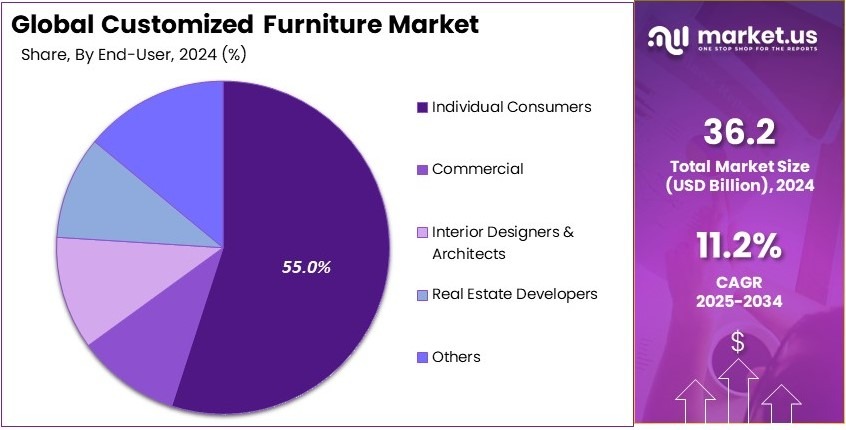
- In 2024, Individual Consumers dominate the end-user segment with 55.0%, showing a strong preference for custom furniture tailored to personal tastes.
- In 2024, Premium furniture leads the price range segment with 40.0%, reflecting the growing demand for high-quality, luxury furniture.
- In 2024, Offline Retail dominates the distribution channel segment with 45.2%, indicating a preference for purchasing customized furniture in-store for personal selection.
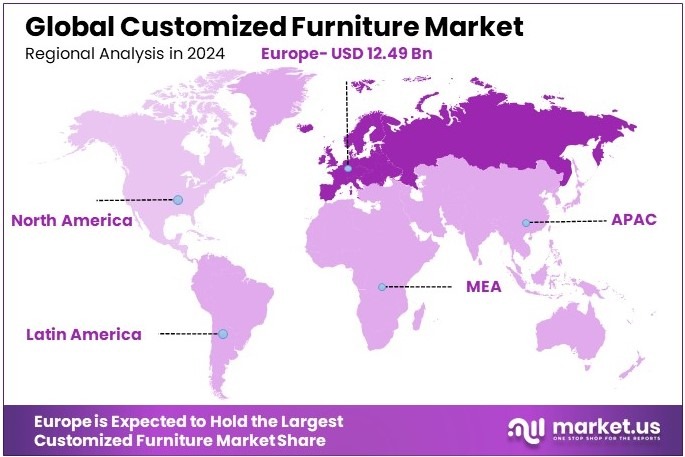
- In 2024, Europe is the dominant region with 34.5%, contributing USD 12.49 Billion, driven by a growing preference for high-quality, custom furniture solutions.
Product Type Analysis
Customized Living Room Furniture dominates with 38.0% due to its versatility, popularity, and high consumer demand.
In the Customized Furniture Market, Customized Living Room Furniture holds the largest market share, accounting for 38.0% of the market. This segment is highly popular because living rooms are central spaces in homes where people spend most of their time.
As a result, homeowners are increasingly seeking personalized furniture pieces, such as sofas, coffee tables, and entertainment units, to fit their unique space and style. The growing trend of creating comfortable, stylish living spaces has led to an increase in demand for customized living room furniture.
Other sub-segments like Customized Bedroom Furniture, Customized Office Furniture, and Customized Kitchen Furniture also contribute to the market but to a lesser extent. Customized Bedroom Furniture is important for creating a comfortable and personalized sleep environment, but it doesn’t have the same widespread appeal as living room furniture.
Customized Office Furniture caters to businesses and home offices, offering ergonomic designs and functionality. However, the market for office furniture is more niche, with fewer consumers seeking customization compared to living room furniture. Other categories, like accessories and smaller furniture, also add to the growth but do not dominate the market.
End-User Analysis
Individual Consumers dominate with 55.0% due to their preference for tailored furniture solutions for their homes.
The dominant end-user segment in the Customized Furniture Market is Individual Consumers, accounting for 55.0% of the market share. As more people focus on creating personalized living spaces, the demand for customized furniture has surged.
Individual consumers often seek furniture that reflects their style, fits specific spaces, and meets functional needs. This growing trend is driven by a desire for uniqueness and higher quality than what is available in mass-market furniture. Moreover, home renovation projects and interior makeovers continue to be popular, further fueling the demand for customized pieces.
Commercial customers, including businesses and offices, also contribute to the market but represent a smaller portion. These consumers often seek functional and ergonomic office furniture, though their customization needs are not as extensive as those of individual consumers.
Interior Designers & Architects have a specialized role in the market, helping clients select and design customized furniture for specific projects. However, they do not make up the largest share of the market. Real Estate Developers, while influential in the commercial segment, focus more on providing standard furniture for properties, rather than offering full customization. Other end-users, like institutions or hospitality businesses, are less dominant in this market.
Price Range Analysis
Premium furniture dominates with 40.0% due to its appeal to consumers seeking high-end, long-lasting, and stylish pieces.
The Premium price range dominates the Customized Furniture Market, accounting for 40.0% of the market share. Consumers are increasingly willing to invest in high-quality, durable, and stylish furniture that enhances the look of their homes.
Premium furniture often features unique materials, custom finishes, and superior craftsmanship, which appeals to buyers seeking exclusivity and luxury. Additionally, premium furniture tends to last longer and can be seen as a long-term investment, further driving demand. As the trend for personalized, luxurious interiors continues to grow, this segment is expected to maintain its dominance.
The Mid-Range segment also holds a significant portion of the market, appealing to consumers who want customization at a more affordable price. This segment offers a balance between quality and price, making it attractive to a broader range of consumers.
The Economy segment, while contributing to market growth, is the smallest. It appeals to budget-conscious consumers who want customized furniture but are limited by their financial constraints. Despite its smaller share, the Economy segment plays a role in expanding the market by making customized furniture accessible to a wider audience.
Distribution Channel Analysis
Offline Retail sub-segment dominates with 45.2% due to traditional consumer buying behavior.
Offline Retail leads the customized furniture market with a 45.2% share. Despite the rise of online shopping, physical stores still hold a significant advantage, especially for high-involvement purchases like custom furniture.
Consumers prefer to visit stores to get a tactile sense of the materials and craftsmanship of customized products. Showrooms also offer a more personalized experience, where customers can receive expert advice, explore design options, and see samples in person. This makes the offline retail environment particularly appealing for those looking to invest in long-lasting, high-quality pieces.
However, Online Retail is gradually catching up, with an increasing number of consumers preferring the convenience of browsing and purchasing furniture from home.
Direct Sales and B2B sales continue to serve specific needs, but the vast majority of custom furniture transactions still occur offline, especially in markets where personalized service and product experience are key considerations. Offline Retail’s dominance will likely continue for the foreseeable future, though e-commerce will remain a growing competitor in the space.
Key Market Segments
By Product Type
- Customized Living Room Furniture
- Customized Bedroom Furniture
- Customized Office Furniture
- Customized Kitchen Furniture
- Customized Outdoor Furniture
- Others
By End-User
- Individual Consumers
- Commercial
- Interior Designers & Architects
- Real Estate Developers
- Others
By Price Range
- Economy
- Mid-Range
- Premium
By Distribution Channel
- Online Retail
- Offline Retail
- Direct Sales
- B2B
Driving Factors
Consumer Desire for Personalized Home Decor Drives Market Growth
The growing consumer preference for personalized and unique home decor is a key driver of the customized furniture market. As individuals seek to make their living spaces truly their own, the demand for furniture tailored to personal tastes, needs, and lifestyles is on the rise. Customized furniture allows homeowners to create designs that reflect their unique style, providing a sense of ownership and satisfaction that mass-produced items cannot offer.
Alongside this desire for uniqueness, there is an increasing demand for space-saving and multi-functional furniture. As living spaces become smaller, particularly in urban areas, consumers are looking for furniture that maximizes functionality without sacrificing style. Custom furniture offers flexibility in design, making it possible to create pieces that serve multiple purposes while fitting perfectly into available spaces.
Rising disposable income and a willingness to invest in high-quality, custom-made pieces are also contributing to market growth. With more people seeking luxury and long-lasting products, customized furniture offers the opportunity to invest in high-end, personalized pieces that stand out in both quality and design.
Moreover, advancements in furniture manufacturing technologies, such as 3D printing and CNC machining, have made custom furniture more accessible and cost-effective, allowing for quicker production and greater precision in design.
Restraining Factors
High Costs and Production Delays Restrain Market Growth
Despite the demand for customized furniture, several factors limit its growth. One significant restraint is the high cost associated with custom furniture design and production. Custom pieces often require specialized materials, labor, and craftsmanship, which can make them significantly more expensive than mass-produced alternatives. As a result, these products may be out of reach for budget-conscious consumers.
Longer lead times for delivery and production also present a challenge. Customized furniture typically requires more time to design and manufacture, which can lead to delays in delivery. This extended waiting period can deter customers who are looking for quicker solutions or have immediate needs for new furniture.
Another obstacle is the limited availability of skilled artisans and craftsmen who can create high-quality customized furniture. The demand for customization has outpaced the supply of skilled professionals, which can affect both the quality and availability of custom pieces. Additionally, maintaining consistency and quality control in custom orders can be difficult, as each piece is unique, and variations in craftsmanship may occur.
Growth Opportunities
Opportunities for Growth in Online Platforms and Sustainability
There are several growth opportunities in the customized furniture market. The expansion of online platforms for custom furniture design and ordering is a key opportunity. E-commerce platforms that allow customers to visualize and design their furniture online are making the customization process easier and more accessible. Customers can now design their pieces from the comfort of their homes, and businesses can reach a wider audience.
The increasing popularity of sustainable and eco-friendly customized furniture is another growth area. As consumers become more environmentally conscious, they are seeking furniture made from sustainable materials that are both high-quality and ethically sourced. This shift presents an opportunity for companies to offer eco-friendly custom furniture solutions that cater to the growing demand for sustainability.
Additionally, the growing demand for smart furniture integrated with technology is creating new opportunities for customized pieces. Consumers are increasingly interested in furniture that incorporates smart features, such as built-in charging stations or adjustable settings, and custom furniture can cater to these high-tech preferences.
Collaboration with interior designers and architects for bespoke home projects also presents a significant opportunity. Customized furniture solutions that are designed in collaboration with professionals can result in highly tailored pieces that fit perfectly within a client’s overall vision for their home.
Emerging Trends
Customization, Sustainability, and Tech Integration Are Latest Trends
The customized furniture market is evolving with several exciting trends. One of the latest trends is the integration of personalization options with augmented reality (AR). AR technology allows customers to visualize custom designs in their actual living spaces before making a purchase, providing a more interactive and satisfying shopping experience.
Another rising trend is the growing popularity of minimalist and contemporary custom designs. Consumers are increasingly drawn to sleek, simple designs that blend seamlessly with modern home decor. This trend is pushing furniture manufacturers to create streamlined, custom pieces that emphasize clean lines and functional elegance.
Sustainability continues to be a focal point in the furniture industry. There is a growing demand for custom furniture made from sustainable materials and produced using eco-conscious methods. Consumers are seeking out products that minimize environmental impact, and manufacturers are responding by offering eco-friendly customization options.
Lastly, the demand for customization in niche markets is also on the rise. Examples include custom pet furniture and ergonomic solutions. As more consumers look for specific solutions that cater to their needs, the market for highly personalized, niche furniture continues to grow, providing opportunities for manufacturers to tap into specialized segments.
Regional Analysis
Europe Dominates with 34.5% Market Share
Europe leads the Customized Furniture Market, holding a 34.5% share, which equals USD 12.49 billion. This dominance can be attributed to high demand for bespoke furniture that aligns with the region’s culture of individuality and quality craftsmanship. The increasing interest in home personalization and the growing preference for eco-friendly materials also support this market growth.
Key factors driving Europe’s market share include the region’s strong manufacturing capabilities and design expertise, particularly in countries like Italy, Germany, and France. Consumers in Europe tend to favor custom-made furniture that reflects their unique tastes, often opting for premium, sustainable options.
The market dynamics in Europe are shaped by a growing trend toward sustainable living, where eco-conscious consumers seek furniture made from renewable materials or with low environmental impact. The region’s high disposable income also makes it an ideal market for premium customized furniture. Additionally, the rise in interior design and home improvement culture has further fueled demand.
Regional Mentions:
- North America: North America, particularly the U.S. and Canada, is a key player in the Customized Furniture Market, driven by high disposable incomes and a growing trend for personalized home furnishings. The region benefits from a well-established retail infrastructure and rising demand for eco-conscious products.
- Asia Pacific: Asia Pacific shows rapid growth in the Customized Furniture Market, driven by urbanization and increasing demand for home decor. Countries like China and India are emerging as significant players due to growing middle-class populations and interest in modern furniture styles.
- Middle East & Africa: The Middle East and Africa’s Customized Furniture Market is growing, fueled by an expanding affluent class and increasing demand for luxury and custom-designed furnishings. High-end furniture demand in the UAE and Saudi Arabia is especially notable.
- Latin America: Latin America’s market for customized furniture is expanding, driven by rising income levels and a greater interest in home renovation. Brazil and Mexico lead the charge, with consumers seeking personalized and functional pieces for their homes.
Key Regions and Countries Covered in the Report
- North America
- US
- Canada
- Europe
- Germany
- France
- The UK
- Spain
- Italy
- Rest of Europe
- Asia Pacific
- China
- Japan
- South Korea
- India
- Australia
- Rest of APAC
- Latin America
- Brazil
- Mexico
- Rest of Latin America
- Middle East & Africa
- South Africa
- Saudi Arabia
- UAE
- Rest of MEA
Competitive Landscape
The Customized Furniture Market is booming, with major players like IKEA, Ashley Furniture Industries, La-Z-Boy, and American Leather leading the charge. These companies offer tailored solutions to meet the growing demand for personalized and unique furniture designs.
IKEA is a global leader in affordable and customizable furniture solutions. Known for its modular designs and innovative approach, IKEA allows customers to personalize furniture with various finishes, sizes, and accessories. The company’s strong brand presence and extensive range of customizable options make it a top choice for consumers seeking modern and functional furniture.
Ashley Furniture Industries is one of the largest furniture manufacturers in the world, offering a wide range of customizable furniture. Known for its traditional and contemporary styles, Ashley allows customers to customize fabrics, colors, and sizes. The company’s strong distribution network and high-quality products make it a leader in the customized furniture market.
La-Z-Boy is recognized for its high-quality, comfortable recliners and customizable seating solutions. The company allows customers to select from various fabrics, colors, and styles, ensuring that each piece of furniture meets their unique needs. La-Z-Boy’s reputation for comfort, durability, and customization options has made it a go-to brand for consumers seeking personalized furniture.
American Leather specializes in premium, customizable leather furniture. The company offers a wide variety of seating solutions, including sofas, chairs, and sectionals, with extensive customization options in terms of materials, sizes, and finishes. American Leather’s focus on craftsmanship and quality makes it a top choice for consumers looking for high-end, tailored furniture solutions.
These companies lead the Customized Furniture Market by offering a wide range of products that can be tailored to suit individual preferences, combining style, functionality, and personalization to meet the needs of modern consumers.
Major Companies in the Market
- IKEA
- Ashley Furniture Industries
- La-Z-Boy
- American Leather
- Craftmaster Furniture
- Design Within Reach
- Ethan Allen
- Williams-Sonoma, Inc.
- Restoration Hardware
- Raymour & Flanigan
- BenchMade Modern
- Room & Board
Recent Developments
- bowmo & OWNverse/Digital Tails Group: On February 2025, bowmo and merger partner OWNverse/Digital Tails Group launched a custom Configure-Price-Quote (CPQ) platform for Téchne, a European furniture maker. The AI-powered platform features real-time 3D configuration and reduces design time by 40% through automation of manual tasks like price calculations.
- Godrej Interio: On January 2025, Godrej Interio (part of the Godrej Group) launched UPMODS, a modular furniture line offering 2,450 customization combinations. The line is aimed at achieving ₹50 Crore in revenue with its extensive range of price options.









