


Report Overview
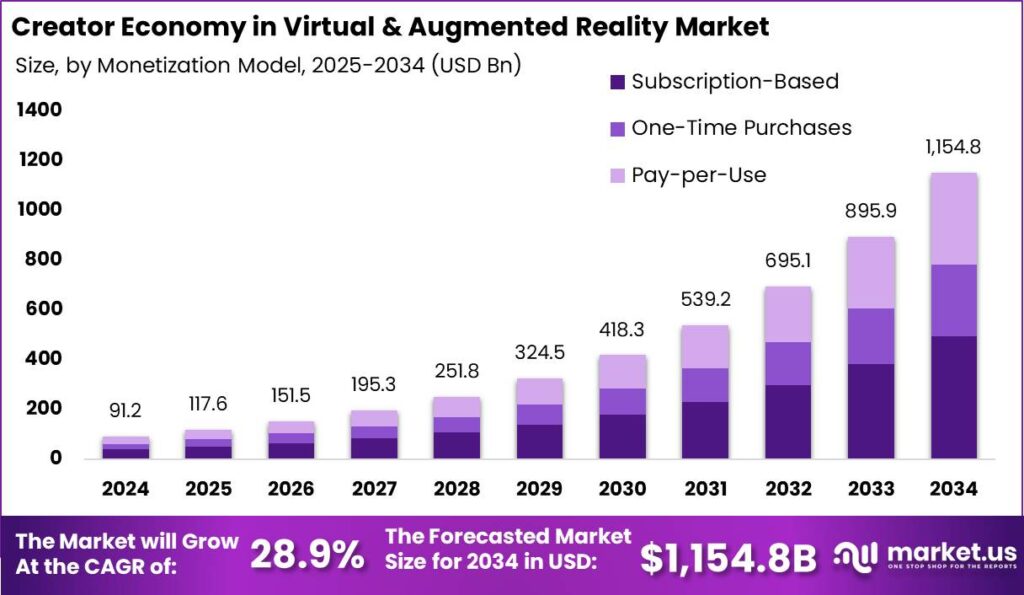
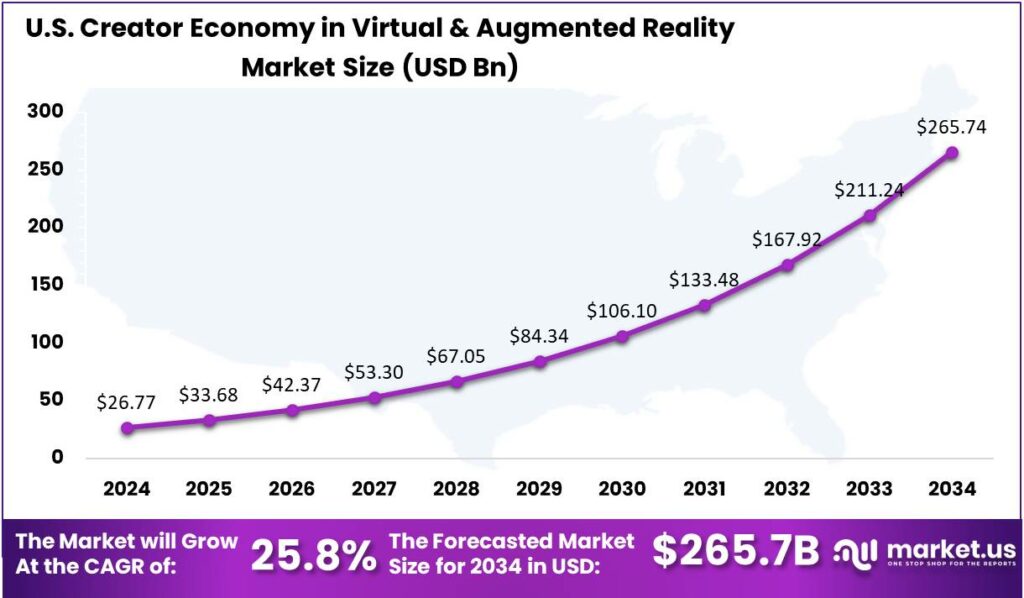
The Global Creator Economy in Virtual & Augmented Reality Market size is expected to be worth around USD 1,154.8 Bn By 2034, from USD 91.2 Bn in 2024, growing at a CAGR of 28.90% during the forecast period from 2025 to 2034. In 2024, North America held a 36.7% share of the Virtual & Augmented Reality sector in the Creator Economy, generating USD 33.4 bn. The U.S. market is projected to reach USD 26.77 bn, growing at a CAGR of 25.8%.
The Creator Economy in Virtual & Augmented Reality (VR & AR) refers to a burgeoning sector where content creators, developers, and artists leverage VR and AR technologies to create immersive experiences and interactive content. This segment of the creator economy is characterized by its use of cutting-edge technology to craft virtual worlds, augmented reality filters and applications, and digital experiences that are both engaging and transformative.
The growth of the Creator Economy in VR & AR is fueled by several key factors. The increasing affordability and availability of VR and AR hardware are broadening access, allowing more creators to get involved. Additionally, advancements in technology like better graphics and user interfaces are improving the quality and appeal of VR and AR experiences, drawing in both creators and users alike.
Additionally, the growing demand for immersive and interactive content across various sectors including gaming, education, and retail, provides substantial opportunities for creators. Social platforms and marketplaces for VR and AR content are expanding, offering creators new avenues to monetize their work and reach global audiences.
The popularity of VR and AR in the creator economy is evident in the proliferation of platforms that support user-generated content. Social VR platforms like VRChat and AltspaceVR and AR tools on smartphones allow creators to build and share their worlds and applications, highlighting the technologies’ potential to transcend traditional media boundaries.
According to Creative Class Group, only 5% of creators currently use VR, and 4% use AR. However, nearly 80% of creators are eager to adopt these technologies as they become more affordable and accessible. In 2023, creators worldwide generated $368 billion in revenue across 20 surveyed countries, a figure comparable to the GDP of countries like Hong Kong or South Africa.
Looking ahead, the Global Creator Economy Market is projected to reach a value of $1.487 trillion by 2034, up from $143 billion in 2024, with a compound annual growth rate (CAGR) of 26.4%. North America leads the market, holding over 35.1% of the global share, with the U.S. market alone valued at $50.1 billion in 2024.
The opportunities in the VR and AR market are extensive, especially in sectors that benefit from experiential learning and remote collaboration. Healthcare, real estate, and education are key areas where VR and AR can drive significant improvements. Advancements in ARKit and ARCore are also enabling creators to develop more advanced, practical AR applications, expanding market potential.
As infrastructure for VR and AR improves, the market is poised for significant expansion. Increased investments in hardware and software are fueling this growth, creating a dynamic ecosystem of creators, consumers, and tech providers. This thriving ecosystem is driving the evolution of the creator economy in the VR and AR spaces.
Key Takeaways
- The Global Creator Economy in Virtual & Augmented Reality Market size is projected to reach USD 1,154.8 Billion by 2034, up from USD 91.2 Billion in 2024, with a CAGR of 28.90% during the forecast period from 2025 to 2034.
- In 2024, the Social Media & Influencer Content segment dominated the Creator Economy in Virtual & Augmented Reality Market, capturing more than 28.4% share.
- The Subscription-Based segment held a dominant market position in the creator economy within virtual and augmented reality sectors, securing more than 42.7% share in 2024.
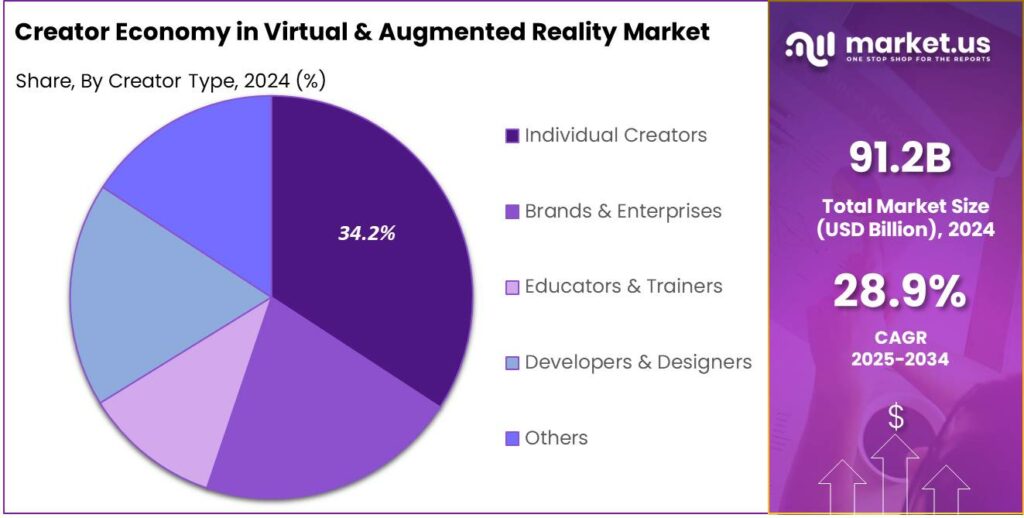
- In 2024, the Individual Creators segment also dominated the Virtual & Augmented Reality sector within the Creator Economy, with a share exceeding 34.2%.
- The Entertainment & Gaming segment led the market in 2024, capturing more than 38.2% share.
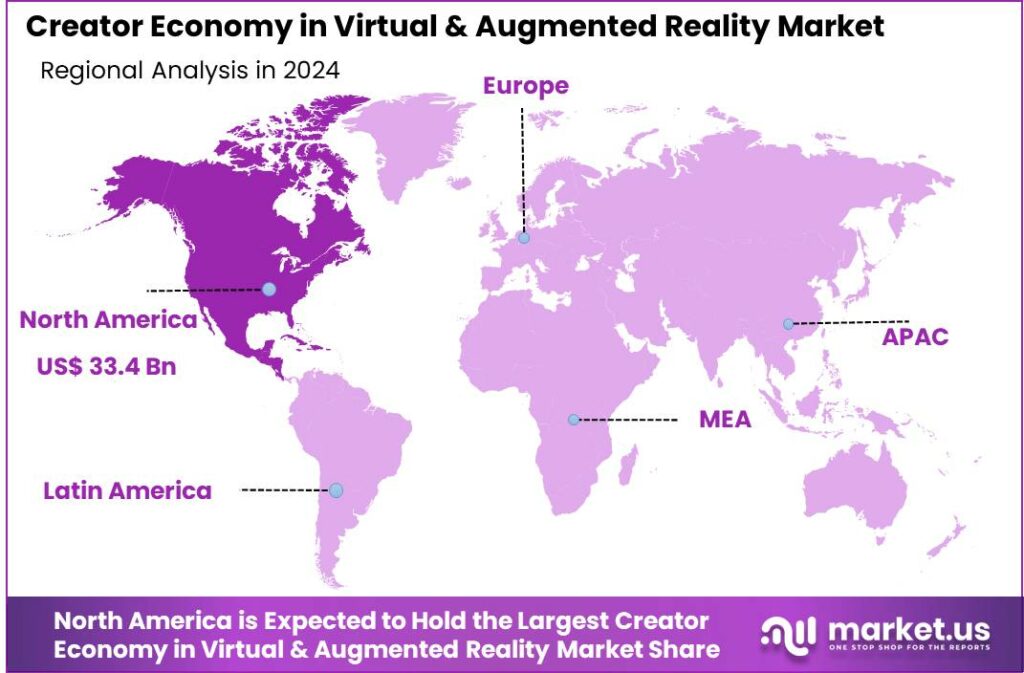
- North America held a significant position in the Virtual & Augmented Reality sector within the Creator Economy in 2024, with a share of 36.7%, translating to revenues of USD 33.4 billion.
- The U.S. Creator Economy in Virtual & Augmented Reality market is projected to reach USD 26.77 billion in 2024, growing at a CAGR of 25.8%.
U.S. Market Size
The market for Virtual and Augmented Reality in the U.S. Creator Economy is expected to experience significant growth, reaching a projected value of $26.77 billion by the year 2024. This sector is forecasted to grow at a compound annual growth rate (CAGR) of 25.8%.
This growth is driven by the rising demand for immersive user experiences in sectors such as gaming, training, and education, as well as in professional content creation. As technology advances, creators are leveraging VR and AR to produce innovative and engaging content that pushes the boundaries of traditional media.
Furthermore, the development of more sophisticated VR and AR platforms by leading tech companies is facilitating easier access and lower entry barriers for creators. The expansion of 5G networks is expected to further boost the capabilities of these technologies, enabling more complex and richly detailed virtual experiences.
In 2024, North America held a dominant market position in the Virtual & Augmented Reality sector within the Creator Economy, capturing more than a 36.7% share with revenues reaching USD 33.4 billion. This region’s leadership can be attributed to several key factors that drive innovation and adoption of VR and AR technologies.
North America’s advanced digital infrastructure, including high-speed internet and expanding 5G networks, supports the bandwidth and low-latency needs of VR and AR. This enhances user experience and makes these technologies more accessible, enabling immersive virtual environments.
In addition to technological and infrastructural advantages, North America also has a robust consumer market with a high willingness to adopt new technologies. This consumer base is eager to engage with advanced VR and AR experiences, from entertainment and gaming to educational and training applications.
Educational institutions and businesses in North America are driving market growth by adopting VR and AR for training and development. The effectiveness of immersive learning environments expands their applications and highlights the region’s commitment to integrating these technologies across various sectors.
Application Analysis
In 2024, the Social Media & Influencer Content segment held a dominant position within the Creator Economy in Virtual & Augmented Reality Market, capturing more than a 28.4% share. This segment’s leadership stems primarily from the pervasive use of VR and AR technologies to enhance user engagement on social platforms.
Influencers and content creators are using VR and AR to produce immersive, interactive content that captivates audiences. As social media platforms integrate advanced AR filters and VR features, demand for VR and AR content is expected to rise.
This segment benefits enormously from the commercial appeal of enhanced reality experiences in marketing and brand promotions. Social media influencers and brands leverage AR and VR to create novel advertising content that resonates more profoundly with viewers, providing them with an interactive and engaging experience rather than passive consumption.
Furthermore, the development of platforms that specifically support AR and VR content has provided influencers and creators with new tools to expand their creativity and outreach. These platforms are designed to be highly user-friendly, lowering the entry barrier for creators who might not have technical expertise in AR and VR.
Monetization Model Analysis
In 2024, the Subscription-Based segment held a dominant market position in the creator economy within the virtual and augmented reality sectors, capturing more than a 42.7% share. This model’s success stems largely from its ability to provide steady revenue streams to creators and a continuous value proposition to users.
Subscription services like Adobe Aero for AR and Viveport for VR provide creators with ongoing access to tools, assets, and updates for a recurring fee. This model is especially appealing in AR and VR, where continuous content updates and platform improvements are vital for user engagement.
One-Time Purchases represent a straightforward monetization model where users pay once to gain access to a piece of content or software. This model appeals to consumers who prefer not to commit to ongoing payments. However, it poses challenges for creators who must continuously attract new buyers to sustain their revenue.
The Pay-per-Use model, though less prevalent than subscription services and one-time purchases, offers flexible pricing that allows users to pay based on the usage or the specific features they employ. This can be particularly appealing in educational or professional VR/AR applications where users may need access to advanced features on an as-needed basis.
Creator Type Analysis
In 2024, the Individual Creators segment held a dominant market position in the Virtual & Augmented Reality sector within the Creator Economy, capturing more than a 34.2% share. This segment’s prominence is largely due to the rise of independent content creation fueled by accessible VR and AR technologies.
The rise of platforms supporting VR and AR content has lowered entry barriers for creators, offering necessary infrastructure and monetization options like sales, subscriptions, and sponsorships. This fosters innovation and helps sustain creators’ ventures.
Additionally, the support from an increasingly tech-savvy consumer base has propelled the growth of the Individual Creators segment. As consumers seek more personalized and engaging content, individual creators are able to deliver tailor-made experiences that resonate with niche interests and communities.
Educational resources and community support also play a critical role in nurturing this segment. Various online courses, tutorials, and community forums have emerged, dedicated to teaching VR and AR content creation. This educational support not only enhances skills but also fosters a collaborative environment that accelerates the sharing of ideas and techniques among creators.
End-User Industry Analysis
In 2024, the Entertainment & Gaming segment held a dominant market position, capturing more than a 38.2% share. This prominence is largely due to the rapid adoption of virtual and augmented reality (VR/AR) technologies within the gaming industry.
Advancements in VR/AR hardware and software, including better graphics, motion tracking, and user-friendly headsets, have strengthened the Entertainment & Gaming sector. Developers are using these improvements to create more engaging content, attracting a larger audience and growing market share.
Moreover, strategic partnerships and investments have played a crucial role in the expansion of VR/AR in entertainment and gaming. Major technology companies are investing heavily in developing advanced VR hardware and software, driving innovation and making VR more accessible to a wider consumer base.
The COVID-19 pandemic boosted demand for immersive entertainment as people sought at-home experiences. VR/AR gaming offered a compelling solution, allowing users to explore virtual worlds and engage in interactive activities, driving market growth during this time.
Key Market Segments
By Application
- Social Media & Influencer Content
- Gaming & Interactive Experiences
- Virtual Events & Conferences
- Digital Art & NFTs
- Education & Training
- Virtual Virtual Film & Animation
- Metaverse Content Creation
- Others
By Monetization Model
- Subscription-Based
- One-Time Purchases
- Pay-per-Use
By Creator Type
- Individual Creators
- Brands & Enterprises
- Educators & Trainers
- Developers & Designers
- Others
By End-User Industry
- Entertainment & Gaming
- Education & E-Learning
- Retail & E-Commerce
- Healthcare & Wellness
- Real Estate & Architecture
- Others
Driver
Technological Advancements Enhancing Immersive Experiences
The swift progress in VR and AR technologies has significantly enriched the immersive quality of digital content. Innovations like enhanced motion tracking, high-resolution displays, and advanced haptic feedback have allowed creators to build more immersive experiences. In gaming, VR provides players with an unparalleled level of interaction and presence.
AR applications have transformed industries like retail and education by overlaying digital information onto the physical world, thereby enhancing user engagement and interaction. These technological strides have opened new avenues for creators to develop content that captivates and retains audiences, driving the expansion of the VR/AR creator economy.
Restraint
High Development Costs and Accessibility Barriers
Despite the promising opportunities, the VR/AR creator economy faces challenges related to the high costs of development and limited accessibility. Creating high-quality VR/AR content often requires substantial investment in specialized equipment, software, and technical expertise.
Additionally, consumers need access to compatible hardware, such as VR headsets or AR-enabled devices, which can be prohibitively expensive for many. This financial barrier restricts both creators and users, limiting the widespread adoption of VR/AR experiences. Moreover, the steep learning curve associated with VR/AR development tools can deter new creators from entering the market, thereby slowing the growth of the creator community in this space.
Opportunity
Expansion into Diverse Sectors
The application of VR/AR technologies is extending beyond entertainment into various sectors, presenting creators with diverse opportunities. In healthcare, VR is being utilized for patient therapy and medical training simulations, offering immersive environments for learning and treatment.
In education, AR enhances learning by bringing interactive, 3D models into the classroom, thereby enriching the educational experience. The real estate industry is also leveraging VR for virtual property tours, allowing potential buyers to explore properties remotely. These expanding applications provide creators with the chance to develop specialized content tailored to different industries, thereby broadening their market reach and potential revenue streams.
Challenge
Navigating Platform Dependencies and Market Fragmentation
Creators in the VR/AR space often contend with platform dependencies and a fragmented market landscape. Reliance on specific platforms or app stores can subject creators to varying policies, revenue-sharing models, and content restrictions, which may impact their creative freedom and profitability.
Additionally, the VR/AR market is fragmented across different hardware devices and operating systems, requiring creators to adapt their content for multiple platforms to reach a wider audience. This necessity for cross-platform compatibility increases development complexity and costs. Furthermore, the absence of standardized development protocols can lead to inconsistent user experiences, posing a challenge for creators aiming to deliver high-quality content across diverse platforms.
Emerging Trends
Creators are using VR and AR to craft immersive experiences, allowing audiences to interact with content in novel ways. For instance, virtual fashion shows enable viewers to explore designs in a 3D space, enhancing engagement.
Brands are partnering with creators to develop AR experiences, like virtual try-ons, to offer consumers interactive ways to engage with products. This approach not only boosts customer engagement but also provides creators with new opportunities for collaboration.
A blend of physical and digital art, known as phygital art, is gaining traction. Artists create pieces that exist both physically and digitally, providing unique experiences and expanding the ways art can be consumed.
Business Benefits
- New Revenue Streams: Selling virtual goods and experiences allows creators to monetize their work beyond traditional methods, tapping into the growing market for digital assets.
- Global Reach: VR and AR platforms enable creators to reach a worldwide audience without geographical constraints, expanding their potential market.
- Cost Efficiency: Creating in virtual spaces can reduce costs associated with physical production, such as materials and venue rentals, making it more accessible for creators.
- Innovative Marketing: Brands can leverage VR and AR to create memorable marketing campaigns, enhancing customer engagement and brand loyalty.
- Data Insights: Digital platforms provide valuable data on audience interactions, helping creators and businesses refine their offerings and strategies for better engagement.
Key Regions and Countries
- North America
- US
- Canada
- Europe
- Germany
- France
- The UK
- Spain
- Italy
- Rest of Europe
- Asia Pacific
- China
- Japan
- South Korea
- India
- Australia
- Singapore
- Rest of Asia Pacific
- Latin America
- Brazil
- Mexico
- Rest of Latin America
- Middle East & Africa
- South Africa
- Saudi Arabia
- UAE
- Rest of MEA
Key Player Analysis
Companies in this market aim to provide tools that enable creators to build, share, and monetize their content in a way that can reach vast audiences globally.
Meta (formerly Facebook) has emerged as a leader in the VR and AR space, with its vision of the “Metaverse” at the center of its strategy. Meta’s investments in Oculus (now Meta Quest) headsets, Horizon Worlds, and other VR applications position the company as a powerful force in the creator economy.
Apple Inc. approach to VR and AR focuses on blending the virtual and physical worlds through its highly anticipated AR glasses and tools like ARKit, a framework that allows creators to build AR apps. Apple is known for its ability to seamlessly integrate hardware and software, offering a user-friendly experience that appeals to both developers and creators.
Microsoft Corporation role in the creator economy is heavily influenced by its focus on enterprise-level AR solutions, particularly with products like the HoloLens. HoloLens allows creators to design immersive experiences for industries ranging from education and healthcare to architecture and entertainment.
Top Key Players in the Market
- Meta Platforms, Inc.
- Apple Inc.
- Microsoft Corporation
- HTC Corporation
- Sony Group Corporation
- Magic Leap, Inc.
- Unity Software Inc.
- Epic Games, Inc.
- Adobe Inc.
- Google LLC
- Others
Top Opportunities Awaiting for Players
- New Platforms for Content Creation: The expansion of virtual and augmented reality technologies allows creators to pioneer new forms of storytelling, performance art, and social interactions through immersive environments. As VR and AR become more mainstream, the scope for innovative content creation in 3D virtual worlds, avatars, and custom virtual spaces broadens, offering a canvas for creativity and new business ventures.
- Monetization Through NFTs and Digital Assets: Non-fungible tokens (NFTs) and digital assets present a lucrative avenue for creators in the VR and AR spaces. By creating unique digital goods and experiences, creators can directly monetize their work through platforms that support blockchain technologies. This includes selling digital art, virtual real estate, and exclusive virtual experiences, which cater to a growing audience of digital collectors and enthusiasts.
- Specialized Platforms and Services: The rise of specialized platforms that cater to niche areas of content creation such as digital art, virtual concerts, and educational content enables creators to reach specific audiences and monetize their unique offerings. These platforms not only facilitate content distribution but also provide tools and resources to enhance the creation process and improve engagement with audiences.
- Collaboration and Community Building in the Metaverse: The metaverse offers a new realm for creators to build communities and engage with audiences in meaningful ways. This includes collaborative projects, community-driven events, and interactive experiences that leverage the social and interconnected nature of VR and AR technologies. Such environments are conducive to fostering a sense of belonging and community among users, which is integral for sustained engagement and growth.
- Enhanced Global Reach and Accessibility: VR and AR technologies break down geographical barriers, allowing creators to reach a global audience with minimal overhead. This accessibility not only expands the market potential but also diversifies the audience base, allowing creators to tap into international markets and cater to a broader range of cultural tastes and preferences.
Recent Developments
- In January 2025, Sony launched the XYN platform, which includes tools like the XYN Headset (a 4K OLED-equipped AR/VR prototype), XYN Spatial Capture, and XYN Motion Studio for industries like gaming and industrial design. Collaborations with Siemens highlight its enterprise applications in the industrial metaverse.
- At CES 2025, XREAL unveiled its One Series AR glasses, featuring the X1 Spatial Computing Chip and advanced optical designs. The flagship model, XREAL One Pro, is priced at $599 and will ship by Q2 2025. These glasses are designed for immersive entertainment and productivity use cases
- In December 2024, Meta has teamed up with James Cameron’s Lightstorm Entertainment to revolutionize 3D content creation for immersive media. This collaboration focuses on advancing stereoscopic technology and refining tools for 3D production, aiming to elevate storytelling in mixed reality.









