


Report Overview
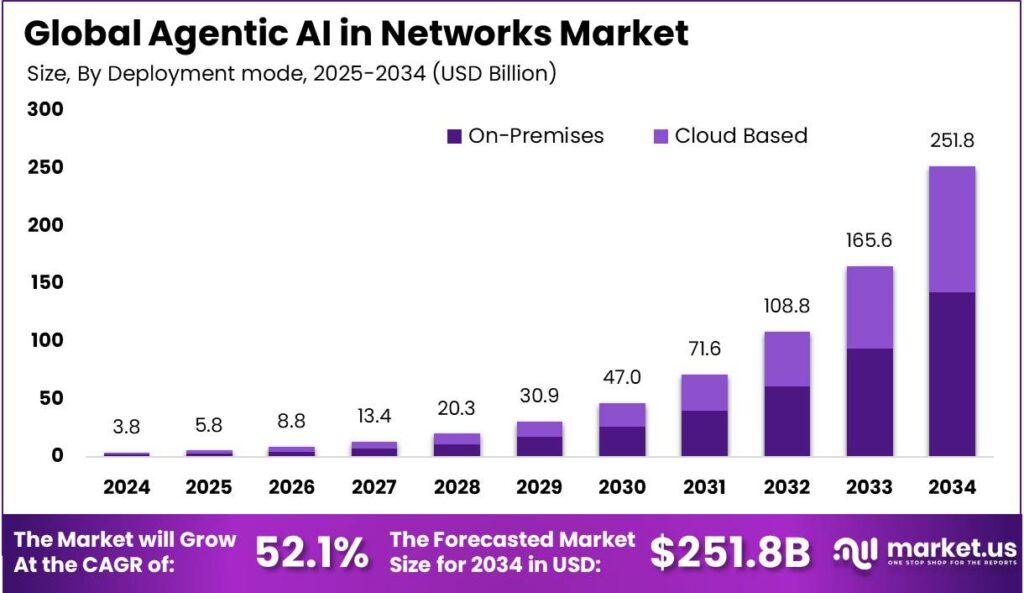
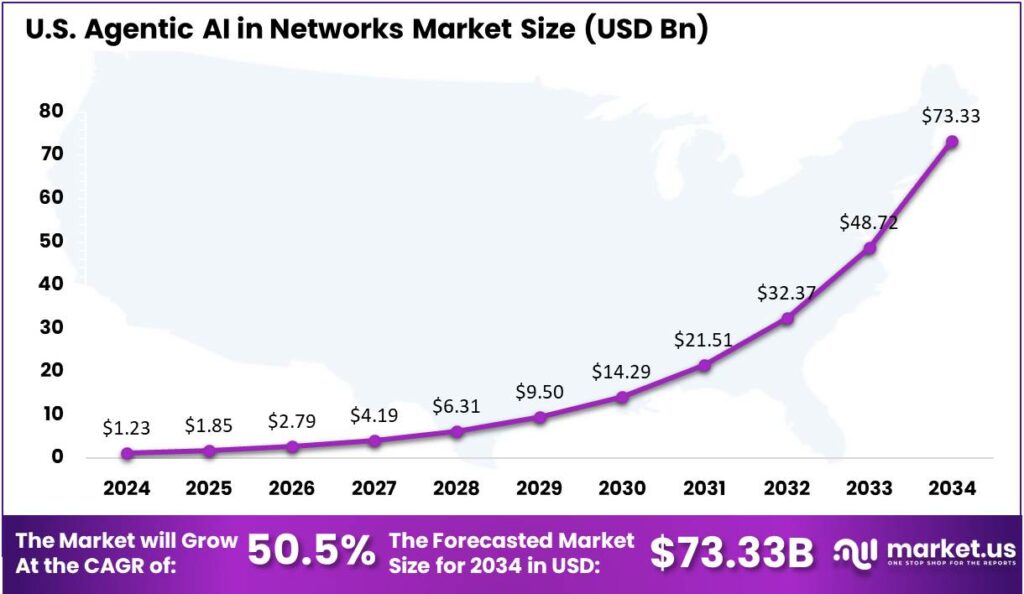
The Global Agentic AI in Networks Market size is expected to be worth around USD 251.8 Billion By 2034, from USD 3.8 Billion in 2024, growing at a CAGR of 52.10% during the forecast period from 2025 to 2034. In 2024, North America held 40.5% of the market share, generating about USD 1.5 billion. The U.S. Agentic AI in Networks Market, valued at USD 1.23 billion, is expected to grow at a CAGR of 50.5%.
The market for agentic AI in networks is expanding as industries recognize the benefits of autonomous systems that can manage complex tasks and make informed decisions quickly. This technology is particularly transformative in sectors like telecommunications, cybersecurity, and enterprise IT systems, where the ability to rapidly analyze and respond to data can significantly enhance efficiency and security.
The primary drivers of the agentic AI market include the increasing demand for automation and efficient data processing in industries facing large-scale, complex operational challenges. Businesses are leveraging agentic AI to improve response times, enhance accuracy, and reduce the workload on human employees, which in turn drives productivity and operational efficiencies.
According to Market.us, the Global Agentic AI Market is set to grow rapidly, reaching USD 196.6 billion by 2034, up from USD 5.2 billion in 2024. This represents a strong CAGR of 43.8% over the forecast period from 2025 to 2034. North America is leading the way, holding more than a 38% market share in 2024, translating to USD 1.97 billion in revenue.
The U.S. Agentic AI market alone was valued at USD 1.58 billion in 2024, with a projected CAGR of 43.6%. This growth is driven by increasing investments in AI technologies, rising demand for automation, and advancements in machine learning models.
The growing need for stronger cybersecurity in network infrastructures accelerates the adoption of Agentic AI, as it can detect and respond to threats more quickly than traditional methods. Additionally, the push for digital transformation across industries motivates organizations to embrace intelligent technologies like Agentic AI to remain competitive and efficient in network management.
The popularity of agentic AI in networks is also on the rise, reflecting its growing acceptance and implementation across various sectors.As organizations strive for competitive advantages, the adoption of AI technologies is becoming more common. This trend is fueled by growing trust in AI’s ability to manage and secure complex networks, driving its integration into critical infrastructure.
Key Takeaways
- The Global Agentic AI in Networks Market size is projected to reach USD 251.8 Billion by 2034, up from USD 3.8 Billion in 2024, growing at a CAGR of 52.10% during the forecast period from 2025 to 2034.
- In 2024, the Natural Language Processing (NLP) segment dominated the market, holding a 34.6% share.
- The On-Premise deployment mode of Agentic AI in networks led the market in 2024, capturing 56.7% of the total share.
- In 2024, Network Automation emerged as the leading application, holding a 40.8% market share in the Agentic AI in Networks sector.
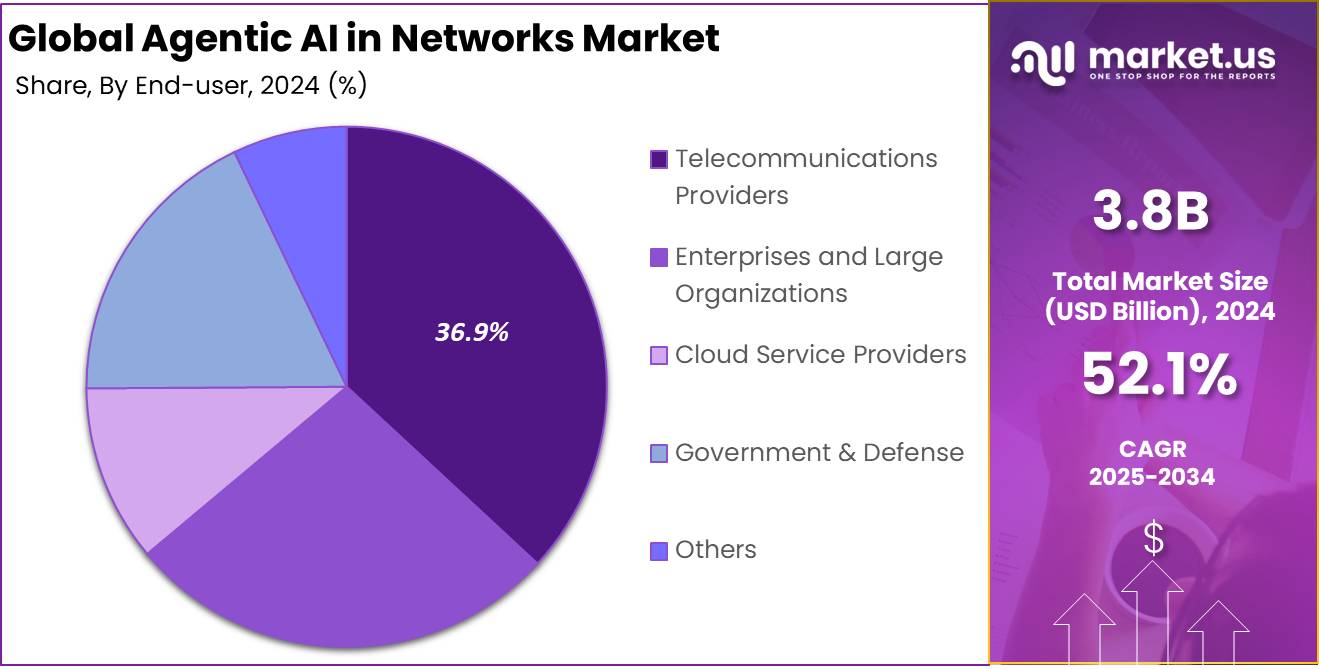
- The Telecommunications Providers segment dominated the Agentic AI in Networks market in 2024, capturing 36.9% of the total market share.
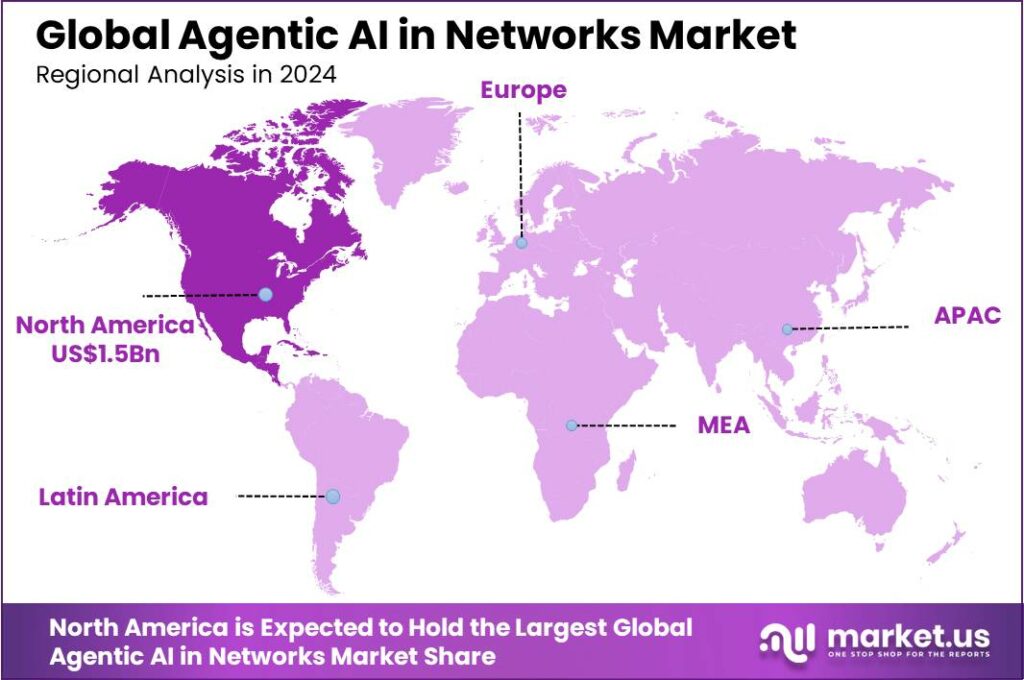
- North America held a dominant market position in 2024, securing 40.5% of the market share and generating approximately USD 1.5 billion in revenue.
- The U.S. Agentic AI in Networks Market, valued at $1.23 billion in 2024, is projected to grow at a CAGR of 50.5%.
U.S. Agentic AI in Networks Market
The U.S. Agentic AI in Networks Market, currently valued at $1.23 billion in 2024, is poised for significant expansion, with a projected compound annual growth rate (CAGR) of 50.5% over the coming years. This growth highlights the widespread adoption of AI-driven network solutions, transforming network operations, performance, and security.
The growth trajectory of agentic AI in networks is fueled by advancements in machine learning (ML), deep learning, and real-time data processing that enable networks to function with minimal human intervention. Enterprises and service providers are increasingly leveraging AI-powered network management systems to enhance operational efficiency, reduce latency, and proactively detect cyber threats.
As organizations invest in intelligent networking, industry leaders are developing AI models that adapt to real-time changes, optimize bandwidth, and prevent downtime. Meanwhile, regulatory bodies and cybersecurity frameworks are evolving to tackle the ethical and security challenges of AI-driven network decision-making.
In 2024, North America held a dominant market position, capturing more than a 40.5% share and generating approximately USD 1.5 billion in revenue. This leadership stems from the region’s advanced tech infrastructure, swift AI-driven network automation adoption, and major investments from tech giants like Google, Microsoft, IBM, and Cisco.
The presence of major cloud providers and telecom companies has accelerated the use of agentic AI in network management, cybersecurity, and autonomous decision-making. Additionally, U.S. government support for AI innovation and next-gen networking technologies strengthens North America’s competitive edge in the sector.
One of the key drivers of North America’s dominance in the agentic AI in networks market is the early adoption of 5G, edge computing, and AI-powered cybersecurity solutions. With the proliferation of IoT devices, real-time analytics, and data-intensive applications, enterprises in the U.S. and Canada are investing heavily in AI-driven network automation to enhance efficiency and security.
North America’s leadership is bolstered by its strong regulatory framework and cybersecurity efforts that foster AI-driven networking solutions. Agencies like the FCC and NIST are key in establishing standards for AI deployment, ensuring both compliance and security in networks.
Technology Analysis
In 2024, the Natural Language Processing (NLP) segment held a dominant position in the Agentic AI in Networks market, capturing more than a 34.6% share. This leading role can be attributed to the increasing adoption of NLP technologies in enhancing communication between humans and networked systems.
NLP allows networks to interpret human language, enhancing user interfaces and automated customer service. The growth of e-commerce and digital interactions has driven demand for NLP to handle large volumes of data, contributing to its significant market share.
The prominence of NLP in the Agentic AI in Networks market is also supported by its crucial role in automating content moderation and cybersecurity measures. As networks grow in complexity and scale, the ability to automatically monitor, detect, and respond to inappropriate or malicious content becomes imperative.
Additionally, the integration of NLP with other AI technologies like Machine Learning and Deep Learning is creating more sophisticated network management tools. These integrations are enhancing the capability of networks to learn from data inputs and improve over time without explicit programming.
Deployment Mode Analysis
In 2024, the On-Premise deployment mode of agentic AI in networks held a dominant position in the market, capturing more than a 56.7% share. This leading status can be attributed to several key factors that appeal to organizations prioritizing control and security of their network systems.
On-premise solutions offer enterprises the ability to maintain all data and AI capabilities within their physical premises, thus providing enhanced security measures and reducing vulnerability to external breaches. This is particularly crucial for industries such as finance, government, and healthcare, where data sensitivity is paramount.
The preference for on-premise deployments is driven by the control and customization they offer. Organizations can tailor AI systems to their needs and integrate them with existing infrastructure, enabling optimized network management and driving the segment’s popularity.
On-premise solutions can reduce ongoing costs associated with data transmission and cloud service fees, making them appealing for organizations with the capital to invest in the required hardware and software. This cost-effectiveness is particularly attractive to companies with large-scale operations, as it allows for more predictable cost management.
Application Analysis
In 2024, the Network Automation segment held a dominant market position, capturing more than a 40.8% share, making it the leading application in the Agentic AI in Networks Market. The primary reason for this leadership is the increasing demand for self-optimizing, AI-driven network solutions that can manage complex, large-scale infrastructures with minimal human intervention.
As networks grow in complexity due to the expansion of 5G, IoT, and edge computing, organizations are increasingly investing in AI-powered traffic management, fault detection, network slicing, and predictive maintenance to ensure seamless connectivity and operations.
The traffic management sub-segment in network automation has grown significantly due to the demand for real-time data routing, congestion control, and intelligent bandwidth allocation. AI-driven automation is being used by businesses, telecom operators, and cloud providers to optimize data flow, prevent network failures, and reduce latency, enhancing user experiences.
Network automation is also driven by its role in network slicing, vital for 5G and next-gen mobile networks. AI-powered network slicing enables service providers to create multiple virtual networks within a single infrastructure, optimizing performance for use cases like autonomous vehicles, remote healthcare, and industrial IoT applications.
End-User Analysis
In 2024, the Telecommunications Providers segment held a dominant position in the Agentic AI in Networks market, capturing more than a 36.9% share. This segment’s leadership can be attributed primarily to the growing demand for enhanced network management and optimization solutions, which are essential in the era of increasing data traffic and complex network architectures.
Telecommunications providers are increasingly adopting Agentic AI technologies to improve service reliability, reduce operational costs, and enhance customer satisfaction. The strategic deployment of AI enables these providers to automate network operations and proactively manage service disruptions, making it a critical factor in their market dominance.
Enterprises and Large Organizations also represent a significant portion of the market. These entities leverage Agentic AI to bolster their network security and efficiency, driven by the need to handle vast amounts of data and maintain robust connectivity across global operations.
The adoption within this segment is propelled by the necessity to integrate AI capabilities to streamline operations and mitigate the risks associated with data breaches and cyber threats. As businesses continue to expand digitally, the reliance on Agentic AI tools is expected to rise, reflecting a growing segment share.
Key Market Segments
By Technology
- Machine Learning (ML)
- Reinforcement Learning (RL)
- Deep Learning (DL)
- Natural Language Processing (NLP)
- Computer Vision
- Others
By Deployment Mode
- On-Premise
- Cloud-Based
By Application
- Network Automation
Traffic Management
Fault Detection and Prevention
Network Slicing
Others - Security Management
Intrusion Detection Systems (IDS)
Anomaly Detection
Threat Intelligence
Others - Service Management
Virtual Network Functions (VNFs)
Network Performance Monitoring
Others - Others (Edge Computing, Customer Experience, etc.)
By End-User
- Telecommunications Providers
- Enterprises and Large Organizations
- Cloud Service Providers
- Government & Defense
- Others
Driver
Technological Advancements and Demand for Automation
The rapid growth of agentic AI in networks is primarily driven by significant technological advancements and an increasing demand for automation across various industries. Innovations in machine learning, natural language processing, and data analytics have enhanced AI systems’ capabilities, enabling them to perform complex tasks with greater efficiency and accuracy.
Businesses are leveraging these advancements to streamline operations, reduce costs, and improve decision-making processes. For instance, in manufacturing, AI-driven automation optimizes production lines, while in healthcare, it assists in patient data analysis and personalized treatment plans. This trend reflects a broader shift towards embracing digital transformation to remain competitive in a fast-paced market.
Restraint
Ethical and Regulatory Challenges
Despite its benefits, the adoption of agentic AI faces significant ethical and regulatory hurdles. The autonomous nature of these systems raises concerns about data privacy, security, and potential biases in decision-making.
Ensuring compliance with regulations like the GDPR and the California Consumer Privacy Act (CCPA) necessitates robust security measures and transparent data handling practices. Moreover, the lack of standardized global frameworks for AI governance complicates the deployment of these technologies across different regions. Organizations must navigate these complexities carefully to maintain public trust and avoid legal pitfalls.
Opportunity
Integration with Cloud Services and AI-as-a-Service (AIaaS)
A promising opportunity for agentic AI lies in its integration with cloud platforms and the growing availability of AI-as-a-Service models. Cloud-based deployment offers scalability and flexibility, making advanced AI tools accessible to businesses of all sizes, including small and medium-sized enterprises.
AIaaS allows organizations to implement sophisticated AI functionalities without substantial upfront investments in infrastructure. This model supports on-demand resource allocation and can automate complex processes, providing real-time intelligent solutions that can be tailored to specific industry needs.
Challenge
Complexity of Implementation and Integration
Implementing agentic AI systems presents challenges, particularly concerning their integration into existing organizational infrastructures. Large enterprises may have the resources to manage such integrations, but small and medium-sized businesses often struggle with the financial and technical demands.
Ensuring compatibility with legacy systems requires careful planning and significant investment. Additionally, as AI systems become more complex, maintaining their performance and ensuring they operate without constant human oversight becomes increasingly difficult. Organizations need to invest in training and infrastructure to manage these systems effectively, which can be a substantial undertaking.
Emerging Trends
One emerging trend is the integration of agentic AI into network management. By embedding AI agents within networks, organizations can automate routine tasks, such as monitoring performance and detecting anomalies. This leads to quicker responses to issues and reduces the need for manual intervention.
Another trend is the use of Agentic AI to optimize resource allocation by dynamically adjusting network resources based on demand. This adaptability ensures optimal performance, especially in environments with fluctuating workloads, maintaining service quality without overprovisioning resources.
Incorporating agentic AI into networks enhances decision-making by analyzing vast data in real-time. This provides insights that guide strategic planning and operational adjustments, allowing organizations to anticipate trends and make informed decisions to boost network efficiency and reliability.
Business Benefits
- Boosts Efficiency: By automating routine tasks, agentic AI allows employees to focus on more important work, leading to increased productivity.
- Enhances Decision-Making: Agentic AI can quickly analyze large amounts of data, providing insights that help businesses make informed decisions.
- Reduces Costs: Automating complex workflows with agentic AI minimizes the need for manual labor, leading to significant cost savings.
- Improves Customer Experience: Agentic AI can provide personalized support to customers, enhancing their overall experience with the business.
- Increases Scalability: Agentic AI systems can adapt to changing market conditions, allowing businesses to scale operations efficiently without significant new investments.
Key Regions and Countries
- North America
- US
- Canada
- Europe
- Germany
- France
- The UK
- Spain
- Italy
- Rest of Europe
- Asia Pacific
- China
- Japan
- South Korea
- India
- Australia
- Singapore
- Rest of Asia Pacific
- Latin America
- Brazil
- Mexico
- Rest of Latin America
- Middle East & Africa
- South Africa
- Saudi Arabia
- UAE
- Rest of MEA
Key Player Analysis
Key players in Agentic AI in Networks Market are driving the future of AI-powered network solutions, playing a crucial role in the growth of the sector.
AT&T has been at the forefront of adopting AI technologies to enhance its network operations. By integrating Agentic AI, AT&T aims to improve network automation, optimize service delivery, and enhance operational efficiency. With a robust portfolio of patents and innovations, AT&T has positioned itself as a leader in applying AI to drive smarter, self-managing networks.
Verizon Communications Inc. is another key player leveraging Agentic AI to enhance its network capabilities. With a focus on delivering reliable and efficient 5G services, Verizon utilizes AI technologies to optimize network management, reduce latency, and ensure high-quality service for its customers.
Vodafone Group PLC has been making strides in using Agentic AI to transform its network operations. The company has embraced AI-powered automation to improve network performance, particularly in managing large-scale infrastructure. Vodafone’s AI-driven approach helps in predictive maintenance, real-time monitoring, and enhanced decision-making processes.
Top Key Players in the Market
- AT&T Intellectual Property
- Verizon Communications Inc.
- Vodafone Group PLC
- Deutsche Telekom
- China Mobile Limited
- Cisco Systems, Inc.
- Huawei Technologies Co., Ltd.
- Juniper Networks, Inc.
- Nokia Corporation
- Arista Networks, Inc.
- Amazon Web Services, Inc.
- International Business Machines Corporation (IBM)
- Others
Top Opportunities Awaiting for Players
As the agentic AI landscape evolves, several market opportunities emerge for network companies.
- Enhanced Decision-Making and Automation: Agentic AI’s capacity for autonomous decision-making is significantly enhancing efficiencies across various industries, including networks. These AI agents can autonomously manage complex network configurations and optimizations, drastically reducing the need for human intervention and allowing for quicker, more efficient network management.
- AI-Driven Customer Engagement: Networks companies can leverage agentic AI to revolutionize customer interactions. AI agents can provide personalized customer support, manage service requests, and even handle complaints, leading to improved customer satisfaction and retention. The predictive capabilities of these agents allow them to offer tailored solutions to customers before issues escalate.
- Dynamic Workforce Management: With the integration of agentic AI, network companies can optimize workforce management by using AI to forecast demand, schedule maintenance, and manage resources effectively. This not only improves operational efficiency but also reduces burnout and improves employee satisfaction by allowing more focused human oversight where it is most needed.
- Network Security and Threat Detection: Agentic AI can significantly enhance network security protocols by continuously learning and adapting to new threats. AI agents can autonomously detect and respond to security threats in real-time, a critical advantage as network architectures become more complex and cyber threats more sophisticated.
- Infrastructure Management and Service Optimization: Network companies can use agentic AI to manage and optimize infrastructure deployments, from traffic management to hardware maintenance. AI’s ability to analyze vast amounts of data and predict potential failures or bottlenecks before they occur can lead to substantial cost savings and improved service reliability.
Recent Developments
- In August 2024, telecommunications giant Lumen Technologies has secured new deals valued at $5 billion. These agreements, with leading cloud and tech companies, will see Lumen providing cutting-edge networking and cybersecurity solutions to meet the growing demand for advanced digital infrastructure.
- In 2025, Telecom providers are shifting from traditional network management to fully intuitive systems that autonomously adjust to changing conditions. These networks will continuously monitor performance, learn from traffic patterns, and adapt to fluctuations in demand and service quality.









