


Report Overview
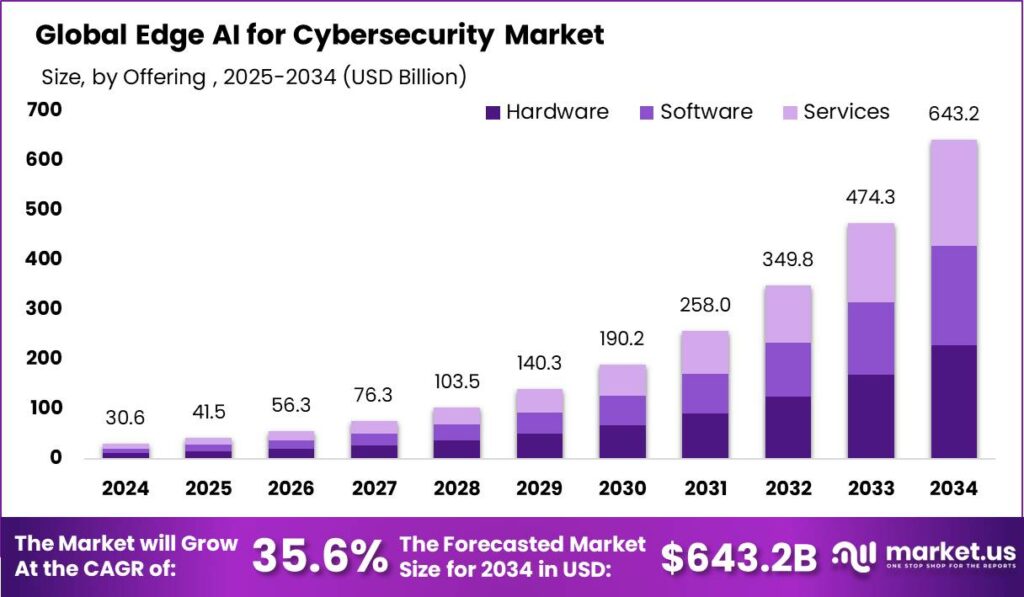
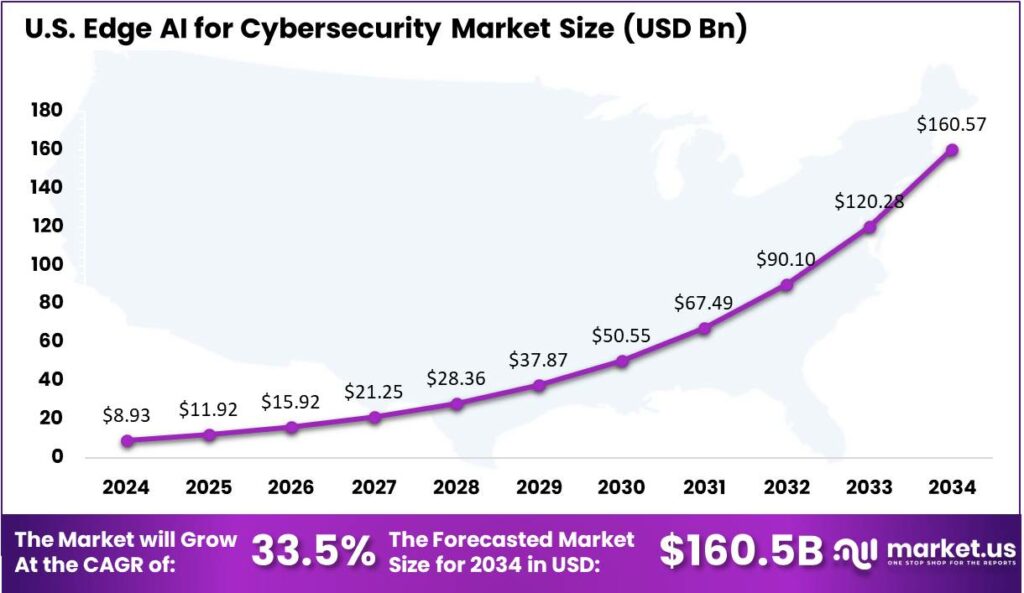
The Global Edge AI for Cybersecurity Market size is expected to be worth around USD 643.2 Bn By 2034, from USD 30.6 Bn in 2024, growing at a CAGR of 35.60% during the forecast period from 2025 to 2034. In 2024, North America held over 36.5% of the Edge AI for Cybersecurity market, with revenues of approximately USD 11.1 bn. The U.S. market was valued at USD 8.93 bn, reflecting a strong CAGR of 33.5%.
The Edge AI for cybersecurity market is rapidly expanding due to the proliferation of IoT devices and the increased need for real-time, efficient threat detection and response mechanisms. Organizations utilize Edge AI to handle the vast data generated by edge devices without the lag of cloud computing.
Several factors are driving the growth of the Edge AI for cybersecurity market. The proliferation of IoT devices and the accompanying increase in data generation require robust real-time processing and analysis capabilities at the edge. Additionally, the need for improved privacy and data protection standards encourages the adoption of edge computing solutions, which keep sensitive data localized and secure.
According to the Nasscom community, research indicates that the U.S. will see approximately 36 million people working remotely by the end of 2025. This represents about 22% of the entire workforce, marking an 87% increase from pre-pandemic levels. In this evolving landscape, Edge AI emerges as a pivotal technology.
The implementation of Edge AI in cybersecurity is not just a trend but a strategic move by forward-thinking enterprises. These companies recognize the dual benefits of improved security and operational efficiency. The market value of Edge AI, which stood at just US$355 million in 2018, is projected to soar to US$1.12 trillion by 2023.
Key Takeaways
- The Global Edge AI for Cybersecurity Market size is expected to reach USD 643.2 Billion by 2034, growing from USD 30.6 Billion in 2024, with a CAGR of 35.60% during the forecast period from 2025 to 2034.
- In 2024, Network Security held a dominant position within the Edge AI for Cybersecurity market, capturing more than 37.4% of the market share.
- The hardware segment was also dominant in the same year, securing more than 35.6% of the market share.
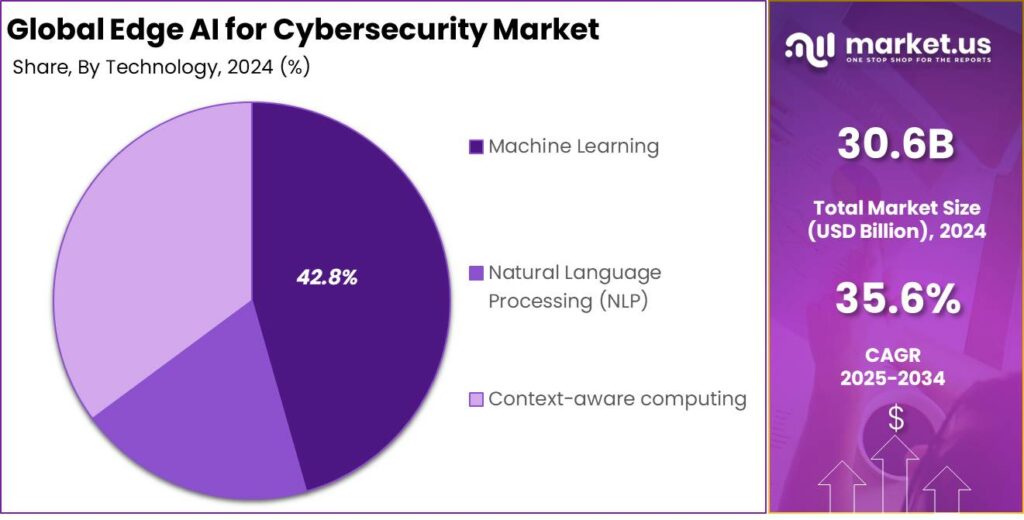
- In 2024, Machine Learning played a leading role in the market, commanding more than 42.8% of the share.
- The Fraud Detection/Anti-Fraud segment held a strong position, representing over 30.7% of the market share.
- The BFSI (Banking, Financial Services, and Insurance) sector accounted for more than 40.0% of the market share in 2024.
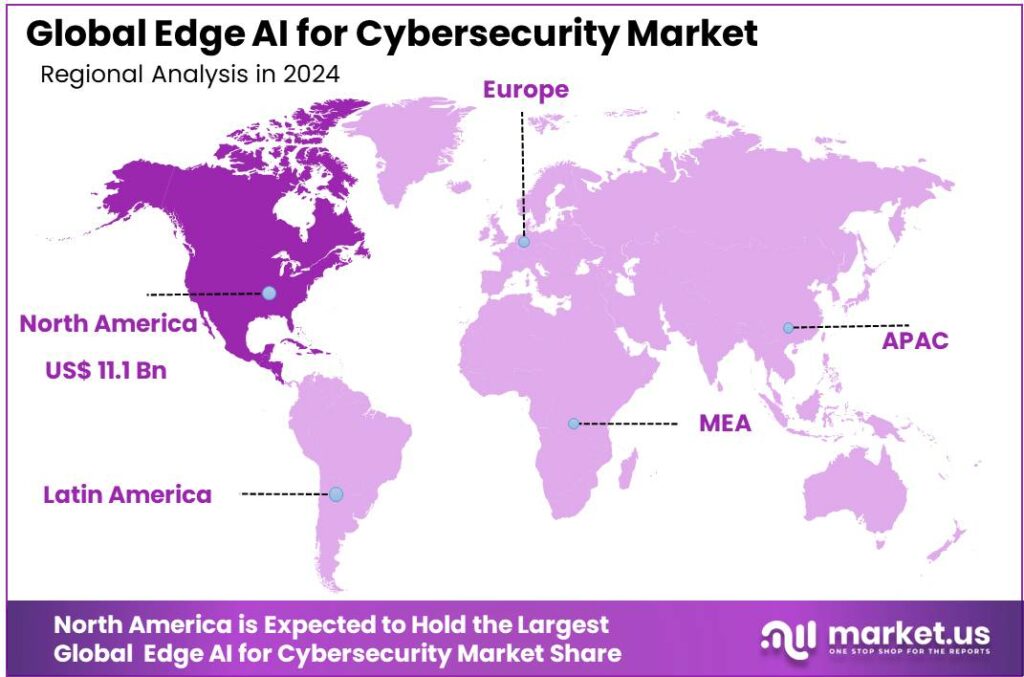
- North America was the dominant region, capturing more than 36.5% of the market share in 2024, with revenues amounting to approximately USD 11.1 billion.
- Specifically, the U.S. Edge AI for Cybersecurity Market was valued at USD 8.93 billion in 2024, showcasing a robust CAGR of 33.5%.
U.S. Market Size
In 2024, the U.S. Edge AI for Cybersecurity Market was valued at $8.93 billion, showcasing a robust compound annual growth rate (CAGR) of 33.5%. This significant growth is indicative of the increasing reliance on edge computing technologies integrated with artificial intelligence (AI) to enhance cybersecurity measures.
The burgeoning market reflects a broader trend towards deploying AI at the network’s edge, where data processing occurs closer to the data source rather than centralized data centers. This shift is primarily driven by the need for real-time data processing and decision-making in cybersecurity applications, which is critical for the immediate detection and response to potential threats.
Furthermore, the impressive growth rate of the market can also be attributed to the increasing number of cyber threats and the growing complexity of cyber attacks. As businesses and government agencies continue to digitize their operations, the demand for more sophisticated and localized cybersecurity solutions has risen.
In 2024, North America held a dominant market position in the Edge AI for Cybersecurity Market, capturing more than a 36.5% share with revenues amounting to approximately USD 11.1 billion. This leading stance can be attributed to several factors that uniquely position North America at the forefront of the edge AI for cybersecurity industry.
The region’s leadership is underpinned by its advanced technological infrastructure and the presence of key industry players that drive innovation and development in cybersecurity solutions. North America has historically been a hub for technological advancement, housing major tech companies and startups alike that prioritize and invest heavily in cybersecurity.
Moreover, the robust regulatory framework and stringent cybersecurity policies in North America compel businesses and organizations to adopt advanced security measures. This regulatory environment acts as a catalyst for the deployment of edge AI technologies, as these tools provide enhanced data protection capabilities and compliance with legal standards.
Analysts’ Viewpoint
There is a growing demand for Edge AI solutions in cybersecurity, driven by the need for real-time threat detection, data privacy, and operational efficiency. Industries such as healthcare, finance, and critical infrastructure are increasingly reliant on Edge AI to safeguard sensitive information against evolving cyber threats.
This demand is expected to increase as more devices connect to the internet and generate data that require immediate processing and protection. The expansion of IoT and mobile devices presents significant opportunities for the Edge AI cybersecurity market. There is a burgeoning need for solutions that can operate independently of central networks, capable of local data processing and real-time response.
This opens up market opportunities for developing robust Edge AI applications that can enhance security protocols on-device, without relying on central data centers. Technological advancements in AI algorithms and machine learning models capable of operating on low-power edge devices are revolutionizing cybersecurity.
These advancements enable devices to detect and respond to threats autonomously, with minimal human intervention. Improvements in AI capabilities, coupled with the development of more sophisticated edge computing hardware, are key enablers for deploying advanced security solutions directly where data is generated.
Type Analysis
In 2024, the Network Security segment held a dominant market position within the Edge AI for cybersecurity market, capturing more than a 37.4% share. This segment leads largely due to the escalating complexity and frequency of cyber-attacks targeting network infrastructures of businesses across various industries.
Network security solutions empowered by edge AI are crucial for analyzing and responding to threats in real-time, directly at the point where data flows into the network. This immediacy is vital for preventing data breaches and ensuring the integrity of network communications.
The surge in adoption of smart devices and the expansion of IoT networks have further propelled the need for robust network security measures. As more devices connect to networks, the potential entry points for attackers multiply, making traditional centralized security measures less effective.
The rise of remote work and cloud operations has made securing network perimeters a top priority for organizations. As a result, companies are investing in advanced network security solutions, with Edge AI technologies gaining popularity for their ability to provide on-device processing and safeguard remote and cloud interfaces.
Analysts’ Viewpoint
The demand for Edge AI solutions in cybersecurity is high among industries that manage critical infrastructure or sensitive data, such as healthcare, finance, and government. Opportunities in this market are largely centered around the development of AI models that can be deployed directly on edge devices to detect and respond to threats instantaneously.
There is also significant potential in refining these technologies to enhance their efficiency and scalability, which would make them suitable for a wider range of applications. Technological advancements are continuously shaping the Edge AI for cybersecurity landscape. Improvements in AI algorithms, machine learning models, and the hardware required to run these technologies at the edge are key developments.
These advancements enable more sophisticated threat detection and response mechanisms that are crucial for protecting against the latest cyber threats. Additionally, the integration of 5G technology is set to further boost the capabilities of edge devices by reducing latency and increasing the speed and reliability of network connections
Offering Analysis
In 2024, the hardware segment held a dominant market position within the Edge AI for cybersecurity market, capturing more than a 35.6% share. This segment leads primarily due to the critical role that specialized hardware plays in facilitating edge AI operations.
AI-optimized chips and advanced processors are crucial for local data processing on edge devices, enabling rapid, efficient real-time threat detection in cybersecurity. As threats grow more sophisticated, the demand for powerful hardware that supports AI algorithms at the network’s edge is increasing.
The growth of IoT devices has driven the expansion of the hardware segment, with a focus on embedded security features. Manufacturers are prioritizing compact, energy-efficient, and powerful hardware solutions capable of handling AI-driven security tasks.
The integration of AI into consumer electronics and industrial machinery is driving the hardware segment’s growth. As devices become more interconnected, the need for built-in cybersecurity increases. Edge AI hardware addresses this by enabling localized data processing, improving security while reducing bandwidth use and latency.
Technology Analysis
In 2024, the Machine Learning segment held a dominant position in the Edge AI for Cybersecurity market, capturing more than a 42.8% share. This segment’s leadership stems from its critical role in enhancing the accuracy and efficiency of threat detection and response systems.
Machine learning algorithms are adept at analyzing vast datasets quickly, learning from data patterns, and making real-time decisions, which is essential for identifying and neutralizing novel security threats. This technology’s ability to adapt and evolve with new data makes it indispensable in cybersecurity, where threats continuously change and evolve.
One of the primary reasons for the Machine Learning segment’s supremacy in the market is its integration into various cybersecurity applications. These include anomaly detection, where algorithms learn what normal network behavior looks like and can instantly flag deviations, potentially indicating a cyberattack.
The growing complexity of cyberattacks is boosting the demand for machine learning in cybersecurity. Traditional protocols are lagging, making machine learning’s adaptive and proactive capabilities essential. Its ability to continuously learn and adjust to new threats without human intervention enhances security and reduces breach risks.
Application Analysis
In 2024, the Fraud Detection/Anti-Fraud segment in the Edge AI for Cybersecurity market held a dominant position, capturing over 30.7% of the market share. This prominence is largely attributed to the increasing sophistication of cyber-attacks and financial fraud, which have underscored the necessity for robust, real-time fraud detection solutions.
Edge AI enhances the ability of systems to identify and respond to threats instantaneously, right at the data source. This immediacy in fraud detection is crucial for industries like banking, retail, and telecommunications, where milliseconds can mean the difference between a blocked transaction and a significant financial loss.
The effectiveness of Edge AI in the Fraud Detection/Anti-Fraud segment is further magnified by its integration with other cutting-edge technologies such as machine learning and behavioral analytics. These technologies enable the system to learn from past data, recognize patterns of normal and anomalous behavior, and predict potential threats before they occur.
Rising regulatory pressure and the high costs of data breaches are pushing businesses to invest in advanced cybersecurity solutions. Edge AI addresses these challenges by offering decentralized processing, reducing the risk of data interception and theft during transmission to central servers.
Vertical Analysis
In 2024, the BFSI segment in the Edge AI for Cybersecurity market held a dominant market position, capturing more than a 40.0% share. This leading position can be attributed to the high volume of sensitive financial transactions and personal data managed by banks, insurance companies, and other financial institutions, which necessitate the highest level of security measures.
Edge AI technology offers the BFSI sector the ability to process and analyze data directly on devices and local servers, reducing latency and improving the speed and efficiency of threat detection and response. This is particularly valuable in high-stakes environments where real-time decision-making is critical to preventing fraud and safeguarding customer assets.
The adoption of Edge AI in the BFSI sector is fueled by the need to comply with strict data privacy and security regulations. Financial institutions face hefty penalties for breaches and non-compliance, prompting them to invest in advanced technologies that offer enhanced monitoring and security capabilities.
Moreover, the BFSI sector is increasingly targeted by sophisticated cyber-attacks and fraud schemes, such as synthetic identity fraud, credential stuffing, and mobile banking malware. Edge AI’s capability to deploy advanced machine learning models that evolve with changing attack vectors makes it an essential tool for the BFSI sector.
Key Market Segments
By Type
- Network Security
- Endpoint Security
- Application Security
- Hardware Security
By Offering
- Hardware
- Software
- Services
By Technology
- Machine Learning
- Natural Language Processing (NLP)
- Context-aware computing
By Application
- Identity and Access Management
- Natural Language Processing (NLP)
- Data Loss Prevention
- Unified Threat Management
- Fraud Detection/Anti-Fraud
- Threat Intelligence
- Others
By Vertical
- BFSI
- Retail
- Government & Defense
- Manufacturing
- Enterprise
- Healthcare
- Automotive & Transportation
- Others
Driver
Real-Time Threat Detection
In today’s fast-paced digital landscape, the ability to detect and respond to cyber threats in real-time is paramount. Edge AI brings computational power closer to data sources, enabling immediate analysis and swift action against potential security breaches. This proximity reduces latency, allowing systems to identify and neutralize threats almost instantaneously.
For instance, in autonomous vehicles, edge AI can process sensor data on the spot to detect anomalies, ensuring passenger safety without relying on distant servers. Similarly, in industrial settings, edge AI can monitor machinery in real-time, predicting and preventing malfunctions that could be exploited maliciously. By processing data at the source, organizations can enhance their cybersecurity posture, making it more robust against evolving threats.
Restraint
Security Concerns at the Edge
While edge AI offers numerous benefits, it also introduces unique security challenges. Deploying AI models at the edge means they operate on devices that might be more vulnerable to physical tampering and reverse engineering. Attackers with access to these devices can dissect and manipulate AI models, potentially extracting sensitive information or altering functionalities for malicious purposes.
For example, an edge AI system in a smart home device could be compromised to spy on users or gain unauthorized network access. Additionally, decentralized data processing increases the attack surface, making it harder to implement consistent security measures across all devices. Organizations must, therefore, invest in robust security protocols and continuous monitoring to safeguard edge AI deployments.
Opportunity
Integration of TinyML
The emergence of TinyML—machine learning models optimized for resource-constrained devices—presents a significant opportunity in edge AI for cybersecurity. TinyML enables complex data processing and threat detection directly on devices with limited computational power, such as IoT sensors and wearable technology.
This advancement allows for real-time analytics and decision-making without the need for constant connectivity to centralized servers. For instance, a health monitoring wearable equipped with TinyML can detect irregularities in vital signs and alert users immediately, all while ensuring that sensitive health data remains on the device, enhancing privacy and security. The adoption of TinyML can lead to more efficient and secure edge AI applications across various industries.
Challenge
Managing Data Diversity and Volume
Edge AI systems often grapple with the challenge of handling vast and diverse datasets generated in real-time. Devices at the edge produce a continuous stream of data in various formats, including structured logs, unstructured text, and multimedia files. Processing and analyzing this heterogeneous data locally require significant computational resources and sophisticated algorithms capable of real-time performance.
Moreover, ensuring data consistency and accuracy across distributed edge devices adds another layer of complexity. For example, in a smart city infrastructure, numerous sensors and cameras generate massive amounts of data that need to be processed promptly to manage traffic flow and public safety effectively. Developing scalable solutions that can efficiently manage this data deluge is crucial for the success of edge AI in cybersecurity.
Emerging Trends
One significant trend is the integration of AI into edge computing devices, allowing for immediate analysis and response to potential threats. By processing data locally, these devices minimize the need to transmit sensitive information over networks, thereby reducing exposure to potential breaches.
Another trend is the development of autonomous security systems powered by AI. These systems can independently detect, analyze, and respond to cyber threats in real-time, minimizing the reliance on human intervention and reducing response times.
Additionally, AI-driven behavioral analytics are becoming increasingly prevalent. By establishing a baseline of normal user behavior, these systems can identify anomalies that may indicate a security threat, such as unauthorized access or data exfiltration.
Business Benefits
- Enhanced Threat Detection: AI can rapidly analyze vast amounts of data to identify potential threats that traditional methods might miss, leading to more robust security postures.
- Proactive Defense Mechanisms: AI enables predictive analysis, allowing businesses to anticipate and mitigate potential cyber attacks before they occur, thereby reducing the risk of data breaches.
- Operational Efficiency: By automating routine security tasks, AI frees up IT staff to focus on more strategic initiatives, improving overall productivity and resource allocation.
- Reduced False Positives: AI’s ability to accurately distinguish between legitimate and malicious activities minimizes the occurrence of false alarms, ensuring that security teams can concentrate on genuine threats.
- Scalability: AI-driven security solutions can easily scale to accommodate growing data volumes and increasingly complex networks, ensuring consistent protection as businesses expand.
Key Regions and Countries
- North America
- US
- Canada
- Europe
- Germany
- France
- The UK
- Spain
- Italy
- Rest of Europe
- Asia Pacific
- China
- Japan
- South Korea
- India
- Australia
- Singapore
- Rest of Asia Pacific
- Latin America
- Brazil
- Mexico
- Rest of Latin America
- Middle East & Africa
- South Africa
- Saudi Arabia
- UAE
- Rest of MEA
Key Player Analysis
Key players in this space are leveraging artificial intelligence to process and analyze data closer to its source, which helps businesses identify and mitigate cyber threats quickly and effectively.
Acalvio Technologies is a prominent player in the Edge AI cybersecurity market, known for its innovative approach to security. Their platform focuses on “deception technology,” which creates traps and decoys within a network to lure and detect cyber attackers. This helps organizations reduce the risk of data breaches and enhance their overall security posture.
Amazon Web Services, Inc. (AWS), a leading cloud computing provider, also plays a significant role in Edge AI for cybersecurity. With services like AWS IoT and AWS Wavelength, AWS brings AI-powered threat detection to the edge, allowing real-time security insights and automated responses to security events.
Cylance Inc. (BlackBerry), now a part of BlackBerry, is a key player in the Edge AI cybersecurity domain with its focus on AI-driven endpoint protection. By using machine learning and AI algorithms, Cylance offers predictive security solutions that help identify threats before they can cause harm.
Top Key Players in the Market
- Acalvio Technologies, Inc.
- Amazon Web Services, Inc.
- Cylance Inc. (BlackBerry)
- Darktrace
- FireEye, Inc.
- Fortinet, Inc.
- IBM Corporation
- Intel Corporation
- LexisNexis
- Micron Technology, Inc.
- Others
Top Opportunities Awaiting for Players
- Enhanced Threat Detection and Response: Companies like CyberArk and SentinelOne are leading the way by merging endpoint detection with identity security to boost threat detection through AI-driven analytics. This trend highlights the potential for other market players to develop AI-powered solutions that provide real-time threat detection and proactive defenses.
- Strategic Partnerships and Collaborations: Larger, incumbent organizations hold a considerable advantage over newer startups due to their access to extensive data pools. However, there’s an emerging trend of partnerships between these established companies and nimble AI startups. Such collaborations can accelerate AI advancements in cybersecurity, fostering a competitive and innovative market environment.
- Quantum-Resistant Cybersecurity Measures: As quantum computing becomes more feasible, the cybersecurity sector must evolve to counter potential quantum threats. This area offers significant investment and development opportunities as market players seek to safeguard against advanced cryptographic attacks.
- AI Governance and Secure Enterprise Browsers: As AI’s role in cybersecurity expands, the importance of governance grows. Ensuring AI transparency and understanding AI decision-making processes will be critical. Additionally, the adoption of secure enterprise browsers to mitigate security risks from consumer browsers presents a new avenue for growth in the cybersecurity market.
- Sustainable AI Development: With the increasing energy demands of AI workloads, there is a clear opportunity for innovations in energy-efficient AI models and frameworks. This not only addresses the environmental impact but also optimizes the operational costs associated with AI deployments in cybersecurity applications.
Recent Developments
- January 2025: BlackBerry announced enhancements to its Cylance AI platform, focusing on edge-based threat detection and response. The update includes improved anomaly detection for IoT devices and real-time security analytics for edge environments.
- January 2025: Darktrace highlighted the adoption of multi-agent systems in cybersecurity for 2025, with a focus on securing edge infrastructure and preventing vulnerabilities in autonomous systems. This aligns with their push toward AI-driven defense mechanisms for edge devices
- March 2024: Acalvio Technologies was recognized as a leader in the GigaOm Radar Report for Deception Technology. This report highlighted Acalvio’s strengths in cost, scalability, and ease of use, emphasizing its innovation in deception-based active defense strategies that align with Zero Trust architecture.
- December 2024: AWS unveiled ten new AI and security products at its re:Invent conference. The AWS Security Incident Response service was launched to help organizations manage security events effectively.









