


Report Overview
The Global Organic Skin Care Market size is expected to be worth around USD 28.4 Billion by 2034, from USD 12.0 Billion in 2024, growing at a CAGR of 9.0% during the forecast period from 2025 to 2034.
Organic skin care refers to beauty and personal care products made from natural ingredients without the use of harmful chemicals, synthetic additives, or pesticides. These products are designed to nourish and protect the skin using plant-based ingredients like essential oils, herbs, and natural extracts. Organic skin care focuses on providing gentle, sustainable solutions for skin health.
The organic skin care market consists of companies that produce and sell natural, eco-friendly skin care products. This market is driven by increasing consumer awareness about the benefits of using products that are free from harmful chemicals. The market includes a wide range of products, including moisturizers, cleansers, and anti-aging solutions.
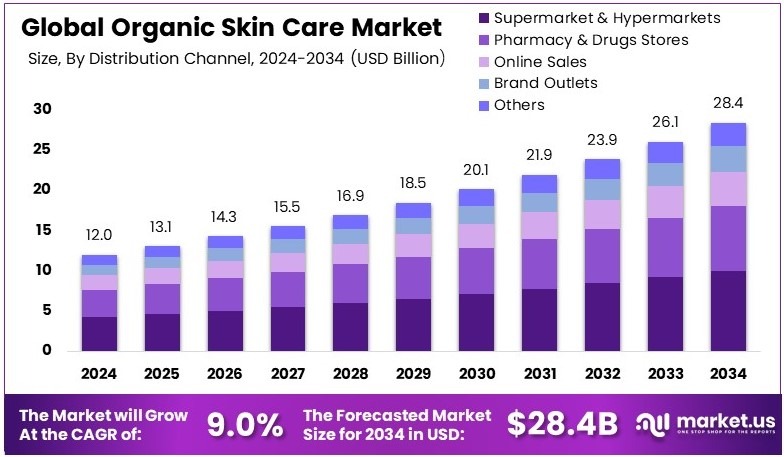
The organic skin care market is experiencing robust growth, driven by an increasing consumer awareness of harmful chemicals in everyday products. According to the International Journal of Creative Research Thoughts (IJCRT), 67% of consumers actively seek out products with fewer harmful chemicals, particularly in personal care items.
This growing concern for personal health is reflected in the fact that 48% of consumers rank chemicals in food and personal care products as their top safety concern. Additionally, about 61% of consumers connect environmental health to their own well-being, further boosting demand for organic products that prioritize both health and sustainability.
This demand has triggered a shift in consumer purchasing behavior, with many turning to natural and specialty retailers for cleaner beauty options. Jocelyn Lyle, senior vice president at the Environmental Working Group (EWG), highlights that 75% of Americans consider toxic chemicals in personal care products a serious threat, a belief even stronger among women under 50, where the figure rises to 84%. As a result, organic skin care products, free from chemicals like parabens and phthalates, are gaining popularity.
The organic skin care industry also offers significant growth opportunities for brands that focus on sustainability, transparency, and eco-friendly practices. Companies that invest in organic farming, biodegradable packaging, and cruelty-free certification can tap into a growing market of eco-conscious consumers. There is also potential to expand into emerging markets where consumer interest in natural and organic products is on the rise.
The market’s growth is also being driven by legislative actions. In 2024, 36 U.S. states introduced over 450 bills addressing toxic chemicals in skincare products. These regulations reflect a global shift towards safer consumer products and create a more favorable environment for organic skin care brands. The increase in government focus on product safety not only boosts consumer confidence but also encourages the industry to align with cleaner, more sustainable practices.
In contrast, while the organic skin care market is competitive, it remains far from saturated. The market continues to offer substantial opportunities for innovation, particularly for brands that prioritize transparency and sustainability. With growing demand, stricter regulations, and an evolving market, the organic skin care sector is poised for continued growth.
Key Findings
- Organic Skin Care Market was valued at USD 12.0 Billion in 2024, and is expected to reach USD 28.4 Billion by 2034, with a CAGR of 9.0%.
- In 2023, Face creams & lotions dominate with over 50%, driven by increasing demand for organic skincare solutions.
- In 2023, Hypermarket/Supermarket channels lead with 44%, reflecting the popularity of in-person purchasing for skincare products.
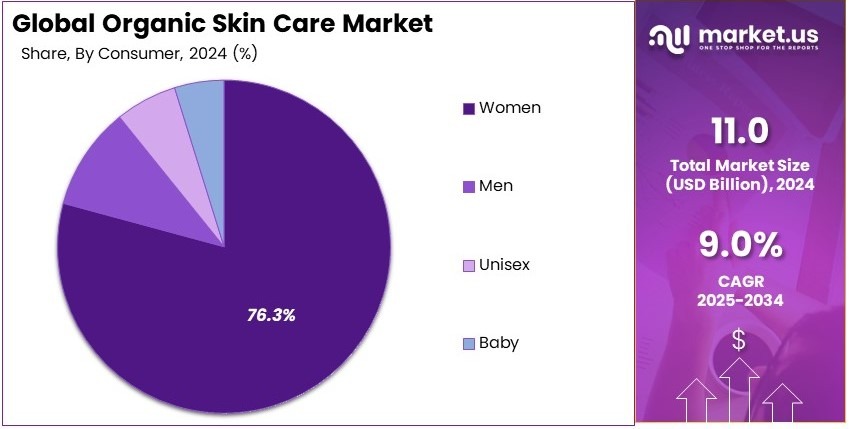
- In 2023, Women are the primary consumers with 76.3%, showing the significant market share held by female users.
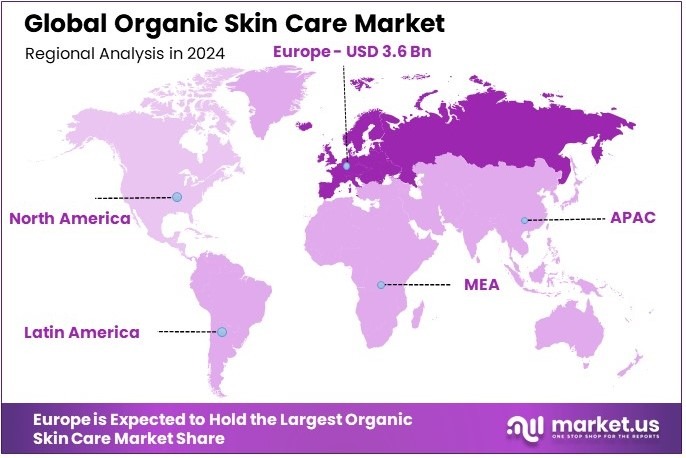
- In 2023, Europe leads with 30% market share, attributed to the growing demand for sustainable and organic beauty products.
Business Environment Analysis
The Organic Skin Care Market shows moderate saturation, with 58% of consumers spending between USD 1 to USD 100 monthly on skincare and makeup. According to recent market studies, this indicates significant opportunities for new brands targeting niche segments within the natural products space.
Millennials and Generation Z are pivotal target demographics, significantly influencing market trends. Specifically, 57% of women in the U.S. prefer all-natural skincare products, as highlighted by consumer surveys. This preference drives brands to innovate and cater to health-conscious consumers.
Product differentiation is essential, achieved through unique formulations and sustainable practices. For instance, Verlinvest’s investment in Cible Skin addresses safety concerns by reducing harmful ingredients like fluorine, appealing to consumers who prioritize health and environmental impact, according to industry reports.
Value chain analysis reveals strategic opportunities in sourcing and production efficiencies. In April 2024, Indus Valley Cosmetics invested ₹40 crore in marketing and research to enhance R&D and brand visibility. This move aims to strengthen the company’s presence among Gen Z and Millennial consumers, ensuring a competitive edge.
Investment opportunities remain robust, evidenced by H.I.G. Capital’s acquisition of Naturalia Tantum S.p.A. in July 2024. This acquisition expands their portfolio in organic beauty products, reflecting strong investor confidence and the sector’s promising growth potential, as noted by financial analysts.
Export and import dynamics are crucial for market expansion. According to the OECD, in 2022, France exported beauty products worth $10.8 billion, while China imported $11.1 billion. These figures highlight significant global trade flows and the strategic importance of international markets for organic skincare brands.
Adjacent markets, such as sustainable packaging and eco-friendly ingredients, play a complementary role in the organic skin care sector. Melvita’s rebranding in January 2024 to enhance its organic image demonstrates the synergy between related industries, fostering overall market growth and supporting sustainable business practices.
Regional Analysis
Europe Dominates with 30% Market Share
Europe leads the Organic Skin Care Market with a 30% market share and was valued at USD 3.6 Billion. This dominance is driven by strong consumer demand for natural and eco-friendly products. European consumers prioritize sustainability, and many prefer organic skin care items made from ethically sourced ingredients. Strict regulations on cosmetic products also push brands to adhere to high-quality standards, boosting trust in organic brands.
The European Union (EU) enforces stringent regulations to ensure the safety and authenticity of organic and natural beauty products. Notably, over 1,600 chemicals are banned in personal care products within the EU, reflecting a commitment to high safety standards.
European consumers are increasingly favoring products that align with ethical and sustainable values. This shift is evident in the rise of vegan and cruelty-free cosmetics, with brands such as Dr.Lipp in the UK offering 100% natural-origin skincare products in sustainable packaging.
Market dynamics in Europe are shaped by consumer preferences for transparency and sustainability in product sourcing and packaging. Many consumers are drawn to organic skin care products that align with their ethical values, such as cruelty-free and vegan formulations. Additionally, the popularity of organic products is boosted by government support and environmental initiatives promoting clean, green consumerism.
Regional Mentions:
- North America: North America’s organic skin care market is growing rapidly, driven by increasing awareness of the benefits of natural products. Consumers prefer organic formulations with minimal chemicals and additives.
- Asia Pacific: Asia Pacific is an emerging player in the organic skin care market. Rapid urbanization and growing disposable incomes drive demand for premium organic products, particularly in China and Japan.
- Middle East & Africa: The Middle East & Africa are seeing growing interest in organic skin care products, driven by rising awareness of the benefits of natural ingredients and increasing disposable incomes.
- Latin America: Latin America’s organic skin care market is expanding gradually, supported by consumer interest in natural beauty products. Brazil and Mexico are key markets where organic brands are gaining traction.
Product Analysis
Face Creams & Lotions dominates with 50%+ due to their widespread use and effectiveness in daily skincare routines.
The product segment of face creams and lotions has the largest share of the organic skin care market, accounting for over 50% of the market. This dominance is largely driven by their essential role in everyday skin care routines. Face creams and lotions are among the first products consumers turn to for moisturizing, anti-aging, and protective benefits, making them central to most skincare regimens.
They are available in a wide variety of formulations, catering to different skin types and concerns, which adds to their widespread appeal. Additionally, their ease of use and the direct, visible effects they offer make them a preferred choice for consumers seeking immediate benefits.
In contrast, other skin care products such as serums, face packs, and cleansers, while still significant, do not achieve the same level of dominance. Serums, though highly effective in targeting specific skin issues, have a smaller market share due to their higher price points and more niche appeal.
Face masks and cleansers are also important but are often used less frequently than creams and lotions, which diminishes their overall market share. Despite this, these products continue to contribute to the market’s growth, with consumers using them to complement their daily skin care routine and address more targeted concerns.
Distribution Channel Analysis
Supermarket & Hypermarket dominates with 44% due to their wide accessibility and variety of organic products.
The distribution channel of supermarkets and hypermarkets holds the largest share in the organic skin care market, accounting for 44% of sales. These large retail outlets attract a broad range of consumers, providing easy access to a variety of products under one roof.
Supermarkets and hypermarkets also benefit from their established presence and large customer base, making them an ideal channel for organic skin care products that appeal to mass markets. Additionally, they allow consumers to compare products directly, which helps boost consumer confidence in the quality and effectiveness of organic skin care offerings.
Other channels such as pharmacies, online sales, and brand outlets also play crucial roles in the market. Pharmacies and drug stores serve a specific segment of consumers who prefer to purchase skincare products alongside other health-related items.
Online sales, on the other hand, continue to grow in popularity as more consumers turn to e-commerce platforms for convenience and a broader selection. Brand outlets, while more exclusive, cater to customers seeking a premium shopping experience and personalized recommendations.
These channels collectively contribute to the market’s expansion, but the convenience and broad product offerings at supermarkets and hypermarkets continue to make them the dominant force in organic skin care distribution.
Consumer Analysis
Women dominates with 76.3% due to their greater interest in skincare and personal care routines.
The organic skin care market is predominantly driven by women, who account for 76.3% of the consumer base. This dominance is due to women’s greater interest in skincare, as they tend to engage in more elaborate personal care routines. Furthermore, women are more likely to invest in products that offer long-term benefits, such as anti-aging, hydration, and skin protection.
Organic skin care products, which are perceived as safer and more natural, align well with the preferences of female consumers who are increasingly prioritizing non-toxic and environmentally friendly options.
Men and unisex consumers also represent growing segments in the market, although they make up smaller shares. Men’s interest in organic skin care is expanding as they become more conscious of skin health and grooming.
Unisex products are appealing to a broader audience, offering universal benefits that can be used by anyone. Baby products are also gaining traction, as parents are becoming more cautious about the ingredients in products they use on their children’s sensitive skin. While these segments are important, women continue to be the dominant consumer group in the organic skin care market.
Key Market Segments
By Product
- Skin Care
- Creams & Lotions
- Serums
- Face Packs/Masks
- Cleanser
- Other Skin Care Products
- Body Care
- Soaps
- Shower Gels
- Cream
- Oils
- Other Body Care Products
- Fragrance
By Distribution Channel
- Supermarket & Hypermarkets
- Pharmacy & Drugs Stores
- Online Sales
- Brand Outlets
- Other Distribution Channels
By Consumer
- Men
- Women
- Unisex
- Baby
By Regions and Countries
- North America
- US
- Canada
- Europe
- Germany
- France
- The UK
- Spain
- Italy
- Rest of Europe
- Asia Pacific
- China
- Japan
- South Korea
- India
- Australia
- Rest of APAC
- Latin America
- Brazil
- Mexico
- Rest of Latin America
- Middle East & Africa
- South Africa
- Saudi Arabia
- UAE
- Rest of MEA
Driving Factors
Rising Consumer Awareness Drives Market Growth
The increasing consumer awareness of harmful chemicals in conventional skincare products has been a major driver in the organic skin care market. Consumers are more educated about the potential side effects of synthetic ingredients, prompting a shift toward organic and natural alternatives.
Additionally, the growing demand for sustainably sourced products has driven the popularity of organic skincare, aligning with the broader global trend toward environmental responsibility.
The rise in disposable income, especially in developing markets, also plays a critical role in boosting demand for premium organic products. This is further supported by an increasing focus on wellness and self-care, where consumers are more willing to invest in products that are perceived as healthier and safer for their skin.
Growth Constraints
High Costs and Limited Shelf Life Restraints Market Growth
One of the primary restraining factors in the organic skin care market is the high cost of production. Organic ingredients are often more expensive due to the stringent sourcing and processing requirements, leading to higher retail prices. This makes organic products less accessible to price-sensitive consumers, especially in developing markets.
In addition to the cost, organic skincare products often have a shorter shelf life due to the absence of synthetic preservatives, which can limit their marketability.
Limited awareness about the effectiveness of organic products compared to conventional ones is another barrier to market growth. Lastly, regulatory challenges, including inconsistent labeling standards across regions, create confusion for consumers and limit the market’s ability to expand uniformly.
Growth Potential
Expansion into Emerging Markets Provides Opportunities
The organic skincare market has immense growth opportunities, particularly in emerging markets where disposable incomes are rising, and consumer awareness is increasing. As consumers in these regions become more health-conscious, they are likely to shift from traditional skincare products to organic alternatives. This provides a significant opportunity for brands to enter untapped markets and grow their presence.
Additionally, the development of new product lines targeting specific skin concerns, such as anti-aging or sensitive skin, offers growth potential for the organic skincare industry. The growing trend of e-commerce also provides brands with a global platform to reach a wider audience, bypassing traditional retail channels.
Furthermore, innovations in packaging, such as sustainable and eco-friendly materials, present a unique opportunity for brands to differentiate themselves in the marketplace. These growth opportunities indicate a bright future for the organic skincare industry.
Challenges
Sourcing and Consumer Trust Challanges Market Growth
Sourcing high-quality organic ingredients is a significant challenge for the organic skin care market. Many ingredients are sourced from remote regions, which can create supply chain disruptions and limit the availability of certain products. Additionally, there is a challenge in maintaining consumer trust, as not all products labeled “organic” meet the same standards, leading to skepticism among consumers.
Counterfeit products in the market also undermine consumer confidence, especially in online sales channels where authentication is difficult. The rapid pace of innovation in the skincare industry also makes it difficult for organic brands to keep up with technological advancements, often requiring substantial investment in research and development.
Lastly, stringent certification processes for organic labeling add time and cost to getting products to market, slowing down growth. These challenges collectively create hurdles for the market’s expansion.
Growth Factors
Product Innovation and E-commerce Are Growth Factors
Product innovation is a key growth factor in the organic skin care market. Brands that invest in research and development to create innovative formulations using new organic ingredients are driving market expansion. The demand for multifunctional products, such as moisturizers that also offer anti-aging benefits, is increasing, pushing companies to continually update their offerings.
E-commerce platforms are also playing a significant role in market growth by providing easy access to organic skincare products. Consumers are increasingly turning to online shopping for the convenience it offers, particularly in regions where organic products may not be as readily available in physical stores.
Collaborations between beauty brands and influencers on social media platforms are further driving product awareness and market penetration. These growth factors are ensuring that the organic skin care market continues to expand at a healthy pace.
Emerging Trends
Sustainability and Personalized Products Are Latest Trending Factor
Sustainability is one of the most prominent trends in the organic skin care market today. Consumers are increasingly looking for products that are not only good for their skin but also better for the planet. This trend is pushing brands to adopt eco-friendly packaging and sustainable sourcing practices. Products that are biodegradable or come in recyclable packaging are highly sought after.
Another trending factor is the rise of personalized skincare products. Consumers are becoming more interested in products tailored to their specific skin types and concerns, such as custom-formulated serums or creams.
The “clean beauty” movement is also driving demand for transparency in ingredient sourcing and production processes. Finally, the popularity of vegan and cruelty-free products continues to grow, aligning with broader ethical consumerism trends. These trends are reshaping the organic skin care market by influencing both product development and marketing strategies.
Competitive Landscape of Organic Skin Care Market
The Organic Skin Care Market is led by Shiseido Company Limited, Natura & Co., and The Estee Lauder Companies, three major players that shape the industry with their focus on sustainability, innovation, and consumer trust. Their global reach and dedication to natural ingredients have positioned them as leaders in the organic beauty sector.
Shiseido Company Limited is a pioneering company in the organic skin care market, especially in the Asia-Pacific region. Shiseido is known for combining natural ingredients with advanced skincare technology. Its dedication to sustainability and innovation has helped it maintain a strong market presence, appealing to consumers seeking high-quality, effective organic products.
Natura & Co. is a Brazilian multinational known for its commitment to sustainability and the use of ethically sourced ingredients. With brands like Aesop and The Body Shop under its umbrella, Natura has established itself as a leader in organic and natural beauty products. The company’s focus on environmental and social responsibility resonates with consumers globally, driving its success in this growing market.
The Estee Lauder Companies is another dominant player, with a diverse portfolio of luxury skincare brands, including Origins and Aveda, which focus on organic and natural ingredients. Estee Lauder’s strong presence in the premium organic skincare segment and its emphasis on sustainability and innovation continue to drive its market influence and consumer trust.
These companies lead the organic skin care market through their commitment to natural ingredients, sustainability, and continuous innovation, catering to the growing demand for clean and eco-friendly beauty products.
Top Key Players in the Market
- Shiseido Company Limited
- Natura & Co.
- The Estée Lauder Companies
- Yves Rocher
- True Botanicals
- Tata Harper
- The Hain Celestial Group
- Weleda AG
- Arbonne International
- L’Oréal Group
- The Clorox Company
- The Honest Company
- Himalaya Drug Company
- Babylist Inc.
- Avalon Organics
- Kora Organics
- Other Market Players
Latest Advancements in Organic Skin Care Market
- Chantal Kreviazuk: September 2024 – Canadian singer-songwriter Chantal Kreviazuk, as the official brand ambassador for Back to Earth Skin, promoted the brand’s natural skincare products in Kelowna. Kreviazuk is championing the company’s GLOW product line, which is crafted from 100% natural ingredients and features a proprietary Mineral Microbiome Clay Complex™.
- Organic Harvest: 2024 – Organic Harvest, a leading beauty brand, introduced a range of vegan, organic makeup products. This new collection is designed to cater to the growing demand for ethical, environmentally friendly cosmetics, emphasizing cruelty-free and organic formulations.
- Mono Skincare: 2024 – French start-up Mono Skincare launched a line of waterless, customizable skincare products. These formulations, aimed at minimizing environmental impact, are activated by water and tailored to individual skin needs.
- Sky Organics: 2024 – Sky Organics expanded its skincare lineup with new organic products, blending natural ingredients aimed at enhancing beauty while promoting health. The launch focuses on eco-friendly packaging and powerful, nutrient-rich formulations designed to improve skin’s appearance while being kind to the planet.









