


Report Overview
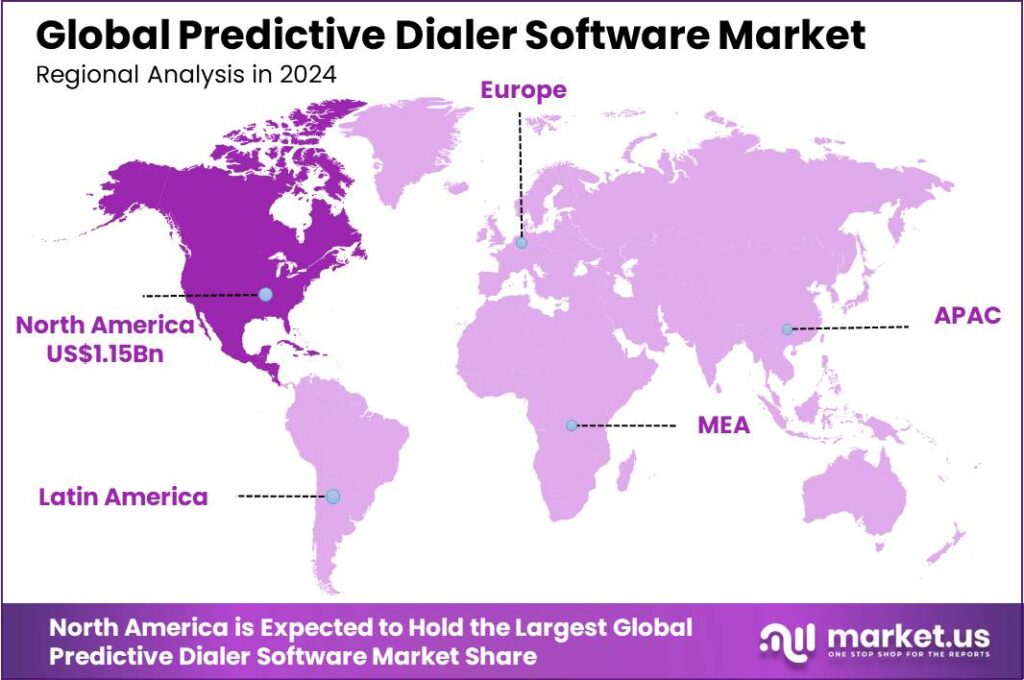
The Global Predictive Dialer Software Market size is expected to be worth around USD 6.1 Billion By 2034, from USD 3.12 Billion in 2024, growing at a CAGR of 7.00% during the forecast period from 2025 to 2034. In 2024, North America dominated the global market, holding over 37% market share and generating around USD 1.15 billion in revenue.
Predictive dialer software is a telecommunications technology used primarily in call centers. It automates the dialing process, predicting when an agent will be available and dialing a list of phone numbers accordingly. By analyzing agent availability and call patterns, predictive dialers ensure that agents spend more time talking to customers rather than waiting for calls to connect
The predictive dialer software market is seeing significant growth, fueled by the rising demand for automation in customer service operations. As businesses look to reduce labor costs and improve agent efficiency, predictive dialers have become a crucial investment. The market is expanding globally, with a focus on regions like North America and Europe, where the adoption of advanced communication technologies is accelerating.
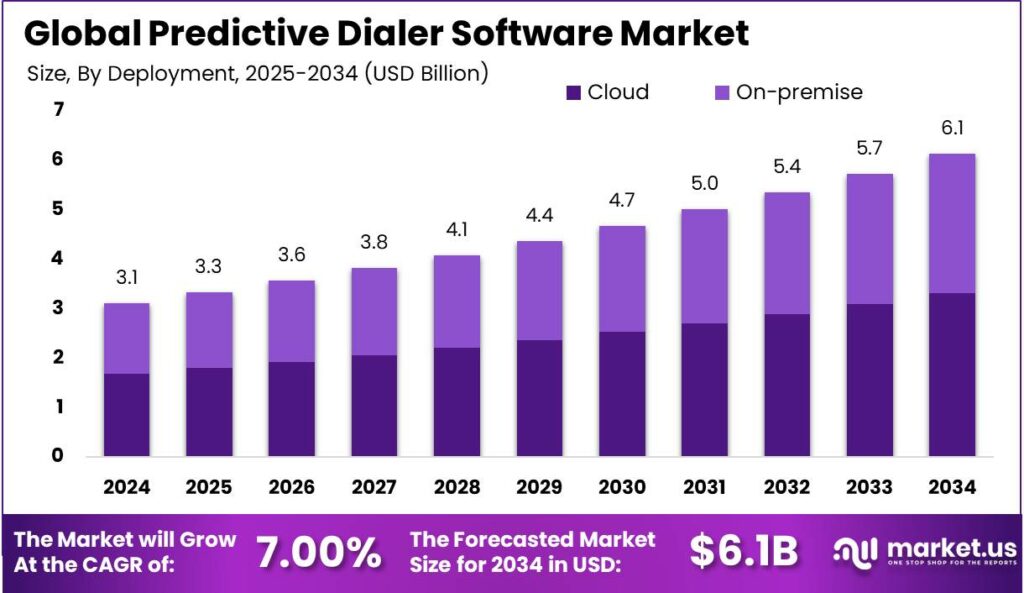
Key factors driving the growth of the predictive dialer market include the rise of cloud computing, which makes these solutions more accessible and reduces the need for on-premise infrastructure. The demand for customer-centric services and efficient call handling is also boosting adoption. Additionally, the integration of AI and machine learning enhances predictive dialers’ accuracy, improving agent performance and customer satisfaction.
Investment in predictive dialer software presents significant opportunities, particularly with the rapid shift to cloud-based platforms and AI-driven technologies. Companies in various sectors, including customer service outsourcing and telemarketing, are increasingly looking for solutions that can boost efficiency and reduce human errors, making predictive dialers an attractive investment.
Key Takeaways
- The Global Predictive Dialer Software Market is projected to be worth around USD 6.1 Billion by 2034, up from USD 3.12 Billion in 2024, growing at a CAGR of 7.00% during the forecast period from 2025 to 2034.
- In 2024, the software segment held a dominant position within the market, capturing more than 62% of the share.
- In 2024, the cloud segment held a dominant position in the market, capturing more than 54% of the share.
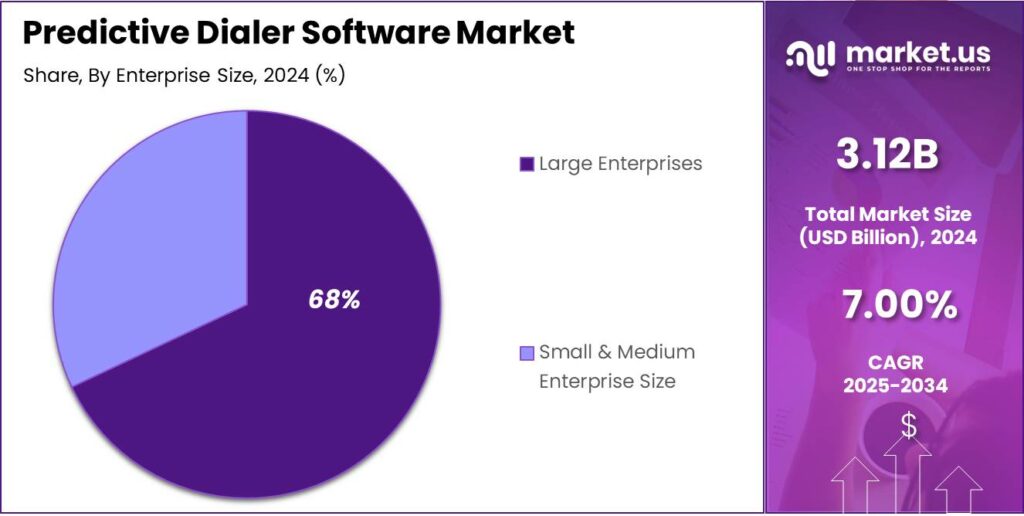
- In 2024, the Large Enterprise segment held a dominant market position, capturing more than 68% of the market share.
- In 2024, the BFSI (Banking, Financial Services, and Insurance) segment held a dominant position in the market, capturing more than 26% of the share.
- In 2024, North America held a dominant position in the global market, capturing over 37% of the market share, with a revenue of approximately USD 1.15 billion.
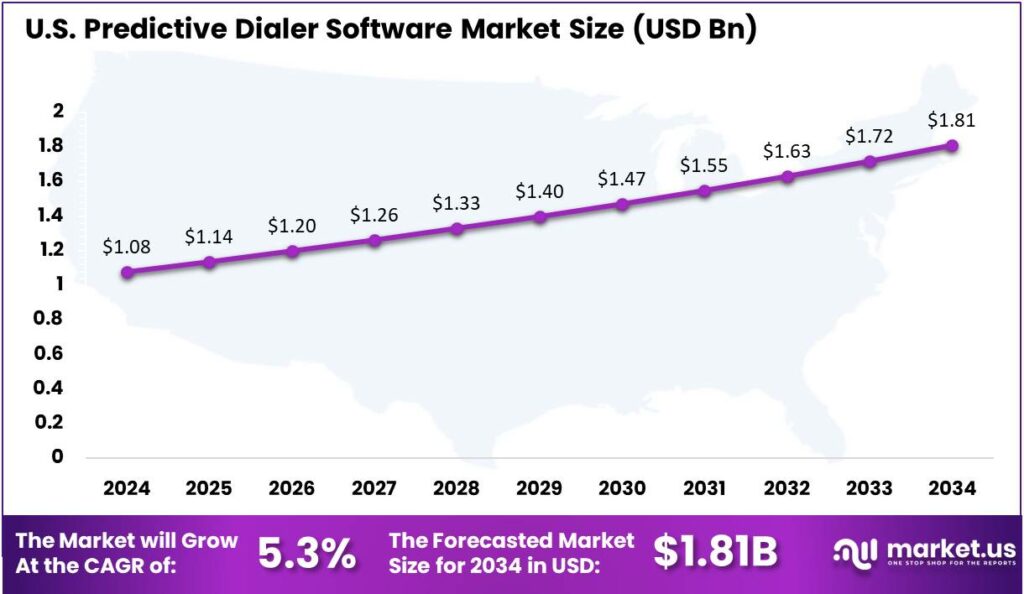
- The U.S. Predictive Dialer Software Market is projected to reach a valuation of $1.08 billion by 2024, driven by a steady CAGR of 5.3%.
U.S. Market Size
The U.S. Predictive Dialer Software Market is projected to reach a valuation of $1.08 billion by 2024, driven by a steady compound annual growth rate (CAGR) of 5.3%. This market is witnessing strong momentum due to the growing demand for efficient customer interaction solutions across various industries such as telecommunications, financial services, healthcare, and retail.
Predictive dialer systems, automating the dialing process, are crucial for businesses aiming to boost sales productivity and streamline outbound calls. The increasing demand for CRM tools and the shift toward cloud-based technologies are driving the widespread adoption of predictive dialer solutions.
The integration of AI and ML with predictive dialers will bring advanced features like intelligent call routing and real-time agent performance analytics. As customer service operations become more digitized and data-driven, predictive dialer software will play a key role in enhancing operational performance and boosting customer satisfaction across industries.
In 2024, North America held a dominant position in the global Predictive Dialer Software Market, capturing over 37% of the market share, with a revenue of approximately USD 1.15 billion. This dominance is due to the region’s advanced tech infrastructure, widespread automation, and a competitive business environment driving the need for efficient customer engagement solutions.
The U.S. plays a key role, with rising demand for predictive dialers driven by a focus on customer experience and operational efficiency in sectors like telecom, banking, and healthcare. The integration of AI and ML technologies is further boosting their effectiveness, making them crucial in the region.
North America’s strong market presence is driven by numerous contact centers seeking solutions to boost productivity and cut costs. Predictive dialer software reduces downtime, optimizes call distribution, and enhances customer interactions. The growing adoption of cloud-based contact center solutions further drives market growth due to their scalability, flexibility, and cost-efficiency.
Strict regulations on customer interactions and data security in North America have driven organizations to adopt advanced predictive dialer systems for compliance and performance. Major players like Genesys, 8×8, and Five9 are strengthening the region’s leadership by innovating new features and expanding services to meet the demand for omnichannel communication solutions, fueling market growth.
Component Analysis
In 2024, the software segment held a dominant position within the predictive dialer software market, capturing more than a 62% share. This segment comprises the core predictive dialer systems that are crucial for automating the calling process, managing call queues, and optimizing agent productivity.
The substantial market share of this segment can be attributed primarily to the critical need for robust and scalable dialing platforms in call centers across various industries. The demand for advanced dialing software that integrates with business systems has surged as companies focus on improving efficiency and customer interaction.
The services segment follows, providing essential support that enhances the functionality and effectiveness of predictive dialer software. This segment includes integration and deployment services that ensure the software is correctly configured and optimized for specific business environments.
Integration and deployment services are particularly vital for companies that are newly adopting predictive dialer technologies or upgrading their existing systems. These services help ensure that the predictive dialer software integrates smoothly with the existing IT infrastructure, including CRM systems and data analytics tools.
Deployment Analysis
In 2024, the cloud segment held a dominant position in the predictive dialer software market, capturing more than a 54% share. This notable predominance is largely attributed to the flexibility and scalability that cloud-based solutions offer.
Cloud deployment is favored by businesses with limited IT infrastructure as it provides access to advanced predictive dialer features without high upfront costs. It also enables quicker updates and maintenance, reducing the workload for client IT teams since the service provider handles these tasks.
Another key factor driving the popularity of cloud-based predictive dialer software is its inherent capability to support remote work environments. With the rise of telecommuting, companies need tools that can be accessed from anywhere, at any time, without the need for complex setups or dedicated hardware.
The growth of the cloud segment is driven by its seamless integration with other cloud-based applications. Many businesses use a range of cloud services, and linking predictive dialers with CRM systems, email marketing tools, and more creates a unified tech ecosystem. This integration streamlines workflows, enhances data consistency, and boosts customer engagement and satisfaction.
Enterprise Size Analysis
In 2024, the Large Enterprise segment held a dominant market position in the Predictive Dialer Software Market, capturing more than a 68% share. This significant market dominance can be attributed to the complex operational requirements and high call volumes handled by large organizations that necessitate robust and scalable communication solutions.
Large enterprises, spanning multiple regions and customer segments, need advanced dialer systems to handle extensive customer databases and automate high volumes of daily calls. With the financial capacity to invest, they often opt for premium predictive dialer systems that provide AI-driven call routing, analytics, and smooth integration with existing enterprise systems.
The preference for predictive dialer software in large enterprises is also driven by their need to maintain high customer service standards and improve operational efficiencies. These systems enable large organizations to minimize idle time for call agents and increase contact rates, which is crucial for achieving business objectives such as sales growth, customer retention, and timely customer support.
Strict compliance and data security requirements in industries like finance, healthcare, and telecommunications drive large enterprises to invest in secure predictive dialer solutions. These systems ensure regulatory compliance with features like call time restrictions, consent-based calling, and robust data protection, essential for handling sensitive customer data.
End-Use Analysis
In 2024, the BFSI (Banking, Financial Services, and Insurance) segment held a dominant position in the predictive dialer software market, capturing more than a 26% share. This leadership can be attributed to the high volume of customer interactions typical in these industries, where efficiency and customer service levels are directly tied to business success.
Predictive dialer software streamlines operations by automating dialing, reducing idle time for agents, and maintaining consistent communication. In the BFSI sector, AI and machine learning enhance system effectiveness, enabling personalized and timely customer interactions.
The demand within BFSI for predictive dialer software is also driven by the need for compliance and risk management. These sectors are often subject to strict regulatory requirements regarding customer communications and data handling. Predictive dialer systems equipped with advanced compliance features help ensure that businesses adhere to these regulations while minimizing the risk of human error.
Another factor contributing to the dominance of the BFSI segment is the ongoing digital transformation within the sector. As banks and financial institutions increasingly move towards digital channels to engage with customers, the need for effective communication tools that can integrate with other digital platforms has become paramount.
Key Market Segments
By Component
- Software
- Services
- Integration & Deployment
- Support & Maintenance
- Training & Consulting
- Managed Services
By Deployment
- On-premise
- Cloud
By Enterprise Size
- Large Enterprise
- Small & Medium Enterprise
By End-Use
- BFSI
- Government
- Healthcare
- IT & Telecom
- Retail & E-comerce
- Others
Key Regions and Countries
- North America
- US
- Canada
- Europe
- Germany
- France
- The UK
- Spain
- Italy
- Rest of Europe
- Asia Pacific
- China
- Japan
- South Korea
- India
- Australia
- Singapore
- Rest of Asia Pacific
- Latin America
- Brazil
- Mexico
- Rest of Latin America
- Middle East & Africa
- South Africa
- Saudi Arabia
- UAE
- Rest of MEA
Driver
Enhancing Call Center Efficiency
Predictive dialer software significantly boosts call center efficiency by automating the dialing process, allowing agents to focus solely on live connections. This automation reduces idle time and increases the number of productive calls made, leading to improved agent productivity and operational efficiency.
By filtering out unproductive calls such as busy signals, voicemails, or disconnected numbers the software ensures that agents engage only in meaningful customer interactions. This streamlined approach not only enhances the volume of customer engagements but also improves the quality of service provided, making it a valuable tool for businesses aiming to optimize their outbound calling campaigns.
Restraint
Regulatory and Compliance Challenges
The adoption of predictive dialer software is often hindered by stringent telemarketing regulations designed to protect consumer privacy. Laws such as the Telephone Consumer Protection Act (TCPA) in the United States impose strict guidelines on automated calling systems, including limitations on call frequency and requirements for obtaining prior consent from recipients.
Non-compliance with these regulations can result in substantial fines and legal repercussions. Consequently, businesses must invest in compliance measures and continuously monitor regulatory changes, which can be resource-intensive and may deter especially smaller enterprises from implementing predictive dialer solutions.
Opportunity
Integration of Artificial Intelligence and Machine Learning
The integration of Artificial Intelligence (AI) and Machine Learning (ML) into predictive dialer software presents a significant growth opportunity. These technologies enhance dialing algorithms by analyzing patterns in customer behavior and agent performance, leading to more accurate call predictions and improved connection rates.
AI-driven insights enable personalized customer interactions and efficient call routing, thereby increasing customer satisfaction and loyalty. As businesses increasingly prioritize data-driven decision-making, the demand for AI-enhanced predictive dialer solutions is expected to rise, offering a competitive edge to early adopters in various industries.
Challenge
Integration with Existing Systems
Integrating predictive dialer software with existing Customer Relationship Management (CRM) systems and other operational platforms poses a significant challenge. Compatibility issues can arise, leading to disruptions in workflow and data inconsistencies.
The integration process often requires specialized technical expertise and can be time-consuming, potentially causing operational downtime during implementation. Additionally, training staff to effectively use the new integrated system adds to the complexity. Businesses must carefully plan and allocate resources to ensure a seamless integration process, which can be particularly daunting for organizations with limited IT capabilities.
Emerging Trends
Predictive dialer software is transforming how businesses connect with customers. A significant trend in this field is the integration of artificial intelligence (AI) and machine learning (ML). These technologies analyze past call data to optimize dialing times, enhancing the chances of reaching someone. Cloud-based predictive dialers are gaining popularity for their flexibility and scalability, allowing businesses of all sizes to access advanced solutions without significant upfront costs.
This move to the cloud also supports remote work, allowing agents to operate from various locations seamlessly. Moreover, the focus on compliance is intensifying. Developers are embedding features that help businesses adhere to regulations, ensuring respectful and lawful customer interactions. These advancements make predictive dialer software essential for businesses looking to improve customer engagement strategies.
Business Benefits
Embracing predictive dialer software brings numerous benefits to businesses. It significantly boosts efficiency. By automating the dialing process, agents spend more time conversing with customers and less time dialing numbers or waiting for responses. This leads to increased productivity and a higher volume of successful calls.
It enhances lead management. The system can prioritize calls based on the likelihood of conversion, ensuring that agents focus on the most promising prospects. This targeted approach improves sales outcomes and optimizes resource use.
Predictive dialers reduce operational costs. Automation decreases the need for manual labor, and the efficiency gains mean that fewer agents can handle more calls, leading to cost savings. Additionally, the real-time analytics provided by these systems offer valuable insights into call patterns and agent performance, enabling continuous improvement.
Key Player Analysis
- NICE Systems is a global leader in the predictive dialer software market. Known for its innovative solutions, NICE offers an AI-driven dialer that not only enhances call center efficiency but also integrates seamlessly with cloud-based systems. Their software enables real-time analytics and performance monitoring, empowering businesses to make data-driven decisions.
- Five9 is another top player that stands out for its cloud-based predictive dialer solutions. The company’s dialer offers advanced features like automated call distribution, real-time reporting, and artificial intelligence, which contribute to streamlining call center operations. Five9’s software is known for its user-friendly interface and flexibility, allowing businesses to scale up or down as needed.
- Aspect Software is a strong contender in the predictive dialer market, offering comprehensive call center solutions. Their predictive dialer technology is built to optimize agent workflows and reduce operational costs. Aspect’s software utilizes sophisticated algorithms to predict the best time to connect calls, ensuring higher answer rates and reducing dropped calls.
Top Key Players in the Market
- NICE Systems
- Five9
- Aspect Software
- RingCentral
- Talkdesk
- Genesys
- Avaya
- Voximplant
- agilecrm.com
- DialedIn
- Convoso
- PhoneBurner
- Star2Billing S.L.
- VanillaSoft
- Ytel Inc.
- Other Key Players
Top Opportunities Awaiting for Players
The predictive dialer software market is poised for significant growth, offering numerous opportunities for industry players.
- Increasing SME Adoption: Small and Medium-sized Enterprises (SMEs) are rapidly adopting predictive dialer software to enhance customer outreach, improve sales performance, and reduce operational costs. This trend is expected to continue, driven by the need for efficiency and cost-effectiveness in customer engagement and sales operations.
- Advancements in AI and Machine Learning: The integration of AI and machine learning technologies into predictive dialers is transforming their capabilities, making them smarter and more efficient. These technologies help in optimizing call strategies and automating complex processes, thus improving the effectiveness of outbound calling campaigns and enhancing customer interactions. This technological shift is creating a significant competitive advantage for companies that integrate these advanced features into their systems.
- Regulatory Compliance and Consumer Protection: As regulatory frameworks around telecommunications evolve, there is a growing need for compliance with laws which restricts unsolicited calls. Predictive dialer software that can ensure compliance and protect consumer rights is in high demand. This regulatory aspect presents an opportunity for dialer software developers to differentiate their products with features that ensure compliance and avoid penalties.
- Expansion in Emerging Markets: The Asia-Pacific region, in particular, is experiencing rapid growth in the adoption of predictive dialer systems. This growth is fueled by the digital transformation initiatives and increasing investments in cloud computing and automation technologies across various industries, including IT, telecom, and customer service. Market players have the opportunity to capitalize on this trend by offering localized and cost-effective solutions tailored to the needs of these emerging markets.
- Government Sector Adoption: There is a rising trend of predictive dialer software adoption within the government sector, driven by the need for efficient public service delivery and effective communication with citizens. Government agencies are utilizing these systems to automate outreach and improve response times for public services, which presents a substantial market opportunity for providers specializing in solutions that meet the unique needs of the public sector.
Recent Developments
- In November 2024, RingCentral and Verint established a strategic partnership aimed at enhancing employee productivity and improving customer experience. Through this collaboration, RingCentral’s RingCX customers will gain access to Verint’s advanced customer experience (CX) and Workforce Engagement Management (WEM) automation solutions.
- Five9 announced the acquisition of Acqueon in August 2024, a move that is expected to strengthen Five9’s Intelligent CX Platform. The acquisition is set to bolster Five9’s omnichannel outreach and customer journey orchestration capabilities, enabling businesses to proactively engage with customers through AI-powered solutions.









