


Report Overview
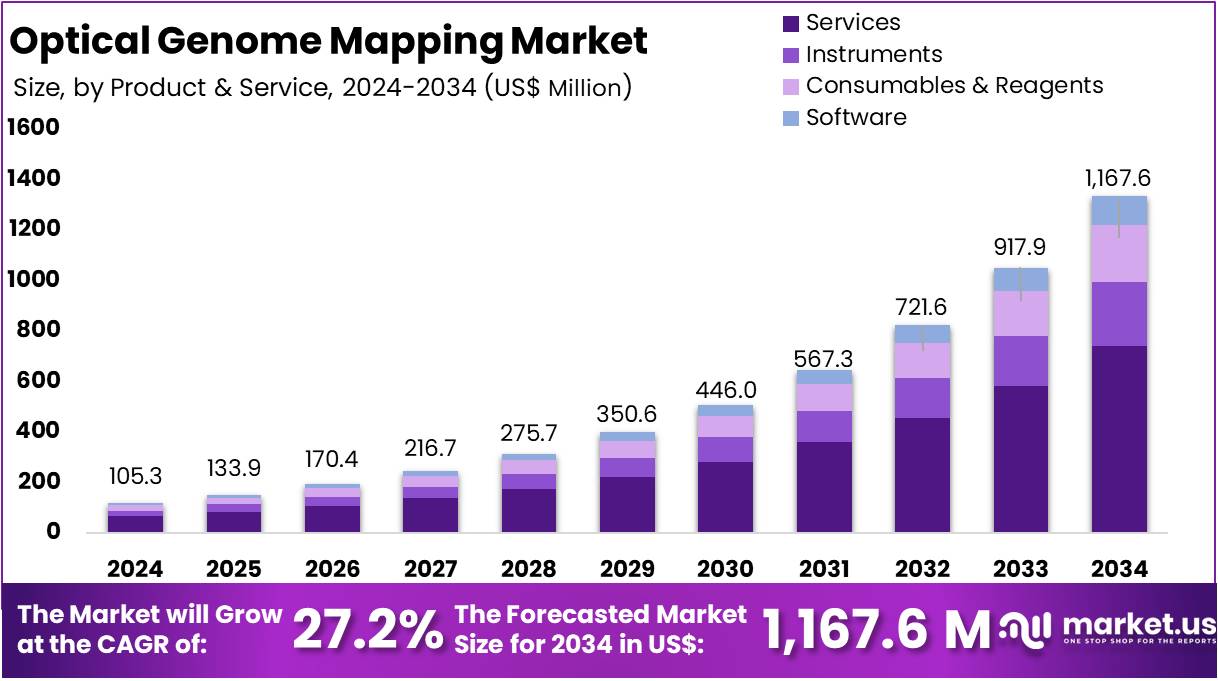
The Global Optical Genome Mapping Market Size is expected to be worth around US$ 1167.6 Billion by 2034, from US$ 105.3 Billion in 2024, growing at a CAGR of 27.2% during the forecast period from 2025 to 2034.
The global genome mapping market is witnessing significant growth, driven by advancements in genomics technologies and the increasing demand for personalized medicine. Genome mapping, which involves creating a comprehensive map of an organism’s genetic makeup, is essential for understanding genetic variations, disease predisposition, and personalized treatment strategies.
Technological innovations, such as next-generation sequencing (NGS) and CRISPR gene-editing, have revolutionized genome mapping by providing faster, more accurate, and cost-effective solutions. The rise of precision medicine, which tailors treatments based on individual genetic profiles, further fuels the market’s expansion.
Additionally, government initiatives and funding to support genomics research, along with a growing focus on rare genetic diseases and cancer research, are driving market growth. With continued advancements in technology and an expanding research landscape, the global genome mapping market is expected to grow rapidly in the coming years.
Key Takeaways
- The Optical genome mapping market was valued at USD 105.3 million in 2024 and is anticipated to register substantial growth of USD 1167.6 million by 2034, with 27.2% CAGR.
- In 2024, the services segment took the lead in the global market, securing 63.4% of the total revenue share.
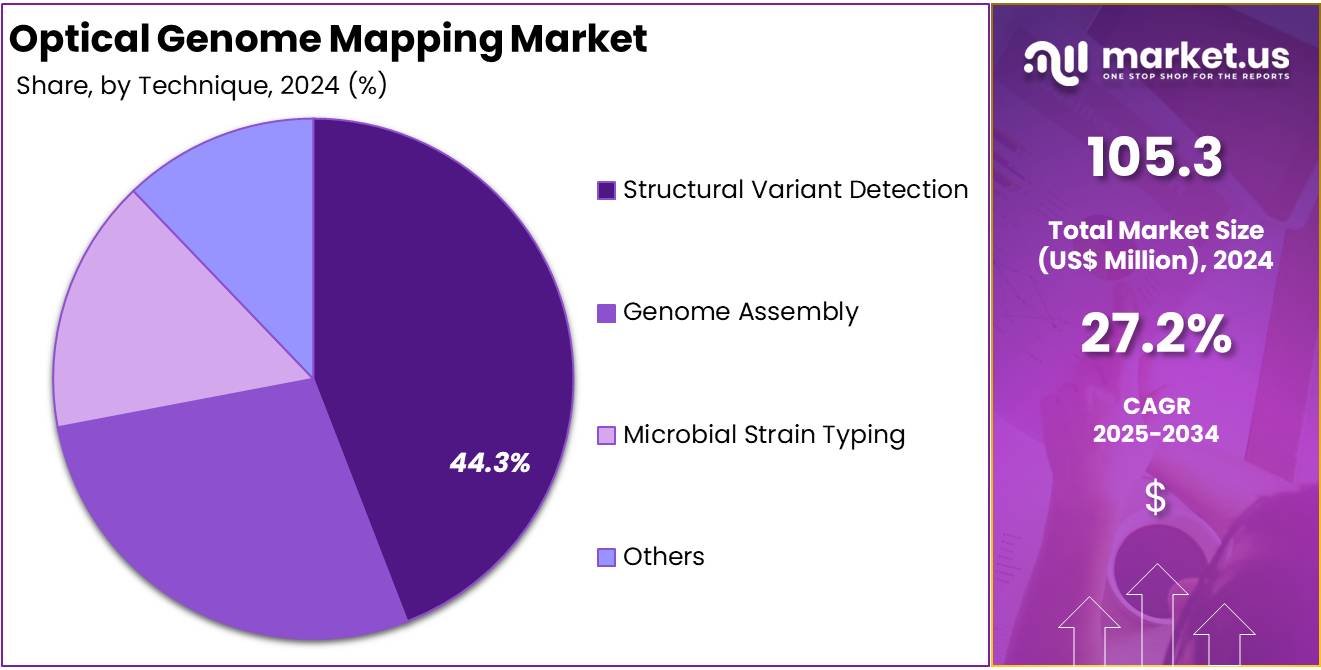
- The structural variant detection segment took the lead in the global market, securing 44.3% of the total revenue share.
- The research segment took the lead in the global market, securing 67.6% of the total revenue share.
- The academic research institutes segment took the lead in the global market, securing 60.8% of the total revenue share.
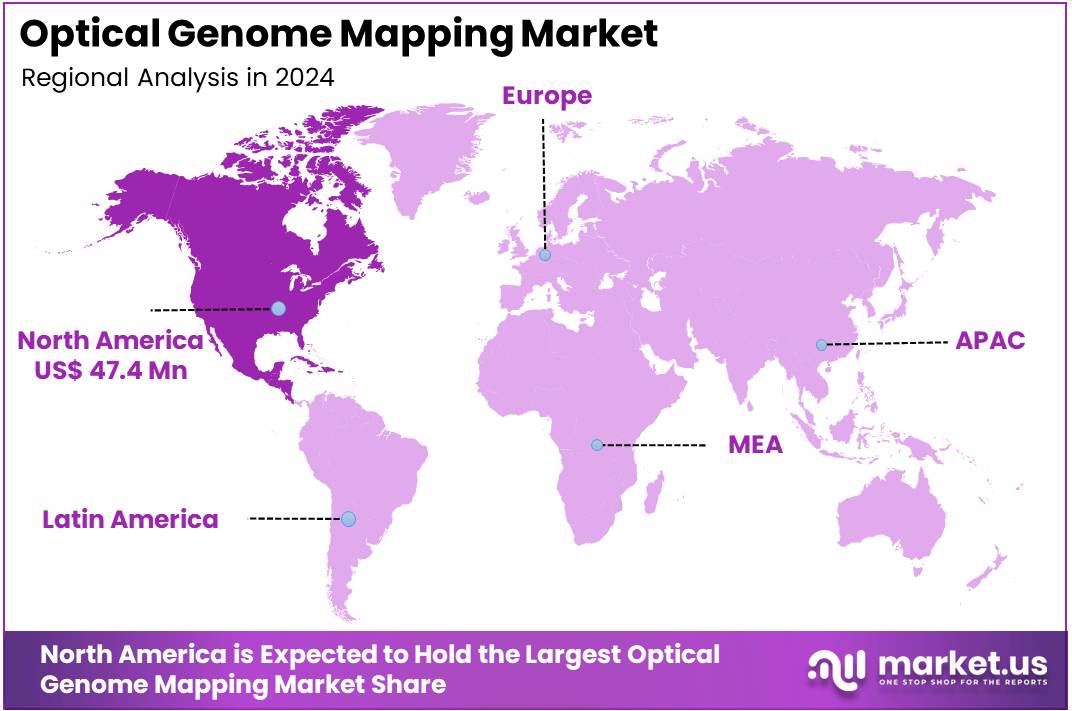
- North America took the lead in the global market, securing 45.1% of the total revenue share.
Product & Service Analysis
Based on product & service the market is fragmented into services, instruments, consumables & reagents, and software. Amongst these, services segment dominated the genome mapping market capturing a significant market share of 63.4% in 2024. The services segment has dominated the global optical genome mapping market, driven by the increasing demand for expert analysis, data interpretation, and customized genomic solutions.
As genomic research becomes more complex, researchers and healthcare providers increasingly rely on specialized services to navigate the vast amounts of data generated.These services are essential for applications in personalized medicine, drug development, and clinical diagnostics, where precision and expertise are critical.
The growth of genomics research, particularly in areas such as cancer genomics, rare genetic disorders, and biotechnology, has further fueled the demand for high-quality genome mapping services. Additionally, the expansion of research collaborations, partnerships, and advancements in sequencing technologies have solidified the services segment as the leading contributor to market revenue, driving continued growth in the genome mapping space.
Technique Analysis
The market is fragmented by technique into structural variant detection, genome assembly, microbial strain typing, and others. Structural variant detection dominated the optical genome mapping market capturing a significant market share of 44.3% in 2024 due to its crucial role in identifying large-scale genetic variations, such as deletions, duplications, inversions, and translocations, that can have significant implications for health and disease.
These structural variations are often linked to complex genetic disorders, cancers, and developmental abnormalities, making their detection essential for advancing personalized medicine, diagnostics, and therapeutic strategies. With the increasing availability and affordability of next-generation sequencing (NGS) technologies, structural variant detection has become more accurate and accessible, allowing researchers and clinicians to identify these variants with higher resolution and precision.
The growing focus on understanding the genetic basis of diseases has driven significant investments in technologies and tools specifically designed for detecting structural variants.
Application Analysis
The market is fragmented by application into research and diagnostics. Research dominated the optical genome mapping market capturing a significant market share of 67.6% in 2024. Research has dominated the genome mapping market, with scientists in genetics, molecular biology, and biotechnology continuously seeking innovative tools and methods to deepen their understanding of genomes.
The demand for advanced genome mapping technologies is driven by the need for precision in areas such as disease research, drug development, and personalized medicine.
- A key example is the increased focus on optical genome mapping, which was highlighted at the American College of Medical Genetics and Genomics annual clinical genetics meeting in April 2021. During the meeting at Columbia University Medical Center (CUMC), optical genome mapping was shown to offer 100 percent concordance in detecting genetic variations in a study of 100 Acute Myeloid Leukemia (AML) patients, outperforming traditional methods.
Such breakthroughs in research have demonstrated the power of next-generation mapping technologies in clinical applications, further fuelling+ the demand for advanced genome mapping solutions.
End-use Analysis
The market is fragmented by end-use into academic research institutes, biotechnology & pharmaceutical companies, and hospitals & clinical laboratories. Academic research institutes dominated the optical genome mapping market capturing a significant market share of 60.8% in 2024 due to their extensive resources, cutting-edge technology, and strong research-driven focus. These institutions often lead in pioneering genomic research, contributing significantly to scientific advancements and breakthroughs in understanding the human genome and other species.
Their involvement in large-scale projects, such as the Human Genome Project and various genetic sequencing initiatives, has paved the way for innovations in medicine, agriculture, and biotechnology. Academic research institutes also benefit from collaboration with governments, private enterprises, and global research networks, which provide additional funding and resources for complex genome mapping endeavors.
Key Segments Analysis
By Product & Service
- Services
- Instruments
- Consumables & Reagents
- Software
By Technique
- Structural Variant Detection
- Genome Assembly
- Microbial Strain Typing
- Others
By Application
- Research
- Diagnostics
By End-use
- Academic Research Institutes
- Biotechnology & Pharmaceutical Companies
- Hospitals & Clinical Laboratories
Drivers
Increasing Demand for High-Resolution Genomic Analysis
The increasing demand for high-resolution genomic analysis. OGM technology offers unique advantages, such as its ability to detect structural variations such as large deletions, insertions, and translocations—that traditional sequencing methods might miss. This capability is crucial for studying complex genetic disorders, advancing personalized medicine, and improving cancer genomics, where precise mapping of the genome can lead to better-targeted treatments.
Furthermore, the rise of genomic research initiatives and the growing emphasis on precision medicine have amplified the need for accurate and comprehensive genomic mapping tools. OGM’s ability to integrate with other sequencing technologies, such as next-generation sequencing (NGS), has further enhanced its appeal, offering more holistic and detailed insights into genetic data.
Additionally, OGM plays a critical role in various industries, including agriculture, where it aids in improving crop resilience and breeding. As these applications continue to expand, the market for OGM technologies is expected to continue growing, attracting investments and driving technological advancements that improve performance, efficiency, and accessibility in genome mapping.
Restraints
High Cost Associated With the OGM Equipment
The technology requires specialized instruments and reagents, which may be financially prohibitive for smaller research labs and institutions, limiting its widespread adoption. The complexity of OGM systems also requires highly trained personnel, further increasing operational costs. In addition to financial barriers, the relatively nascent stage of OGM technology presents challenges related to standardization and scalability.
As the technology is still evolving, there is a lack of universally accepted protocols and methodologies, which can hinder its integration into clinical settings or large-scale studies. Moreover, concerns about the reproducibility of results, especially when integrating with other genomic techniques, may delay broader acceptance. Regional disparities in access to advanced technologies may also limit market growth in certain parts of the world.
Market Opportunities
The Continuous Advancements in Optical Mapping Technologies
Continuous advancements in optical mapping technologies are creating significant new growth opportunities in the optical genome mapping market. Optical mapping allows for high-resolution, large-scale genome analysis, offering a unique approach to visualizing DNA at the single-molecule level.
This technology has revolutionized the ability to detect structural variations, complex genomic rearrangements, and other critical features that traditional sequencing methods may miss. By improving the accuracy and efficiency of genome assembly, optical mapping enables more precise mapping of genomes, enhancing research in various fields such as personalized medicine, disease diagnostics, and agriculture.
Moreover, the integration of optical mapping with other sequencing technologies, like next-generation sequencing (NGS), has expanded the scope of genomic research, providing more comprehensive insights into genetic information. These innovations are driving the development of new products and services, further fuelling market growth and establishing optical mapping as a vital tool in the future of genomics.
- In January 2023, Bionano Genomics introduced new products and updates to enhance its optical genome mapping workflow. These enhancements feature more robust sample preparation, faster DNA labeling, and improved imaging turnaround times. Additionally, the updates provide higher throughput and superior quality metrics. Developed based on customer feedback, Bionano’s revised sample preparation kits, chips, and software aim to boost efficiency in routine, high-volume genome analysis tasks.
Impact of Macroeconomic Factors / Geopolitical Factors
Macroeconomic and geopolitical factors have a significant impact on the optical genome mapping (OGM) market, influencing both demand and supply dynamics. On a macroeconomic level, economic downturns or recessions can lead to reduced investments in research and development, slowing the adoption of advanced technologies like OGM, especially in smaller institutions and emerging markets with limited budgets.
Conversely, economic growth and increased healthcare spending can stimulate demand for innovative genomic tools. Geopolitical factors also play a role, as international trade policies, regulatory frameworks, and political instability can affect the availability of resources, global collaborations, and the expansion of genomic research initiatives.
For example, trade restrictions or tariffs on technology imports may hinder access to critical components required for OGM systems, while global tensions can disrupt cross-border partnerships, slowing technological advancements. Additionally, geopolitical factors may influence government funding for public health initiatives, which could either drive or restrict the growth of the OGM market in specific regions.
Latest Trends
The optical genome mapping (OGM) market is witnessing several key trends that are shaping its growth and adoption. One prominent trend is the integration of OGM with next-generation sequencing (NGS) technologies, which enhances the overall capabilities of genome analysis. This combination provides more comprehensive insights by capturing both structural variations and sequence-level information, improving diagnostic accuracy in fields such as cancer genomics and personalized medicine.
Additionally, there is a growing focus on automation and high-throughput capabilities, as researchers and laboratories seek faster, more efficient ways to process large-scale genomic data. Advances in software tools and data analytics are also enhancing the user experience, allowing for more precise interpretation of complex genomic data.
Furthermore, OGM is gaining traction in agriculture for applications like crop improvement and disease resistance, leading to expanding use cases beyond traditional medical research. As these trends continue to evolve, the OGM market is expected to grow rapidly, with broader applications and greater accessibility.
Regional Analysis
North America has emerged as a dominant force in the genome mapping market, driven by several factors, including a robust healthcare system, substantial research funding, and technological advancements. The region is home to some of the world’s leading academic research institutions, biotechnology firms, and healthcare organizations, all of which are heavily invested in genomic research. The United States, in particular, has played a significant role in pioneering genome mapping technologies and large-scale projects like the Human Genome Project, which set the foundation for modern genomic studies.
Additionally, North America benefits from strong government support, such as funding from agencies like the National Institutes of Health (NIH), which accelerates research and development in genomics. The presence of major technology companies also promotes innovation in genome mapping tools and technologies, further driving market growth. Moreover, the growing emphasis on personalized medicine and precision healthcare in North America has heightened the demand for advanced genome mapping solutions, contributing to the region’s market leadership.
Key Regions and Countries
- North America
- US
- Canada
- Europe
- Germany
- France
- The UK
- Spain
- Italy
- Russia
- Netherland
- Rest of Europe
- Asia Pacific
- China
- Japan
- South Korea
- India
- New Zealand
- Singapore
- Thailand
- Vietnam
- Rest of APAC
- Latin America
- Brazil
- Mexico
- Rest of Latin America
- Middle East & Africa
- South Africa
- Saudi Arabia
- UAE
- Rest of MEA
Key Players Analysis
The competitive landscape of the Optical Genome Mapping (OGM) market is characterized by the presence of several key players focused on advancing genome mapping technologies and expanding their market presence. Major companies, such as Bionano Genomics and Hitachi High-Tech Corporation, dominate the market through innovative product offerings and strategic acquisitions.
Bionano Genomics, for instance, leads with its optical genome mapping systems, offering high-resolution genome analysis and structural variant detection. Hitachi High-Tech’s acquisition of Nabsys strengthens its position in the OGM space by expanding its product portfolio for analyzing genomic structural variations.
The market also sees increasing competition from companies investing in the development of integrated solutions that combine OGM with next-generation sequencing (NGS) technologies to provide more comprehensive genomic insights. Research institutions and biotech firms are continually exploring new applications for OGM in personalized medicine, agriculture, and disease research, further intensifying competition. As the technology matures, ongoing innovation and strategic partnerships will shape the future competitive dynamics of the OGM market.
Bionano Genomics is a leading company in the field of genome mapping, specializing in optical genome mapping (OGM) technology. It offers high-resolution genomic analysis tools that enable the detection of structural variations, which are crucial for understanding genetic diseases, cancer, and other complex biological conditions.
In addition, Nucleome Informatics Private Limited is a biotech company focused on providing data-driven solutions in genomics, primarily leveraging advanced bioinformatics tools and services for genomic data analysis. It specializes in the development of proprietary software and algorithms designed to enhance the analysis of genomic data, including structural variants and sequence variations.
Top Key Players in the Medical Tubing Market
- Bionano Genomics
- Nucleome Informatics Private Limited
- Praxis Genomics LLC
- SourceBio International Limited
- MedGenome
- INRAE (French Plant Genomic Resources Center (CNRGV))
- PerkinElmer
- Genohub Inc.
- Hofkens Lab
- Cerba
Recent Developments
- In August 2024, Hitachi High-Tech Corporation announced the acquisition of a majority stake in Nabsys, a company specializing in tools and products for analyzing genomic structural variations. Following this acquisition, Nabsys will become part of the Hitachi High-Tech Group.
- In July 2024, Bionano Genomics, Inc. unveiled a study that compares their optical genome mapping (OGM) technology with traditional cytogenetic methods for detecting structural variants (SVs) in multiple myeloma (MM). Conducted across multiple sites, this study is the first of its kind in this area.
- In March 2023, Bionano Genomics launched two new OGM-Dx tests: prenatal and postnatal whole genome structural variant tests. These tests offer a comprehensive evaluation of structural variants and the detection of chromosomal abnormalities, providing valuable insights for patient diagnosis and management.









