


Report Overview
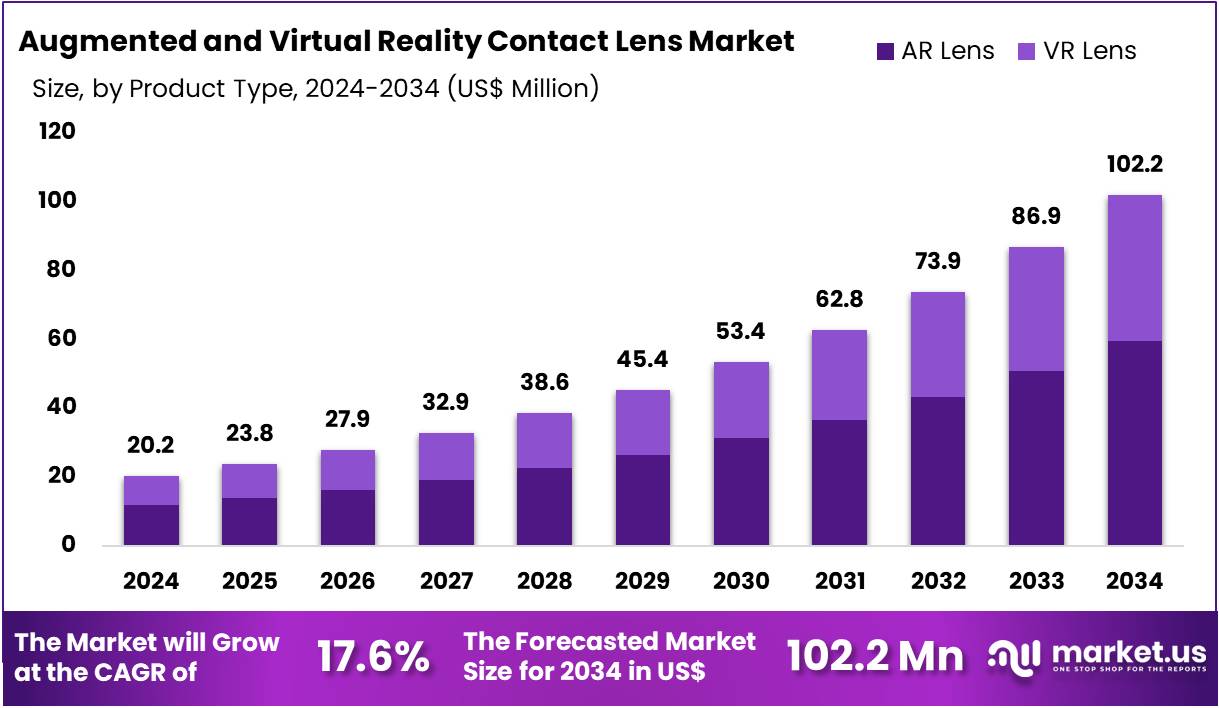
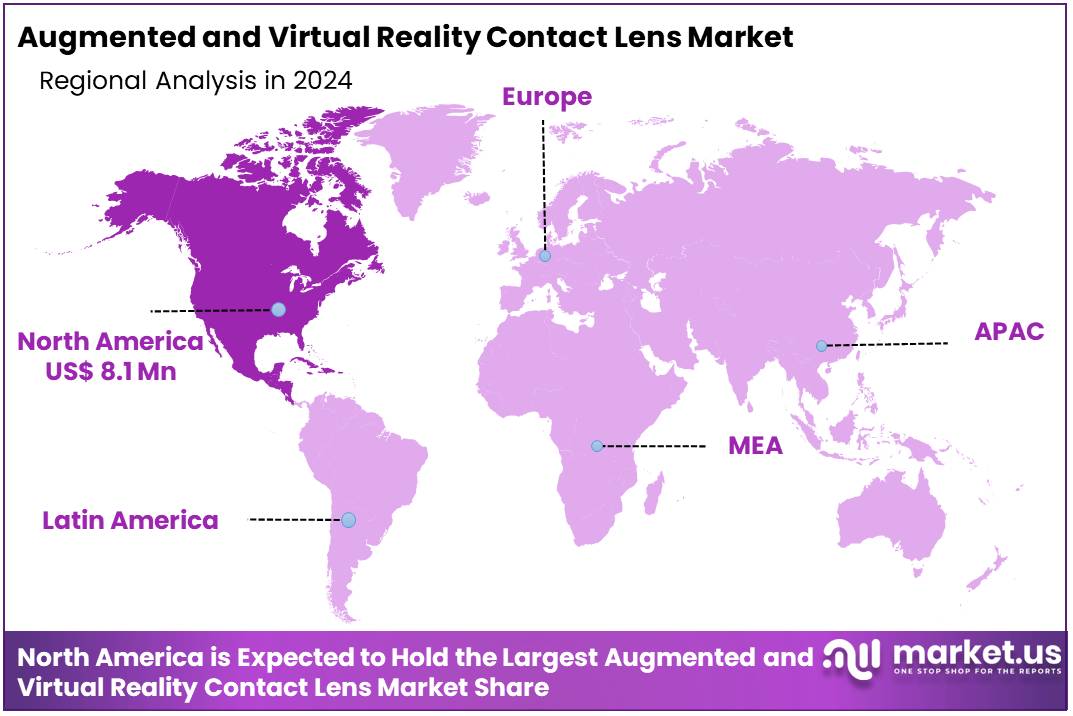
Global Augmented and Virtual Reality Contact Lens Market size is expected to be worth around US$ 102.2 million by 2034 from US$ 20.2 million in 2024, growing at a CAGR of 17.6% during the forecast period 2025 to 2034. In 2024, North America led the market, achieving over 40.2% share with a revenue of US$ 8.1 Million.
Increasing demand for enhanced visual experiences and the rising popularity of augmented and virtual reality technologies are driving the growth of the augmented and virtual reality (AR/VR) contact lens market. These contact lenses aim to revolutionize how users interact with digital content by providing immersive, hands-free experiences that seamlessly integrate the virtual world with the physical one.
The applications of AR/VR contact lenses span various sectors, including gaming, healthcare, education, and even navigation, where real-time information can be projected directly onto the user’s field of vision. Growing interest in wearable technology and the desire for more discreet, functional alternatives to traditional AR/VR devices, such as glasses and headsets, are fueling market demand.
In July 2020, Google acquired North, a Canada-based company specializing in augmented reality eyewear. This acquisition reflects Google’s commitment to advancing AR technologies, potentially influencing the development of AR contact lenses by integrating North’s expertise in miniaturized electronics and smart optics. Recent trends show that companies are increasingly focusing on miniaturizing the technology and improving the comfort and usability of AR/VR contact lenses, as these lenses need to be lightweight, safe, and easy to wear for extended periods.
As the market evolves, the integration of AR and VR with health-monitoring features and other innovations presents significant opportunities for growth. As consumer demand for more interactive and integrated technologies increases, AR/VR contact lenses are poised to become a transformative part of the wearable tech landscape.
Key Takeaways
- In 2023, the market for Augmented and Virtual Reality Contact Lens generated a revenue of US$ 2 million, with a CAGR of 17.6%, and is expected to reach US$ 102.2 million by the year 2033.
- The product type segment is divided into AR lens and VR lens, with AR Lens taking the lead in 2023 with a market share of 58.4%.
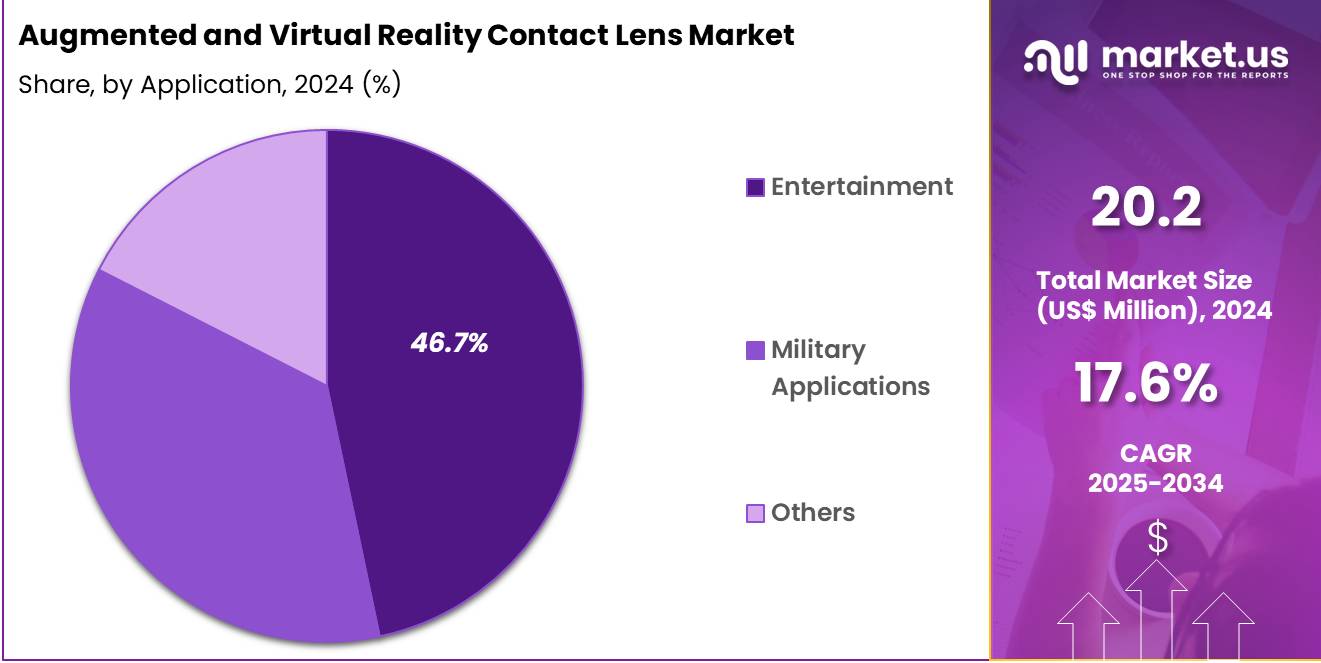
- Considering application, the market is divided into military applications, entertainment, and others. Among these, entertainment held a significant share of 46.7%.
- North America led the market by securing a market share of 40.2% in 2023.
Product Type Analysis
The AR Lens segment led in 2023, claiming a market share of 58.4% owing to increasing demand for immersive experiences and advancements in lens technology. AR lenses are anticipated to be integrated into everyday devices, enhancing user interaction with digital environments while keeping users’ hands free. These lenses are projected to revolutionize industries such as gaming, healthcare, and education by providing real-time data overlay, improving engagement and productivity.
The rapid growth of the AR technology in mobile applications and wearable devices further accelerates the demand for AR lenses. Moreover, developments in lens miniaturization, improving comfort, and ensuring clear visual outputs will likely make these lenses more accessible to consumers, leading to their broader adoption in various sectors.
Application Analysis
The entertainment held a significant share of 46.7% as immersive experiences become a major focus in the gaming and media industries. AR and VR lenses provide new ways for consumers to interact with digital content, offering fully immersive environments that traditional screens cannot match. The entertainment sector’s increasing investment in these technologies is likely to fuel demand, with AR lenses enhancing the gaming experience by blending real-world interactions with digital simulations.
Additionally, advancements in AR and VR content for movies, theme parks, and live performances are expected to boost growth in this segment. As more companies seek to differentiate their offerings, the need for high-quality augmented and virtual reality lenses tailored to entertainment applications will continue to grow.
Key Market Segments
Product Type
- AR Lens
- VR Lens
Application
- Military Applications
- Entertainment
- Others
Drivers
Surge in Innovation Driving the Augmented and Virtual Reality Contact Lens Market
Rising innovation is anticipated to drive the augmented and virtual reality contact lens market, enabling seamless integration of digital content into everyday life. In early 2024, Blink Energy introduced the BlinkIT contact lens, featuring an ergonomic power solution placed within the eyelid to enhance usability. At MWC 2024, XPANCEO unveiled four prototype smart contact lenses with functionalities such as health monitoring, content browsing, and immersive video interactions.
These developments highlight the rapid advancements in smart lens technology, offering users a more natural and comfortable alternative to traditional headsets. The incorporation of micro-LED displays enhances image clarity, improving user experience in augmented and virtual environments. AI-driven eye-tracking technology is revolutionizing interaction capabilities, making virtual engagement more intuitive. Battery optimization solutions are extending operational hours, addressing previous limitations in wearability.
Lightweight and flexible materials are improving comfort and reducing eye strain, enhancing long-term usability. Strategic partnerships between tech giants and healthcare firms are accelerating product commercialization. Regulatory bodies are working closely with manufacturers to ensure safety and compliance, fostering trust in the market. These advancements position smart contact lenses as the future of immersive digital experiences.
Restraints
High Costs Are Restraining the Augmented and Virtual Reality Contact Lens Market
High costs are restraining the augmented and virtual reality contact lens market, limiting accessibility to a niche consumer base. The integration of micro-displays, biometric sensors, and wireless connectivity requires advanced manufacturing processes, increasing production expenses. High research and development costs further elevate product pricing, restricting affordability for the general public.
Limited large-scale production capabilities prevent economies of scale, keeping costs high compared to traditional contact lenses. Battery miniaturization and wireless power solutions add complexity, making mass production challenging. Strict regulatory approvals for medical-grade smart lenses extend development timelines, adding additional financial burdens for companies.
The need for continuous software updates and cloud-based integration increases operational expenses, further limiting widespread adoption. Addressing cost-related challenges through technological advancements and strategic partnerships could improve affordability and market expansion.
Opportunities
Growing Investments in R&D as an Opportunity for the Augmented and Virtual Reality Contact Lens Market
Growing investments in R&D are expected to drive opportunities in the augmented and virtual reality contact lens market. In September 2023, Innovega Inc. secured a substantial investment to advance its iOptik AR contact lens system. This funding aims to accelerate commercialization, offering users a high-resolution, wide-field-of-view experience for immersive applications.
Increased venture capital interest is supporting the development of next-generation AR lenses with improved optical performance. AI-driven innovations are enhancing real-time data visualization, strengthening the potential for healthcare and enterprise applications. Research in nanomaterials is leading to more lightweight and breathable smart lenses, improving comfort and wearability.
Advancements in wireless power solutions are addressing battery life concerns, making prolonged use more feasible. Collaborative efforts between tech firms and medical institutions are expanding use cases, from gaming to medical diagnostics. These investments highlight the growing confidence in AR contact lenses as a transformative technology for the future.
Impact of Macroeconomic / Geopolitical Factors
Macroeconomic and geopolitical factors significantly influence the augmented and virtual reality contact lens market. On the positive side, the growing investment in immersive technologies, driven by increasing consumer demand for AR/VR applications, enhances the market’s expansion. Rising interest in wearable tech for gaming, healthcare, and education contributes to the adoption of AR/VR lenses as a user-friendly solution.
However, economic recessions or political instability may affect consumer spending on high-tech devices, slowing the adoption of augmented and virtual reality contact lenses. Regulatory challenges and intellectual property concerns across countries could delay product development and launch. Additionally, global trade restrictions and supply chain disruptions may increase production costs, affecting the affordability of these products.
Despite these challenges, technological advancements, the push for more immersive user experiences, and growing interest in non-intrusive, wearable technology ensure a positive outlook for the market in the coming years.
Latest Trends
Increase in Partnerships and Collaborations Driving the Augmented and Virtual Reality Contact Lens Market:
Increasing partnerships and collaborations are driving growth in the augmented and virtual reality contact lens market. High demand for advanced AR/VR solutions, coupled with the need for enhanced user experiences, is expected to encourage companies to form strategic alliances to accelerate development. These collaborations bring together expertise in optics, display technology, and AR/VR applications, helping companies create more effective and accessible contact lens solutions.
The ability to combine resources and knowledge will likely enable faster innovation and commercialization of augmented and virtual reality lenses. In October 2023, Mojo Vision announced a strategic partnership with a leading technology firm to co-develop advanced augmented reality contact lenses.
This collaboration aims to integrate cutting-edge display technology directly into contact lenses, enhancing the user experience in AR applications. As partnerships and collaborations continue to rise, the market will likely benefit from technological advancements, increased product offerings, and wider adoption of AR/VR contact lenses.
Regional Analysis
North America is leading the Augmented and Virtual Reality Contact Lens Market
North America dominated the market with the highest revenue share of 40.2% owing to advancements in smart lens technology and increasing adoption of immersive digital experiences. The region’s strong presence of leading tech companies and startups investing in AR and VR applications accelerated innovation in this sector.
Growing demand for hands-free, high-resolution augmented displays in industries such as healthcare, gaming, and military applications fueled adoption. Expanding applications in vision correction, coupled with the integration of micro-LED displays and wireless connectivity, further enhanced consumer interest. The presence of established regulatory frameworks supporting medical-grade smart lenses contributed to market expansion. Collaborations between technology firms and healthcare organizations also played a crucial role in developing multifunctional lenses with enhanced user experience.
Additionally, rising consumer awareness about the potential of AR-enabled lenses in interactive education and professional training drove investment in research and development. The increasing convergence of AI and AR contact lenses for real-time information processing further positioned North America as a key innovation hub for this technology.
The Asia Pacific region is expected to experience the highest CAGR during the forecast period
Asia Pacific is expected to grow with the fastest CAGR owing to rising technological advancements and increasing healthcare investments. The collaboration between a research team at POSTECH in South Korea and PHI BIOMED Co. in March 2022, which led to the development of smart lenses for diabetic retinopathy management, demonstrated the region’s focus on medical applications for wearable optics.
Expanding demand for AR-driven solutions in gaming, consumer electronics, and telemedicine is anticipated to fuel adoption. Rapid growth in smartphone and wearable device penetration across countries like China, Japan, and South Korea is likely to accelerate interest in smart lenses. Government initiatives promoting digital innovation and smart healthcare solutions are expected to drive further research in AR-integrated optics.
Collaborations between local manufacturers and global tech firms are projected to enhance accessibility and affordability of smart contact lenses. Increasing awareness of eye health and digital vision correction solutions is likely to support broader adoption. Advancements in nanotechnology and AI-assisted visual overlays are anticipated to further strengthen the market’s expansion across Asia Pacific.
Key Regions and Countries
North America
- US
- Canada
Europe
- Germany
- France
- The UK
- Spain
- Italy
- Russia
- Netherland
- Rest of Europe
Asia Pacific
- China
- Japan
- South Korea
- India
- Australia
- New Zealand
- Singapore
- Thailand
- Vietnam
- Rest of APAC
Latin America
- Brazil
- Mexico
- Rest of Latin America
Middle East & Africa
- South Africa
- Saudi Arabia
- UAE
- Rest of MEA
Key Players Analysis
Key players in the augmented and virtual reality contact lens market focus on advancing micro-display technology and integrating real-time data overlays to enhance user experience. Companies invest in research and development to improve lens transparency, battery efficiency, and wireless connectivity for seamless functionality.
Strategic collaborations with tech firms and healthcare providers drive innovation and expand the applications of smart lenses in both consumer and medical fields. Geographic expansion into regions with increasing demand for wearable augmented reality solutions supports further market growth. Many players also prioritize regulatory approvals and user safety to accelerate commercialization and adoption.
Mojo Vision is a leading company in this market, developing innovative smart contact lenses that integrate microLED displays for real-time augmented reality applications. The company emphasizes cutting-edge technology and strategic partnerships to refine its product offerings. Mojo Vision’s commitment to revolutionizing wearable AR solutions positions it as a key player in the next-generation contact lens industry.
Top Key Players
- Innovega
- Inwith Corp.
- Mojo Vision
- Sony Corporation
- Samsung Electronics
- Verily Life Sciences
- Sensimed AG
- Medella Health
Recent Developments
- In October 2023, Meta Platforms Inc. expanded its partnership with EssilorLuxottica to develop the next generation of Ray-Ban smart glasses. This collaboration aims to integrate advanced AR features into eyewear, signaling a significant move towards more immersive and user-friendly AR experiences, which could pave the way for future developments in AR contact lenses.
- In January 2021, InWith Corporation showcased its innovative smart contact lenses at the CES event, opening new possibilities for computerized applications in augmented reality (AR) within soft contact lenses. This demonstration highlighted the potential for integrating AR technologies into everyday eyewear, paving the way for future advancements in the AR contact lens market.









