


Report Overview
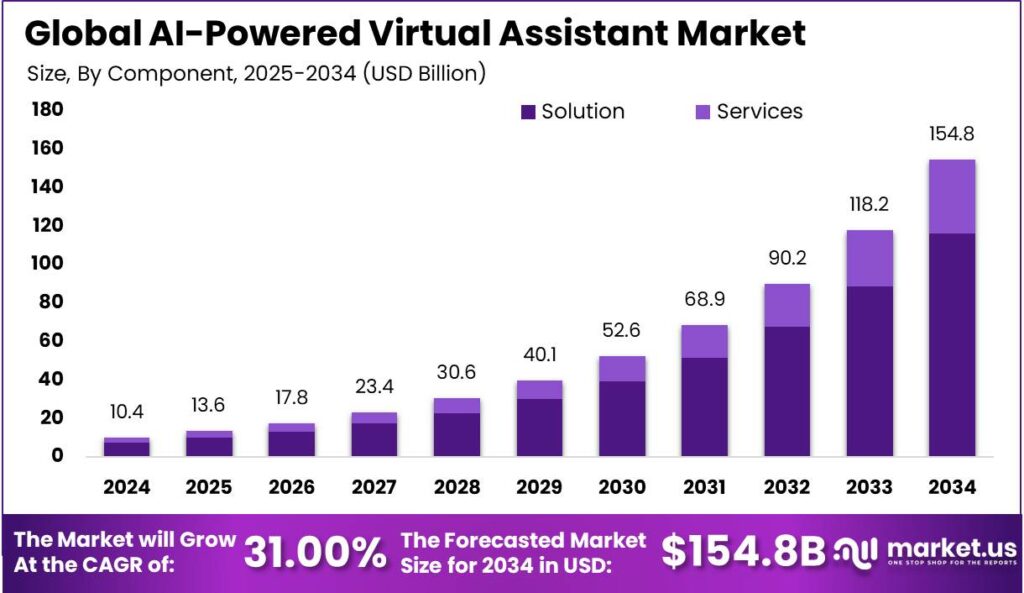
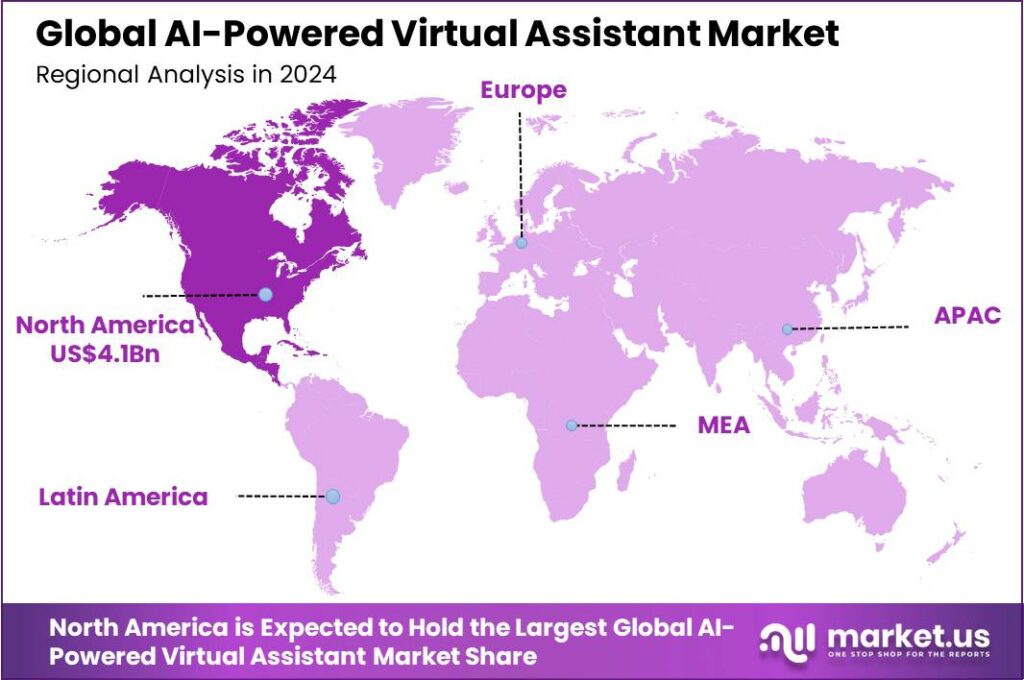
The Global AI-Powered Virtual Assistant Market size is expected to be worth around USD 154.8 Billion By 2034, from USD 10.4 Billion in 2024, growing at a CAGR of 31.00% during the forecast period from 2025 to 2034. North America was the leading region in 2024, holding over 40% of the market share, with revenues reaching approximately USD 4.1 billion.
An AI-powered virtual assistant is a sophisticated software tool that utilizes artificial intelligence technologies, including machine learning and natural language processing, to simulate human interaction and perform tasks. AI-powered virtual assistants help with tasks like scheduling and customer support, improving efficiency and productivity.
The market spans industries such as technology, healthcare, and customer service, highlighting their key role in automating communication and administrative tasks.The growth of the AI-powered virtual assistant market can be attributed to several key factors such as the increasing demand for automation and efficiency in business processes drives the adoption of these technologies.
Advancements in AI and machine learning have made virtual assistants more intelligent, broadening their use across sectors. Additionally, the integration of voice-activated technology into devices like smartphones and smart speakers is driving market growth by expanding both the user base and application scenarios.
AI-powered virtual assistants have gained significant popularity due to their ability to integrate seamlessly into everyday devices such as smartphones, home automation systems, and even cars. Their ability to understand and predict user needs has made them indispensable tools for personal organization, lifestyle management, and proactive responses to inquiries.
Based on data from Software Oasis, 70% of organizations worldwide have adopted AI-driven tools, with virtual assistants emerging as one of the top three most widely used solutions. Notably, Microsoft’s Copilot for IT has proven to enhance employee productivity by 30% by integrating enterprise data with real-time user context, automating routine tasks.
Companies leveraging AI-driven task management tools have seen a 25% reduction in project completion times, demonstrating the significant time-saving potential of AI technologies in improving operational efficiency. Additionally, according to Artsmart, AI-powered content creation tools have led to a 58% improvement in content performance, allowing businesses to produce more content in less time.
Developers also benefit from AI coding assistants, which have reduced manual coding time by 55.8%. Marketing automation, fueled by AI, has resulted in an astounding 451% increase in qualified leads. Meanwhile, companies with over 100 employees lose approximately $420,000 annually due to unproductive meetings, emphasizing the growing need for AI-driven workplace optimization.
The market is set to expand further into new verticals such as elderly care, where virtual assistants can provide reminders for medication, appointments, and daily activities, thereby improving the quality of life for many individuals. Expansion is also evident in enterprise applications, where companies are adopting AI assistants to drive engagement and transform consumer interactions into more personalized experiences.
Key Takeaways
- The Global AI-Powered Virtual Assistant Market size is expected to reach USD 154.8 billion by 2034, growing from USD 10.4 billion in 2024. The market is projected to expand at a CAGR of 31.00% from 2025 to 2034.
- In 2024, the Solution segment held a dominant position, capturing more than 75% of the AI-powered virtual assistant market share.
- The cloud-based segment dominated the market in 2024, capturing over 67% of the share.
- The Customer Support and Management segment led the AI-powered virtual assistant market in 2024, accounting for more than 34% of the market share.
- The BFSI (Banking, Financial Services, and Insurance) segment captured a dominant position in 2024, holding over 21% of the market share.
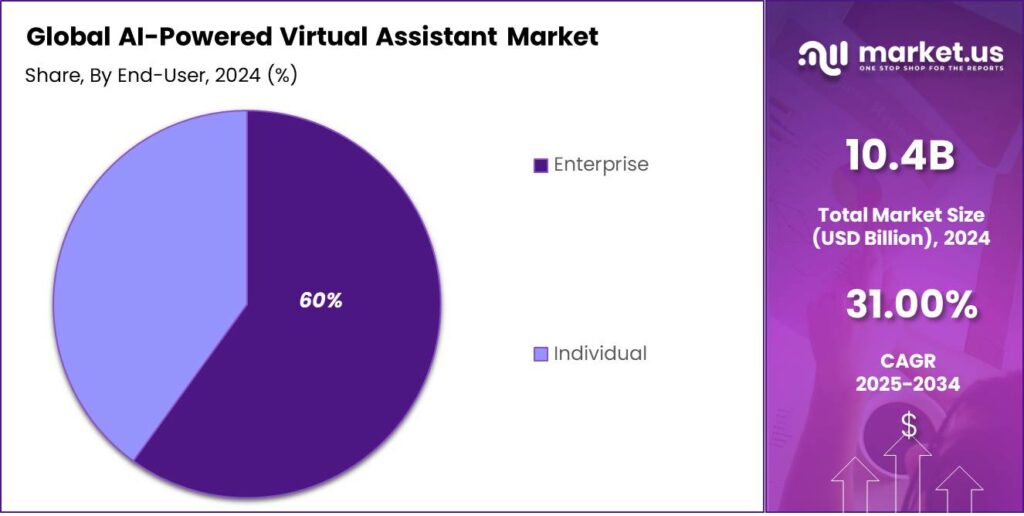
- The Enterprise segment was the dominant player in 2024, with a share of more than 60% of the market.
- North America was the leading region in 2024, holding over 40% of the market share, with revenues reaching approximately USD 4.1 billion.
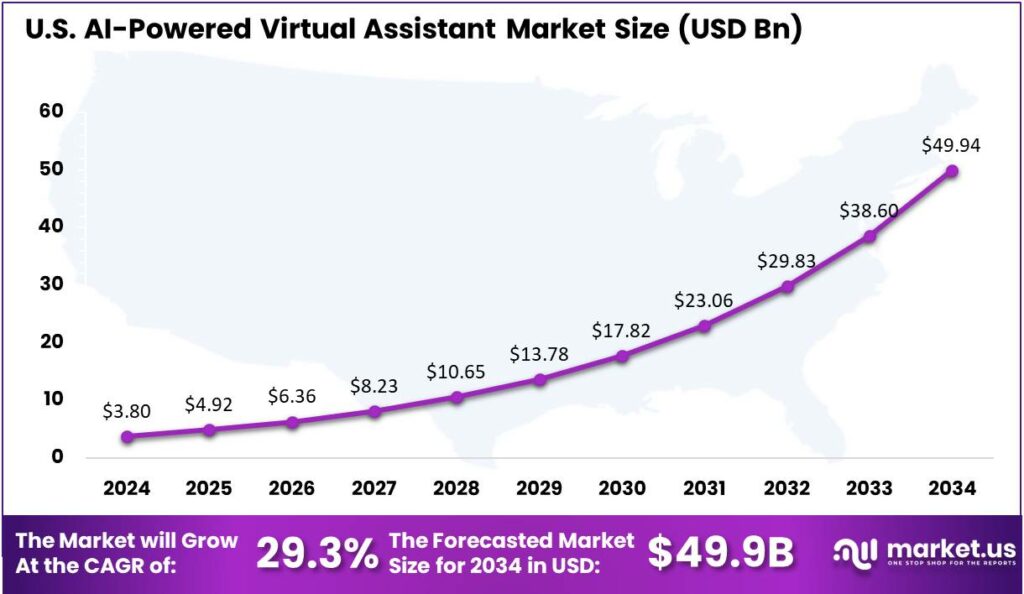
- In 2024, the market for AI-powered virtual assistants in the United States was valued at approximately USD 3.8 billion. The market is projected to grow at a CAGR of 29.38%.
U.S. AI-Powered Virtual Assistant Market
In 2024, the market for AI-powered virtual assistants in the United States was estimated to be valued at $3.8 billion. The projected compound annual growth rate (CAGR) for this market is 29.38%.
The U.S. AI-powered virtual assistant market is growing due to the rise in smart device adoption and improved AI capabilities in sectors like healthcare, finance, and customer service. As businesses realize the efficiency and cost benefits of AI, demand for intelligent virtual assistants is expected to increase, with more integration into everyday applications like voice assistants and chatbots.
Technological advancements and the integration of NLP are improving user experience, making interactions with AI virtual assistants more seamless. These enhancements are expected to drive market growth. As data privacy and security improve, trust in AI-driven solutions will increase, further supporting market expansion.
In 2024, North America held a dominant market position in the AI-powered virtual assistant industry, capturing more than a 40% share with revenues amounting to approximately USD 4.1 billion. This leadership stems from the region’s strong tech infrastructure and early adoption of AI across sectors like telecommunications, healthcare, and consumer services.
The growth of AI-powered virtual assistants in North America is fueled by high smart device penetration and AI integration in business operations. Enterprises use these assistants to enhance customer engagement, streamline operations, and provide personalized experiences, boosting productivity. The focus on customer service automation and data-driven decision-making further drives adoption.
The regulatory landscape in North America, particularly in the U.S. and Canada, supports AI development through frameworks that promote ethical use and a competitive market. This regulatory backing, along with significant investments in AI startups, fosters innovation and helps the region maintain its global market leadership.
Europe, APAC, Latin America, the Middle East, and Africa are growing but still lag behind North America in AI-powered virtual assistant adoption. Each region faces distinct challenges and opportunities based on economic, technological, and regulatory factors. As digital infrastructure improves, these markets are expected to grow, driven by the need for improved efficiency and customer service.
Component Analysis
In 2024, the Solution segment held a dominant position in the AI-powered virtual assistant market, capturing more than a 75% share. This segment comprises the core technologies and software that power AI virtual assistants, including AI algorithms, machine learning models, and natural language processing tools.
The leading position of the Solution segment can also be attributed to the substantial investments in AI technologies by major tech companies. These companies are continuously enhancing their offerings to deliver more sophisticated and seamless user experiences, which in turn fuels the adoption of advanced virtual assistant solutions across various industries.
Another reason for the dominance of the Solution segment is the increasing consumer preference for smart home devices and IoT-enabled products, where AI-powered virtual assistants are a key feature. Products like smart speakers, home automation systems, and wearable technology often rely on advanced virtual assistant solutions to function effectively.
Regulatory and security concerns are key to the Solution segment’s dominance in the AI-powered virtual assistant market. With growing data privacy concerns, there’s increased demand for AI solutions that comply with strict data protection laws. AI providers are investing in secure platforms to protect user data while maintaining high performance, ensuring their continued market leadership.
Deployment Analysis
In 2024, the cloud-based segment held a dominant position in the AI-powered virtual assistant market, capturing more than a 67% share. This segment’s leadership is primarily attributed to its flexibility and scalability, which are essential for integrating AI technologies.
Cloud-based deployment allows businesses of all sizes to utilize advanced AI capabilities without the need for substantial upfront investments in hardware infrastructure, making it a preferred choice for companies aiming to innovate and enhance their service offerings efficiently.
The cloud-based segment’s prominence is fueled by its ability to deliver seamless updates and improvements. Cloud platforms can push updates globally, ensuring users always have access to the latest features and security upgrades. This is especially important in AI, where continuous learning and adaptation are essential for virtual assistants to remain effective.
The cloud-based model also addresses the rising need for remote accessibility. With more distributed and mobile workforces, virtual assistants that can be accessed from anywhere are essential. Cloud-based AI assistants thrive in this environment, offering reliable, consistent support across different devices and locations.
Application Analysis
In 2024, the Customer Support and Management segment held a dominant market position in the AI-powered virtual assistant industry, capturing more than a 34% share. This leadership is largely due to the increasing demand for efficient customer service solutions that can handle large volumes of queries in real time.
The dominance of this segment is further strengthened by integrating AI virtual assistants into CRM systems. These integrations streamline customer interactions and automate tasks like ticketing, data updates, and feedback collection. This boosts operational efficiency, allowing human agents to handle more complex issues, optimizing workforce management, and lowering operational costs.
Advancements in NLP and machine learning have greatly enhanced AI virtual assistants’ ability to understand and process human language. This has resulted in more natural and effective interactions, increasing customer trust and reliance on AI for support functions.
The growing focus on personalized customer experiences drives this segment’s growth. AI-powered virtual assistants analyze customer data to provide tailored recommendations and support, boosting engagement and helping businesses build stronger customer relationships, highlighting AI’s importance in customer support.
Industry Vertical Analysis
In 2024, the BFSI (Banking, Financial Services, and Insurance) segment held a dominant market position within the AI-powered virtual assistant industry, capturing more than a 21% share. This significant market share can be attributed to the increasing adoption of AI technologies by financial institutions to enhance customer experience and streamline operations.
The BFSI segment’s leadership in the AI-powered virtual assistant market is reinforced by its focus on compliance and security. AI assistants in BFSI meet strict regulatory requirements and ensure secure customer interactions with features like biometric recognition and end-to-end encryption, earning the trust of financial institutions.
Moreover, the BFSI segment’s dominance is supported by the integration of sophisticated AI capabilities that allow for complex decision-making processes. AI virtual assistants in this sector are equipped with capabilities to analyze large volumes of data to detect fraud, manage risk, and provide real-time financial insights.
Additionally, the ongoing digital transformation in the BFSI sector contributes to the extensive deployment of AI-powered virtual assistants. Banks and insurance companies are focusing on digital channels to meet the evolving customer expectations, which involves the use of AI technologies to offer seamless and efficient user experiences.
End-User Analysis
In 2024, the Enterprise segment held a dominant market position in the AI-powered virtual assistant industry, capturing more than a 60% share. This dominance is primarily driven by the widespread integration of AI virtual assistants across various organizational functions to enhance efficiency and productivity.
The lead of the Enterprise segment is also supported by the growing demand for AI-driven automation in data-intensive industries such as telecommunications, finance, and healthcare. In these sectors, AI virtual assistants are crucial for processing large volumes of data to derive insights, manage customer interactions, and perform predictive analytics.
The expansion of AI capabilities like NLP and machine learning has increased the appeal of virtual assistants in corporate settings. These technologies allow assistants to handle complex queries, boosting employee productivity and decision-making. Enterprises are leveraging these advancements to create more interactive and responsive work environments.
The COVID-19 pandemic accelerated digital transformation, pushing enterprises toward remote work and digital customer service. This shift increased the need for AI-powered virtual assistants to handle online interactions and support remote workforce management. As businesses adapt, reliance on AI assistants is expected to grow, boosting the segment’s market dominance.
Key Market Segments
By Component
- Solution
- Services
By Deployment
- Cloud-based
- On-premises
By Application
- Customer Support and Management
- Sales and Marketing
- Smart Home Control
- Workflow Automation
- Healthcare Assistance
- Others
By Industry Vertical
- BFSI
- Automotive
- IT & Telecom
- Retail
- Healthcare
- Education
- Others
By End-User
- Individual
- Enterprise
Driver
Integration of AI Assistants in Industrial Operations
The integration of AI-powered virtual assistants into industrial operations is significantly enhancing efficiency and productivity. For instance, the Schaeffler factory in Hamburg has adopted Microsoft’s Factory Operations Agent, an AI-driven tool utilizing large language models to diagnose defects and operational issues in steel ball bearing manufacturing.
This system streamlines traditionally manual tasks, such as analyzing data from various industrial equipment, thereby reducing downtime and improving operational efficiency. The deployment of such AI assistants in manufacturing settings exemplifies how automation and advanced data analysis can lead to more responsive and efficient production processes. As industries continue to embrace digital transformation, the role of AI-powered virtual assistants is expected to expand, driving further advancements in operational capabilities.
Restraint
Data Privacy and Security Concerns
The adoption of AI-powered virtual assistants raises significant data privacy and security concerns. These assistants often process sensitive personal and organizational information, making them potential targets for data breaches. In addition to the above adversities, organizations must also focus on continuous monitoring and auditing of their AI systems.
Regular assessments of the security posture, vulnerability testing, and updating AI models to address emerging threats are essential practices. Furthermore, businesses should adopt a privacy-by-design approach, ensuring that data protection is integrated into the development and deployment stages of AI systems. This proactive strategy helps prevent data breaches and ensures compliance with data protection regulations such as GDPR.
Opportunity
Integration with Virtual Reality (VR) Technologies
The convergence of AI-powered virtual assistants with virtual reality (VR) technologies presents a significant opportunity for enhancing user experiences. In VR environments, virtual assistants can serve as interactive guides, assisting users in navigating immersive digital spaces, managing tasks, and providing real-time information.
This integration enables more intuitive and engaging interactions, particularly in sectors like education, healthcare, and retail, where immersive experiences can enhance learning, patient engagement, and customer satisfaction. As VR technology becomes more accessible and widespread, the demand for intelligent virtual assistants capable of operating within these environments is expected to grow, offering businesses new avenues for innovation and customer engagement.
Challenge
High Development and Maintenance Costs
Developing and maintaining sophisticated AI-powered virtual assistants involve substantial financial investments. The process requires advanced technology, skilled personnel, and continuous updates to ensure the system remains effective and secure.
For small and medium-sized enterprises, these costs can be prohibitive, limiting their ability to adopt and integrate such technologies into their operations. Additionally, the rapid pace of AI advancements necessitates ongoing investments to keep systems current, further escalating expenses. Organizations must carefully assess the return on investment and consider scalable solutions to manage these financial challenges effectively.
Emerging Trends
AI-powered virtual assistants are rapidly evolving, becoming integral to both personal and professional spheres. A significant trend is the development of autonomous AI agents capable of performing tasks without human intervention. These agents handle tasks like scheduling, managing emails, and making purchases, streamlining daily operations.
Another notable trend is the integration of AI assistants across various industries. In the travel sector, companies like Priceline are developing AI assistants to handle all aspects of travel, from flight bookings to hotel reservations. Likewise, AI receptionists in hospitality are improving efficiency and customer service by managing inquiries and reservations.
The workplace is transforming as AI assistants take on roles traditionally handled by humans. For example, AI tools can now attend meetings, take notes, and summarize key points, reducing meeting overload and boosting productivity.
Business Benefits
The adoption of AI-powered virtual assistants offers numerous advantages to businesses, primarily through enhanced efficiency and productivity. By automating routine tasks such as data entry, scheduling, and customer inquiries, employees can focus on more strategic activities, leading to improved operational workflows.
In customer service, AI assistants provide immediate responses to client queries, ensuring a seamless and satisfactory customer experience. This not only increases customer retention but also reduces the workload on human support teams. AI-powered virtual assistants improve internal communication by managing emails, organizing meetings, and providing real-time information, boosting collaboration and efficiency.
Financially, businesses benefit from cost reductions associated with automating repetitive tasks, leading to decreased operational expenses. Additionally, AI assistants can analyze vast amounts of data to identify trends and patterns, facilitating informed decision-making and strategic planning.
Key Regions and Countries
- North America
- US
- Canada
- Europe
- Germany
- France
- The UK
- Spain
- Italy
- Rest of Europe
- Asia Pacific
- China
- Japan
- South Korea
- India
- Australia
- Singapore
- Rest of Asia Pacific
- Latin America
- Brazil
- Mexico
- Rest of Latin America
- Middle East & Africa
- South Africa
- Saudi Arabia
- UAE
- Rest of MEA
Key Player Analysis
- Amazon’s Alexa is one of the leading virtual assistants in the market. It was designed primarily for Amazon’s Echo devices, which integrate with a wide range of smart home products. Alexa offers robust voice recognition and a vast ecosystem of “skills” that allow users to perform tasks from controlling lights to shopping on Amazon.
- Google Assistant stands out for its superior search capabilities, thanks to Google’s search engine, and is known for delivering more accurate and context-aware responses. Available on Android devices and Google Home speakers, it can handle a wide range of tasks and is deeply integrated with Google services like Gmail, Google Maps, and YouTube.
- Apple’s Siri has been a pioneer in virtual assistants, introduced back in 2011. While it has faced some criticism over the years for being less advanced than competitors like Alexa and Google Assistant, Siri still holds a significant share of the market, particularly among iPhone and Apple device users.
Top Key Players in the Market
- Amazon (Alexa)
- Google (Google Assistant)
- Apple (Siri)
- Fireflies
- PeopleAI
- IBM Corporation
- Microsoft
- Cogram
- Google Workspace AI Assistant
- Zoho Zia
- ChatGPT
- Gemini
- Bing AI
- GitHub Copilot
- Jasper
- Salesforce Einstein Voice
- Other Key Players
Top Opportunities Awaiting for Players
The AI-powered virtual assistant market is poised for significant expansion, presenting a number of opportunities for players in the industry.
- Integration with Smart Devices: The proliferation of smart devices offers a considerable growth avenue for virtual assistants. As smart device adoption increases, virtual assistants are becoming integral in managing these devices, providing personalized services, and enhancing user experiences. For instance, the rising number of smart homes is expected to bolster the demand for virtual assistants that can integrate seamlessly with various home automation systems.
- Enhanced Customer Engagement: Innovations in AI technology are enabling virtual assistants to offer more accurate, context-aware interactions, improving customer service across various industries. Businesses are leveraging AI-driven virtual assistants to reduce operational costs and enhance customer satisfaction, particularly in sectors like retail, finance, and healthcare, where personalized communication is key.
- Healthcare Sector Applications: There is growing adoption of virtual assistants in healthcare, aiding in tasks such as managing appointments and patient data, which improves efficiency and reduces administrative burdens. AI-driven assistants are increasingly handling significant portions of telemedicine interactions, thus playing a crucial role in the digital transformation of the healthcare industry.
- Investment and Funding Surge: The virtual assistant market is attracting substantial investment, with a considerable increase in funding rounds and financial backing from prominent investors. This influx of capital is fueling innovation and startup growth, creating a vibrant ecosystem for new AI solutions and applications across various sectors.
- Global Market Expansion: The virtual assistant market is experiencing robust growth globally, with significant developments in regions like North America, Asia-Pacific, and Europe. Companies are expanding their geographic footprint, tailoring solutions to regional market needs and compliance, such as GDPR in Europe or integrating culturally relevant interactions in Asian markets.
Recent Developments
- In February 2025, DTDC has unveiled DIVA 2.0, an AI-driven virtual assistant designed to revolutionize customer support. This cutting-edge technology marks a milestone in the domestic logistics sector, offering smart and efficient assistance like never before.
- IBM partnered with Penn State in February 2025, a top global university, to develop MyResource, a student concierge powered by Watsonx. This AI-driven assistant will simplify access to campus resources for nearly 90,000 students when it launches.
- In November 2024, Syntheia Corp., a Canadian leader in conversational AI, is set to launch its innovative SaaS platform in January 2025. Designed to transform inbound call management, it uses advanced NLP to boost communication and efficiency, targeting small and medium businesses worldwide.









