


Report Overview
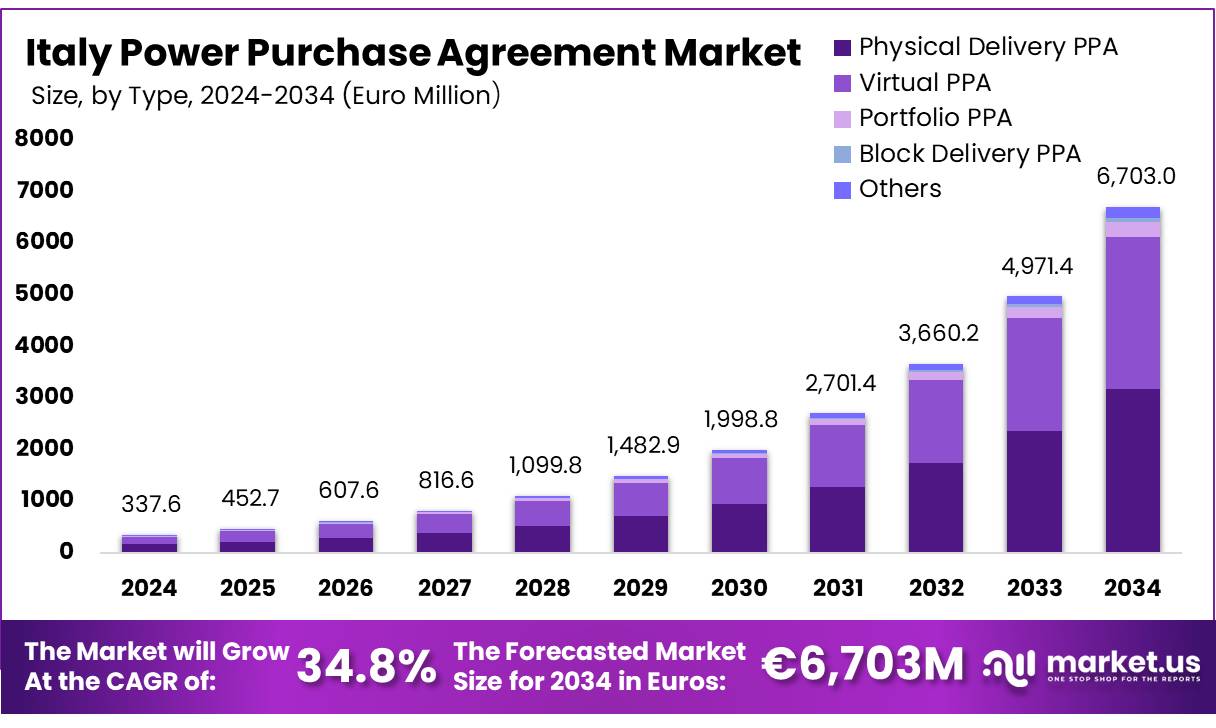
Italy Power Purchase Agreement Market size is expected to be worth around Euro 6,703.0 Million by 2034, from Euro 337.6 Million in 2024, growing at a CAGR of 34.8% from 2025 to 2034.
Italy’s Power Purchase Agreement (PPA) market is experiencing significant growth, driven by the country’s ambitious renewable energy targets and favorable regulatory changes. The Italian government aims to achieve 70% of its electricity production from renewable sources by 2030, a goal that has accelerated the adoption of PPAs as a mechanism to secure long-term renewable energy procurement.
The introduction of the “FER X” legislation in 2024, which seeks to add 60 GW of new renewable capacity by 2028, has been pivotal in this expansion. This decree allocates 45 GW to solar energy and 16.5 GW to onshore wind, streamlining approval processes and incentivizing investments in renewable projects. The market has seen a surge in both corporate and utility-driven PPAs.
The Italian electricity market’s structure, divided into seven bidding zones, introduces complexities such as the Corrispettivo Capacità di Trasporto (CCT), reflecting transmission capacity constraints. These factors influence PPA pricing and risk assessments, necessitating careful consideration by market participants.
- Italy aims for 72% of its electricity to come from renewable sources by 2030. However, the National Energy and Climate Plan (NECP) indicates a more conservative target of 55% renewables in the electricity mix by the same year.
- To achieve these targets, Italy needs to increase its renewable capacity significantly. Estimates suggest that an additional 90 GW of renewable capacity is required by 2035, bringing the total to 250 GW2.
- By 2030, projections indicate that Italy could reach around 107.7 GW of renewable capacity, with a generation share of approximately 59% from renewables.
Key Takeaways
- Italy power purchase agreement market is valued at Euro337.6 million in 2024 and is estimated to register a CAGR of 34.8%.
- Italy power purchase agreement market is projected to reach Euro 6,703.0 million by 2034.
- Among types, physical delivery PPA dominated the Italy power purchase agreement market, holding a 47.5% revenue share.
- In 2024, solar energy dominated the Italy Power Purchase Agreement (PPA) market, among other applications, accounted for 54.0% of the total share.
Regulatory Framework
| Region/Country | Regulatory Body/ Regulation | Description | |||||||||||||||||||||||||||||||||||||||||||||||||||||||||||||||||||||||||||||||||||||||||||||||||||||
|---|---|---|---|---|---|---|---|---|---|---|---|---|---|---|---|---|---|---|---|---|---|---|---|---|---|---|---|---|---|---|---|---|---|---|---|---|---|---|---|---|---|---|---|---|---|---|---|---|---|---|---|---|---|---|---|---|---|---|---|---|---|---|---|---|---|---|---|---|---|---|---|---|---|---|---|---|---|---|---|---|---|---|---|---|---|---|---|---|---|---|---|---|---|---|---|---|---|---|---|---|---|---|---|
| Category Analysis |
| Category | 2020 | 2021 | 2022 | 2023 | 2024 | |||||||||||||||||||||||||||||||||||||||||||||||||||||||||||||||||||||||||||||||||||||||||||
|---|---|---|---|---|---|---|---|---|---|---|---|---|---|---|---|---|---|---|---|---|---|---|---|---|---|---|---|---|---|---|---|---|---|---|---|---|---|---|---|---|---|---|---|---|---|---|---|---|---|---|---|---|---|---|---|---|---|---|---|---|---|---|---|---|---|---|---|---|---|---|---|---|---|---|---|---|---|---|---|---|---|---|---|---|---|---|---|---|---|---|---|---|---|---|---|---|
| Capacity | 2020 | 2021 | 2022 | 2023 | 2024 |
|---|---|---|---|---|---|
| Up to 20 MW | 16.9 | 21.1 | 26.5 | 33.2 | 41.9 |
| 20-50 MW | 19.6 | 25.8 | 34.2 | 45.1 | 59.7 |
| 50-100 MW | 48.2 | 64.7 | 86.5 | 115.7 | 154.3 |
| Above 100 MW | 21.1 | 29.5 | 41.4 | 58.1 | 81.7 |
Application Analysis
By applications, the market is further divided into solar, wind, geothermal, hydropower, carbon capture and storage & others. In 2024, solar energy dominated the Italy power purchase agreement market, accounting for 54.0% of the total share, driven by favorable policies, declining solar technology costs, and the country’s geographical advantage. Italy has one of the highest solar potentials in Europe, with over 2,000 sunlight hours annually, making it an ideal location for large-scale solar power generation.
The Italian government’s FER X scheme, which aims to install 60 GW of new renewable capacity by 2028, has allocated 45 GW specifically to solar projects, boosting market growth. Additionally, corporate buyers and utilities prefer solar PPAs due to their lower capital costs, quicker deployment, and predictable output compared to wind or other renewables. Technological advancements, such as bifacial solar panels and improved energy storage solutions, have further enhanced solar’s competitiveness.
Italy Power Purchase Agreement Market, By Application, 2020-2024 (Mn Euros)
| Application | 2020 | 2021 | 2022 | 2023 | 2024 |
|---|---|---|---|---|---|
| Solar | 61.2 | 80.6 | 106.0 | 139.1 | 182.2 |
| Wind | 29.2 | 40.9 | 57.3 | 80.5 | 113.4 |
| Geothermal | 2.0 | 2.4 | 3.0 | 3.8 | 4.7 |
| Hydropower | 4.7 | 5.9 | 7.5 | 9.4 | 11.8 |
| Carbon Capture & Storage | 1.3 | 1.6 | 2.1 | 2.7 | 3.5 |
| Others | 7.4 | 9.7 | 12.7 | 16.6 | 21.9 |
End-Use Analysis
Based on end-uses, the market is further divided into residential, commercial & industrial. the industrial sector accounted for 48.9% of the Italy Power Purchase Agreement (PPA) market, primarily due to high energy consumption and sustainability commitments from manufacturing, automotive, and technology industries. Industrial operations require large and stable energy supplies, making long-term PPAs an attractive option for cost control and carbon footprint reduction.
With Italy’s push for decarbonization and stricter carbon regulations, industries increasingly adopted renewable energy PPAs to align with Environmental, Social, and Governance (ESG) goals. Companies like STMicroelectronics, Fiat, and other major manufacturers secured PPAs to ensure stable energy pricing and reduce exposure to volatile fossil fuel markets. The growing demand for data centers and energy-intensive industries, such as chemicals and metals production, also drove PPA adoption. As Italy continues its industrial decarbonization efforts, the industrial sector is expected to remain the largest PPA consumer in the coming years.
Italy Power Purchase Agreement Market, End-Use Analysis, 2020-2024 (Mn Euros)
| Deal Type | 2020 | 2021 | 2022 | 2023 | 2024 |
|---|---|---|---|---|---|
| Residential | 4.7 | 5.9 | 7.5 | 9.4 | 11.9 |
| Commercial | 57.4 | 74.3 | 96.1 | 124.3 | 160.6 |
| Industrial | 43.7 | 60.9 | 84.9 | 118.3 | 165.1 |
Key Market Segments
By Type
- Physical Delivery PPA
- Virtual PPA
- Portfolio PPA
- Block Delivery PPA
- Others
By Location
- On-site
- Off-site
By Application
- Corporate
- Government
- Others
By Deal Type
- Wholesale
- Retail
- Others
By Capacity
- Up to 20 MW
- 20-50 MW
- 50-100 MW
- Above 100 MW
By Application
- Solar
- Wind
- Geothermal
- Hydropower
- Carbon Capture and Storage
- Others
By End-Use
- Residential
- Commercial
- Industrial
Drivers
Italy’s Renewable Energy Targets and Decarbonization Goals
One of the key drivers propelling the growth of the Power Purchase Agreement (Italy’s PPA) market in Italy is the country’s ambitious renewable energy targets and its commitment to decarbonization. Italy has set a national target to source at least 30% of its total energy consumption from renewable sources by 2030, a goal that is aligned with the European Union’s broader Green Deal and the Renewable Energy Directive (RED II). This policy framework aims to reduce greenhouse gas emissions by 55% by 2030 compared to 1990 levels, creating significant demand for renewable energy generation across all sectors of the Italian economy.
In response, power purchase agreements are increasingly being viewed as a key mechanism to help meet these targets by facilitating the direct procurement of renewable energy. The Italian government has implemented several policies to promote the uptake of renewable energy. Particularly, the “FER 1” incentive scheme, launched in 2019, aims to support the development of new renewable energy plants, especially in the wind and solar sectors. Under this scheme, renewable energy projects benefited from competitive auctions that enable developers to secure long-term contracts at favorable rates. By ensuring stable, predictable revenues for energy producers, PPAs complement such incentives, reducing the financial risks associated with renewable energy projects.
Restraints
Impact of Zonal Pricing on Power Purchase Agreements (PPAs) in Italy
The Italy’s transition from a PUN-based pricing system to zonal pricing in Italy’s electricity market introduces significant restraints for Power Purchase Agreements (PPAs) market growth. In Italy’s current PUN-based system, producers take on the basis risk due to the difference between zonal prices and the national PUN price. This has generally been more predictable in northern and central regions.
However, with the upcoming shift to zonal pricing, both producers and buyers will need to adapt to a more complex pricing structure that reflects regional demand and grid constraints. This change introduces the potential for increased basis risks, particularly for companies that are not experienced in managing these new variables. As a result, there could be hesitation in signing new contracts, as businesses navigate these more unpredictable pricing dynamics. This factors could discourage corporate buyers, particularly those unfamiliar with managing the complexities of CCT risk, from entering into new PPAs.
Opportunity
Growing Demand for Corporate Sustainability and ESG Initiative Is Estimated to Create More Opportunities
A major opportunity for the growth of the PPA market in Italy lies in the increasing demand for corporate sustainability and ESG initiatives. Over the past few years, businesses across various sectors have come under growing pressure from investors, consumers, and regulatory bodies to demonstrate their commitment to sustainability and reduce their carbon footprints. As a result, more companies are adopting ambitious sustainability targets, with several setting goals for carbon neutrality and renewable energy procurement. This trend is creating a significant opportunity for PPAs, particularly in the corporate sector, as businesses seek reliable and cost-effective ways to source renewable energy and meet their ESG commitments.
Corporate PPAs offer a powerful tool for companies looking to achieve their sustainability goals. By entering into long-term agreements with renewable energy producers, corporations can directly support the development of new renewable energy capacity while securing stable energy prices. This is especially important in industries with high energy consumption, such as manufacturing, technology, and retail, where energy costs represent a significant portion of operational expenses.
- According to the Business Climate Survey for 2024, 81% of Swedish companies operating in Italy believe that environmental concerns significantly influence customer purchasing decisions. This statistic highlights how sustainability is becoming integral to business strategy and consumer behavior.
Trends
Blockchain-enabled Power Purchase Agreements
Blockchain-enabled Power Purchase Agreements (PPAs) trends rising as smart contract technology these help to automate contract administration and payments between signatories, providing agreements transparency, mitigating risks, and reducing transaction costs. In renewable PPAs corporate buyers could use blockchain technology, supporting further PPA market growth. This could lead to an increase in smaller organizations contracting renewable power as simplified blockchain PPAs become more accessible and affordable. Blockchain PPAs facilitate peer-to-peer transactions, revolutionizing the electricity sector by enabling more efficient and secure transactions, achieving renewable energy integration, empowering prosumers, cost savings, grid resilience, innovation in technology, and regulatory evolution.
- Recently in 2023 Sofidel, Italian based paper company signed a 10-year Power Purchase Agreement (PPA) with ACCIONA, these agreement aligns with ACCIONA Energeia’s GREENCHAIN® blockchain platform for real-time tracking of renewable energy sources.
Geopolitical Impact Analysis
The Geopolitical Tensions Significantly Impacted the Global Power Purchase Agreement Market
Geopolitical tensions significantly impacted the Italy Power Purchase Agreement (PPA) market, influencing energy prices, supply chains, investment flows, and renewable energy adoption. The ongoing Russia-Ukraine conflict, rising tensions in the Middle East, and global trade disruptions led to heightened energy security concerns, pushing Italy to accelerate its transition towards renewable energy procurement through PPAs. One of the most immediate impacts was the volatility in energy prices, particularly in natural gas, which still plays a crucial role in Italy’s energy mix.
As Italy historically relied on Russian gas imports, European sanctions on Russia, coupled with supply chain disruptions, caused fluctuations in wholesale electricity prices. This increased the attractiveness of long-term renewable PPAs, as businesses and utilities sought stable, predictable energy costs to mitigate financial risks. Additionally, supply chain disruptions impacted renewable energy projects, as essential components like solar panels, wind turbines, and battery storage systems faced delays and price hikes due to trade restrictions and logistical bottlenecks.
Several of these components are sourced from China, Southeast Asia, and the U.S., making the renewable energy sector vulnerable to geopolitical instability. In response, Italy’s government accelerated its renewable energy initiatives, particularly through the FER X scheme, which aims to install 60 GW of renewable capacity by 2028. Corporate and industrial buyers increased their PPA commitments to reduce reliance on volatile fossil fuels and align with sustainability goals.
Key Players Analysis
Companies are Strongly Focusing On Product Portfolio Expansion Through Various Strategies To Maintain their Dominance as Industry Leaders
leading companies in the Italy Power Purchase Agreement (PPA) market adopted several strategic approaches to maintain their dominance, focusing on renewable energy expansion, technological innovation, long-term partnerships, and regulatory alignment. These strategies have been crucial in securing market leadership amid growing competition and evolving energy policies. Another significant approach is technological innovation and digitalization. Industry leaders are incorporating smart grid technology, AI-driven energy management systems, and advanced energy storage solutions to optimize energy distribution and enhance efficiency.
Market Key Players
- General Electric
- Siemens AG
- Shell Plc
- Statkraft AS
- Ameresco
- RWE AG
- Enel Italy Trading
- Iberdrola, S.A.
- Ørsted A/S
- Vestas
- ERG SpA
- Drax Energy Solutions Limited
- Other Key Players

- 蓝茶市场(2026—2031)
0评论2026-09-15

- 泡沫材料市场(2026—2031)
0评论2026-09-15

- 重铬酸钠市场(2026—2031)
0评论2026-09-15

- 家族性淀粉样多发性神经病(FAP)市场(2026—2031)
0评论2026-09-15

- 次氯酸钙市场(2026—2031)
0评论2026-09-15

- 海上储能市场(2026—2031)
0评论2026-09-12

- 混凝土市场(2026—2031)
0评论2026-09-12

- 矫形器械市场(2026—2031)
0评论2026-09-12

- 木质素基树脂市场(2026—2031)
0评论2026-09-12

- 聚碳酸酯二元醇市场(2026—2031)
0评论2026-09-12