


Report Overview
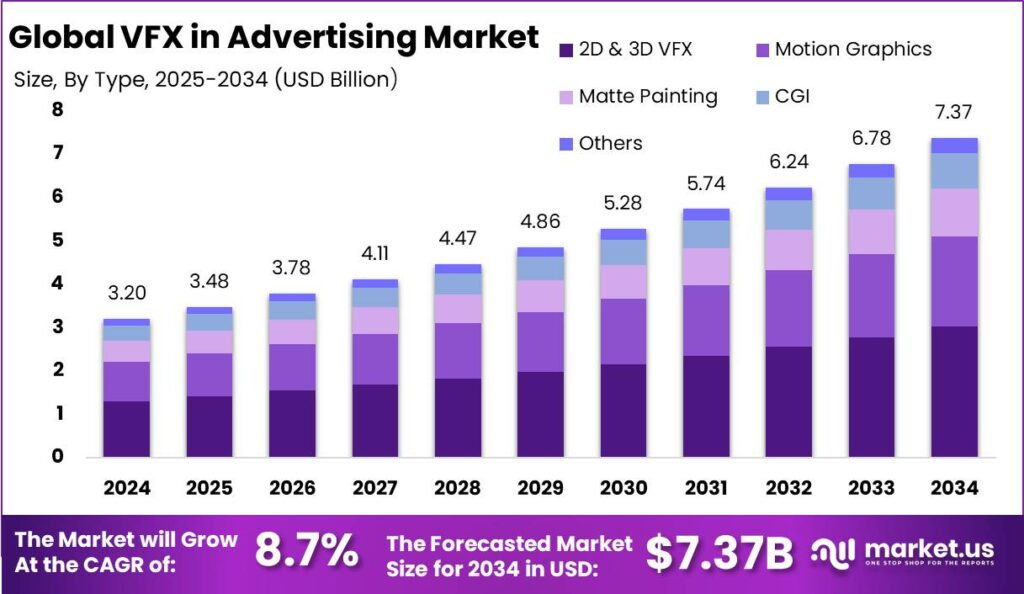
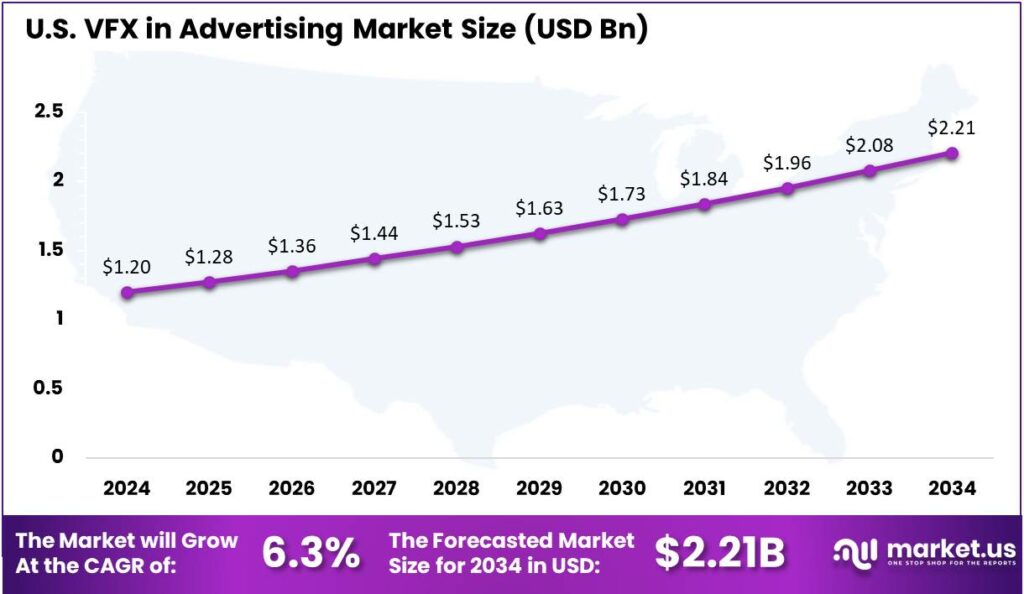
The VFX in Advertising Market size is expected to be worth around USD 7.37 Bn By 2034, from USD 3.2 Bin in 2024, growing at a CAGR of 8.70% during the forecast period from 2025 to 2034. In 2024, North America dominated the VFX in advertising sector with over 40% market share, generating an estimated revenue of USD 1.2 bn. The U.S. VFX market in advertising is projected to reach USD 1.2 bn by 2024, driven by a 6.3% CAGR.
The global VFX in advertising market is witnessing robust growth, driven by the increasing demand for high-quality, visually captivating advertisements across digital and traditional media platforms. As brands seek innovative ways to engage consumers, VFX enables the creation of unique, eye-catching campaigns that are both effective and memorable.
Several factors are contributing to the growth of the VFX in advertising market. The increasing demand for high-quality visual content, especially with the rise of digital media platforms, has made VFX a critical component of modern advertising strategies. Moreover, brands’ emphasis on creating more immersive and emotional experiences for consumers is further propelling the market.
Additionally, the rise of digital and social media platforms, where short-form, eye-catching content is crucial, has further accelerated the use of VFX in advertising. The growing integration of virtual and augmented reality in marketing strategies is expected to fuel the continued expansion of VFX usage in the advertising sector.
VFX has become popular in advertising for its ability to create stunning visuals that capture diverse audiences. Platforms like YouTube, Instagram, and TikTok, with their short-form video focus, provide ideal spaces for VFX-driven campaigns that can go viral. The accessibility of VFX tools allows brands of all sizes to create high-quality content, not just large-budget productions.
According to Market.us, The Global Visual Effects (VFX) Market size is expected to be worth around USD 28,073.92 Million By 2033, from USD 10,440.5 Million in 2023, growing at a CAGR of 10.7% during the forecast period from 2024 to 2033. The growing VFX market in advertising offers opportunities for innovation through VR/AR, providing interactive experiences, and sustainable campaigns that reduce costs and environmental impact.
The VFX market in advertising is expanding as industries like entertainment, fashion, healthcare, technology, and automotive embrace its potential. With digital platforms on the rise, emerging markets are adopting VFX-driven campaigns. Cloud-based VFX software further supports this growth, offering flexible, cost-effective production solutions for global brand campaigns.
Key Takeaways
- The Global VFX in Advertising Market is projected to grow from USD 3.2 Billion in 2024 to USD 7.37 Billion by 2034, with a CAGR of 8.70% during the forecast period from 2025 to 2034.
- In 2024, the 2D & 3D VFX segment held a dominant position, accounting for more than 41% of the total market share.
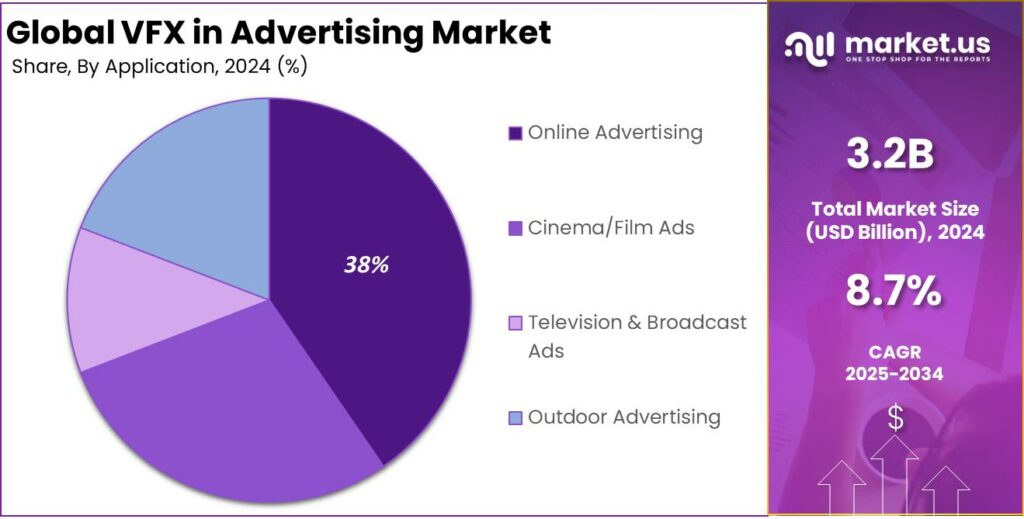
- The Online Advertising segment dominated in 2024, capturing more than 38% of the VFX in advertising market share.
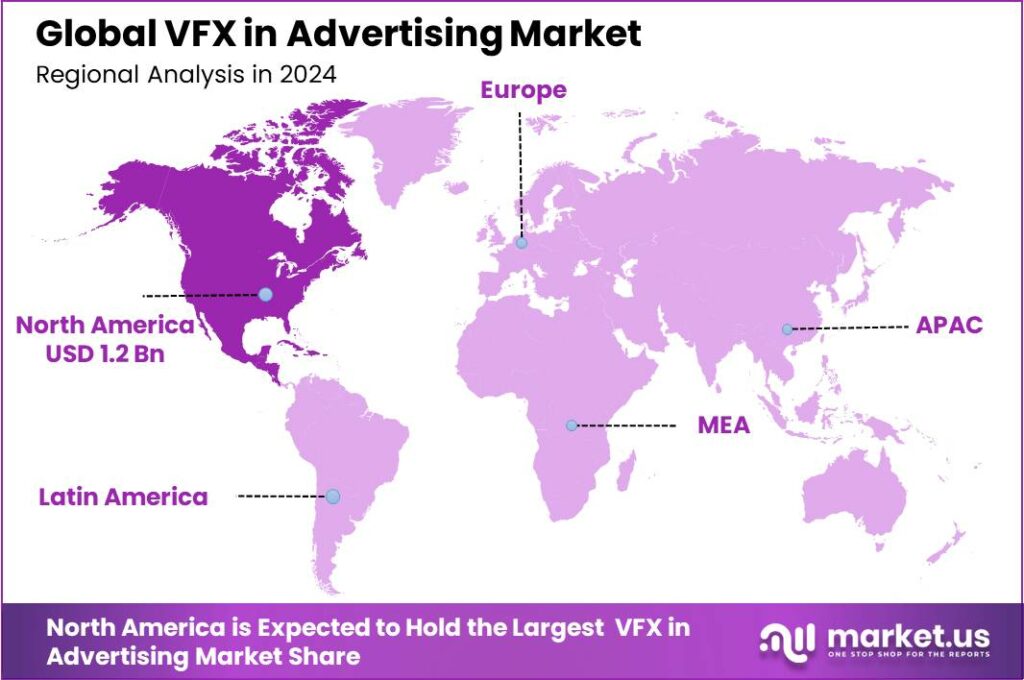
- North America led the VFX in advertising sector in 2024, with a dominant market share of more than 40%, translating to an estimated revenue of approximately USD 1.2 billion.
- The U.S. visual effects (VFX) market in advertising is set to reach USD 1.2 billion by 2024, driven by a CAGR of 6.3%.
Analysts’ Viewpoint
The VFX market in advertising presents numerous investment opportunities. The rise of digital-first advertising and the increasing demand for high-end visual content are prompting both large and small production studios to expand their capabilities. Investment in VFX software tools, hardware, and training is expected to remain strong, with key players like Autodesk, Adobe, and Epic Games continually innovating and offering state-of-the-art solutions.
Governments are also playing a role in fostering the growth of the VFX in advertising market. In many regions, initiatives and funding are being provided to stimulate the local film and advertising industries, encouraging innovation and the adoption of advanced technologies such as VFX. For example, countries like Canada, New Zealand, and the UK offer tax incentives and grants to businesses investing in creative industries, including advertising and media production.
U.S. VFX in Advertising Market
The U.S. visual effects (VFX) market in advertising is projected to reach a valuation of $1.2 billion by 2024, driven by a compound annual growth rate (CAGR) of 6.3%. This growth reflects a steady demand for advanced digital effects in advertising campaigns, as companies continue to embrace innovative visual storytelling to capture consumer attention.
In recent years, the integration of VFX technology in advertising has evolved significantly, driven by advancements in software and hardware capabilities. As advertisers seek to differentiate themselves in an increasingly competitive market, VFX allows for more creative and dynamic ad experiences. Moreover, the expanding use of digital platforms for marketing, including social media and online streaming services, has further fueled the demand for high-quality VFX in advertisements.
In 2024, North America held a dominant market position in the VFX in advertising sector, capturing more than 40% of the global market share, with an estimated revenue of approximately USD 1.2 billion. The region’s leadership in this market can be attributed to several key factors, including the presence of major advertising agencies, global brands, and cutting-edge media production studios.
The U.S., in particular, has long been a hub for technological innovation, with established infrastructure and a strong ecosystem supporting the development and application of advanced VFX. Additionally, the rising investment in digital advertising across platforms such as social media, streaming services, and digital video content has propelled the demand for high-quality VFX in marketing campaigns.
Europe follows closely behind, with steady growth observed in key markets such as the U.K., Germany, and France. The adoption of VFX in advertising has gained traction due to an increasing emphasis on creative content, particularly in the luxury goods and automotive sectors, where visual storytelling plays a crucial role.
Europe remains a key player in VFX, despite a smaller market share than North America, thanks to strong production standards and film industries. Challenges like varying digital infrastructure and regulatory differences impact growth. In Latin America, the Middle East, and Africa, VFX adoption in advertising is smaller but growing, with Brazil and Mexico seeing increased digital ad investments and rising VFX demand.
Impact of AI
The impact of artificial intelligence (AI) on the VFX market in advertising cannot be understated. AI technologies are being increasingly integrated into VFX production processes, enabling faster rendering, better visual effects, and more intuitive editing tools. AI-driven algorithms can automate tedious tasks like rotoscoping (isolating objects in a frame) or applying special effects to entire scenes, reducing human error and saving time.
As AI continues to evolve, its integration into VFX tools is expected to streamline the creative process even further, providing advertisers with more cost-effective and efficient ways to produce visually stunning content. This shift toward AI-powered solutions is expected to be a key driver of innovation in the VFX market, making it a highly attractive area for investment in the coming years.
Type Analysis
In 2024, the 2D & 3D VFX segment held a dominant market position, capturing more than 41% of the total market share. This segment’s leadership can be attributed to its versatile application across various advertising mediums, ranging from television commercials to digital platforms. 2D and 3D VFX are essential for creating visually engaging advertisements that stand out, allowing brands to produce immersive and eye-catching content.
The widespread use of 3D technology in product animations and character modeling has further solidified the growth of this segment. Additionally, the increasing demand for high-quality, cinematic visuals in advertising has contributed to the sustained preference for 2D & 3D VFX, particularly in industries such as automotive, consumer electronics, and entertainment.
The demand for 2D and 3D VFX is rising as visual storytelling becomes more sophisticated. 3D VFX, in particular, enables detailed product representations and realistic simulations, enhancing ads’ appeal. As brands seek unique, engaging content, 2D and 3D VFX will continue to expand, solidifying its dominant role in advertising.
Furthermore, advancements in VFX software and hardware technologies have made 2D & 3D VFX more accessible and cost-efficient for advertisers. Previously, high-end VFX required significant investment, but with the development of more affordable solutions and cloud-based platforms, smaller advertisers are now able to integrate these effects into their campaigns.
Application Analysis
In 2024, the Online Advertising segment held a dominant market position, capturing more than a 38% share of the VFX in advertising market. This dominance can be attributed to the increasing shift of consumer attention towards digital platforms, where online ads are often the most effective medium for engagement.
The rise of short-form video on platforms like YouTube, Instagram, and TikTok boosts online advertising, allowing VFX to capture attention quickly. Accessible digital tools and cloud-based software make VFX production easier and more cost-effective, enabling brands to create high-quality, targeted ads for specific demographics.
The shift to programmatic advertising and data-driven strategies has led to more personalized, VFX-powered online ads. Tailored to individual preferences, these ads enhance engagement and relevance, boosting consumer interaction and improving campaign effectiveness, resulting in higher conversion rates.
Additionally, the growing trend of e-commerce and the increasing investment in digital marketing are key factors that contribute to the prominence of the Online Advertising segment. With more consumers shopping online, advertisers are increasingly relying on digital ads to drive sales and promote brand awareness.
Key Market Segments
By Type
- 2D & 3D VFX
- Motion Graphics
- Matte Painting
- CGI (Computer-Generated Imagery)
- Others
By Application
- Television & Broadcast Ads
- Cinema/Film Ads
- Online Advertising
- Outdoor Advertising
Key Regions and Countries
- North America
- US
- Canada
- Europe
- Germany
- France
- The UK
- Spain
- Italy
- Rest of Europe
- Asia Pacific
- China
- Japan
- South Korea
- India
- Australia
- Singapore
- Rest of Asia Pacific
- Latin America
- Brazil
- Mexico
- Rest of Latin America
- Middle East & Africa
- South Africa
- Saudi Arabia
- UAE
- Rest of MEA
Driver
Increased Demand for Visual Storytelling in Advertising
The increasing demand for visual storytelling in advertising has significantly driven the growth of VFX (Visual Effects) in the sector. As brands strive to stand out in an increasingly crowded market, marketers are turning to visually compelling ads to capture audience attention. VFX enhances the storytelling process by enabling brands to create visually rich, engaging content that resonates emotionally with consumers.
It offers a way to transform abstract concepts or ideas into easily understood and memorable visuals. In particular, VFX is effective in digital and social media advertising, where short-form, eye-catching content is essential for capturing attention quickly. This shift towards more visually engaging formats has resulted in higher engagement rates, increased brand recall, and a broader audience reach. As consumer preferences evolve toward immersive and interactive experiences, the demand for high-quality VFX in advertisements is anticipated to grow.
Restraint
High Costs of VFX Production
Despite the increasing reliance on VFX in advertising, one significant restraint is the high cost of production. Creating high-quality VFX requires substantial investment in specialized software, skilled labor, and advanced technology. These costs can be particularly burdensome for smaller brands or companies with limited advertising budgets.
While some large-scale corporations may have the resources to afford these expenses, smaller businesses may struggle to justify the investment in VFX, especially when simpler, less expensive methods can achieve a similar impact. Furthermore, the return on investment (ROI) can be difficult to quantify for certain types of advertising campaigns, making it challenging for companies to decide whether the financial outlay for VFX is justified. In a market where cost-effectiveness is often prioritized, the expensive nature of VFX may deter many potential advertisers from incorporating these effects into their campaigns.
Opportunity
Rise of Immersive Technologies (AR/VR)
The growing adoption of immersive technologies such as Augmented Reality (AR) and Virtual Reality (VR) presents a significant opportunity for VFX in advertising. As consumers increasingly demand interactive and engaging brand experiences, AR and VR have emerged as powerful tools for creating unique and memorable advertising campaigns. These technologies offer brands the ability to deliver immersive, on-demand experiences that allow consumers to engage with products and services in innovative ways.
Both technologies rely heavily on VFX to enhance realism and engagement. This growing trend presents an opportunity for advertisers to integrate cutting-edge visual effects into their campaigns, offering a novel way to communicate their brand message. AR and VR experiences often lead to higher levels of consumer engagement, increased interaction time, and improved brand recall. As more companies invest in immersive technologies, the demand for VFX specialists is expected to rise, creating new avenues for growth within the industry.
Challenge
Maintaining Consistency Across Platforms
A key challenge that advertisers face when using VFX in their campaigns is maintaining consistency across multiple platforms. With the proliferation of digital channels ranging from television and social media to streaming services and mobile applications ensuring that VFX-based content looks equally compelling and effective on all platforms can be difficult.
Furthermore, social media platforms often require different file formats and compression techniques that may degrade the quality of VFX, leading to a less engaging viewer experience. Maintaining the integrity of the visual experience while adapting content for multiple platforms requires careful planning, additional resources, and technical expertise. As advertisers continue to expand their presence across diverse digital platforms, the complexity of ensuring a consistent, high-quality VFX experience will likely remain a significant challenge in the industry.
Emerging Trends
One of the most notable trends is the increased integration of CGI (Computer Generated Imagery) into commercials. Brands are now able to create hyper-realistic images, seamlessly blending digital effects with live-action footage. This allows for more dynamic storytelling, where anything can be visualized, no matter how impossible it seems in the real world.
Another emerging trend is the use of virtual environments and augmented reality (AR). With the rise of AR, advertisers are creating interactive experiences that allow consumers to engage with products in immersive ways. Additionally, the development of AI-driven tools is making it easier for companies to streamline their production process, resulting in faster turnaround times and lower costs.
Sustainability in VFX is also becoming an increasing focus. Brands are adopting environmentally friendly practices, utilizing digital solutions instead of physical sets and props. This not only reduces carbon footprints but also enables more creative freedom without the need for large-scale production setups.
Business Benefits
The integration of VFX in advertising brings substantial business benefits, primarily by improving audience engagement. Ads featuring high-quality visual effects tend to capture attention more effectively than those relying on traditional methods. The ability to create stunning visuals that evoke emotion or surprise allows brands to leave a lasting impression on consumers, increasing the likelihood of brand recall.
Moreover, VFX provides brands with the opportunity to differentiate themselves from competitors. With unique and visually captivating advertisements, businesses can stand out in a crowded marketplace. The creative use of VFX can elevate a brand’s image, positioning it as innovative and forward-thinking.
From a financial perspective, VFX also helps companies achieve cost-efficiency. Digital effects eliminate the need for expensive physical props, large sets, and elaborate filming locations, reducing production costs. The speed of digital production means that projects can be completed in shorter time frames, allowing brands to be more agile in responding to market trends or campaigns.
Key Player Analysis
With rapidly growing demand for high-quality, immersive content, several companies stand out as key players in the VFX for advertising space.
- Industrial Light & Magic (ILM) is one of the most well-known VFX companies in the world. Founded by George Lucas in 1975, ILM has shaped some of the most iconic films and advertising campaigns. With decades of experience and a reputation for groundbreaking work, ILM’s expertise spans from digital compositing to complex animation and virtual reality.
- Framestore is another leading name in VFX and animation, known for its innovation in visual storytelling. Based in London, the company has won numerous awards for its work in both advertising and film. Framestore brings a unique approach to VFX by blending technical expertise with a strong creative vision. Their team of artists, designers, and engineers work collaboratively to create stunning visual experiences.
- The Mill is a global leader in VFX, particularly in advertising, with a reputation for pushing the boundaries of creativity and technology. With offices in London, New York, Los Angeles, and Chicago, The Mill has established itself as a go-to company for high-end VFX work in commercials. Known for its pioneering work in CGI, motion capture, and digital animation, The Mill helps brands bring their ideas to life with mesmerizing visual effects.
Top Key Players in the Market
- Industrial Light & Magic (ILM)
- Framestore
- The Mill
- Weta Digital
- Double Negative (DNEG)
- MPC (Moving Picture Company)
- Sparks & Shadows
- Rodeo FX
- Glassworks
- Supermodern
- Blur Studio
- Cut+Run
- Ollin VFX
- Aardman Studios
- Rise VFX
- Lola Post Production
- Shy the Sun
- MediaMonks
- Other Key Players
Top Opportunities Awaiting for Players
The VFX (Visual Effects) industry in advertising is poised for significant growth, presenting multiple opportunities for market players and companies.
- Increased Demand for Immersive Advertising: As consumers increasingly seek immersive experiences, augmented reality (AR) and virtual reality (VR) are becoming essential tools for advertisers. VFX allows brands to create interactive, engaging experiences that captivate audiences, increasing brand recall and customer engagement.
- Rise of Social Media and Digital Platforms: With the expansion of digital media, particularly on platforms like Instagram, TikTok, and YouTube, the demand for high-quality, visually compelling ads has surged. VFX offers an efficient way to create dynamic, attention-grabbing content that performs well on these platforms, especially in short-form video formats.
- Advancements in AI and Machine Learning for VFX: The integration of AI and machine learning into VFX production processes has enabled faster and more cost-effective creation of visual effects. These technologies can automate tasks such as image tracking, compositing, and rendering, lowering costs while enhancing output quality.
- Growing Focus on Sustainability: Brands are becoming increasingly aware of their environmental impact. VFX provides a way to create visually stunning campaigns without the need for expensive, resource-intensive shoots. This reduces carbon footprints and aligns with growing consumer preferences for sustainable business practices.
- Creative Collaboration with Influencers and Artists: As influencer marketing continues to thrive, VFX presents an opportunity for brands to collaborate with digital creators, artists, and influencers to craft visually stunning content. These collaborations allow for the creation of highly original, customized campaigns that resonate deeply with target audiences.
Recent Developments
- In January 2024, Framestore released its 2024 VFX showreel, highlighting work on over 250 ads, 54 film and TV projects, and several theme park rides. The showreel showcases Framestore’s extensive VFX capabilities across various mediums.
- In April 2024, MARZ VFX merged with Vitamin VFX to enhance its VFX services and offer more comprehensive solutions to clients. This merger allows MARZ to scale its VFX output significantly while maintaining high creative standards.









