


Report Overview
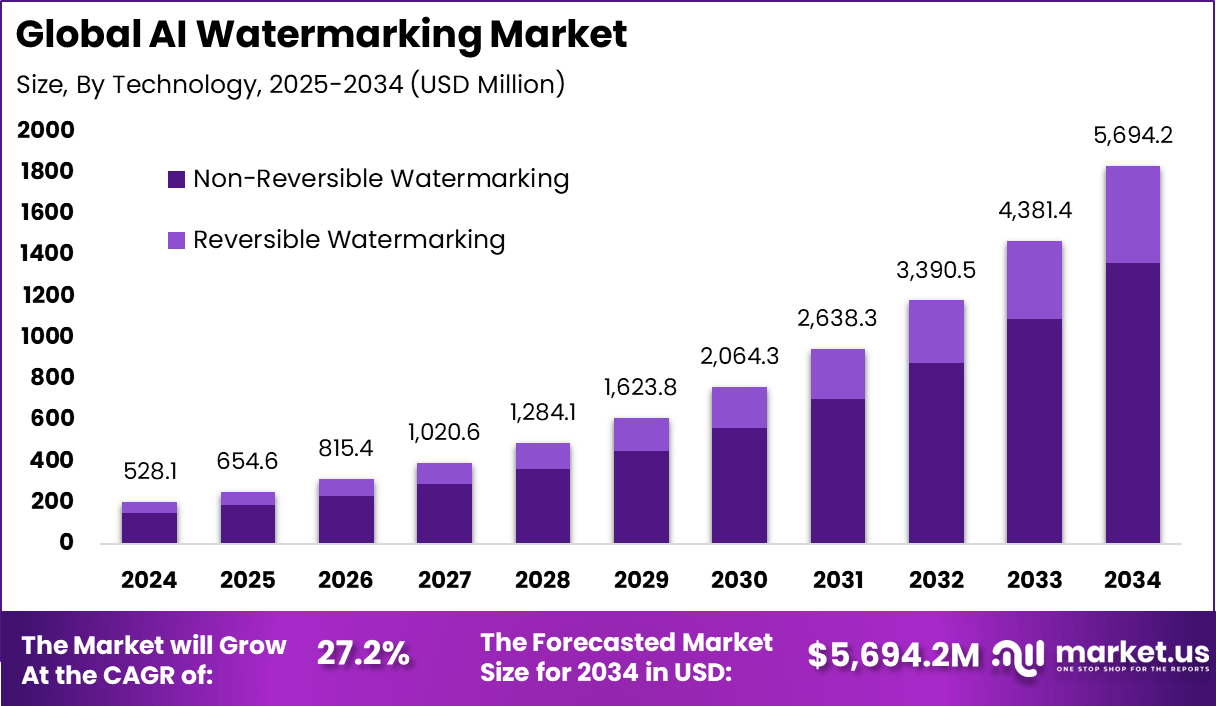
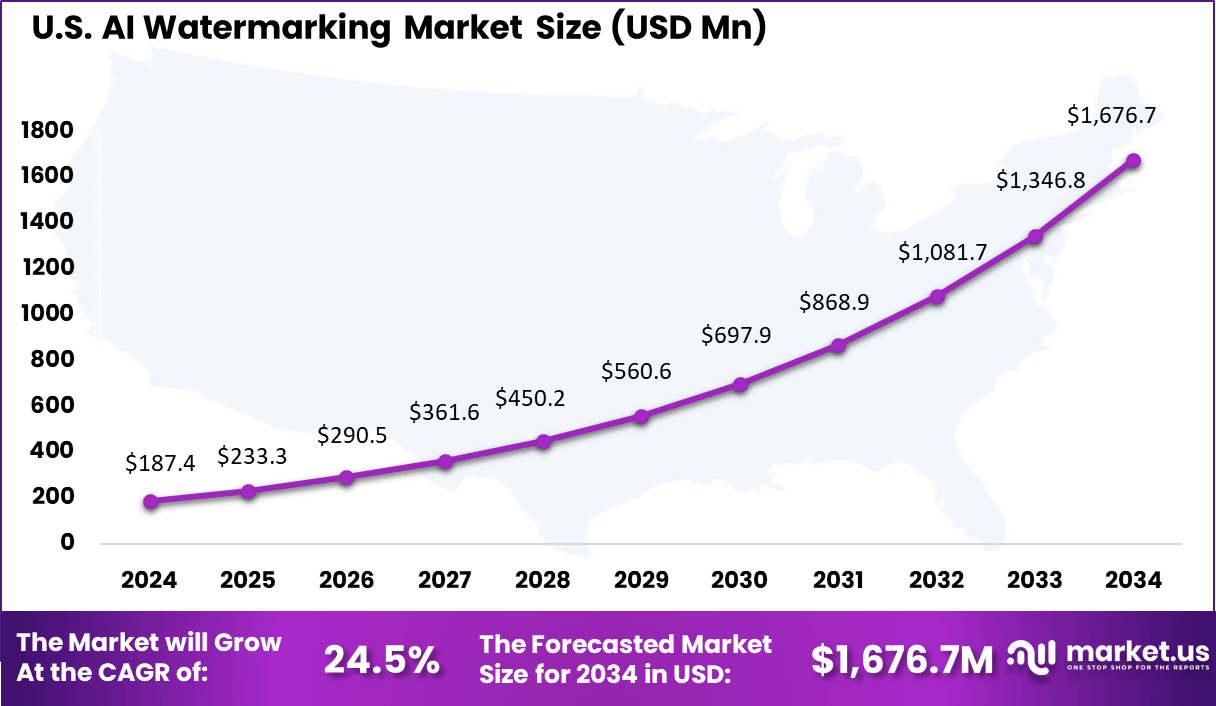
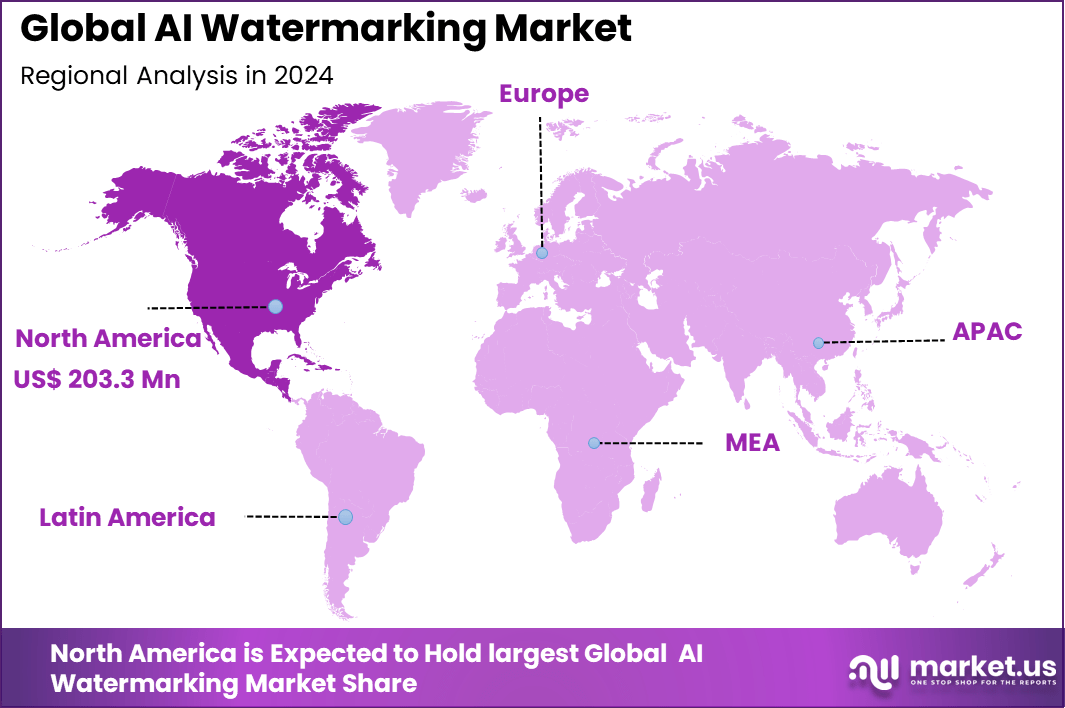
The Global AI Watermarking Market size is expected to be worth around USD 5,694.2 Million By 2034, from USD 528.1 Million in 2024, growing at a CAGR of 27.2% during the forecast period from 2025 to 2034. In 2024, North America held a dominan market position, capturing more than a 38.5% share, holding USD 203.3 Million revenue.
The AI Watermarking Market has gained remarkable traction due to the rapid expansion of AI-generated content such as images, videos, and text. The need to distinguish authentic content from AI-manipulated or deepfake media has become critical in preserving digital trust. This market thrives primarily on embedding hidden or visible markers in AI-generated outputs, ensuring content traceability and authenticity.
The adoption is especially strong among enterprises and governments aiming to combat misinformation and copyright infringement in an increasingly digital world. This rising demand aligns closely with the growing presence of generative AI tools and heightened concerns around digital content’s credibility and integrity.
According to Market.us, The global artificial intelligence market is witnessing exceptional growth, valued at USD 391.70 billion in 2024 and projected to rise from USD 542.50 billion in 2025 to nearly USD 10,173.05 billion by 2034. This reflects a strong compound annual growth rate of 38.50% during the period from 2025 to 2034.
Based on data from exploding topics, The AI industry is on a rapid growth path, with its value expected to expand by nearly 5 times over the next five years. By 2025, the sector is projected to employ around 97 million people, reflecting its growing role in shaping global employment trends. Businesses are also prioritizing adoption, as 83% of companies now consider AI a central part of their strategic planning.
Real-world applications highlight the technology’s impact. Netflix generates $1 billion annually through automated personalized recommendations powered by AI, while 48% of businesses already use AI to manage and analyze big data. In healthcare, about 38% of medical providers integrate computers into diagnostic processes, demonstrating how AI is reshaping critical industries with both efficiency and precision.
Key Insight Summary
- 58.5% of the market is dominated by invisible watermarking, reflecting its effectiveness in securing digital assets without altering content quality.
- 73.2% share is held by non-reversible watermarking, chosen for its strength against tampering and unauthorized modifications.
- 65.5% of deployments are cloud-based, showing preference for scalable, flexible, and cost-efficient solutions.
- 40.6% of adoption comes from copyright protection, confirming its role as the primary driver of AI watermarking demand.
- 35.6% of end-use is from media and entertainment, where protecting original content remains a top priority.
- 38.5% of the global share is concentrated in North America, supported by strong digital ecosystems and IP laws.
- The U.S. leads with 24.5% share, valued at 187.4 Mn, underscoring its dominance in AI-powered content protection technologies.
- Asia-Pacific shows the strongest growth, rising from 24.0% in 2020 to 27.6% in 2024.
- North America steadily declines from 41.6% in 2020 to 38.5% in 2024.
- Europe experiences a mild decrease from 25.7% in 2020 to 24.8% in 2024.
- Latin America shows gradual growth from 4.8% in 2020 to 5.1% in 2024.
- The Middle East & Africa remains almost unchanged, moving from 3.9% to 4.0% over the same
- period.
Role of Generative AI
The role of generative AI in AI watermarking is increasingly crucial as it embeds imperceptible markers within AI-created content, allowing verification of authenticity without affecting the content’s quality. Around 38% of AI image generators now use watermarking techniques to ensure the traceability of their outputs, helping to combat misinformation and copyright infringement.
This technology supports transparency, giving users and platforms tools to identify AI-generated media confidently. With the rise of generative AI models, embedding such watermarks has moved from a security option to an essential feature for responsible content creation in digital ecosystems. The ability to subtly alter text, images, or videos creates a reliable signature that machines detect yet stays invisible to humans, enhancing trust in AI-produced works.
High-Adoption Sectors
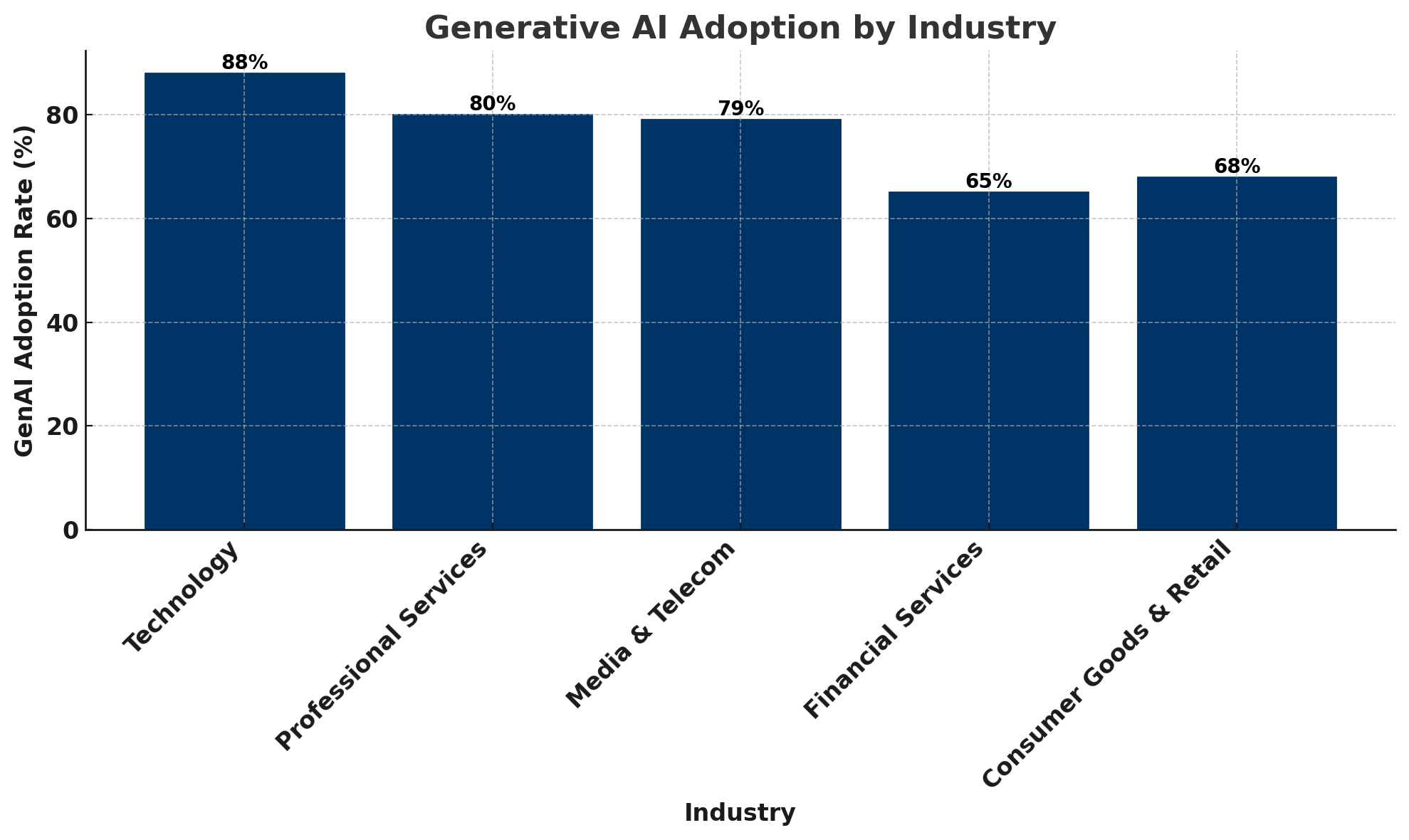
- Technology: 88% of companies use generative AI, making information technology the most advanced sector for adoption.
- Professional services, media, and telecom: Adoption rates stand at 80% and 79%, showing strong uptake in knowledge-driven and content-heavy industries.
- Financial services: Around 65% of firms have implemented generative AI. The banking sector alone is expected to see a $1 billion revenue boost by 2027 from AI integration.
- Consumer goods and retail: Adoption is at 68%, with applications focused on personalization, customer engagement, and sales optimization.
- Industrial and automotive: Particularly strong in India, where the automotive sector has seen a 48% increase in machine learning adoption.
Low-Adoption Sectors
- Energy and materials: The slowest adoption rate among major industries, at 59%.
- Construction and agriculture: The least digitized sectors, with only 1.4% adoption of AI tools.
Common Reasons for AI Adoption
- Internal process automation: Reported by 36% of executives as the leading reason for adopting AI.
- Data analysis and analytics: Widely leveraged to manage and extract insights from large volumes of information.
- Marketing and sales: Deployed for content creation, lead generation, and customer personalization.
- Research and development (R&D): Around 44% of firms use AI in R&D, particularly within the information and communication sector.
- ICT security: High adoption observed in electricity, gas, and water supply sectors, where AI strengthens cybersecurity and operational reliability.
Government-led Investments
Government-led investments play a key role in advancing AI watermarking technology. In North America, governmental bodies contribute to over 22% of funding for watermarking research, fostering partnerships between public institutions and private players. This support accelerates the development of new watermarking methods designed to endure various digital manipulations and enable transparent content verification.
Furthermore, governments are actively introducing regulations that mandate watermarking in AI-generated content, with about 25% of policy proposals in 2024 including such requirements. These initiatives reinforce the importance of watermarking as a tool to curb misinformation and protect intellectual property in the digital space.
Such government initiatives not only provide financial backing but also push for the implementation of watermarking standards across industries. Regulatory frameworks are evolving to compel platforms and content creators to adopt watermarking for AI outputs, creating a culture of accountability and trust. This regulatory momentum encourages technology providers to innovate watermarking solutions that meet compliance demands while supporting scalability.
Investment and Business Benefits
Investment opportunities in the AI Watermarking Market arise from expanding generative AI adoption, growing regulatory frameworks enforcing content provenance, and advancements in AI-driven detection algorithms. Cloud deployment models offer scalable business models.
Emerging regional markets, especially in Asia Pacific, present high-growth potential supported by government initiatives in digital economy and IP enforcement. Innovations such as AI watermarking in real-time monitoring, deep learning enhancements, and blockchain integration open avenues for differentiated product offerings and partnerships between AI developers, cybersecurity firms, and media platforms.
Business benefits of AI watermarking include enhanced protection against copyright infringements, improved credibility and trust for digital content, reduced financial and legal risks from unauthorized use, and alignment with regulatory standards.
Watermarking supports secure content distribution and serves as a deterrent against tampering and fake content propagation. It also provides enterprises with a mechanism for traceability and auditability, promoting transparency in AI-generated outputs which can be crucial for consumer confidence and brand integrity.
US Market Size
In 2024, The US market is a major contributor within North America, with estimated revenue reaching approximately USD 187.4 million and a growth rate around 24.5% CAGR. The US is home to many technology innovators developing watermarking solutions integrated into major software, hardware, and cloud platforms.
Strong efforts and legal frameworks around copyright and digital content protection further stimulate market growth. The US continues to lead in AI watermarking adoption thanks to its technology infrastructure, policy support, and presence of key industry stakeholders focused on securing digital assets.
North America commands a strong presence with 38.5% of the AI watermarking market, reflecting its advanced technology ecosystems and regulatory environment supporting digital content authenticity. Industries here are early adopters of AI watermarking solutions, driven by regulatory frameworks, intellectual property protection demands, and increasing deployment in media, cloud services, and government sectors.
Regional Insights Share (%), 2020-2024
| Region | 2020 | 2021 | 2022 | 2023 | 2024 |
|---|---|---|---|---|---|
| North America | 41.6% | 40.9% | 40.2% | 39.6% | 38.5% |
| Europe | 25.7% | 25.5% | 25.2% | 25.0% | 24.8% |
| Asia-Pacific | 24.0% | 24.8% | 25.5% | 26.3% | 27.6% |
| Latin America | 4.8% | 4.9% | 5.0% | 5.1% | 5.1% |
| Middle East & Africa | 3.9% | 3.9% | 4.0% | 4.0% | 4.0% |
The region benefits from robust innovation and integration of watermarking technologies into creative platforms and digital pipelines. This leadership helps address misinformation risks and unauthorized usage while ensuring traceability in synthetic and AI-generated media.
By Type
In 2024, Invisible watermarking accounts for a significant 58.5% share of the AI watermarking market. This technology embeds hidden data within digital content in a way that is imperceptible to users, allowing creators to protect their intellectual property without affecting the user experience. Its subtlety and ability to maintain content quality make it a preferred choice, particularly for media, entertainment, and digital art industries concerned with content authenticity and anti-piracy measures.
Market Share By Type (%), 2020-2024
By Application
In 2024, Copyright protection holds 40.6% of the application market share. AI watermarking plays a critical role in embedding digital signatures that prove ownership and deter unauthorized distribution or piracy. It has become indispensable in publishing, broadcasting, and entertainment sectors, where protecting creative works is vital for maintaining revenue streams and brand integrity.
The rise in AI-generated and shared digital content has heightened the need for reliable intellectual property protection mechanisms. Watermarking solutions support legal enforcement by providing evidence of ownership and helping mitigate risks associated with content misappropriation or unlawful replication.
Market Share By Application (%), 2020-2024
| Application | 2020 | 2021 | 2022 | 2023 | 2024 |
|---|---|---|---|---|---|
| Authentication & Security | 35.1% | 35.5% | 35.8% | 36.1% | 36.5% |
| Copyright Protection | 40.5% | 40.5% | 40.6% | 40.6% | 40.6% |
| Branding & Marketing | 17.5% | 17.2% | 16.9% | 16.7% | 16.4% |
| Others | 6.9% | 6.8% | 6.7% | 6.6% | 6.5% |
By Technology
In 2024, Non-reversible watermarking dominates the technology segment, capturing 73.2% of the market. It offers permanent protection by embedding watermarks that cannot be removed without degrading the content, making it ideal for industries like media, defense, and BFSI that prioritize content security and authenticity. This permanence provides strong legal enforceability in copyright cases, increasing trust in digital intellectual property management.
Despite its permanence, non-reversible watermarking is highly robust against typical attacks such as compression or tampering. Its widespread adoption is boosted by growing regulatory frameworks and awareness about digital piracy risks. This technology secures digital rights by making alterations evident, ensuring that the original content can be reliably traced back to its creator or owner.
Market Share By Technology (%), 2020-2024
Large cloud and platform providers such as Amazon.com, Inc. are enhancing watermarking through integration with their AI and content moderation services. Their solutions enable authentication, ownership tracking, and detection of AI-generated media across digital platforms. These companies also support developers and enterprises through APIs and compliance-ready tools for responsible AI content distribution.
Specialized firms including Vobile Group Limited and Digimarc Corporation contribute with proprietary watermarking and content identification technologies tailored for media companies, broadcasters, and digital rights holders. Their platforms focus on piracy prevention, content monitoring, and licensing management. A growing number of other players are entering the market with niche solutions in digital media, education, and enterprise security, expanding adoption across industries.
Top Key Players in the Market
- Alphabet Inc. (Google)
- Company Overview
- Product Portfolio
- Financial Performance
- Recent Developments/Updates
- Strategic Overview
- SWOT Analysis
- Meta Platforms Inc.
- Microsoft Corporation
- Adobe Inc.
- Amazon.com, Inc.
- Vobile Group Limited
- Digimarc Corporation
- Others
Note (*): Similar analysis will be provided for other companies as well.
Recent Developments
- February 2025 – Google incorporated its SynthID watermarking into the Photos app for Pixel 9 devices, marking images edited by generative AI in Magic Editor. Users can detect watermarks easily, improving transparency of AI altered photos.
- January 2025 – IMATAG released an invisible watermarking demo on Hugging Face for AI-generated images, integrating watermark embedding during generation for robustness against image modifications. This is noted as a pioneering independent solution outside AI model creators.
- September 2024 – Microsoft announced a watermarking feature in its Azure OpenAI Service that embeds invisible watermarks in DALL·E 3 AI-generated images. This adds transparency and provenance verification while maintaining image quality even if images are resized or cropped.
- June 2024 – Meta Platforms introduced AudioSeal, a system embedding hidden watermarks in AI-generated audio clips. It claims high accuracy in detecting AI audio segments, aiming to fight misinformation and deepfake scams, though widespread adoption and industry standards remain a work in progress.
- July 2024 – NVIDIA filed a patent for an imperceptible audio watermarking method in conversational AI, designed to prevent fraud and misinformation by encoding identifiable signals in synthetic speech. The technology allows detection and robustness to tampering.

- 蓝茶市场(2026—2031)
0评论2026-09-15

- 泡沫材料市场(2026—2031)
0评论2026-09-15

- 重铬酸钠市场(2026—2031)
0评论2026-09-15

- 家族性淀粉样多发性神经病(FAP)市场(2026—2031)
0评论2026-09-15

- 次氯酸钙市场(2026—2031)
0评论2026-09-15

- 海上储能市场(2026—2031)
0评论2026-09-12

- 混凝土市场(2026—2031)
0评论2026-09-12

- 矫形器械市场(2026—2031)
0评论2026-09-12

- 木质素基树脂市场(2026—2031)
0评论2026-09-12

- 聚碳酸酯二元醇市场(2026—2031)
0评论2026-09-12