Report Overview
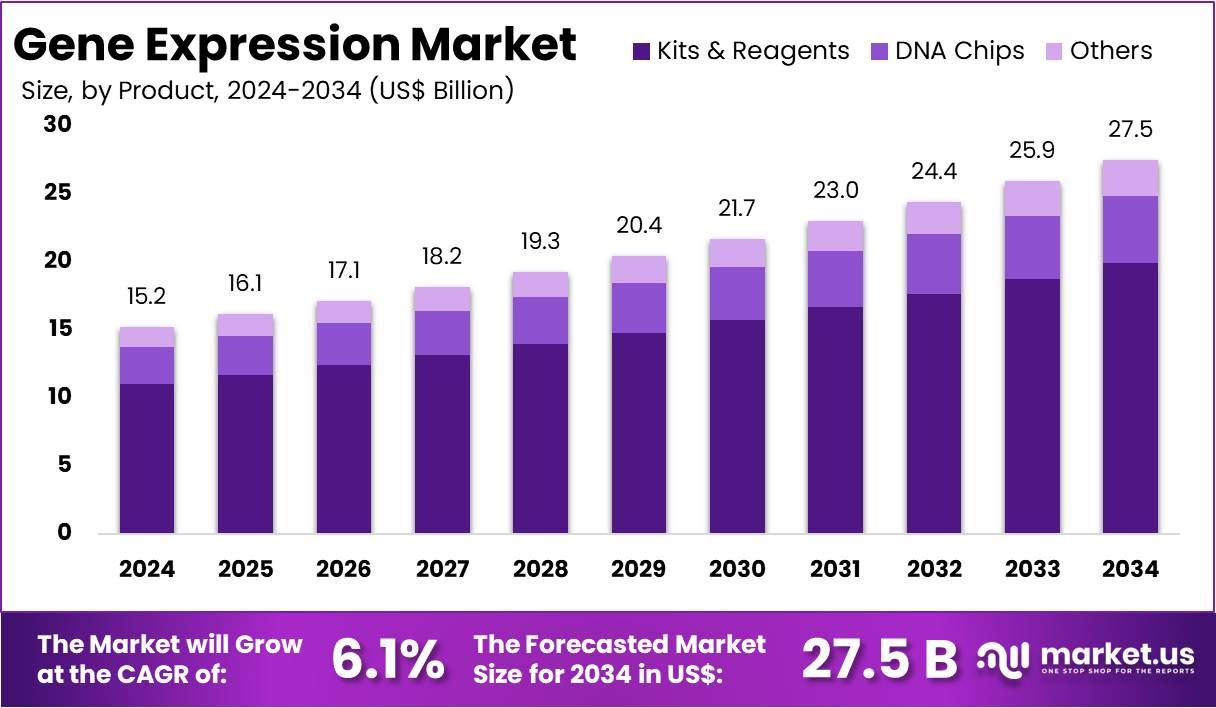
The Global Gene Expression Market Size is expected to be worth around US$ 27.5 Billion by 2034, from US$ 15.2 Billion in 2024, growing at a CAGR of 6.1% during the forecast period from 2025 to 2034.
The global gene expression market is driven by several dynamic factors, including advances in genomic technologies, increasing research and development in personalized medicine, and the growing prevalence of genetic disorders. The demand for gene expression analysis tools is rising as researchers focus on understanding gene activity and its role in diseases such as cancer, neurological disorders, and cardiovascular diseases. The market is also bolstered by innovations in next-generation sequencing (NGS) and quantitative PCR technologies, which offer faster, more accurate results.
Additionally, the rise of personalized and precision medicine is creating new growth avenues, as gene expression data helps in developing targeted therapies. Regulatory support and government funding for genetic research further stimulate market expansion. However, high costs of advanced technology, limited access to skilled professionals, and ethical concerns regarding genetic manipulation may hinder market growth. Nevertheless, increasing awareness, rising funding and ongoing technological breakthroughs continue to shape the market’s trajectory.
- In March 2024, Patient Square Capital, a firm specializing in healthcare investments, completed the acquisition of NanoString Technologies for $220 million. This strategic purchase secures the continuous availability of NanoString’s cutting-edge platforms, which are crucial in spatial biology and gene expression research.
- In March 2023, Chroma Medicine, Inc., a pioneer in genomic medicine, successfully secured $135 million during its Series B funding round. These funds are earmarked for the enhancement of Chroma’s therapeutic programs and further development of its epigenetic editing platform, which focuses on the regulation of gene expression.
Key Takeaways
- The gene expression market was valued at USD 15.2 billion in 2024 and is anticipated to register substantial growth of USD 27.5 billion by 2034, with 6.1% CAGR.
- In 2024, the kits & reagents segment took the lead in the global market, securing 72.3% of the total revenue share.
- The cDNA synthesis & conversion segment took the lead in the global market, securing 28.2% of the total revenue share.
- The drug discovery & development segment took the lead in the global market, securing 42.2% of the total revenue share.
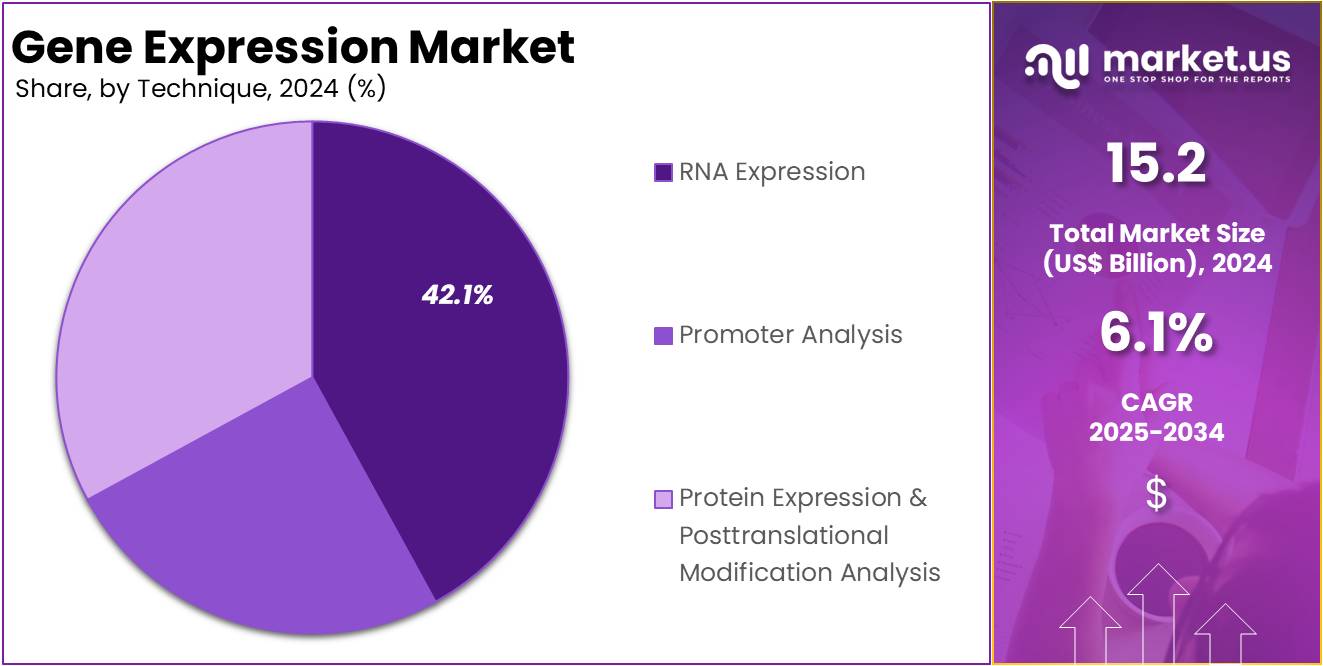
- The RNA expression segment took the lead in the global market, securing 42.1% of the total revenue share.
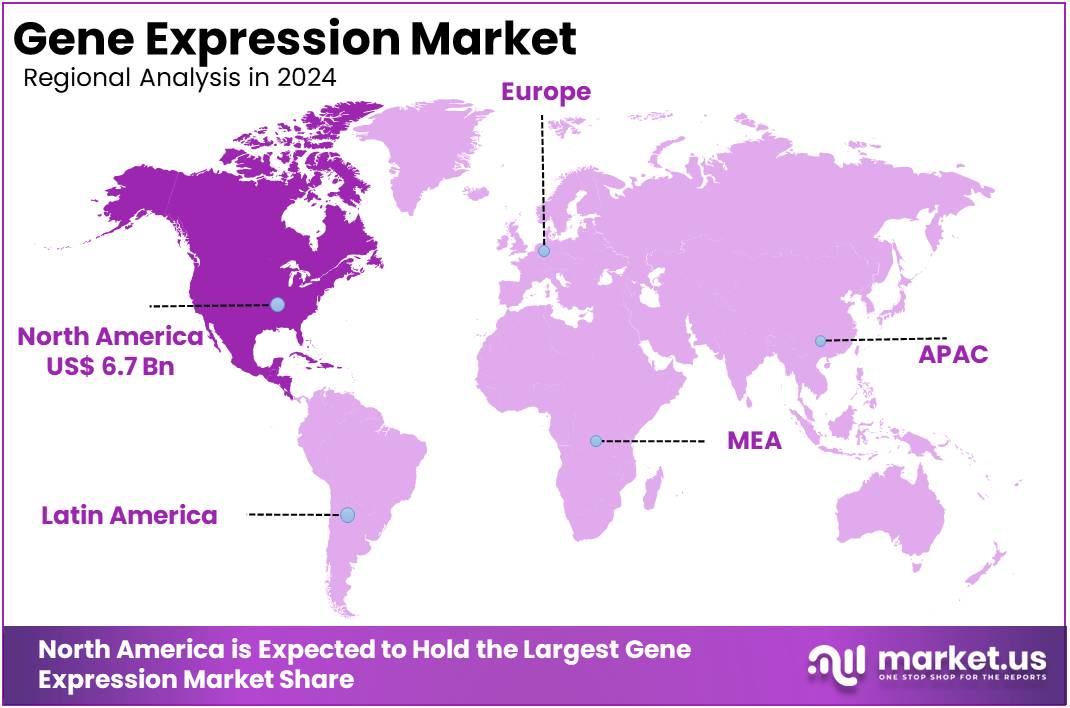
- North America took the lead in the global market, securing 44.2% of the total revenue share.
Process Analysis
Based on process the market is fragmented into sample collection, purification, cDNA synthesis & conversion, PCR analysis, and data analysis & interpretation. Amongst these, cDNA synthesis & conversion segment dominated the gene expression market capturing a significant market share of 28.2% in 2024. The cDNA synthesis and conversion segment has dominated the gene expression market due to its critical role in the transcription of RNA into complementary DNA (cDNA), which is essential for studying gene expression.
This process is pivotal for applications such as quantitative PCR, next-generation sequencing (NGS), and gene expression profiling, as cDNA serves as a stable, amplifiable copy of mRNA. The growing demand for understanding disease mechanisms, particularly in cancer, neurological disorders, and genetic conditions, has further accelerated the need for efficient cDNA synthesis techniques. Technological advancements in reverse transcription and cDNA synthesis kits, which offer higher yield, purity, and sensitivity, have driven market growth.
Product Analysis
The market is fragmented by product into kits & reagents, DNA chips, others. Kits & reagents dominated the gene expression market capturing a significant market share of 72.3% in 2024. Kits and reagents have dominated the gene expression market due to their essential role in enabling accurate and efficient gene expression analysis. These products, which include reverse transcription kits, PCR reagents, and sequencing kits, are fundamental for processes such as cDNA synthesis, amplification, and data analysis.
The increasing demand for gene expression profiling in research areas like cancer genomics, personalized medicine, and drug development has significantly contributed to the growth of the kits and reagents segment. These products offer standardized, ready-to-use solutions that reduce the complexity of experiments, improve reproducibility, and ensure high-quality results. Technological advancements have also led to the development of more efficient and cost-effective kits, further driving their adoption.
Application Analysis
The market is fragmented by application into drug discovery & development, clinical diagnostics, and biotech & microbiology, and others. Drug discovery & development dominated the gene expression market capturing a significant market share of 42.2% in 2024 due to the critical role gene expression analysis plays in identifying biomarkers, understanding disease mechanisms, and developing targeted therapies.
By profiling gene expression patterns, researchers can uncover the molecular underpinnings of diseases such as cancer, neurological disorders, and autoimmune conditions, which is essential for discovering new drug targets. Additionally, gene expression technologies enable the evaluation of drug efficacy and toxicity during preclinical and clinical trials, helping streamline the drug development process. The growing emphasis on precision medicine, where treatments are tailored based on an individual’s genetic profile, further boosts the demand for gene expression tools in drug discovery.
Technique Analysis
The market is fragmented by technique into d RNA expression, promoter analysis, and protein expression & posttranslational modification analysis. RNA expression dominated the gene expression market capturing a significant market share of 42.1% in 2024. RNA expression has dominated the gene expression market due to its fundamental role in understanding cellular function and disease mechanisms. RNA serves as the direct transcript of genes, reflecting the activity of specific genes under various conditions.
By studying RNA expression, researchers can gain insights into gene regulation, cellular responses, and the molecular basis of diseases like cancer, neurological disorders, and infectious diseases. The advent of technologies such as RNA sequencing (RNA-seq) and quantitative PCR has significantly advanced RNA expression analysis, making it more accurate, high-throughput, and cost-effective. As these tools have become more accessible, RNA expression profiling has become an essential method for drug discovery, biomarker identification, and personalized medicine.
Key Segments Analysis
By Process
- Sample Collection
- Purification
- cDNA Synthesis & Conversion
- PCR Analysis
- Data Analysis & Interpretation
By Product
- Kits & Reagents
- DNA Chips
- Others
By Application
- Drug Discovery & Development
- Clinical Diagnostics
- Biotech & Microbiology
- Others
By Technique
- RNA Expression
- Promoter Analysis
- Protein Expression & Posttranslational Modification Analysis
Drivers
Rising Incidences of Cancer
The rising incidence of cancer is significantly driving the growth of the global gene expression market. As cancer cases increase worldwide, there is a growing demand for advanced diagnostic and therapeutic tools that can improve early detection, prognosis, and personalized treatment. Gene expression profiling plays a critical role in identifying cancer-related biomarkers, understanding tumor biology, and monitoring therapeutic responses. By analyzing gene expression patterns, researchers can identify genetic mutations and molecular pathways involved in cancer, leading to the development of targeted therapies that are more effective and less toxic.
This has fuelled the adoption of technologies such as next-generation sequencing (NGS) and microarrays in oncology research. Moreover, gene expression data is essential for the development of precision medicine, where treatments are tailored to the specific genetic profile of individual patients, offering better clinical outcomes. As the demand for personalized cancer treatments grows, gene expression technologies are becoming a cornerstone in cancer research and care.
- According to their 2023 Cancer Facts & Figures report, the ACS estimated that in 2023, approximately 1.9 million new cancer cases would be diagnosed in the United States alone. In addition, The WHO’s Global Cancer Observatory (GCO) reported that in 2020, there were 19.3 million new cancer cases globally, and the number is expected to increase in 2023 due to aging populations and lifestyle factors.
Restraints
RNA Quality Issues and High Cost
RNA quality issues and high costs are significant restraints to the growth of the gene expression market. RNA, being highly unstable and susceptible to degradation, requires strict handling, extraction, and storage conditions to ensure accurate results in gene expression analysis. Poor RNA quality can lead to unreliable data, impacting research outcomes and the development of targeted therapies.
Additionally, advanced technologies used for gene expression profiling, such as next-generation sequencing (NGS) and microarrays, are often costly to implement and maintain. These high upfront costs, along with expenses related to reagents, consumables, and skilled personnel, limit accessibility, especially for smaller research institutions and developing countries.
While the promise of personalized medicine and improved diagnostic tools is substantial, the financial burden associated with these technologies remains a barrier. Together, these challenges slow the adoption of gene expression technologies, hindering market growth despite their potential in areas like oncology and personalized medicine.
Opportunities
Growing Research and Development Activities
Growing research and development (R&D) activities are creating significant growth opportunities for the gene expression market. As scientists and healthcare professionals continue to explore the genetic basis of various diseases, there is an increasing demand for gene expression analysis tools to better understand gene activity, regulatory mechanisms, and their roles in diseases like cancer, neurological disorders, and metabolic conditions.
R&D investments are driving innovations in technologies such as next-generation sequencing (NGS), quantitative PCR, and CRISPR-based gene editing, all of which enable more accurate and efficient gene expression profiling. Furthermore, increased funding from governments, private institutions, and pharmaceutical companies is fuelling the development of new diagnostic platforms, therapeutic applications, and personalized medicine approaches.
As R&D efforts expand, gene expression technologies become crucial for discovering new biomarkers, improving drug development, and enhancing disease treatment strategies. This growth in R&D is positioning gene expression tools as integral components in both basic and applied biomedical research.
- In June 2020, Illumina and GSK announced a collaboration to accelerate R&D in precision medicine, specifically in cancer treatment. By leveraging Illumina’s next-generation sequencing (NGS) technologies, GSK aimed to enhance their understanding of genetic variations in tumors and improve drug development pipelines.
Impact of macroeconomic factors / Geopolitical factors
The gene expression market is significantly influenced by macroeconomic and geopolitical factors that affect research funding and technological adoption. Economic downturns, such as recessions, may reduce healthcare budgets, particularly in genomic research and development within emerging markets. Conversely, periods of robust economic growth often enhance investments in biotechnology, thereby accelerating market expansion.
Geopolitical elements, including trade tensions and regulatory changes, are pivotal in shaping the market. Tariffs or biotechnology export restrictions can disrupt supply chains for gene expression technologies and reagents. Moreover, regulatory climates vary globally; stringent regulations in some countries contrast with more open innovation policies in others.
The stability of political environments and healthcare policies is crucial, impacting government funding for sectors like cancer research and personalized medicine. These dynamics, along with the global demand for innovative treatments, drive technological advancements and influence the overall growth trajectory of the gene expression market.
Trends
The gene expression market is witnessing several key trends shaping its growth. One prominent trend is the increasing adoption of next-generation sequencing (NGS) technologies, which provide high-throughput, accurate, and cost-effective gene expression profiling. This shift is accelerating the development of precision medicine, where therapies are tailored to individual genetic profiles. Another trend is the growing use of single-cell RNA sequencing (scRNA-seq), enabling researchers to analyze gene expression at the single-cell level, revealing new insights into cellular heterogeneity and disease mechanisms, particularly in cancer.
The integration of artificial intelligence (AI) and machine learning (ML) is also transforming gene expression analysis by enhancing data interpretation, identifying biomarkers, and predicting patient outcomes more accurately. Additionally, the rise of liquid biopsy technologies, which detect gene expression changes through blood samples, is revolutionizing non-invasive diagnostics. These innovations, combined with ongoing R&D efforts, are driving the gene expression market toward greater personalization and precision in healthcare.
Regional Analysis
North America emerged as a dominant force in the gene expression market, driven by the increasing funding from government organization on genomic research. Organizations such as the National Institutes of Health (NIH) and the National Human Genome Research Institute (NHGRI) provide significant financial support to advance gene expression technologies, fuelling innovation and research across various fields, including personalized medicine, oncology, and genetic disorders.
- Government organizations such as the National Institutes of Health, the National Human Genome Research Institute (NHGRI), and Health Canada play a crucial role in funding gene expression research. In 2023, Genome Canada announced an $18.1 million investment to support 13 late-stage R&D projects focused on addressing significant challenges in health, environment, and agriculture through genomics. The market is also bolstered by the presence of major players like Thermo Fisher Scientific, Bio-Rad Laboratories, and Promega Corporation.
- In February 2024, the US National Science Foundation awarded approximately $12.7 million to nine research teams to explore the complex functions of RNA and their potential applications, ranging from disease prevention in crops to the development of cancer therapies.
Key Regions and Countries
- North America
- US
- Canada
- Europe
- Germany
- France
- The UK
- Spain
- Italy
- Russia
- Netherland
- Rest of Europe
- Asia Pacific
- China
- Japan
- South Korea
- India
- New Zealand
- Singapore
- Thailand
- Vietnam
- Rest of APAC
- Latin America
- Brazil
- Mexico
- Rest of Latin America
- Middle East & Africa
- South Africa
- Saudi Arabia
- UAE
- Rest of MEA
Key Players Analysis
The competitive landscape of the gene expression market is marked by the presence of several key players offering a range of innovative products and solutions. Major companies like Thermo Fisher Scientific, Bio-Rad Laboratories, Promega Corporation, and Illumina dominate the market by providing cutting-edge technologies such as next-generation sequencing (NGS), quantitative PCR, and microarray platforms for gene expression analysis.
These companies leverage continuous R&D investments to enhance their product offerings, targeting applications in genomics research, personalized medicine, and oncology. Smaller and emerging players are also carving out niches by developing specialized tools and services, particularly in areas like single-cell RNA sequencing and liquid biopsy.
The market is characterized by strong collaborations between academic institutions, research organizations, and biotechnology firms, driving innovation and expanding the range of gene expression applications. With advancements in AI and machine learning for data analysis, companies are intensifying their focus on precision and personalized healthcare solutions, increasing competition and fostering market growth.
F. Hoffmann-La Roche Ltd. is a global healthcare company based in Switzerland, renowned for its expertise in pharmaceuticals and diagnostics. It is a leader in the development of innovative treatments for various conditions, including cancer, diabetes, and infectious diseases. Roche is also a major player in the gene expression market, offering advanced diagnostic tools and technologies such as next-generation sequencing (NGS) platforms and PCR-based assays.
The company focuses on personalized healthcare, integrating molecular diagnostics with treatments to improve patient outcomes. In addition, Illumina, Inc. is a U.S.-based biotechnology company that specializes in next-generation sequencing (NGS) technologies and genomic analysis. Illumina’s cutting-edge platforms enable large-scale DNA sequencing and gene expression profiling, facilitating research in fields like genomics, oncology, and genetic disorders.
Top Key Players in the Medical Tubing Market
- F. Hoffmann-La Roche Ltd.
- Illumina Inc.
- PerkinElmer Inc.
- Bio-Rad Laboratories
- Thermo Fisher Scientific Inc.
- Agilent Technologies
- GE Healthcare
- Takara Bio Inc.
- Danaher Corp.
- Catalent Inc.
- QIAGEN
- Quest Diagnostics Inc.
Recent Developments
- In September 2022, Illumina, Inc., a global leader in DNA sequencing and array-based technologies, introduced the NovaSeq X Plus, a new production-scale sequencer designed to push the boundaries of genomic medicine. This advanced technology enables faster, more powerful, and more environmentally sustainable sequencing. The NovaSeq X Plus can produce over 20,000 whole genomes annually, which is 2.5 times the throughput of previous sequencers, significantly advancing genomic discoveries and clinical insights that help better understand diseases and transform patient care.
- In January 2023, QIAGEN Digital Insights (QDI) launched the QIAGEN CLC Genomics Workbench Premium, a solution aimed at resolving the data-analysis bottleneck in next-generation sequencing (NGS). By integrating high-speed analysis with robust data interpretation for whole exome sequencing (WES), whole genome sequencing (WGS), and large panel sequencing, this tool addresses critical challenges in processing and analyzing NGS data, facilitating more efficient and effective genomic research.