


Report Overview
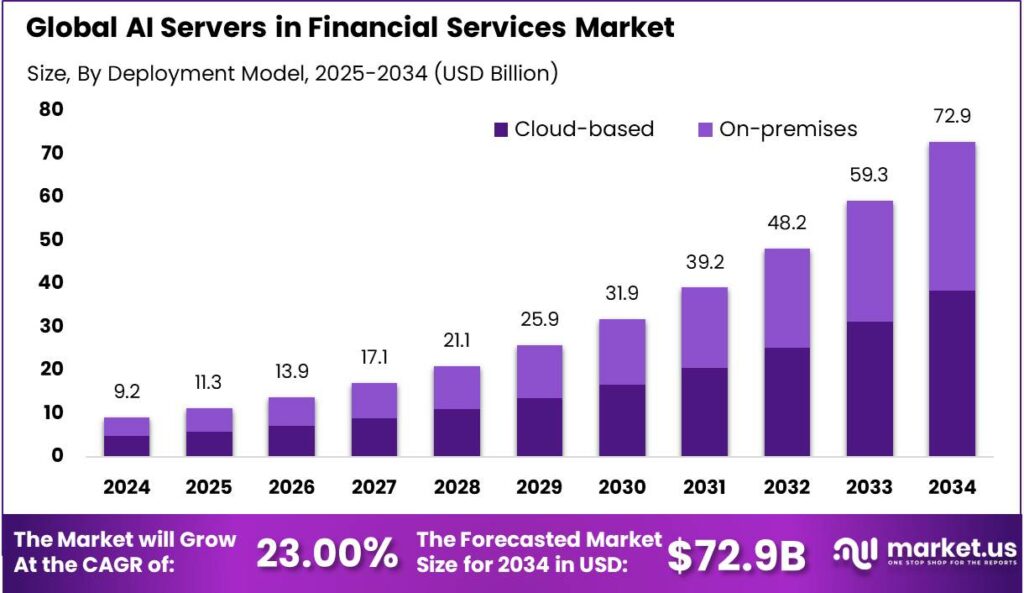
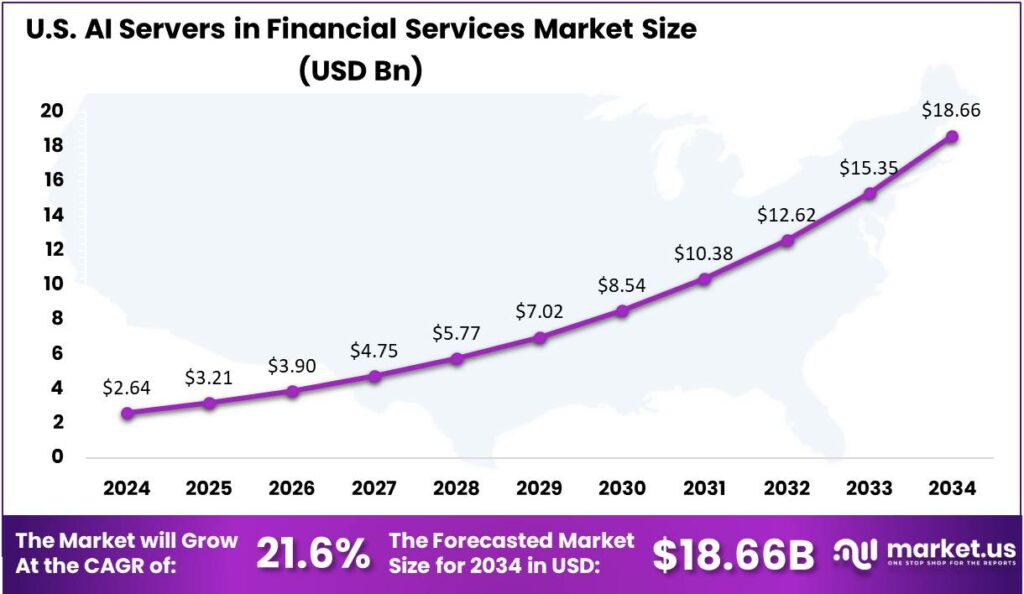
The Global AI Servers in Financial Services Market size is expected to be worth around USD 72.9Billion By 2034, from USD 9.2 Billion in 2024, growing at a CAGR of 23.00% during the forecast period from 2025 to 2034. In 2024, North America dominated the AI servers in financial services market with over 35.9% market share and USD 3.30 billion in revenue. The U.S. market was valued at USD 2.64 billion and is expected to grow at a CAGR of 21.6%.
AI servers in financial services refer to specialized computing hardware designed to handle and accelerate artificial intelligence (AI) workloads in the financial sector. AI servers, equipped with GPUs and CPUs, are crucial for running complex algorithms in applications like risk assessment, fraud detection, customer service, and algorithmic trading.
The market for AI servers in financial services is expanding significantly due to the increasing adoption of artificial intelligence technologies across the sector. Financial institutions are investing heavily in AI to optimize back-office operations, enhance customer interaction, and increase the reliability of security systems. The growth in this market is fueled by the need for powerful computing solutions that can handle the complex algorithms and large data sets typical of AI applications.
Increased regulatory scrutiny on data security and financial transactions drives financial services to invest in secure, efficient solutions like AI servers. Additionally, competitive pressure to innovate and enhance products and services pushes the sector toward adopting advanced technologies. These factors together contribute to the growing use of AI servers in the financial services industry.
AI servers have become popular in financial services due to their ability to enhance operational efficiency and customer experiences. Their deployment supports digital transformation, making processes faster and more reliable. Financial institutions recognize the competitive advantage AI offers, driving widespread adoption across the industry.
Market opportunities in financial services are expanding with the growth of AI, driving innovation. There’s a rising trend towards specialized AI applications, like predictive analytics and customized insurance products. As regulatory compliance becomes more complex, AI servers offer financial institutions a more effective way to manage these challenges.
The AI servers market in financial services is set for promising expansion, driven by technological advancements and growing AI acceptance. As financial institutions prioritize digital transformation, demand for AI servers will rise, fostering innovation and improving efficiency, performance, and customer satisfaction.
Key Takeaways
- The Global AI Servers in Financial Services Market is expected to be valued at USD 72.9 billion by 2034, up from USD 9.2 billion in 2024, growing at a CAGR of 23.00% during the forecast period from 2025 to 2034.
- In 2024, the Hardware segment dominated the AI servers in financial services market, holding more than 45.5% of the market share.
- The cloud-based segment also led the AI servers in financial services market in 2024, capturing over 52.7% of the market share.
- In 2024, the GPU-based servers segment had a dominant market position within the AI servers in financial services market, accounting for more than 42.16% of the market share.
- The Fraud Detection segment was a leader in the AI servers in financial services market in 2024, capturing more than 36.4% of the market share.
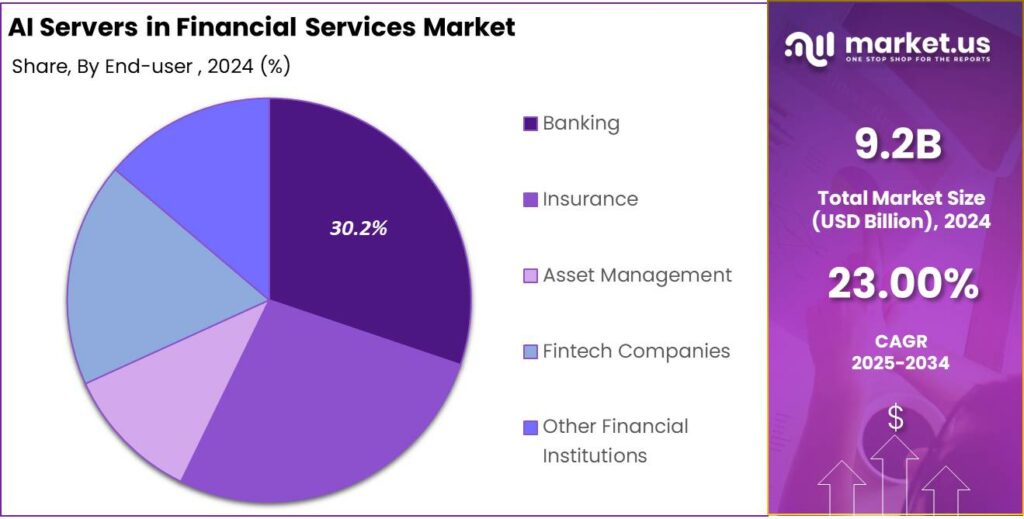
- In 2024, the Banking segment held a significant position in the AI servers in financial services market, commanding more than 30.2% of the market share.
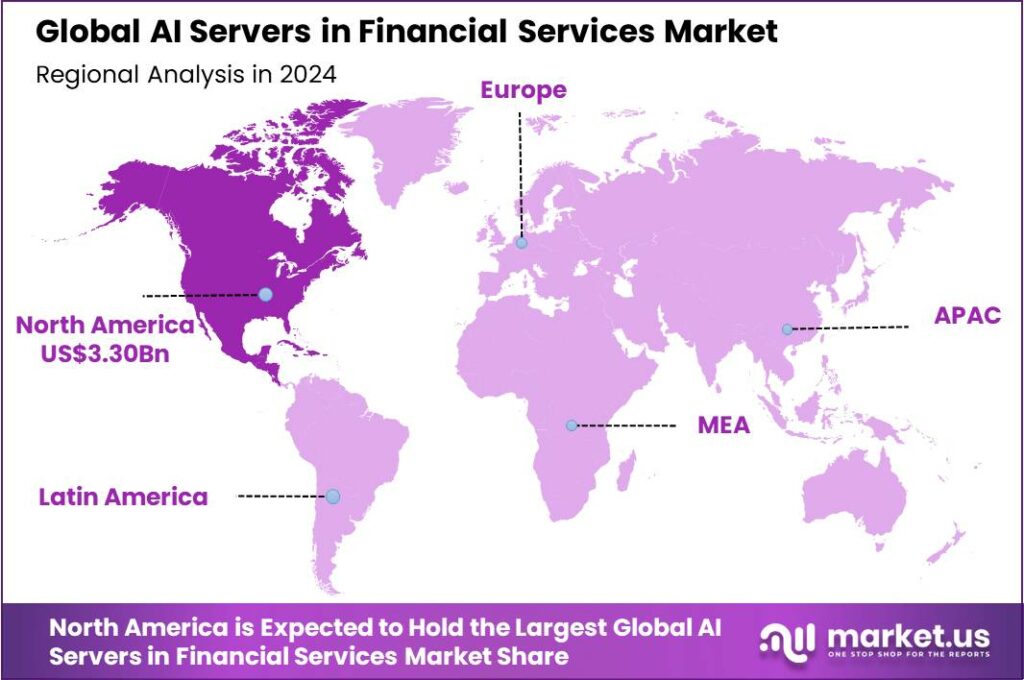
- North America held the largest market share in the AI servers in financial services market in 2024, capturing more than 35.9% with revenue amounting to USD 3.30 billion.
- The U.S. market for AI servers in financial services was valued at USD 2.64 billion in 2024, and is projected to grow at a CAGR of 21.6%.
AI Adoption in Finance
AI adoption in the financial sector has witnessed rapid acceleration, rising from 45% in 2022 to a projected 85% by 2025. This growth reflects a major shift in how financial institutions leverage AI to improve efficiency and decision-making. Currently, 60% of financial companies are integrating AI across multiple business areas, highlighting its role as a core technology in the industry.
By 2030, global banks could save $1 trillion through AI implementation. AI-powered tools have significantly improved transaction processing, completing operations up to 90% faster than traditional methods. This speed advantage has made AI an essential part of financial operations, particularly in automation and risk management.
Fraud detection remains a critical area where AI has demonstrated high effectiveness. Currently, 91% of U.S. banks use AI-driven systems to identify and prevent fraudulent activities, reducing financial crime risks. The impact of AI on customer experience is also evident, with 46% of financial firms reporting improved customer satisfaction after adopting AI-driven solutions.
AI is expected to drive workforce transformation, creating 8-9% of new jobs globally by 2030 in emerging roles that do not yet exist. However, automation and AI adoption could also lead to significant workforce restructuring, with estimates suggesting that AI might replace 300 million jobs worldwide.
Large financial institutions are rapidly moving toward full AI integration. By 2025, 75% of banks with assets exceeding $100 billion are expected to fully implement AI-driven strategies. The cost-saving potential is also substantial, with AI projected to save banks up to $487 billion by 2024, particularly in front and middle-office operations.
U.S. Market Growth
In 2024, the U.S. market for AI servers in financial services was estimated at a valuation of USD 2.64billion. The market is projected to expand at a compound annual growth rate (CAGR) of 21.6%.
Robust growth in AI servers is driven by the increasing use of AI for data analysis and customer service in finance. These servers handle large data volumes with speed and accuracy, improving decision-making and operational efficiency. The rise in digital banking and automated services further boosts demand for advanced AI capabilities.
The integration of AI with cloud computing and the rise of machine learning models in financial services are set to drive significant market growth. These technologies enhance risk assessment, fraud detection, and personalized financial advice, boosting customer satisfaction and loyalty. As financial institutions invest in AI to stay competitive, the AI server market in this sector is expected to continue expanding.
In 2024, North America held a dominant market position in the AI servers in financial services market, capturing more than a 35.9% share with revenue amounting to USD 3.30 billion. The region’s leadership stems from significant investments in AI by U.S.-based financial institutions, which are early adopters aiming to enhance data analytics and customer service through AI.
North America’s market dominance is fueled by a robust ecosystem of tech giants and startups specializing in AI and machine learning, providing essential hardware and software for finance. Regulatory support for digital innovations has also accelerated adoption by banks and financial institutions, outpacing other regions.
North America’s highly skilled workforce in AI, big data analytics, and machine learning drives the development and implementation of advanced AI solutions in financial services. This talent pool is supported by leading universities and research institutions, which collaborate with the financial sector to create tailored AI solutions for industry-specific needs.
Europe follows North America in market share, driven by a focus on data protection and AI adoption for regulatory compliance and improved customer interactions. The Asia-Pacific region is growing rapidly, fueled by digital transformation in China, Japan, and South Korea. Latin America and the Middle East and Africa are catching up, with rising investments in tech infrastructure and growing awareness of AI’s benefits in financial services.
Component Analysis
In 2024, the Hardware segment held a dominant market position within the AI servers in financial services market, capturing more than a 45.5% share. This segment encompasses AI-specific servers, GPUs and accelerators for AI processing, data storage devices, and networking equipment essential for AI infrastructure.
The demand for AI-specific servers has surged as financial institutions increasingly rely on complex AI algorithms for operations such as real-time fraud detection, risk management, and automated financial advising. These servers are specifically designed to handle the intensive computational requirements of AI tasks, which standard servers cannot process.
GPUs and accelerators are pivotal in executing AI processes due to their ability to perform parallel operations, significantly speeding up the data processing and analysis. This capability is crucial in environments where real-time decision-making based on large volumes of data is essential, such as in trading or credit scoring.
Additionally, as AI technologies generate and process vast amounts of data, the need for advanced data storage solutions has grown. Financial services firms require robust storage systems that can not only accommodate the sheer volume of data but also facilitate fast access and high data throughput to support AI applications effectively.
Deployment Model Analysis
In 2024, the cloud-based segment held a dominant market position in the AI servers in financial services market, capturing more than a 52.7% share. This segment’s leadership can be attributed to several key factors that align with the current needs and strategic objectives of the financial sector.
Cloud-based AI servers offer financial institutions scalable and flexible computational resources that can adjust to varying workloads without the upfront costs associated with on-premises infrastructure. This model supports the handling of large data sets and complex algorithms, which are crucial for real-time data processing and analytics.
Another significant advantage of cloud-based AI servers is their ability to provide enhanced security measures and compliance with stringent financial regulations. Cloud providers invest heavily in security technologies and protocols, which ensures that financial data managed on their servers is protected against breaches and cyber threats.
The cost-effectiveness of cloud-based AI servers drives their widespread adoption. By using cloud services, financial institutions can optimize AI investments by paying only for what they use. This on-demand scalability helps manage costs and boosts ROI, making it an appealing option for both large and small financial entities.
Server Type Analysis
In 2024, the GPU-based servers segment held a dominant market position in the AI servers in financial services market, capturing more than a 42.16% share. The leading position is due to GPUs’ superior processing power, ideal for handling complex, data-intensive AI algorithms. Their ability to process large data blocks simultaneously makes them perfect for neural networks and deep learning in the financial services sector.
The demand for GPU-based servers is fueled by their parallel processing capabilities, which reduce data processing and analysis time in financial applications like real-time fraud detection, risk management, and algorithmic trading. These servers provide the high computational bandwidth needed to manage and analyze large data volumes, essential in modern financial services.
Ongoing advancements in GPU technology, with major manufacturers continually enhancing their offerings, fuel the growth of this segment. These improvements boost AI application performance, making GPU-based servers the top choice for financial institutions investing in strong AI infrastructure.
CPU-based servers are suitable for general tasks but lack the specialized power for intensive AI applications. FPGA and ASIC-based servers offer efficiency and customization but are more expensive and complex, making them less appealing for broader financial services use. As a result, GPU-based servers remain the market leader due to their cost-effectiveness.
Application Analysis
In 2024, the Fraud Detection segment within the AI servers in financial services market held a dominant position, capturing more than a 36.4% share. This prominence is driven by the rise in cyber threats and financial fraud, pushing financial institutions to invest heavily in advanced AI-driven security solutions.
The growth of this segment is further supported by the integration of machine learning models that continuously learn and adapt to new fraudulent tactics. Financial services institutions leverage these AI capabilities to analyze vast arrays of transactions in milliseconds, a task that is impractical for human analysts.
Moreover, regulatory pressures also play a crucial role in the adoption of AI for fraud detection. Global financial regulatory bodies have been tightening their norms around transaction monitoring and reporting. Compliance with such regulations necessitates robust systems capable of intricate data analysis and reporting, which AI servers efficiently provide.
The economic rationale behind the Fraud Detection segment’s market share lies in the ROI it provides. Reduced fraud and avoided regulatory fines offer significant cost savings, justifying the adoption of AI-driven systems. These financial benefits, along with improved security, solidify the segment’s leading position in the AI servers market for financial services.
End-user Analysis
In 2024, the Banking segment within the AI servers in financial services market held a dominant position, capturing more than a 30.2% share. This leading status is primarily driven by the critical need within banks to enhance operational efficiencies and customer experiences through technology.
AI’s importance in banking is heightened by digital transformation trends. Banks adopt new technologies to stay competitive and meet the demands of digitally-savvy customers. AI-powered solutions enhance services, from personalized advice to automated fraud detection, improving both service delivery and security.
Banks’ significant investment in AI is also driven by the need for regulatory compliance. With increasing global mandates for stronger risk management and fraud detection, AI servers offer the advanced data analysis and management tools necessary to meet these requirements, helping banks navigate the complex regulatory landscape.
The economic incentives of AI investment in banking are crucial, driving significant cost savings and higher profit margins. AI-driven analytics and customer segmentation help banks optimize offerings and marketing, boosting revenue. These benefits, along with improved compliance and security, explain the banking segment’s dominance in the AI servers market for financial services.
Key Market Segments
By Component
- Hardware
- AI-Specific Servers
- GPUs and Accelerators for AI Processing
- Data Storage Devices
- Networking Equipment for AI Infrastructure
- Software
- AI-Based Analytics Software
- Fraud Detection and Risk Management Software
- Chatbots and Virtual Assistants Software
- AI-Driven Customer Relationship Management (CRM) Software
- Predictive Analytics and Business Intelligence Tools
- Robotic Process Automation (RPA) Software
- Services
- AI Consulting and Integration Services
- AI Deployment and Maintenance Services
- AI Training and Support Services
- Managed Services for AI Solutions
By Deployment Model
- On-premises
- Cloud-based
By Server Type
- GPU-based Servers
- CPU-based Servers
- FPGA-based Servers
- ASIC-based Servers
By Application
- Risk Management
- Fraud Detection
- Credit Scoring
- Forecasting & Reporting
- Customer Service and Chatbots
- Others
By End-user
- Banking
- Insurance
- Asset Management
- Fintech Companies
- Other Financial Institutions
Key Regions and Countries
- North America
- US
- Canada
- Europe
- Germany
- France
- The UK
- Spain
- Italy
- Rest of Europe
- Asia Pacific
- China
- Japan
- South Korea
- India
- Australia
- Singapore
- Rest of Asia Pacific
- Latin America
- Brazil
- Mexico
- Rest of Latin America
- Middle East & Africa
- South Africa
- Saudi Arabia
- UAE
- Rest of MEA
Driver
Enhancing Operational Efficiency
The integration of Artificial Intelligence (AI) servers into financial services is primarily driven by the imperative to enhance operational efficiency. Financial institutions generate vast amounts of data daily, encompassing transactions, customer interactions, and market movements.
AI servers process data at remarkable speeds, automating routine tasks and minimizing errors. For example, AI systems can quickly detect fraud by identifying transaction anomalies, protecting assets and preserving trust.
Also, AI facilitates the automation of customer service through chatbots, providing instant responses to inquiries and freeing human agents to handle more complex issues. This automation not only accelerates service delivery but also significantly reduces operational costs.AI-driven predictive analytics assist in risk assessment and decision-making processes, allowing financial institutions to anticipate market trends and adjust strategies accordingly.
Restraint
Data Privacy and Security Concerns
The deployment of AI servers in financial services raises significant data privacy and security concerns. Financial institutions handle sensitive information, including personal and financial data of clients. Integrating AI necessitates extensive data collection and processing, increasing the risk of data breaches. Unauthorized access to AI systems could lead to substantial financial losses and reputational damage.
Furthermore, AI algorithms may inadvertently perpetuate biases present in training data, leading to unfair treatment of certain customer groups. Ensuring compliance with data protection regulations like GDPR complicates AI implementation. Financial institutions must invest in strong cybersecurity and ethical AI practices to mitigate risks, which can be resource-intensive and slow AI adoption.
Opportunity
Development of Personalized Financial Services
AI servers present a significant opportunity in the development of personalized financial services. By analyzing customer data, AI can identify individual preferences and behaviors, enabling the creation of tailored financial products and services.
For example, AI can recommend investment strategies aligned with a client’s risk tolerance and financial goals, enhancing customer satisfaction and loyalty. Additionally, personalized services can attract new clientele seeking customized financial solutions, thereby expanding the institution’s market share. This level of personalization was previously unattainable with traditional methods, highlighting AI’s potential to revolutionize customer engagement in the financial sector.
Challenge
Integration with Existing Systems
Integrating AI servers into existing financial systems poses a considerable challenge. Many financial institutions operate on legacy systems that may not be compatible with modern AI technologies. This incompatibility can lead to integration difficulties, requiring extensive system overhauls or the development of custom interfaces, both of which are time-consuming and costly.
Additionally, ensuring that AI systems comply with regulatory requirements necessitates meticulous planning and execution. The complexity of integration can result in operational disruptions during the transition period, affecting service delivery and customer satisfaction. Therefore, institutions must carefully strategize the integration process to minimize risks and ensure a seamless transition to AI-enhanced operations.
Emerging Trends
One significant trend is the integration of AI-powered chatbots and virtual assistants. These tools manage customer inquiries, offer financial advice, and assist with transactions, boosting service efficiency and availability. For ex., Commonwealth Bank launched an AI agent to support business customers, streamlining interactions and enhancing satisfaction.
Another development is the application of AI in fraud detection and risk management. AI algorithms analyze transaction patterns to identify anomalies, enabling real-time fraud prevention and more accurate risk assessments. This proactive approach enhances security and trust in financial institutions.
AI-driven predictive analytics are transforming investment management by helping financial institutions forecast market trends and optimize strategies. This technology also enables deeper customer insights and improves decision-making. Additionally, robotic process automation (RPA) is automating routine tasks, reducing costs, minimizing errors, and allowing staff to focus on strategic activities.
Business Benefits
- Enhanced Efficiency: By automating routine tasks like data entry and transaction processing, AI servers help banks operate more smoothly and reduce errors. This means employees can focus on more important work, improving overall productivity.
- Improved Fraud Detection: AI servers can quickly analyze large amounts of data to spot unusual patterns, helping to identify and prevent fraudulent activities. This proactive approach strengthens security and protects both the institution and its customers.
- Better Customer Service: With AI-powered chatbots and virtual assistants, customers can get immediate responses to their inquiries at any time. This leads to higher satisfaction and a more personalized banking experience.
- Accurate Risk Assessment: AI servers can evaluate a person’s creditworthiness more precisely by analyzing various data points, leading to more informed lending decisions and reduced loan defaults.
- Cost Reduction: By automating processes and improving accuracy, AI servers help financial institutions save money on operational costs, allowing them to allocate resources more effectively.
Key Player Analysis
IBM has been a prominent player in the AI servers space, with its AI-powered servers and platforms designed specifically for the financial sector. The company’s Watson platform integrates AI into financial services, offering advanced solutions for fraud detection, risk management, and customer service.
Microsoft Corporation has rapidly gained ground in the AI market for financial services with its Azure cloud platform, which offers a robust suite of tools and services powered by AI. Azure AI provides financial institutions with the computing power they need to build, deploy, and scale machine learning models for everything from predictive analytics to risk management.
Amazon Web Services, Inc. (AWS) is one of the most dominant forces in the cloud computing industry, and its AI solutions for financial services are no exception. AWS offers a range of machine learning and AI tools that help financial institutions improve operational efficiency and decision-making processes. The company’s AI servers are renowned for their scalability, flexibility, and cost-effectiveness, allowing businesses to implement advanced AI technologies without large initial investments.
Top Key Players in the Market
- International Business Machines Corporation
- Microsoft Corporation
- Amazon Web Services, Inc.
- H2O.ai.
- Salesforce, Inc.
- Mastercard
- SAP SE
- Alphasense Inc.
- Kensho Technologies, LLC.
- LeewayHertz
- Others
Top Opportunities Awaiting for Players
In the evolving landscape of the financial services market, artificial intelligence (AI) offers significant opportunities for industry players to enhance efficiency, reduce risks, and innovate services.
- Enhanced Customer Service through AI-driven Platforms: AI technologies like chatbots and virtual assistants will revolutionize customer interactions by providing 24/7 support, handling inquiries, and delivering personalized advice, thereby enhancing customer satisfaction and loyalty.
- Algorithmic Trading: Leveraging complex algorithms, AI can execute trades at unprecedented speeds and with greater accuracy than traditional methods. This not only increases profitability but also reduces risks associated with human error and market volatility.
- Risk Management and Compliance: AI will play a crucial role in automating risk assessments and compliance monitoring. By analyzing vast arrays of data, AI can identify potential risks faster and with greater precision, helping institutions to adhere to regulatory standards while minimizing operational costs.
- Loan Underwriting and Processing: AI will streamline the loan underwriting process, making it faster and more efficient. By automating credit assessments, AI enhances the accuracy of risk evaluations, reducing default rates and improving the customer borrowing experience.
- Advanced Data Management for Insurance: In the insurance sector, AI will be instrumental in processing claims and managing risks by analyzing real-time data for quicker and more accurate decision-making. This will be particularly impactful in domains like property and casualty insurance, where AI can help in assessing risks and managing claims more effectively.
Recent Developments
- In February 2025, IBM released a study highlighting the growing adoption of generative AI in the banking sector. The study predicts significant shifts in AI strategy within financial services.
- In December 2024, Microsoft emphasized its role in empowering financial services through AI. Microsoft partners help mitigate challenges in adopting generative AI, offering tailored solutions for real-time analysis and decision-making.
- In December 2024, Mastercard finalized the acquisition of Recorded Future, enhancing its services with AI-powered threat intelligence and analytics.









